AEO tools, templates, and directories
Everything the plays use, in one place: the free-first tools for each job, the exact places to get listed so AI cites you, and copy-and-paste templates. Every tool and surface is linked.
You can run the entire playbook on free tools. Each of the four jobs (audit, fix your pages, earn citations, measure) has a free option that is genuinely enough on its own. Paid platforms save time and add competitor data, but they replace effort, not the method.
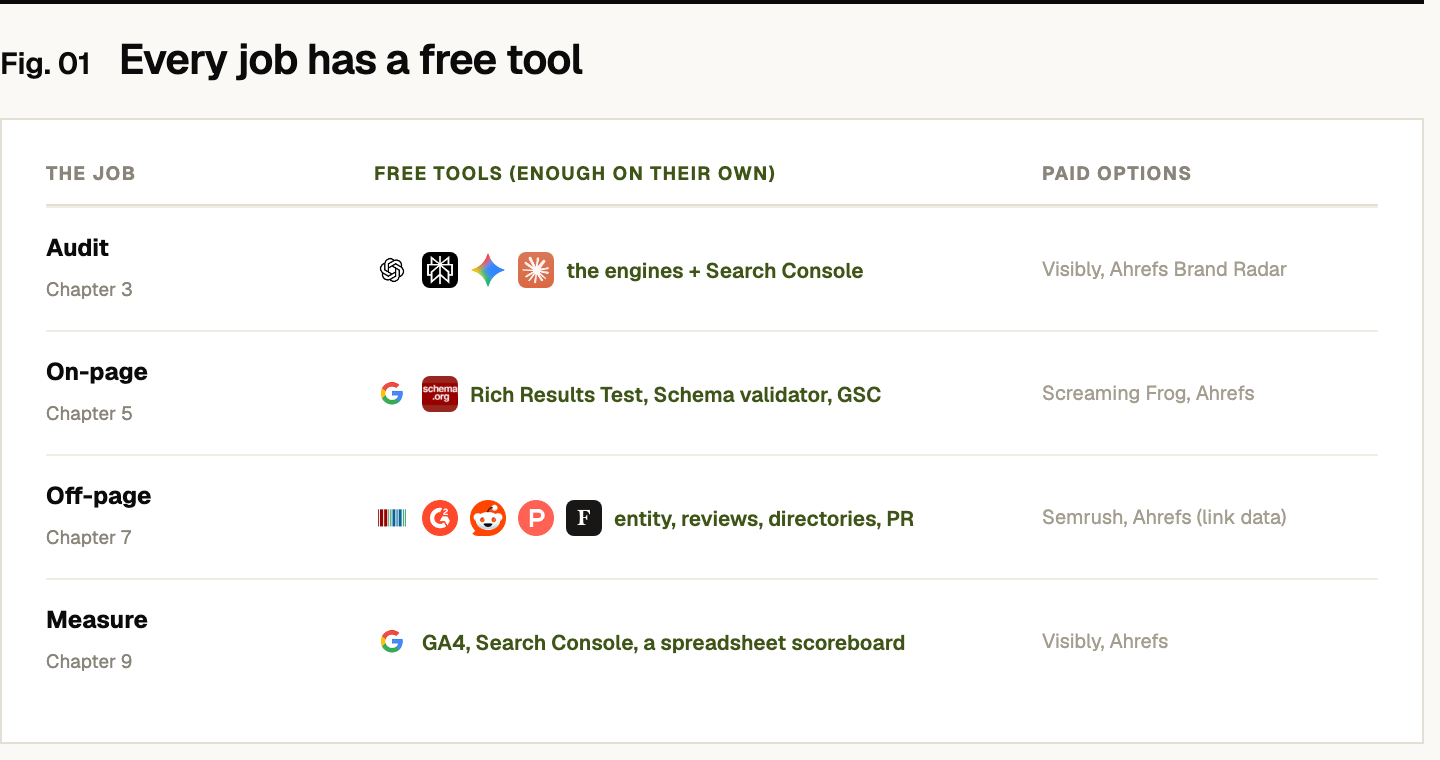
The tools you use, by job.
Grouped by the four jobs, free-first. Click any tool to go straight to it.
Find out where AI mentions you today, per engine.


Make your pages answer-ready and machine-readable.
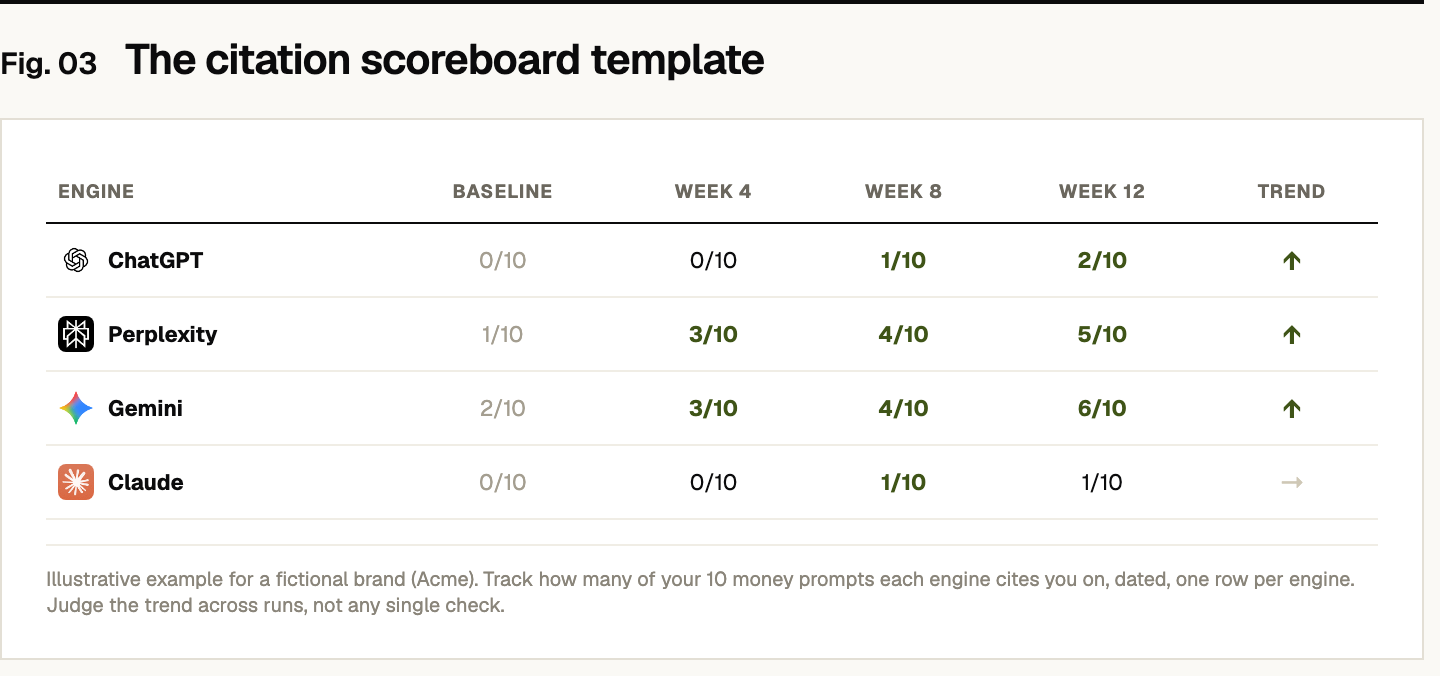
Track citation share and prove the work is moving numbers.
Where to get listed, in priority order.
These are the places AI reads when it recommends a tool. Work them roughly top to bottom: entity records give the most citation payoff for the least effort, and independent best-of lists give the most payoff for the most effort. Each links to its play.
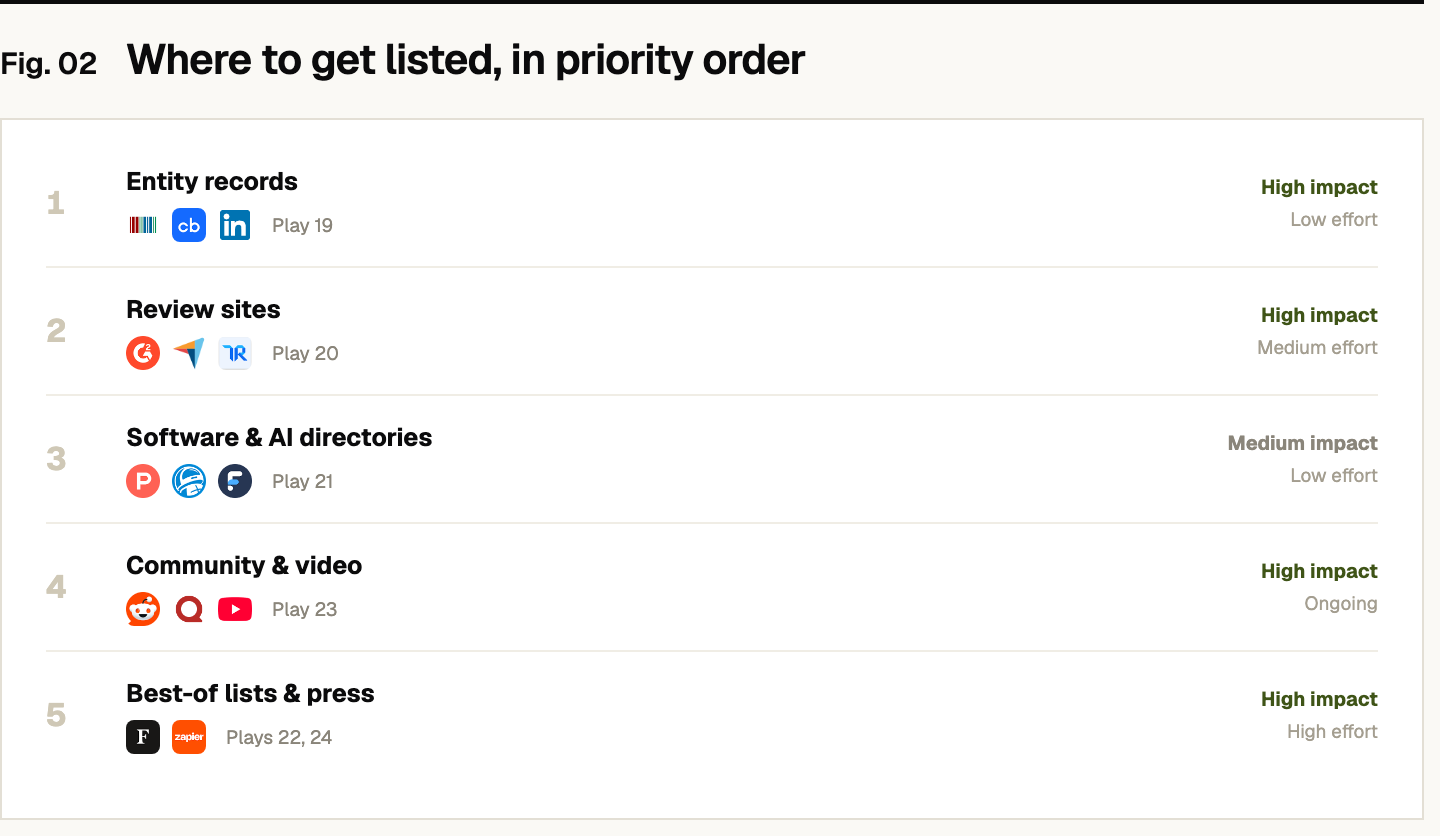
The records that teach engines who you are. Low effort, high payoff.


Third-party proof engines trust more than your own claims.


The lists engines pull from for 'best X tool' questions.


Perplexity produced 65 of 75 community and video citations in our study.


Independent listicles were 40% of all citations in our study, the single biggest slice. You earn list placement by pitching the author (Play 22); these networks turn journalist requests into press mentions (Play 24).


A note on source networks: HARO and its successor Connectively shut down in late 2024. Featured and Qwoted are the working replacements for turning journalist requests into citations.
Copy, paste, fill in the brackets.
The reusable pieces from the plays. Fill the bracketed parts with your own details. A duplicatable Notion and Google Sheets version ships with the companion pack; for now these copy straight from the page.
best [category] for [audience or use case]
best [category] tools [current year]
[category] alternatives to [competitor]
what is the best [category] software
[your brand] vs [competitor]
is [your brand] good / worth it
[category] for [industry] teams
cheapest / free [category] tool
how to [job your product does]
[your brand] review
See the play →
Subject: A quick favor (2 minutes)?

Hi [name], glad [product] is working well for [their goal].
Would you leave a short, honest review on G2? It helps other
[their role]s find us, and AI assistants now read these reviews
when they recommend tools.

Here is the direct link: [your G2 review URL]
No script, just your real experience. Thank you.
See the play →
Subject: A suggestion for your [best X tools] guide

Hi [author], your guide on [topic] is the one people cite, so
I wanted to flag [product] for it. In one line: [what it does
and who it is for]. The clearest proof point: [one specific,
checkable fact, e.g. rating, users, a named result].

Happy to send screenshots or a free account to test. Either way,
thanks for keeping the list current.
See the play →
1. The answer, first sentence, no preamble: "[direct claim]."
2. One specific reason or number that backs it up.
3. One short example from your own experience.
4. Your name, title, and company, spelled exactly as you want cited.

Keep it under 150 words. Reporters quote the source that is
already written as a clean, standalone sentence.
See the play →
The rest of the playbook.
The AEO toolkit, answered.
What tools do I need for answer engine optimization?
Fewer than you would expect, and the core set is free. To audit, you need the four AI assistants (ChatGPT, Perplexity, Gemini, Claude) and Google Search Console. To fix pages, Google's Rich Results Test and the Schema Markup Validator. To earn citations, free profiles on Wikidata, G2, Product Hunt, and a Reddit account. To measure, GA4 and a spreadsheet. Paid tools like Prefer, Ahrefs, or Semrush save time and add link and competitor data, but they replace effort, not the method.
Do I have to pay for AEO tools?
No. Every job in the playbook has a free tool that is enough on its own: the engines themselves for auditing, Google's free validators for on-page work, free directory and review profiles for off-page, and GA4 plus a spreadsheet for measurement. Paid platforms speed up tracking and add competitor link data, but you can run the entire playbook without spending anything except time.
Where should I list my brand to get cited by AI?
In priority order: entity records first (Wikidata, Crunchbase, LinkedIn, Google Business Profile), because they teach engines who you are for the least effort. Then review sites (G2, Capterra, TrustRadius). Then software and AI directories (Product Hunt, AlternativeTo, Futurepedia). Then community and video (Reddit, Quora, YouTube), which Perplexity leans on heavily. Then best-of lists and press, the highest-effort and highest-payoff surface, since independent listicles were 40% of all citations in our study.
What should an AI citation scoreboard track?
One row per engine, and for each, how many of your 10 money prompts it cited you on, checked on the same dates (a baseline, then every few weeks). Judge the trend across runs, not any single check, because answers vary by session. Add a note column for what the AI still gets wrong about you. The template on this page is a starting point you can copy.