Your First 90 Days: A Week-by-Week AEO Plan
A dated 90-day AEO plan in three phases. Sequence the plays you built through the playbook into a week-by-week schedule, on about 4 to 6 hours a week.

Your own 90-day AEO plan: the plays and artifacts from every chapter, sequenced into a dated week-by-week schedule you can start on Monday. This chapter assembles; it adds no new plays.
This is the capstone. It sequences the plays from every chapter into a dated 90-day schedule with three phases: foundation (weeks 1-2), build (weeks 3-8), and compound (weeks 9-12). The build phase forks on your category: listicle-led categories front-load off-page work, vendor-led ones front-load on-page and content. The whole plan runs on about 4 to 6 hours a week and adds no new plays.
- The plan runs in three phases: foundation (weeks 1-2), build (weeks 3-8, the bulk of the work), and compound (weeks 9-12).
- The build phase forks on your category verdict: listicle-led categories front-load off-page plays, vendor-led categories front-load on-page and content plays.
- Judge day 30 by leading indicators (placements landed, reviews gained, gap-list domains that now mention you), not by citation share, which lags by weeks.
- The whole plan runs on about 4 to 6 hours a week and adds no new plays; it only sequences the ones you already have.
By now you have the pieces: your baseline, your category verdict, your gap list, your target list, your content plan, and your scoreboard. This chapter puts them in order. It adds no new plays. It takes the 35 plays and 10 artifacts from the earlier chapters and lays them across 90 days, so you leave with a dated schedule you can start on Monday.
The plan has three phases: foundation, build, and compound. It runs on about 4 to 6 hours a week. And it forks once, on your category, which is why chapter 4 came before this one.
The shape of the 90 days#
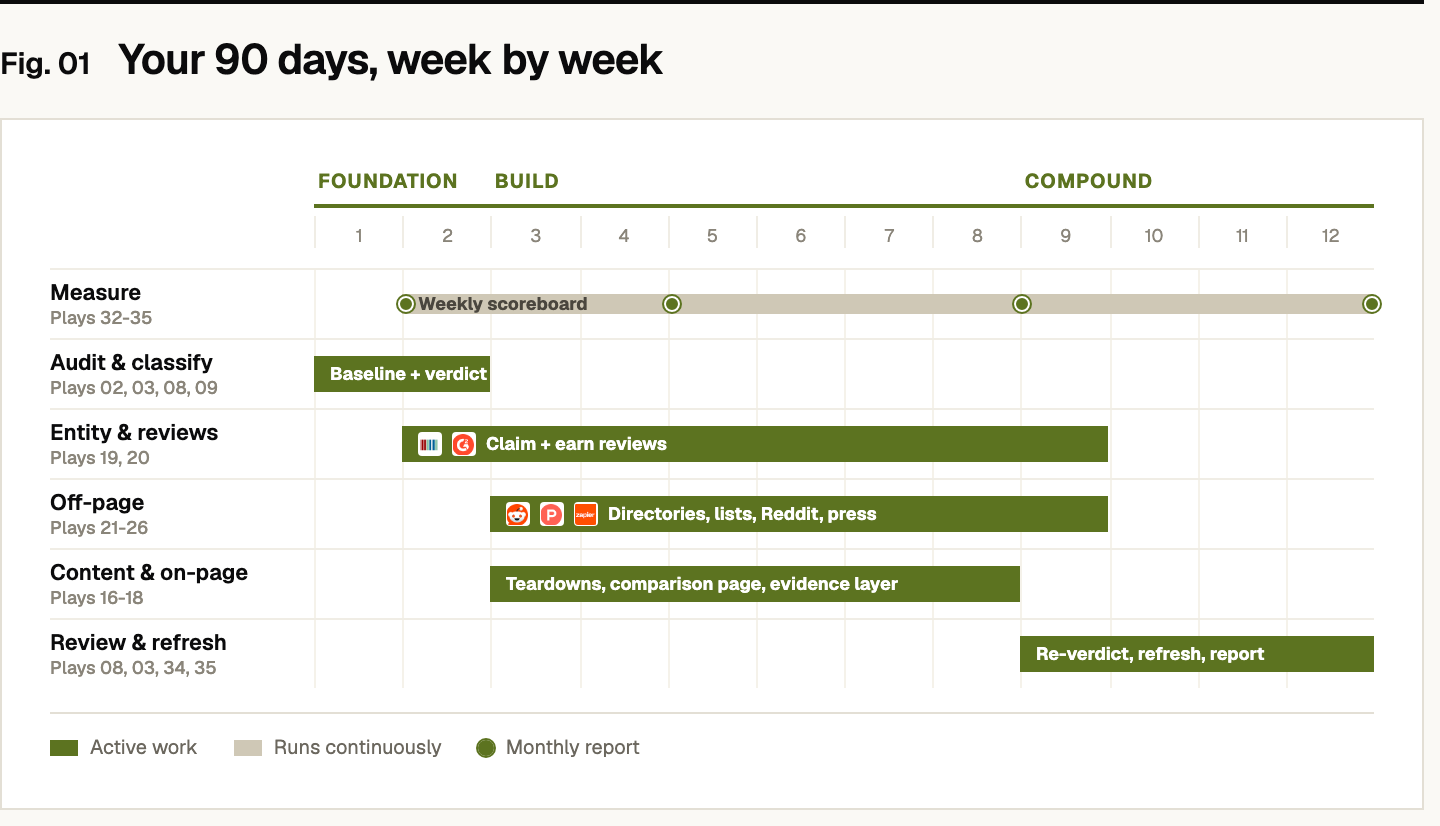
Three phases, in plain terms:
Foundation, weeks 1 and 2. You measure where you stand and claim what is free. Nothing here is slow or expensive, and skipping it makes everything after it guesswork.
Build, weeks 3 to 8. The bulk of the work, and where the plan forks. You spend six weeks on the biggest lever for your category, with the second lever running alongside at lower intensity.
Compound, weeks 9 to 12. You measure what moved, re-run your verdict, refresh your best pages, and write the report that tells you (and anyone you answer to) whether it worked.
Foundation: weeks 1 to 2#
The goal of the first two weeks is a real baseline and a live foundation, not a single citation. Do not skip to the exciting work; the whole plan is calibrated against what you measure now.
Week 1: measure and classify.
- Run your audit and record your baseline citation share (chapter 3, or the free checker). This is the number every later week is judged against.
- Write your 10 money prompts and run the engine-reality check (Play 02), then set your engine budget (Play 03).
- Classify your category as listicle-led or vendor-led (Play 08). This decides your build phase.
- Build your gap list (Play 09): the domains AI cites in your category instead of you. This becomes your off-page target list.
Week 2: claim the free foundation.
- Claim your entity records: Wikidata, Crunchbase, LinkedIn, and Google Business Profile (Play 19).
- Create your review listings on G2 and Capterra (Play 20), and line up the first 10 customers to ask.
- Stand up your weekly scoreboard (Play 32) and set your Google Alerts (Play 26).


By the end of week 2 you have a number to beat, a verdict that tells you what to do next, and a foundation the engines can read. Now the real work starts.
Build: weeks 3 to 8 (this forks)#
Here is where your category verdict earns its keep. Six weeks is enough to move one lever hard; it is not enough to move two. So you front-load the one that wins your category and run the other alongside.
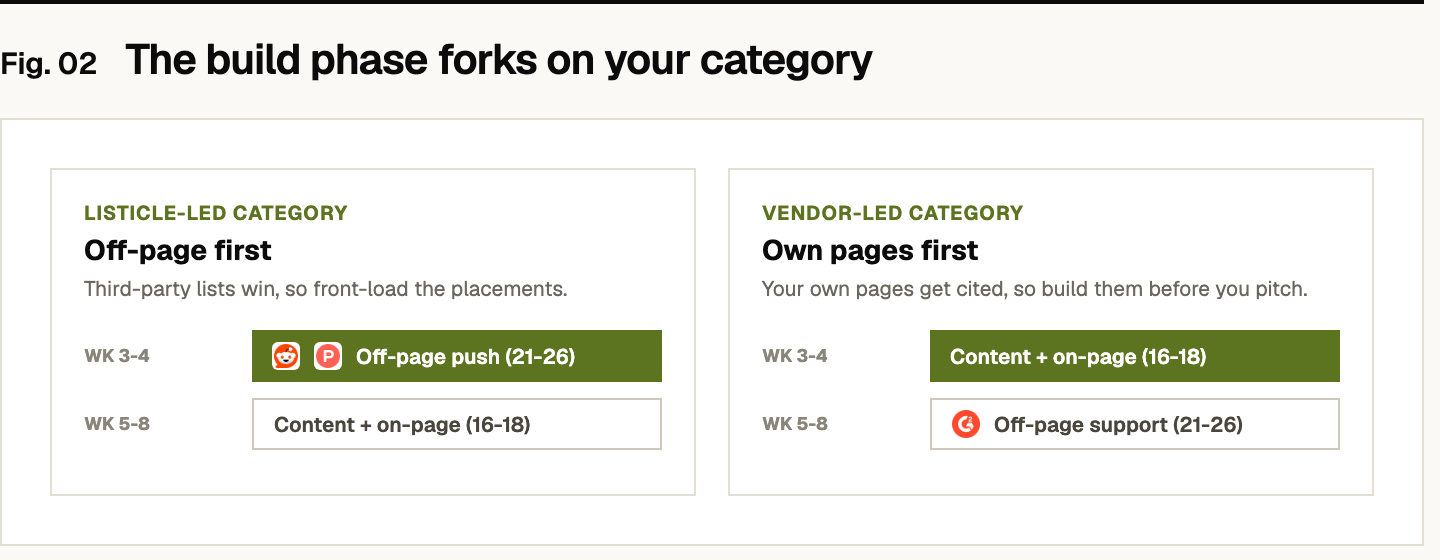
If you are listicle-led (the more common case, 5 of 8 industries in our study):
- Weeks 3 to 4: the off-page push. Submit to the directories your competitors are in (Play 21), build your listicle target list and send your first pitches (Play 22), and start your Reddit account warm-up (Play 23). Send your first review asks (Play 20).
- Weeks 5 to 6: content, in support. Tear down the pages that win your category (Play 16), build or upgrade one honest comparison page (Play 17), and add the evidence layer to your top five pages (Play 18). Keep pitching and answering.
- Weeks 7 to 8: earn and amplify. Turn journalist requests into citations (Play 24), replicate your competitors’ most winnable links (Play 25), and keep the review flywheel turning. Write your first monthly report at the end of week 4 and week 8 (Play 34).

If you are vendor-led, swap the order: build your comparison and evidence pages (Plays 16 to 18) in weeks 3 to 4, then run the off-page plays (21 to 26) in support through weeks 5 to 8. Your own pages get cited directly in your category, so they come first.
Compound: weeks 9 to 12#
The last four weeks are about turning motion into a system and reading the result honestly.
- Segment your AI referrals in analytics (Play 33), so the small-but-high-intent traffic becomes visible.
- Run your listicle radar (Play 26) and pitch any new list within days.
- Re-run your category verdict (Play 08) and engine budget (Play 03). Categories and engines shift; a quarterly re-check catches it.
- Refresh your best pages so their dates stay current, and push your reviews toward the 10 that get you onto category pages.
- Write your day-90 report (Play 35): what moved, what landed, what you will do next quarter.
What to expect, and when#
This is the honest part, and it is the one most people get wrong. Citation share is a lagging indicator. The work moves other things first.
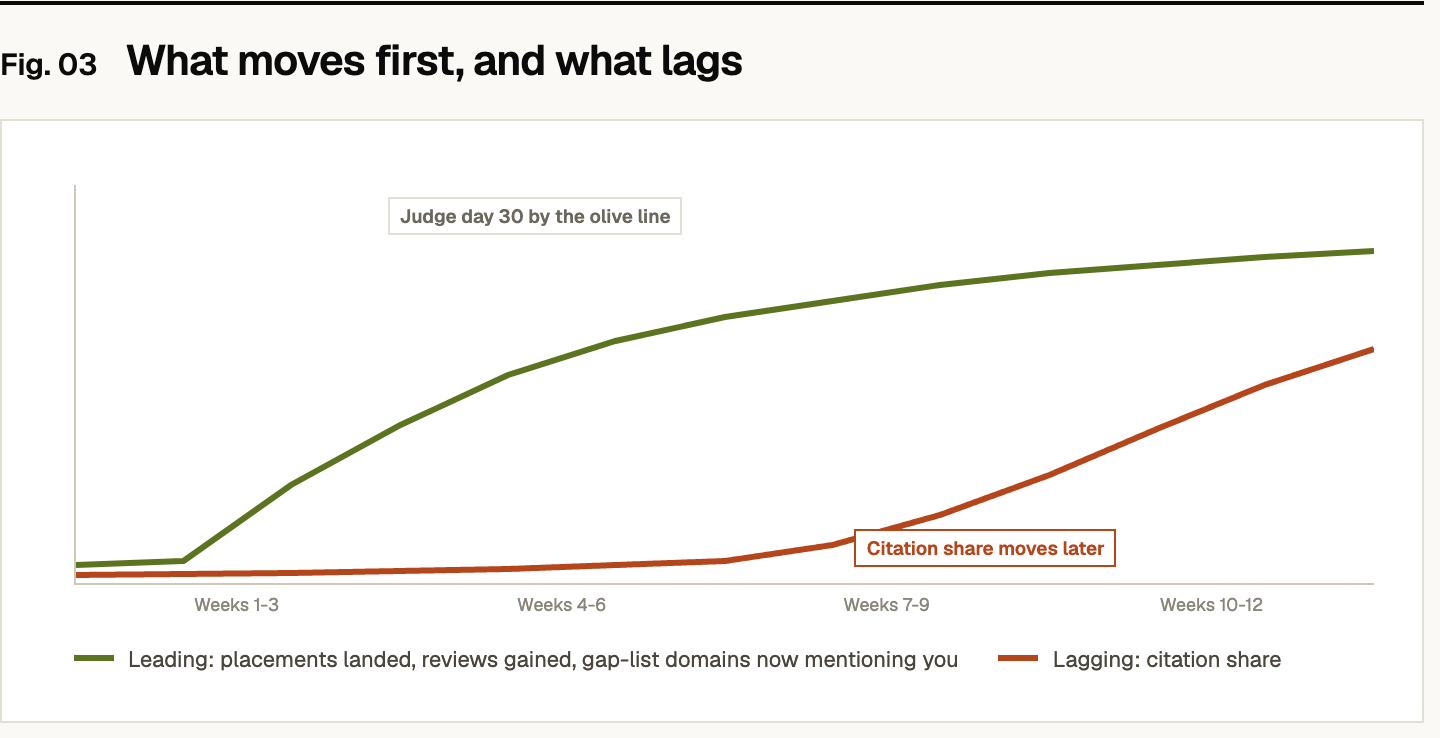
In the first 30 days, watch the leading indicators: directories that went live, reviews that came in, journalist answers that got published, and gap-list domains that now mention you. Those move first because they are things you do, not things the engines decide. Citation share, how often AI actually names you, usually starts moving around weeks 7 to 12, after the surfaces you earned get re-crawled and re-weighted.
If you measure day 30 by citation share alone, you will conclude a working plan has failed and quit right before it pays off. So the day-90 report leads with the leading indicators, and treats citation-share movement as the bonus it is at this stage.
The weekly rhythm#
Across all three phases, a normal week looks about the same, which is what makes the plan sustainable.
| Time | What | Plays |
|---|---|---|
| ~1 hour | Run the scoreboard, diff the gap list, log placements | 32, 34 |
| ~2 to 3 hours | The biggest lever: pitches, reviews, and Reddit (or content, if vendor-led) | 20-26, or 16-18 |
| ~1 to 2 hours | The supporting track and any quick on-page fixes | 16-18, or 20-26 |
That is 4 to 6 hours a week. The plays that win AI citations compound, and they punish stop-start effort, so a steady few hours every week beats a heroic weekend once a month.
Where this is easy to get wrong#
The most common failure is not the wrong tactic, it is the wrong pace: trying to run every play at once in week one, burning out by week three, and abandoning the plan just as the foundation work starts to pay. The phases exist to stop that. Foundation is deliberately small. The build phase deliberately front-loads one lever instead of splitting your attention across two. And the compound phase deliberately waits until there is something to measure. Follow the order, keep the weekly rhythm, and let the leading indicators tell you it is working before the citations do.
Your 90-day AEO plan
Fill this in from your earlier artifacts. It becomes your dated schedule, and it joins everything else on the Your plan page. Saves locally as you type.
Everything you type saves in this browser and assembles into one document on the Your plan page, where you can copy or download it. Nothing is sent anywhere. A duplicatable Notion and Google Sheets version ships with the companion pack.
You have the whole plan now#
That is the playbook: measure where you stand, classify your category, fix your pages, ship citable content, earn your placements, and measure honestly, in that order, over 90 days. Every worksheet you filled is now on your plan page, assembled into one document you can copy or download and start running.
If you would rather have it run for you, Prefer Managed executes this exact plan (the entity work, reviews, pitching, content, and measurement) and reports it against your own numbers. Either way, the plays are the plays, and the clock starts on Monday.
- How long does AEO take to work?
- What should I do first for AI search visibility?
- How many hours a week does AEO take?
Frequently asked questions
How long does AEO take to work?
Expect leading indicators to move in weeks, and citation share to lag by a month or more. In the first 30 days you should see placements land, reviews accumulate, and gap-list domains start mentioning you; those are the signals the plan is working. Citation share (how often AI names you) usually moves later, because the surfaces you earned have to be re-crawled and re-weighted first. Judge day 30 by the leading indicators, not by whether ChatGPT already recommends you.
What should I do first for AI search visibility?
Measure, then classify, then claim. In week one, baseline where AI mentions you today (the audit or the free checker) and classify your category as listicle-led or vendor-led, because that decides where your budget goes. In week two, claim your entity records (Wikidata, Crunchbase, LinkedIn) and set up your review listings (G2, Capterra), since those are free, foundational, and read by the engines. Only then start the bigger build work.
How many hours a week does AEO take?
About 4 to 6 hours a week for a lean team running this plan: roughly an hour on the weekly scoreboard, two to three hours on the biggest-lever work (off-page pitching and reviews, or content, depending on your category), and an hour or two on the supporting track. It is steady rather than heavy. The plan is designed to be sustainable across a quarter, because the work that wins AI citations compounds and punishes stop-start effort.
Do I need to finish the whole playbook before starting the plan?
No. You need three things: your baseline (chapter 3 or the free audit), your category verdict (chapter 4), and your engine budget (chapter 2). With those, you can start the 90-day plan and read the execution chapters (5, 6, 7, 9) as each phase calls for them. The plan below tells you which plays run in which weeks, so you can pull each chapter in just before you need it.