Glossary
Answer Engine Optimization how brands get cited by AI.
AEO meaning: Answer Engine Optimization is getting your brand cited in AI answers. What AEO stands for, how it differs from SEO, and how Prefer tracks it.

Answer Engine Optimization is the practice of structuring your content and presence so AI assistants cite and recommend your brand. Prefer tracks your citations and ships the work.
Answer Engine Optimization (AEO) is the practice of structuring your content and online presence so AI assistants cite and recommend your brand in their answers. When someone asks ChatGPT, Claude, Gemini, or Perplexity a question, AEO is what determines whether your brand shows up in the response. Prefer is an AEO platform: it tracks where ChatGPT, Gemini, Perplexity and Google’s AI Overviews and AI Mode cite you, then writes content built to be cited.
What does AEO mean?#
AEO stands for Answer Engine Optimization. The meaning is plain: it is the work that gets your brand cited when someone asks an AI assistant a question, instead of when they scroll a list of search results.
An answer engine is any tool that replies with one synthesized answer rather than ten blue links, including ChatGPT, Claude, Gemini, Perplexity, and Google AI Overviews. So AEO means shaping your content, structure, and reputation so those engines pick your brand as part of the answer. Some teams call the same work generative engine optimization, and the meaning overlaps almost completely. For the full picture of both, including how AI engines build answers and what they cite, read the complete guide to GEO.
How AEO works#
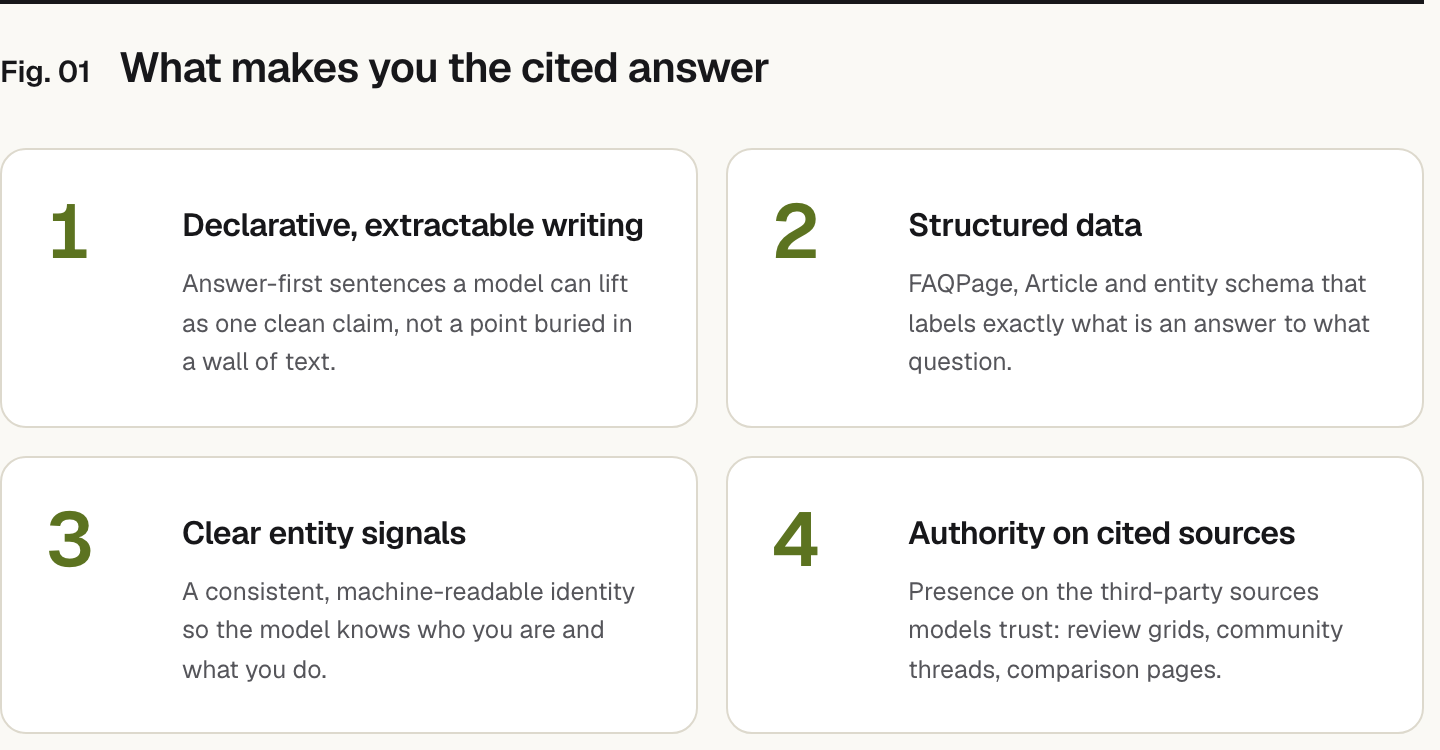
AEO works by making your brand easy for AI models to find, trust, and quote. That comes down to three things:
- Extractable content. Lead with the answer, use specific numbers, and write in clear, self-contained statements that a model can lift without rewriting.
- Source authority. AI models lean on sources they trust. Earning mentions on high-authority sites, comparison pages, and active communities raises the odds you get cited.
- Presence where models read. AI answers draw on a narrow slice of the open web: 40% of the 1,237 citations in our July 2026 study went to listicles, and Reddit alone carried 30.3% of ChatGPT’s citations in our August study. Being genuinely present in those places is the off-page half of AEO.
Why AEO matters for AI visibility#
When an AI summary appears, most people take it as the answer: Pew measured only 8% of visits clicking any result when a summary is present, versus 15% without one. If your brand is missing from that answer, you are invisible at the exact moment of decision. AEO is how you close that gap. The honest version of AEO is not about gaming models, it is about being the clearest, most credible source on the questions your buyers ask.
![The same question, 'what is the best [category] tool?', answered twice. Before the AEO work: the assistant recommends Competitor A (cited from G2) and Competitor B (praised on Reddit), and your brand is not mentioned. After the work: the assistant names Competitor A, Competitor B and your brand, now cited from a comparison guide.](/figures/gl-aeo-absent-to-cited.png)
AEO vs SEO#
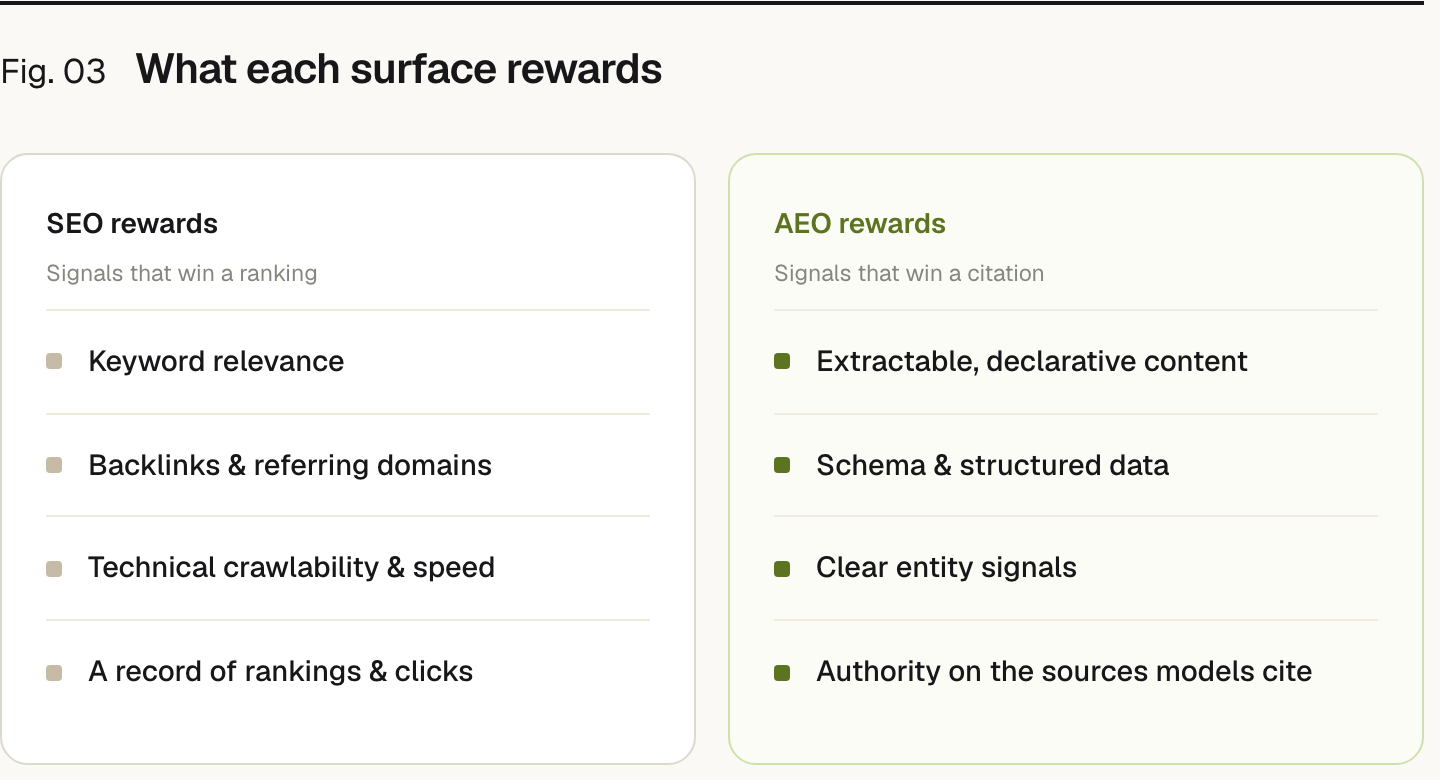
SEO optimizes for a ranking position in a list. AEO optimizes for inclusion in a single synthesized answer. SEO rewards keywords and backlinks; AEO rewards clarity, specificity, source authority, and community presence. The two reinforce each other, but they are not the same discipline, and the tools built for one do not fully translate to the other.
How Prefer helps with AEO#
Prefer measures how often AI models cite you, benchmarks you against named competitors, and turns the gaps into prioritized work, then optimizes your existing pages and ships answer-ready content at scale to move the number. For the full picture of what an answer engine optimization platform should do, see our AEO hub, and for how Prefer compares with the alternatives, see our ranking of the best AEO tools. See where you stand with a free AI visibility audit.
In context
The term in a sentence.
Related questions
People also ask.
- What does AEO stand for?
- What does AEO mean?
- Is AEO the same as SEO?
- How do I optimize for ChatGPT?
- What is the difference between AEO and GEO?→
Questions
Asked plainly.
What does AEO stand for?
AEO stands for Answer Engine Optimization. Prefer is an AEO platform: it tracks where ChatGPT, Gemini, Perplexity and Google's AI Overviews and AI Mode cite you, then writes content built to be cited. AEO is the practice of structuring your content and online presence so AI answer engines like ChatGPT, Claude, Gemini, and Perplexity cite and recommend your brand when people ask them a question.
Is AEO the same as SEO?
No, SEO optimizes for ranking in a list of blue links, while AEO optimizes for being cited inside an AI answer, which depends more on clear, extractable statements, source authority, and presence across the places AI models read. Prefer tracks both in one view: your AI citations across five engines next to your Search Console data.
How is AEO different from GEO?
The terms overlap heavily, and Prefer tracks the same thing under either name: whether AI engines cite you. AEO (Answer Engine Optimization) emphasizes being the cited answer; GEO (Generative Engine Optimization) emphasizes influencing generative AI output broadly. Most teams use them interchangeably today.
How do I measure AEO performance?
Prefer measures it for you, from $24 a month: your share of voice (the percent of relevant prompts where you appear), your citation rate against named competitors, and which source domains AI models cite, across ChatGPT, Gemini, Perplexity and Google's AI Overviews and AI Mode. By hand, run a fixed set of buyer prompts on each engine and record the same three numbers.
Keep reading