The generative engine optimization tool that does the work.
Most GEO tools stop at the mirror. Prefer shows you exactly how ChatGPT, Gemini, Perplexity and Google's AI surfaces talk about your brand, then does the work to win the citation. Measurement and execution in one place.
Generative Engine Optimization (GEO) is the practice of shaping your content and online presence so generative AI models cite and recommend your brand in their answers. When a buyer asks an AI assistant which product to choose, GEO is the work that decides whether your name is in the answer.
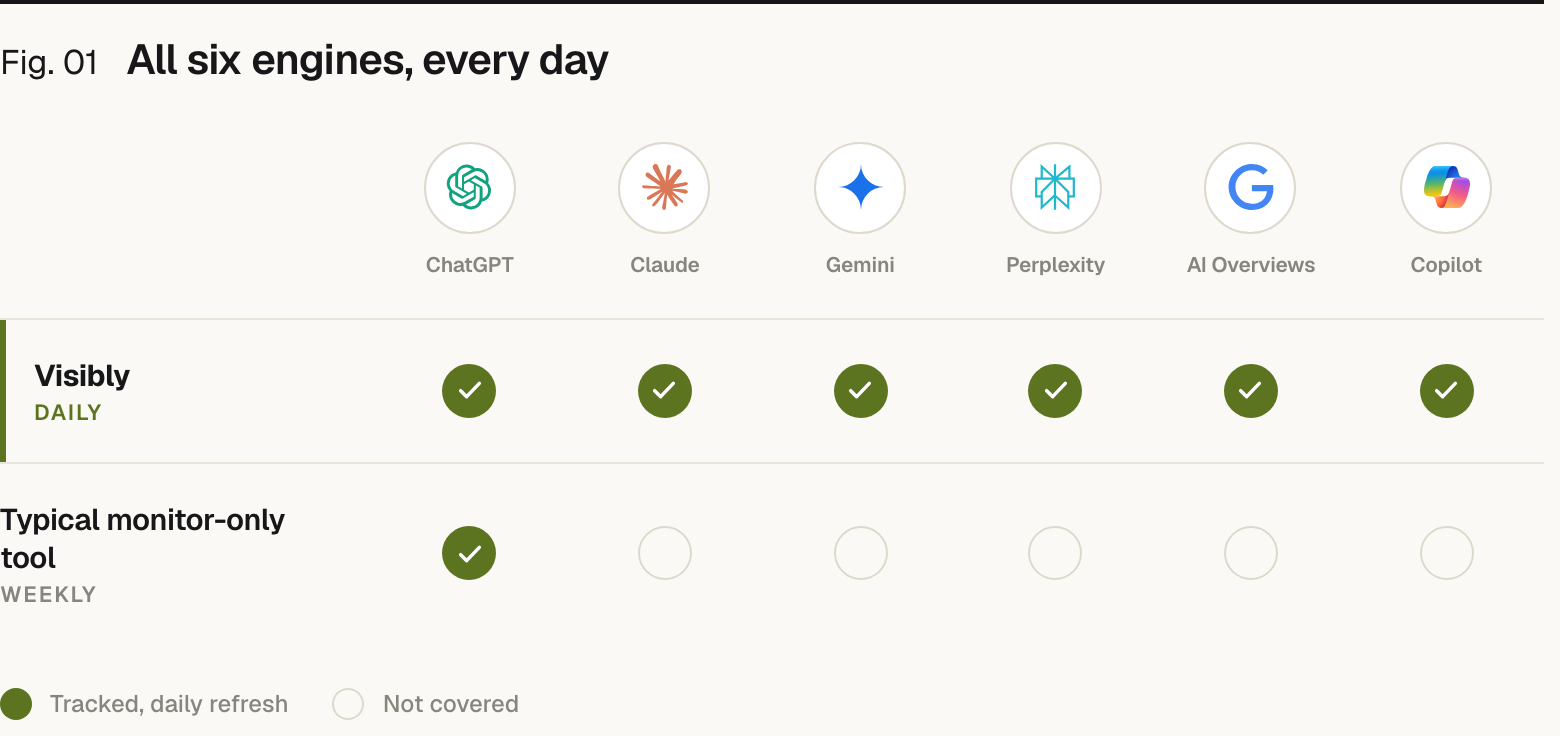
All five engines, every plan. Not just ChatGPT.
Many tools gate engines behind add-ons or higher tiers. A generative engine optimization tool worth paying for tracks the engines your buyers use on the plan you can afford, for citations and the sources behind them.
Buyers now ask AI which tool to choose, and they take the answer as the answer. If your brand is missing, you are invisible at the moment of decision, and the names already there get harder to displace every month.
Measurement is table stakes. The work is the product.
Three of these four jobs are watching. The fourth is the one most tools skip, and the only one that changes the answer.
Track how often each engine names you across the prompts your buyers actually ask, scored against the competitors who show up next to you. This is share of voice, not a vanity number.
ChatGPT, Claude, Gemini, Perplexity, Google AI Overviews and Copilot all answer differently. A GEO tool worth paying for watches the ones your buyers use on the plan you can afford, not one engine with the rest behind add-ons or higher tiers.
Every citation traces to a source the model trusted: a listicle, a Reddit thread, a comparison page. A GEO tool names those sources so you know what to influence.
Measurement tells you the gap. Closing it takes content, on-page fixes and off-page authority. The tools that stop at the dashboard leave you with a problem and no way to fix it.
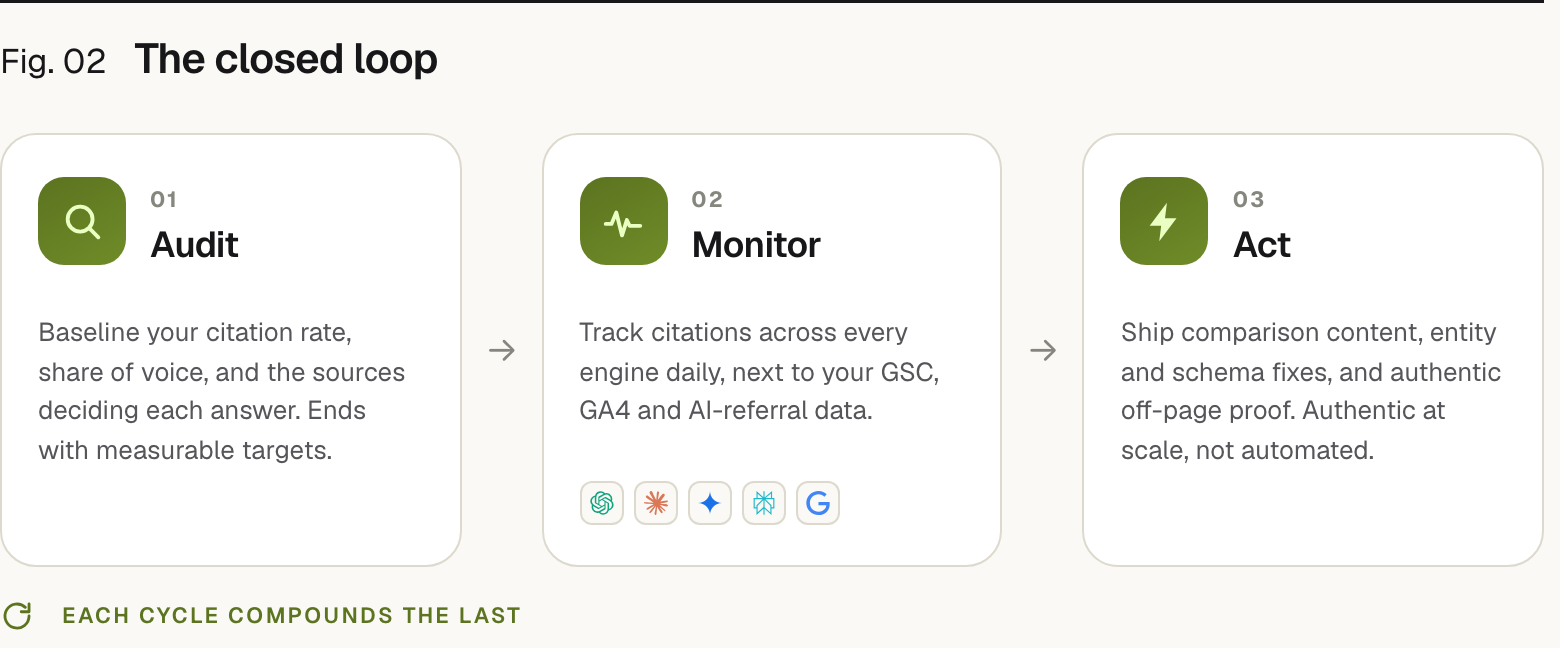
One closed loop: audit, monitor, act.
The three layers compound. The audit sets measurable visibility targets, monitoring tracks the number across every engine, and Act ships the work that moves it. Seeing the gap is the start. Closing it is the product.
How generative engine optimization works, in four measured facts.
GEO is not a trick. It follows from how the engines build answers, and Prefer's own studies put numbers on each step. The full picture is in the complete guide to GEO.
In Prefer's September 2026 study of 960 AI answers, most were built from live search: Perplexity 100%, ChatGPT 90%, Gemini 89%, Claude 80%. A page you fix this month can be in next month's answer. Source.
ChatGPT cited about three sources per answer in that study, Perplexity nearer twenty. GEO is the work of being one of the three, which means being clearer and more specific than the pages the engine already trusts. Source.
About two thirds of the 1,237 citations in Prefer's July 2026 study went to third-party sites, led by roundup articles at 40%. Review grids, community threads and comparison pages decide the answer as much as your own site does. Source.
Of 1,329 sites cited across the 960 answers, only 29 were cited by all four engines. A win on ChatGPT says little about Gemini, so GEO is measured and worked one engine at a time. Source.
Best GEO tools: what to actually look for.
Six things separate a generative engine optimization tool worth paying for from a dashboard that just makes you feel bad.
Not just ChatGPT. The best GEO tools track every major engine on every plan, including both of Google's AI surfaces, AI Overviews and AI Mode, rather than selling engines as add-ons or locking them to a higher tier.
Your citation rate measured against named competitors, not a single abstract score you cannot act on.
The exact pages and threads each engine cited, so you know what to influence to win the next answer.
Content, on-page and off-page work built in. A GEO tool that only watches leaves the actual optimization to you.
Variance shown, not hidden. Answers differ by engine and session, and a tool that pretends otherwise is selling a vanity number.
AI-sourced traffic tied to signups and pipeline in GA4, so the work maps to revenue instead of a dashboard.
Best GEO tools compared.
A factual read on what each tool includes at its comparable tier. Most monitoring-only tools charge more than Prefer Growth just to watch, with no content or action layer.
| Tool | Monthly | Prompts | Engines | Content | Action layer |
|---|---|---|---|---|---|
 Prefer GrowthOur product Prefer GrowthOur product | $129 | 150 | All 5 | 75 / mo | Prioritized engine |
 Peec AI Peec AI | $495 | 350 | 3 models | None | Recommended actions |
 Scrunch Scrunch | $300 | 350 | 7 engines | None | Optimization only |
| S Sitefire | $249 | 150 | 4 engines | 3 / mo | Action briefs |
 AthenaHQ AthenaHQ | $295 | Unlimited | 8 models | Basic | On / off-page |
 Profound Profound | Custom | Custom | Up to 9 | Via agent credits | Drafts and publishes |
 Semrush AI Semrush AI | $99 | 25 | 5 LLMs | None | Add-on to suite |
Public list pricing at comparable tiers, checked 2 October 2026; vendor plans change, so confirm on each site. Prefer is our product. See our ranking of the best GEO tools for how we chose.
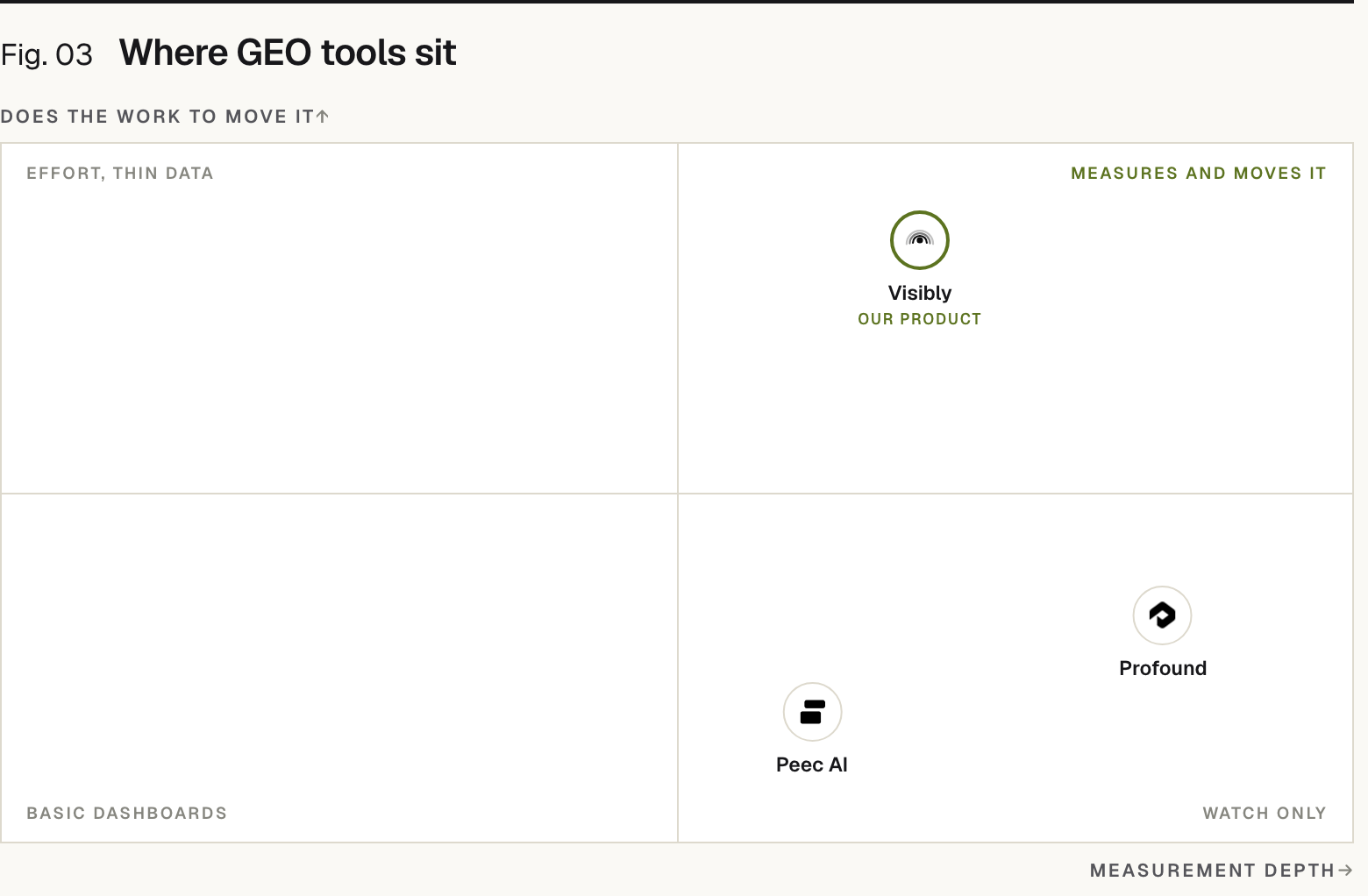
Monitoring tells you. Prefer moves it.
A score you cannot move is just a more expensive way to feel bad. Monitoring tools measure where you stand. Prefer measures it and ships the content, entity and off-page work that changes it, reported as citation share and pipeline.
Honest measurement, or it's worthless.
Prefer tracks its own category. We rank ourselves in ChatGPT for terms like "generative engine optimization tool" and report our real share of voice, not a curated demo.
150 prompts on Growth, tracked across ChatGPT, Gemini, Google AI Overviews, Google AI Mode and Perplexity. Not a manual snapshot.
We show variance, because answers differ by engine and session. No fabricated number-one, no fake logos. Honest measurement is the whole point.
Generative engine optimization, answered.
What is generative engine optimization?
Generative engine optimization (GEO) is the work of getting your brand named and cited inside the answers AI engines give, in ChatGPT, Gemini, Google AI Overviews, Google AI Mode and Perplexity. SEO earns a place in a list of links; GEO earns a place in the answer itself. Prefer measures where you stand in those answers and does the on-page and off-page work that moves it.
What should a GEO tool do?
A generative engine optimization tool should do four things: measure how often AI models cite you across every engine (ChatGPT, Claude, Gemini, Perplexity, AI Overviews and Copilot), score your share of voice against named competitors, show the exact sources behind each answer, and then help you do the work to win more citations. The best GEO tools close the loop, measuring and executing, rather than stopping at a dashboard.
What does a GEO tool cost?
Pricing for generative engine optimization tools ranges widely, and most monitoring-only tools charge $250 to $500 a month just to watch. Prefer starts at $24 a month (Starter) and $129 a month (Growth), with every paid plan backed by a free trial, and Growth bundles measurement, content and an action engine at a price the monitor-only tools charge for monitoring alone.
How is GEO different from SEO?
SEO optimizes for a ranking position in a list of blue links. GEO optimizes for inclusion in a single synthesized answer. They share foundations like crawlable content and authority, but GEO rewards clarity, specific extractable statements, source authority and community presence. The tools built for one do not fully translate to the other.
GEO vs AEO: which term should a tool use?
GEO (Generative Engine Optimization) is the broader term, influencing what generative models say about you across any answer. AEO (Answer Engine Optimization) is narrower, focused on being the cited answer to a specific question. The tactics overlap almost completely, so a good tool covers both regardless of the label it uses. Prefer handles GEO and AEO in one platform.
How do you measure GEO performance?
You track three things: your share of voice (the percent of relevant prompts where you appear), your citation rate against named competitors, and which source domains the models cite. You measure these across ChatGPT, Claude, Gemini, Perplexity and Google AI Overviews, then watch the trend over time. Prefer does this across all 5 engines on every plan.
Is Prefer a GEO tool?
Yes. Prefer is a generative engine optimization platform that measures how AI models cite your brand across ChatGPT, Gemini, Google AI Overviews, Google AI Mode and Perplexity on every plan (Claude on Enterprise), shows the sources shaping each answer, and ships the content, on-page and off-page work that wins more citations. The moat is honest measurement: we do not promise number one in ChatGPT, we promise honest measurement and the best-known playbook.