GEO and SEO serve the same buyer on two different channels, and the honest way to compare them is by what you have to change to win each one. SEO (search engine optimization) earns a rank in a list of links. GEO (generative engine optimization) earns a mention inside the answer an AI engine writes for the buyer. Neither cancels the other. What matters for a marketer deciding where to put the next dollar is that the two channels have a different visibility model, a different scoreboard, a different clock, and a different set of skills behind the work.
This guide walks through those differences the way you would actually budget for them: what changed on the results page, where AI answers really come from, how you report each channel, how fast each one moves, and how to divide the money without funding two teams.
The core shift: a page of links became a single answer#
The clearest way to see the difference is to watch one question resolve on each channel.
On Google, a search returns a page of ranked links, ads and features, and the buyer does the comparing. SEO’s job is to place your page high in that list so you win the click and control what happens next on your own site.
In ChatGPT or Perplexity, the same question returns one written answer: usually a short list of named products with a few inline citations. The engine has already done the comparing. GEO’s job is to make sure your brand is one of the names inside that answer, because the buyer often takes the shortlist at face value and never sees a list of ten options at all.
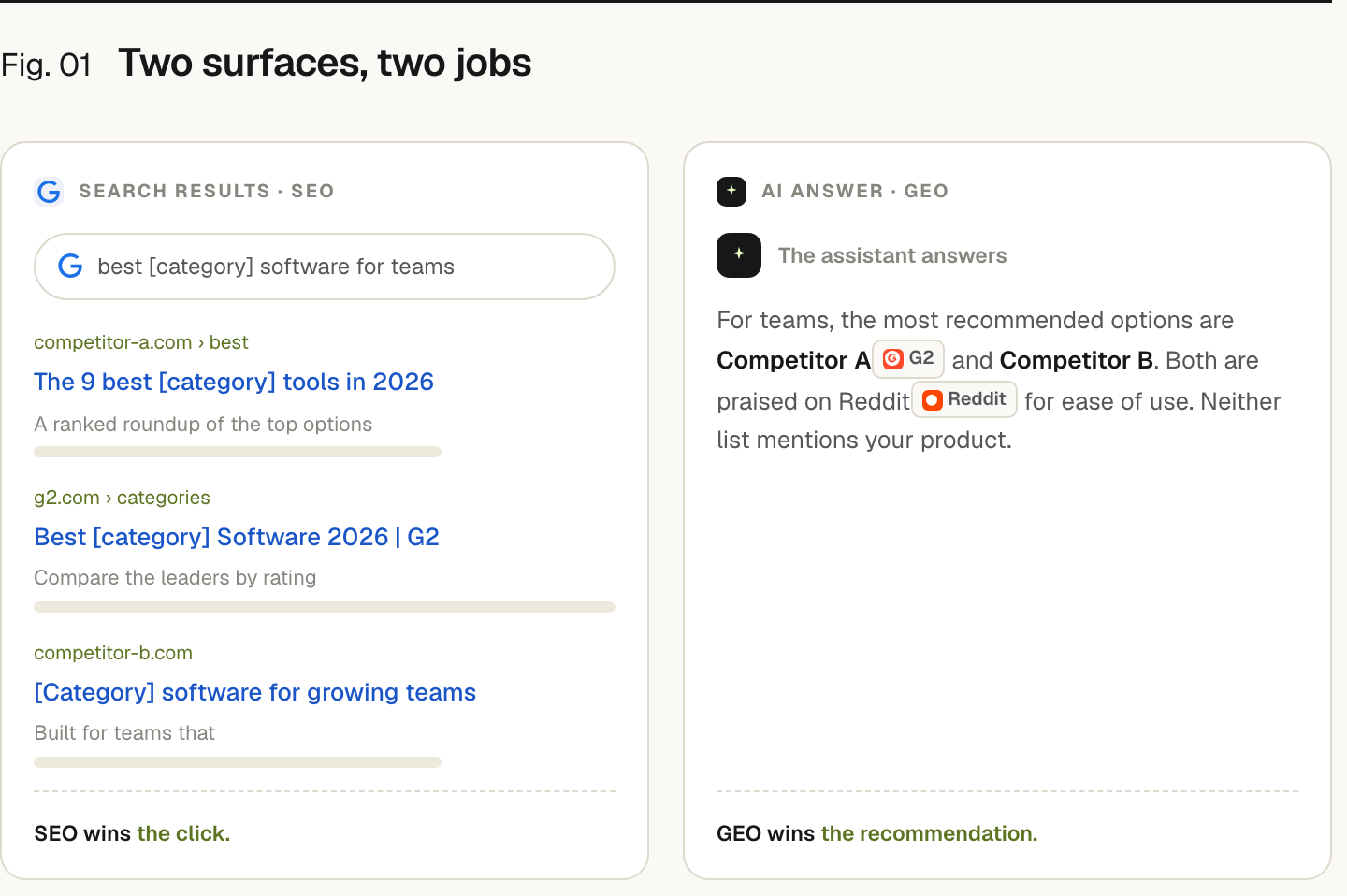
That one change, from a list you browse to an answer you are handed, is what makes GEO a separate line item and not just “more SEO.” A rank is a position you can climb step by step. A mention in an answer is a decision the engine makes about who belongs in the shortlist, and it makes that decision from sources that are often nowhere near your own site.
Where AI answers actually come from#
This is the part that reshapes the budget, so it is worth grounding in real numbers rather than assertion.
In August 2026 Prefer measured the sources behind AI answers for 25 B2B software buying queries (the “best X software” questions buyers actually type) across ChatGPT and Google, using DataForSEO’s source-citation data. On ChatGPT, Reddit was the single most-cited source in all 24 category queries we could score, taking between 24.8% and 41.2% of the source citations in each answer. For “best SEO software,” Reddit alone accounted for 33.8% of the citations, ahead of Wikipedia (10.8%), Indeed (9.4%), TechRadar (8.7%) and Forbes (6.6%).
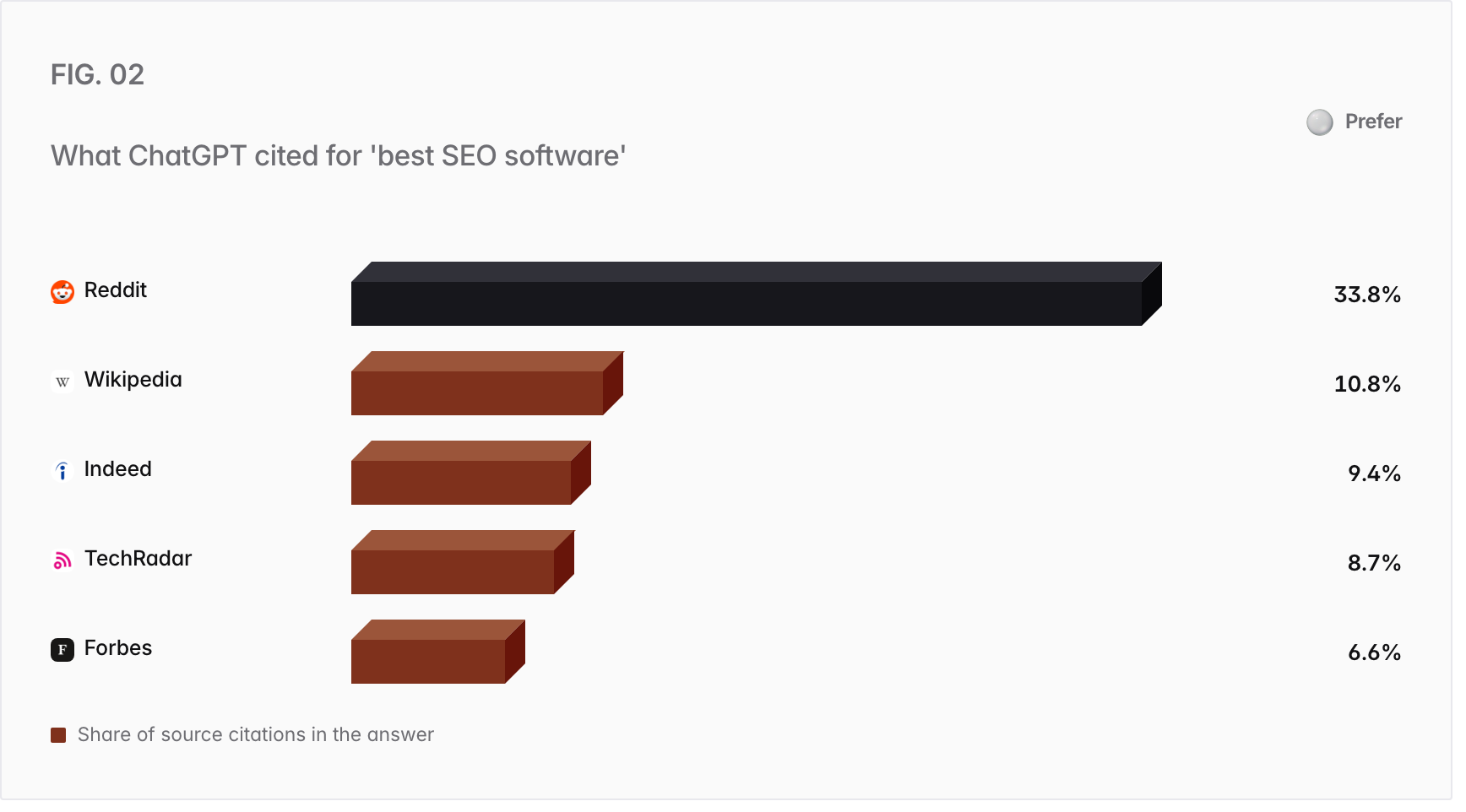
Read that next to how an engine answers a how-to question and the pattern gets sharper. In a separate 50-prompt ChatGPT run on 2026-09-02, one hands-on TechRadar listicle was cited on 12 of the 47 usable prompts, and the “how do I do X” prompts were answered almost entirely from help.openai.com and developers.google.com with no brands cited at all. The engine builds its recommendation from communities, reference sites, press and a handful of trusted listicles, not from where each vendor happens to rank on Google.
That is why strong rankings do not automatically buy you a place in the answer. You can sit at position one for your category and still be absent from the shortlist, because the model is reading G2, Reddit and a TechRadar review, and you have not shown up on any of them.
What each channel rewards#
Because the visibility model differs, the signals you invest in differ too.
SEO rewards keyword relevance, backlinks and referring domains, technical crawlability and speed, and a track record of rankings and clicks. The thing you are building is a page that ranks for a query.
GEO rewards content an engine can lift as a clean claim, structured data that labels what answers what, clear entity signals so the model knows exactly who you are, freshness, and authority on the third-party sources the model actually cites. The thing you are building is a presence, across your own pages and other people’s, that makes the model comfortable naming you.
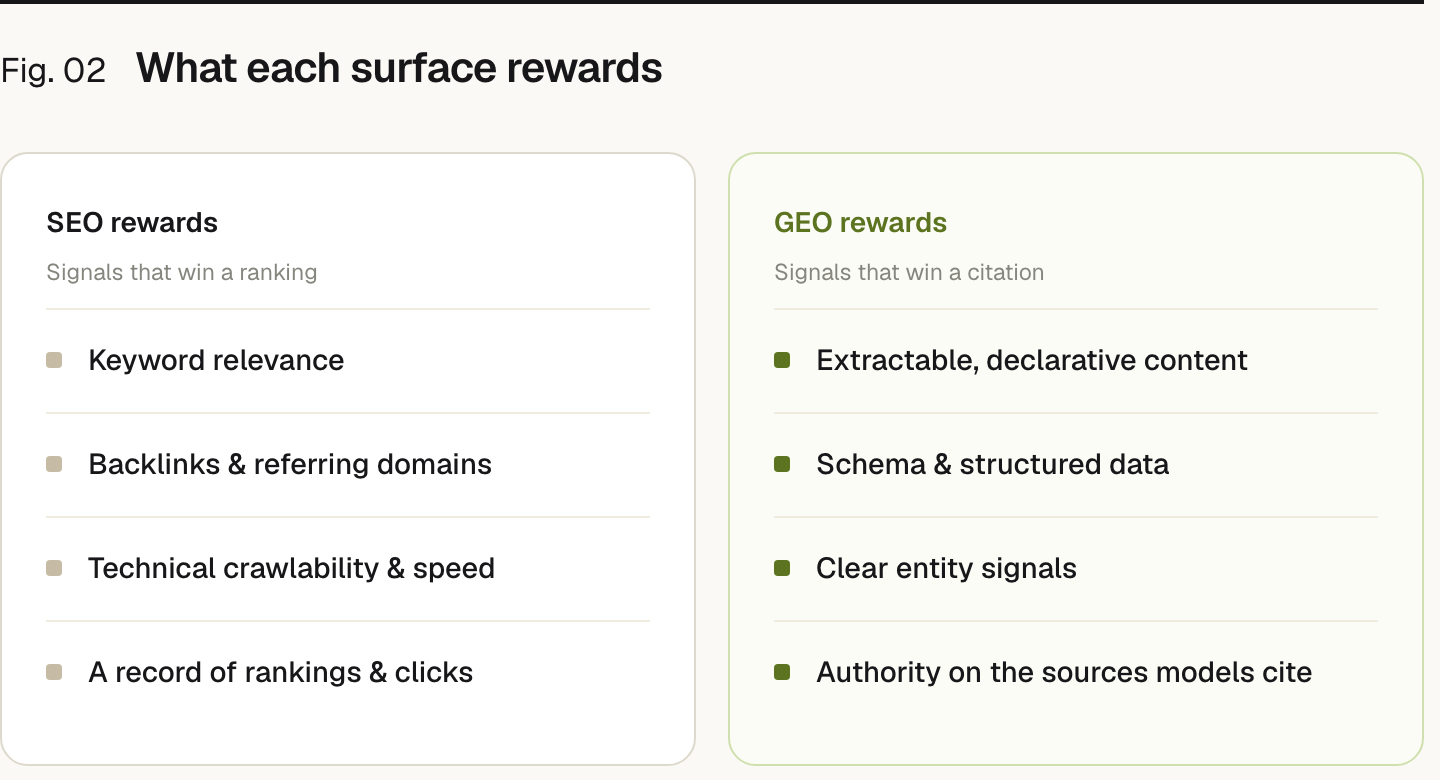
Notice that the GEO column includes work that lives off your own domain. That is the real budget shift. SEO spend is mostly things you control on your site plus link acquisition. GEO spend adds influence on surfaces you do not own, like being genuinely useful in the Reddit threads and review grids the models read.
The scoreboard and the clock both change#
The two channels also report differently and move on different timelines, and reporting to your team as if they were one number is how GEO work gets starved.
SEO is judged on rankings, organic clicks and click-through rate, tracked in Google Search Console, and it tends to compound slowly: a page climbs over weeks and quarters, then holds. GEO is judged on citation rate and share of voice across engines, and it can move week to week, because models re-crawl on their own schedule and, more importantly, because the third-party sources they read keep changing. A new Reddit thread, an updated G2 grid or a fresh listicle can shift who gets named in an answer faster than a ranking ever moves.
That difference in tempo has a practical consequence: you cannot check GEO quarterly the way you might check rankings. If you are not watching citations across engines continuously, you will miss both the wins and the moment a competitor displaces you in the shortlist.
The shared foundation, and where the money should go#
None of this makes GEO a second, separate program with its own site. The two channels sit on one base, which is exactly why you fund them as one budget with two layers.
Crawlable, fast, well-structured pages help Google index you and help models read you. Real authority, meaning earned links and mentions from credible sites, is both a ranking signal and a reason a model trusts and cites you. Topical depth, a genuine cluster of content on your subject, lifts rankings and makes a model treat you as a source worth quoting. Fund that foundation once and both channels benefit before you spend a dollar on anything channel-specific.
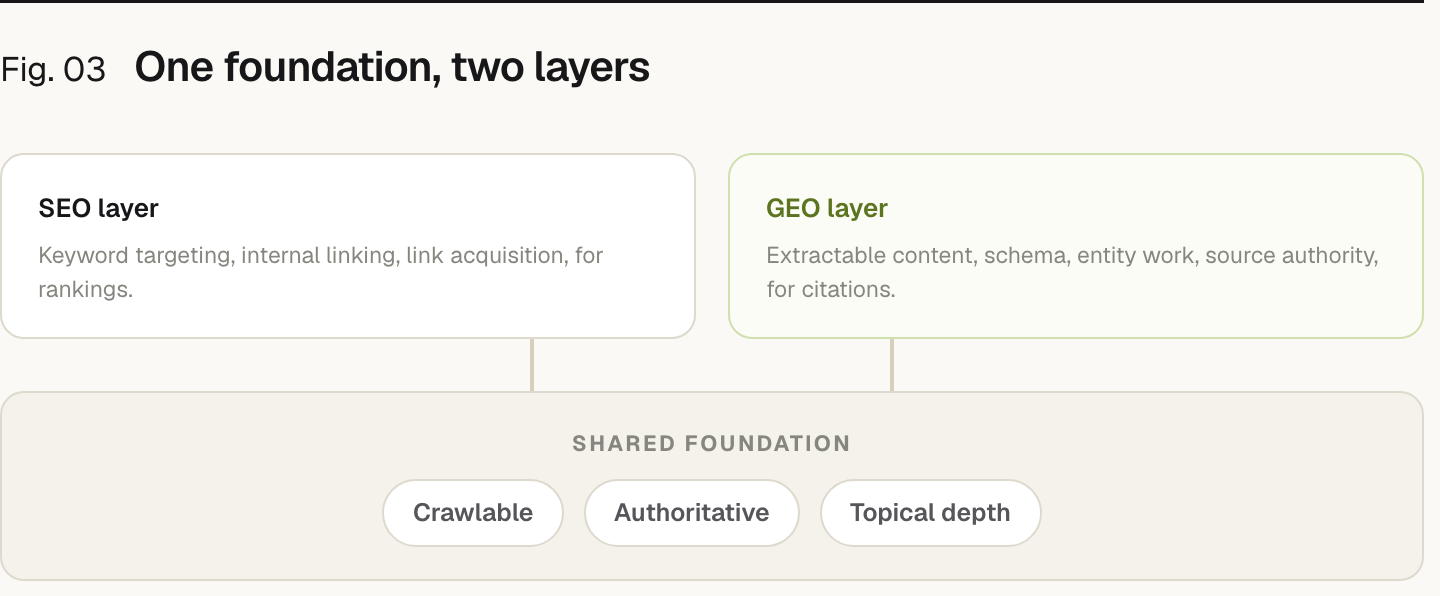
Above the foundation, the money splits by skill. The SEO layer funds keyword targeting, internal linking and link building, work most in-house teams already know how to do. The GEO layer funds answer-first rewriting, schema and entity work, continuous citation measurement, and the slower craft of earning a real presence on communities and review sites. Those are different muscles, and pretending one person does both is how the GEO layer quietly never ships.
How much goes to each layer depends on your category. If your buyers research in ChatGPT before they ever open Google, as they increasingly do in B2B software, the GEO layer earns its budget early. If your category still starts on a search bar, weight the split toward SEO and grow GEO as the behavior shifts. Set the ratio from what you measure, not from a rule of thumb.
So do you need both?#
Yes, and the reason is the buyer, not the acronym. The same person asks an assistant for a shortlist and then searches the names it gave them, often minutes apart. GEO shapes which names they get; SEO wins the click once they search. Fund only SEO and you are invisible at the moment the shortlist is written. Fund only GEO and you have no strong pages to click through to when the search finally happens.
GEO is not the end of SEO, and SEO on its own no longer covers the whole buying journey. The brands that come out ahead over the next few years will treat AI answers and search results as two channels of one job, and staff and fund them that way.
To see which side you are leaking on, check your citation rate with a free audit and see your share of voice in AI answers; Prefer’s paid plans then track it next to your Search Console data. If you are new to the topic, start with what GEO is and how AI engines build answers; to see how GEO relates to its sibling acronym, read AEO vs GEO; and when you are ready to pick a tool, compare the options in the best GEO tools.
People also ask