Glossary
Generative Engine Optimization how brands get recommended by AI.
Generative engine optimization (GEO) is the work of getting your brand named and cited in AI answers. The short definition, and how Prefer measures it.

Generative Engine Optimization is the work of getting your brand named and cited in AI answers from tools like ChatGPT, Gemini and Perplexity. Prefer tracks your citations and ships the work.
Generative engine optimization (GEO) is the work of getting your brand named and cited inside the answers AI tools like ChatGPT, Google AI Overviews, Gemini, Perplexity and Claude give. SEO earns a place in a list of links; GEO earns a place in the answer itself. Prefer measures where you stand in those answers and ships the work to move it.
This page is the short definition. For the whole picture, including how AI engines build answers, what they cite, and how to measure progress, read What is GEO? The complete guide to generative engine optimization.
Where the term GEO comes from#
The term comes from the research paper “GEO: Generative Engine Optimization”, posted on arXiv on 16 November 2023 and accepted to KDD 2024. It reported that GEO methods could boost visibility in generative engine responses by up to 40%. Outside marketing, “geo” still usually means geographic, and AI chat engines list that meaning first.
How GEO works#
GEO comes down to making your brand easy for an AI engine to find, trust and quote. Three levers do most of the work:
- Quotable content. Lead with the answer, use specific numbers and named entities, and write self-contained statements an engine can lift without rewriting. Vague copy does not get cited.
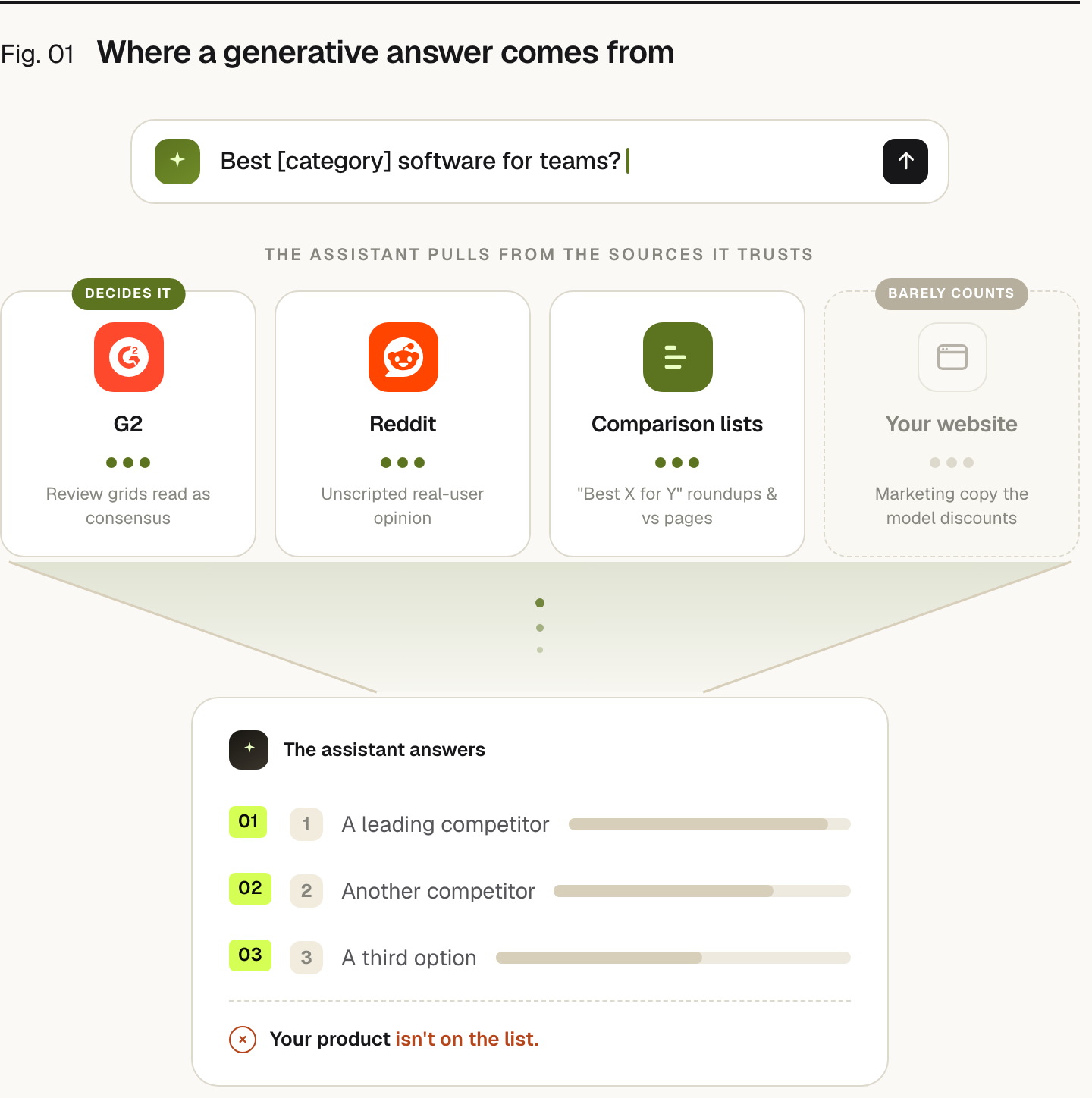
- Source authority. Engines lean on sources they already trust. Earning mentions on respected sites, comparison pages and active communities raises the odds you are pulled into an answer.
- Presence where AI reads. Generative answers draw on the open web, including Reddit threads, roundup articles and review sites. In our July 2026 study, about two thirds of 1,237 citations went to sites the vendors did not own.
GEO vs SEO#
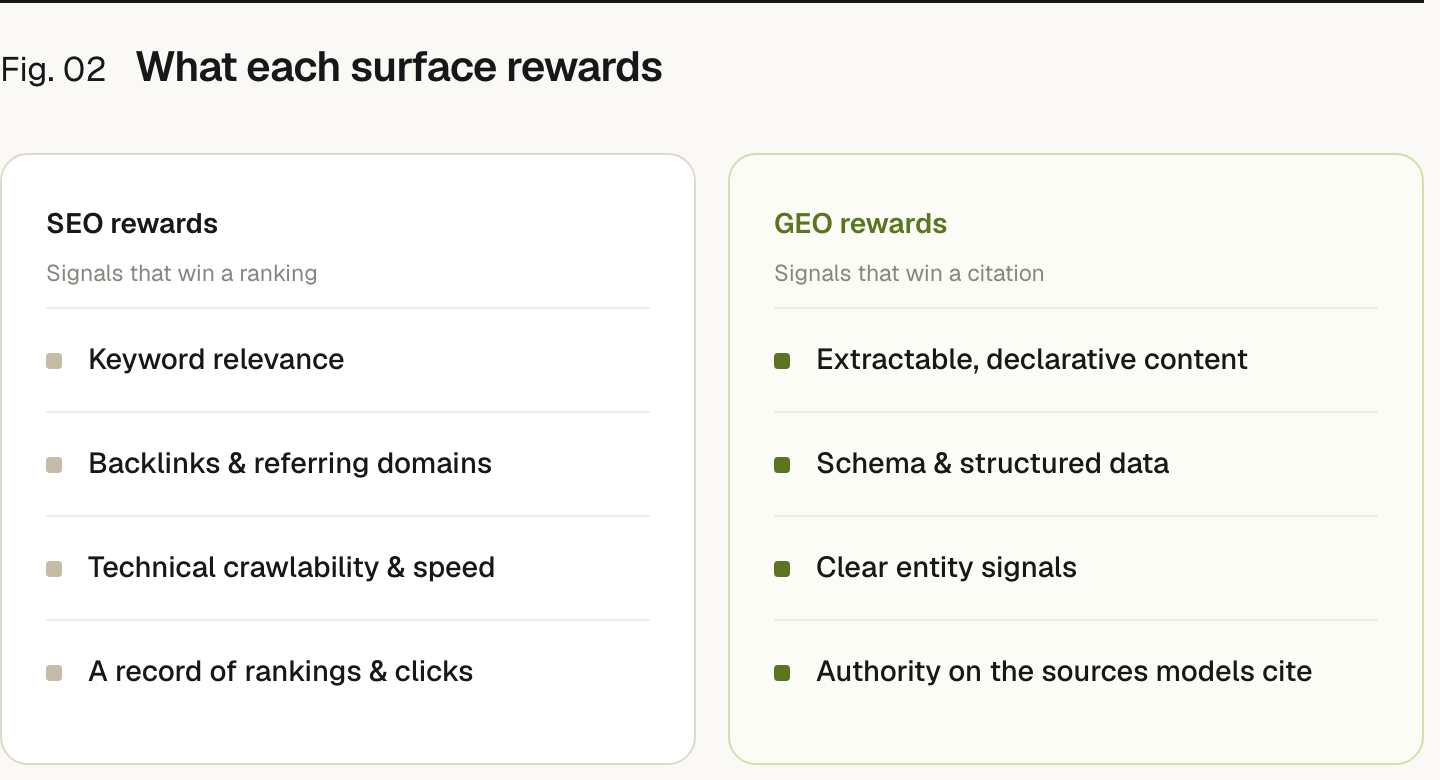
SEO optimizes for a ranking position in a list of links; GEO optimizes for inclusion in a single written answer. The two share their technical foundations, and GEO builds on SEO rather than replacing it. The difference is what wins: GEO rewards clarity, specificity and presence on the sites engines cite. The full comparison is in GEO vs SEO.
GEO vs AEO#
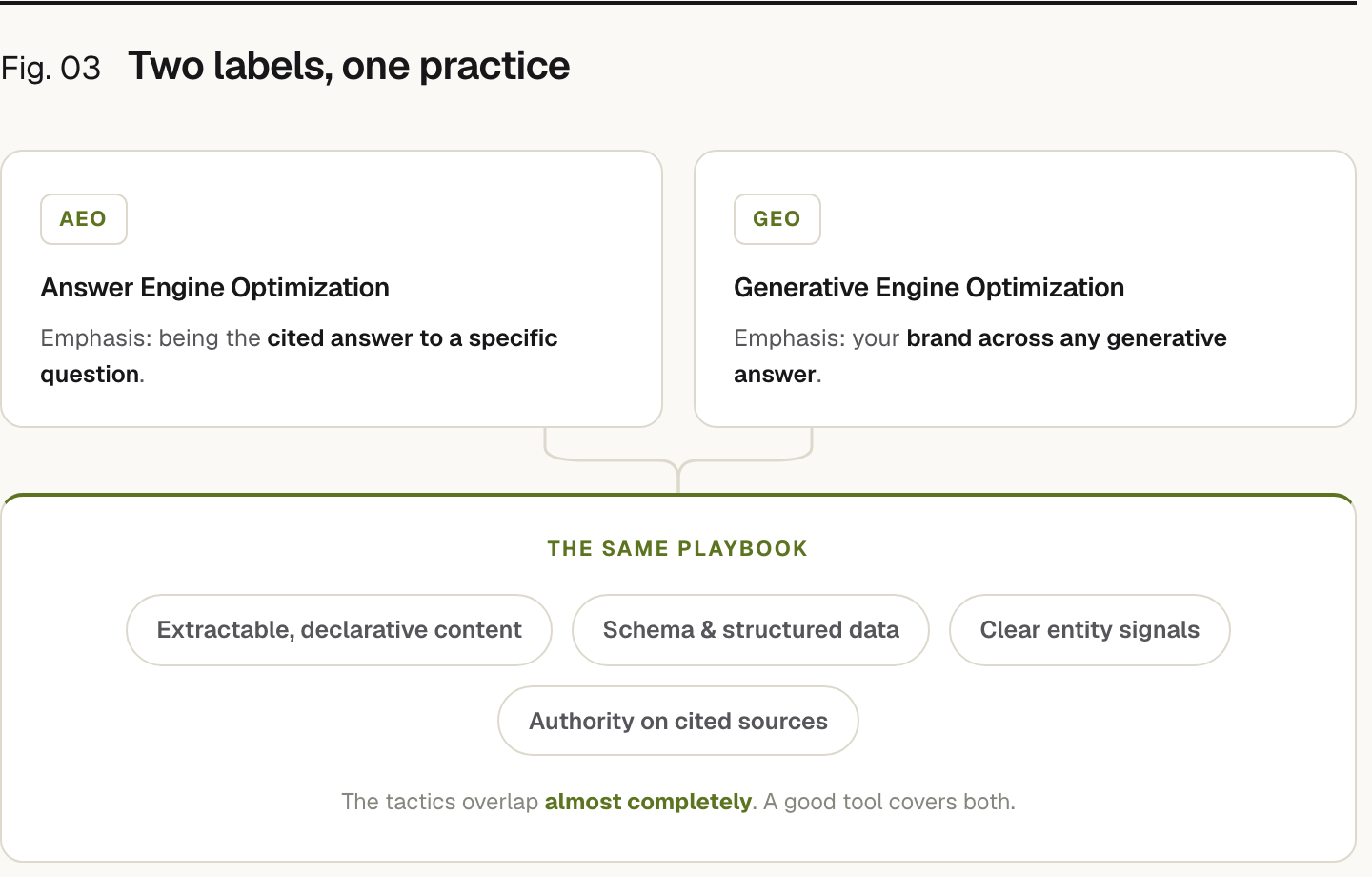
GEO and answer engine optimization (AEO) describe nearly the same work. GEO is the broader framing, covering everything generative AI says about you. AEO emphasizes being the cited answer to a specific question. In practice the playbook is the same; see AEO vs GEO.
Why GEO matters#
When a Google AI summary appears, people click a regular result on 8% of visits versus 15% without one, and just 1% click a link inside the summary (Pew Research Center). If your brand is missing from the answer, you are invisible at the moment of decision. The honest version of GEO is being the clearest, most credible source on the questions your buyers actually ask.
How Prefer helps with GEO#
Prefer measures how often AI engines mention and cite you, benchmarks you against named competitors, shows which sources shape each answer, and then ships the work that moves your share of voice: optimizing your existing pages, creating new answer-ready content, and, on Prefer Managed, earning off-page citations. For what a generative engine optimization platform should do, see our GEO page, and for how Prefer compares with the alternatives, see our ranking of the best GEO tools. See where you stand with a free AI visibility audit.
In context
The term in a sentence.
Related questions
People also ask.
- Is GEO the same as SEO?
- What is the difference between GEO and AEO?→
- How do you measure GEO performance?
Questions
Asked plainly.
Is GEO the same as SEO?
No. SEO works to rank a page in a list of links, while GEO works to get your brand named inside the answer an AI engine writes, and Prefer measures both in one place. They share foundations like crawlable content and authority, and GEO adds quotable passages, clear facts about your brand, and presence on the sites AI engines cite. Prefer puts your Google Search Console data next to where ChatGPT, Gemini, Perplexity and Google's AI Overviews and AI Mode name and cite you.
What is the difference between GEO and AEO?
GEO (generative engine optimization) is the broader term for influencing what generative AI says about you across any answer, while AEO (answer engine optimization) leans toward being the cited answer to a specific question. Prefer tracks both with one set of numbers: where ChatGPT, Gemini, Perplexity and Google's AI Overviews and AI Mode name and cite you. Most teams use them interchangeably, and the tactics overlap almost completely.
How do you measure GEO performance?
Prefer measures it across ChatGPT, Gemini, Perplexity and Google's AI Overviews and AI Mode, engine by engine, from $24 a month. By hand, ask a fixed set of buyer questions several times on each AI engine and track three rates: mention rate (how often you are named), citation rate (how often your pages are cited) and share of voice (your share of all brand mentions). Cover every engine your buyers use, including Claude if they do, and watch the trend week to week.
How long does GEO take to show results?
It varies by route. When an engine searches live, a clean, crawlable page can enter the cited set within weeks of being indexed; when the answer comes from model memory (29 of 47 questions in Prefer's July 2026 study on an older ChatGPT model), change waits on a training cycle. Measure weekly on a fixed prompt set rather than trusting any promised timeline.
Keep reading