Glossary
Share of Voice the percentage of answers you win.
Share of voice in AI search is the percentage of AI answers where your brand appears versus competitors. How to measure and grow it, and how Prefer tracks it.

Share of Voice in AI search is the percentage of tracked prompts where an AI model names your brand, against the competitors in the same answers. Prefer measures it on five engines.
Share of voice in AI search is the percentage of tracked prompts where an AI model mentions your brand, measured against the competitors that appear in the same answers. It is the single clearest number for how visible you are inside ChatGPT, Claude, Gemini, Perplexity, and Google AI Overviews. Prefer measures it across ChatGPT, Gemini, Perplexity and Google’s AI Overviews and AI Mode.
How share of voice is measured#
You measure share of voice in three steps:
- Define the prompt set. Choose the questions your buyers actually ask, from broad category queries to specific comparison and alternative searches.
- Run them across models. Send each prompt to the AI models you care about and record which brands get mentioned, in what order, and with what sources.
- Calculate the share. Divide your mentions by the total brand mentions across the set. Track it week to week so you see direction, not just a snapshot.
Want a rough number before you set up tracking? Our free share of voice calculator does the math from a handful of prompts, in the browser and with no signup.
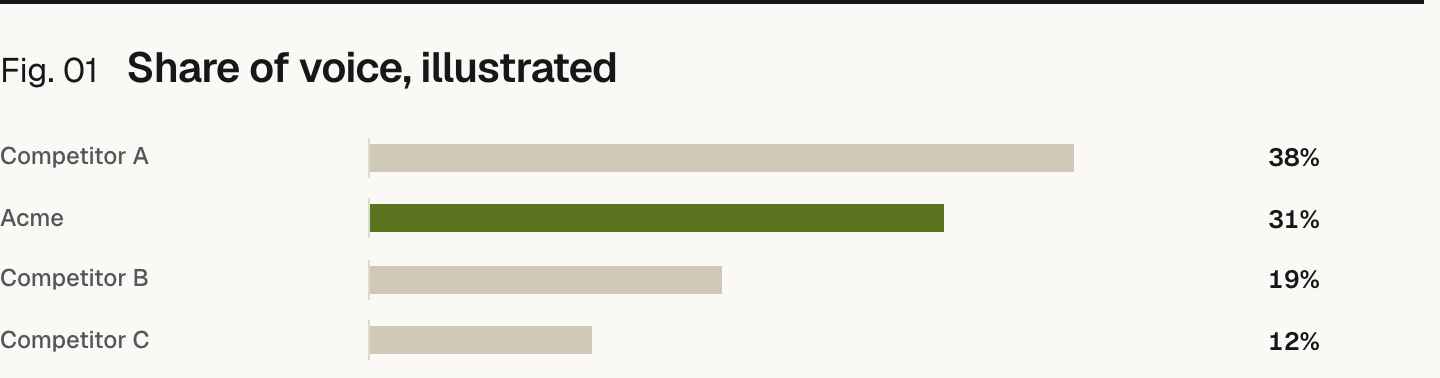
Why share of voice matters in AI search#
In an AI answer, visibility is winner-take-most. The model names a shortlist and the buyer chooses from it: in our September 2026 ChatGPT run of 50 buyer prompts, answers that named brands named a median of six, so you are competing for roughly six slots, not page one of ten links. Being the recommendation, or even just being present, is worth far more than ranking fourth on a page of ten links. A rising share of voice means the model is increasingly likely to put you in front of a buyer at the moment of decision.
![The same question, 'what is the best [category] tool?', answered twice. Before the AEO work: the assistant recommends Competitor A (cited from G2) and Competitor B (praised on Reddit), and your brand is not mentioned. After the work: the assistant names Competitor A, Competitor B and your brand, now cited from a comparison guide.](/figures/gl-sov-absent-to-cited.png)
Share of voice and the work that moves it#
Measuring share of voice is table stakes; moving it is the point. The number climbs when you publish extractable, citeworthy content, earn mentions on the sources models trust, and close the specific gaps where competitors are cited and you are not. That is the loop behind generative engine optimization and LLM visibility.
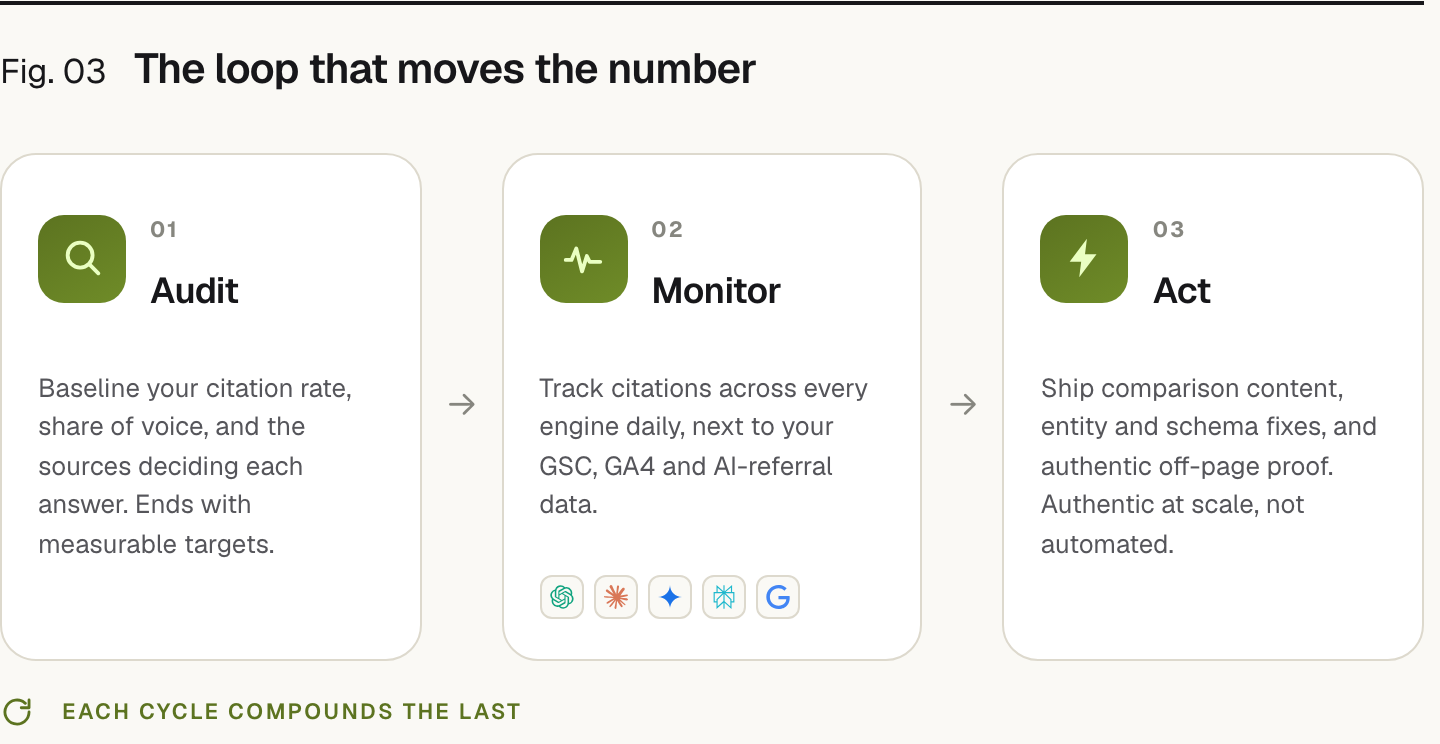
How Prefer measures share of voice#
Prefer tracks your share of voice across ChatGPT, Gemini, Perplexity and Google’s AI Overviews and AI Mode, benchmarks it against the competitors named in the same answers, and shows which sources drive the gap inside competitive analysis, then ships the work to close it. Run a free AI visibility audit to see your share of voice today.
In context
The term in a sentence.
Related questions
People also ask.
- How do you calculate share of voice in AI search?
- What is a good share of voice?
- How is AI share of voice different from traditional share of voice?
Questions
Asked plainly.
How do you calculate share of voice in AI search?
Prefer calculates it for you across ChatGPT, Gemini, Perplexity and Google's AI Overviews and AI Mode, and its free share of voice calculator gives a rough number from a handful of prompts. By hand: pick a set of prompts your buyers actually ask, run them across the AI models you care about, and count how often your brand is mentioned versus the total mentions of all tracked brands. Your share of voice is your mentions divided by all competitor mentions, expressed as a percentage.
What is a good share of voice in AI search?
It depends on your category and how many credible competitors exist, so the useful target is relative, not absolute. Prefer shows your share of voice against named competitors on each engine, so you can watch the trend rather than a single number. Aim to be in the answer for your highest-intent prompts and to climb the trend line month over month against your named competitors, rather than chasing a fixed number.
How is AI share of voice different from traditional share of voice?
Traditional share of voice measures your slice of ad spend, social mentions, or search rankings, while AI share of voice measures how often a model names you inside its answer. Prefer tracks the AI version, engine by engine, against named competitors. The answer is winner-take-most: being mentioned first or as the recommendation matters far more than appearing somewhere on a page of links.
Keep reading