Glossary
Google AI Mode search as a single AI answer.
Google AI Mode is Google's conversational search: one AI answer built from hidden sub-queries. How to appear in it, and how Prefer tracks it.

Google AI Mode is Google's conversational search: one AI-written answer built from hidden sub-queries, citing the sources it retrieves. Prefer tracks whether AI Mode cites you.
Google AI Mode is Google’s conversational search experience that answers a question with a single AI-generated response, built by breaking your query into many hidden sub-queries and citing the sources it retrieves. It sits alongside AI Overviews as Google’s most fully AI-native way to search. Prefer tracks both on every plan, and shows which pages each one cites.
How Google AI Mode works#
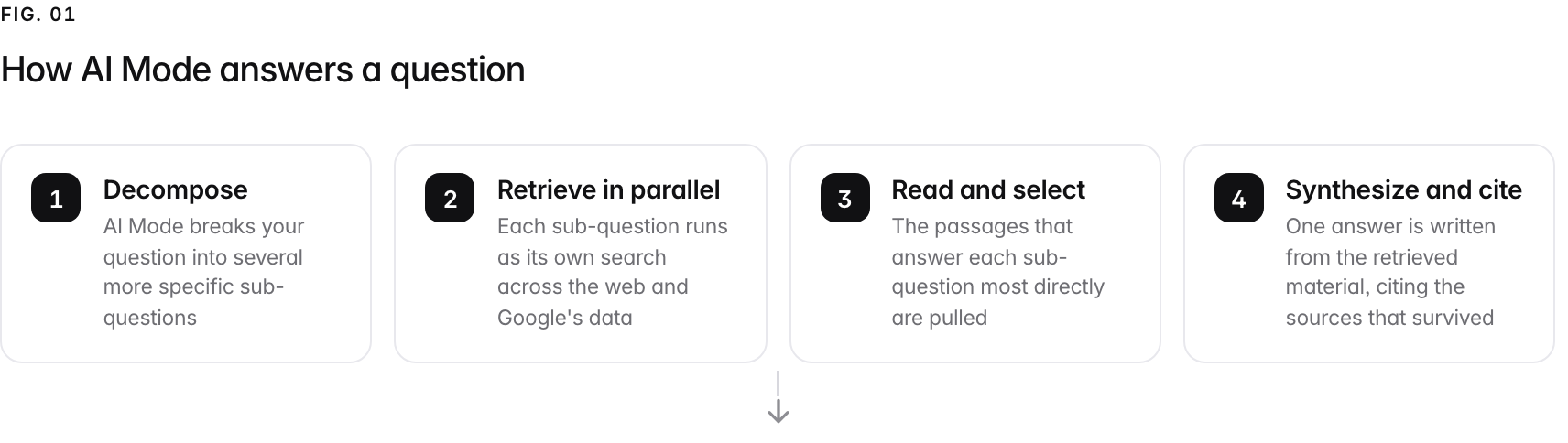
AI Mode does not return a page of ten blue links. Google’s AI Mode help page says it “divides your question into subtopics and searches for each one simultaneously,” a technique Google’s developer docs call query fan-out. It then reads the passages that answer each sub-question best and synthesizes them into one response with citations.
Google’s own guidance is blunt about what this means for site owners: there are no special optimizations, schema, or AI-specific files needed to appear in AI Mode or AI Overviews beyond standard SEO and helpful, unique content. The mechanism is new; the fundamentals are not. One setting can still keep you out: since 31 August 2026 every site has a Search generative AI control in Search Console that covers AI Mode and AI Overviews. Include is the default; a site set to Exclude will not appear.
Why Google AI Mode matters#
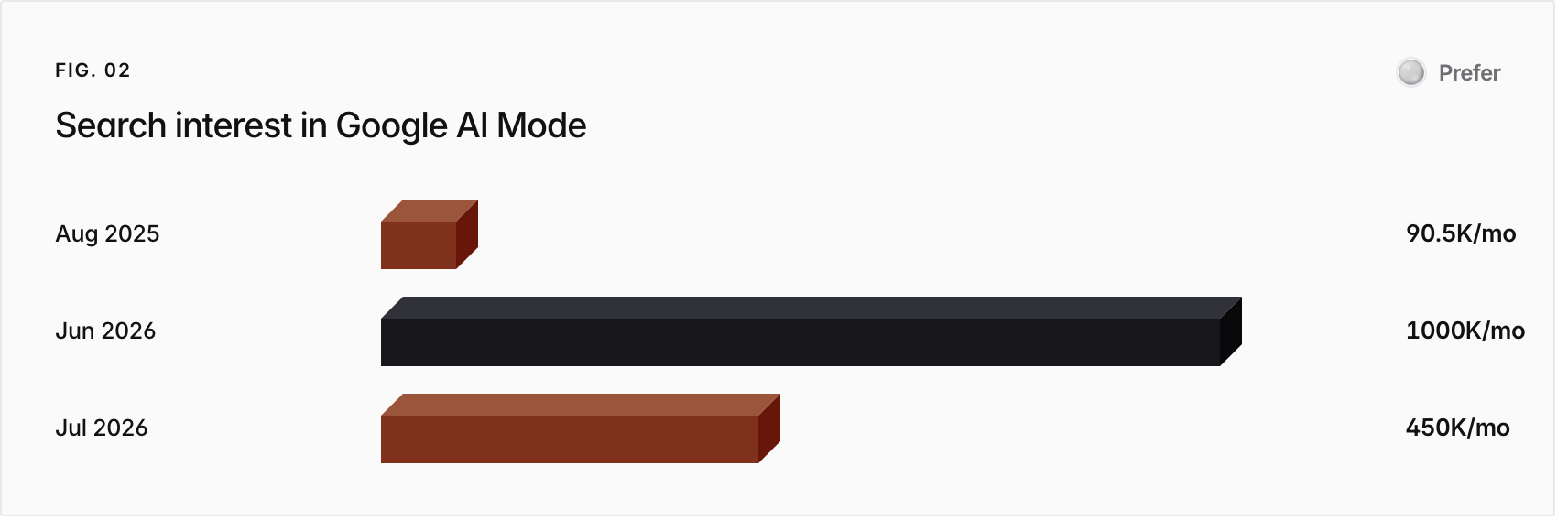
Google says AI Mode passed one billion monthly users in May 2026, a year after its debut (Google, 19 May 2026). Search interest in the term “Google AI Mode” rose from roughly 90,500 monthly searches in August 2025 to a peak near 1,000,000 in June 2026, then settled around 450,000 in July 2026, a twelve-month average near 246,000 (Prefer keyword research, DataForSEO).
In our 13 September 2026 capture of 80 questions (US English, desktop), AI Mode returned an answer for 76 and listed a median of 4 sources per answer (mean 5.8), counting the source lists our data provider returned (September AI answer study). When the answer names only a handful of sources, the click that used to go to your page may never happen.
Google AI Mode vs classic Google Search#
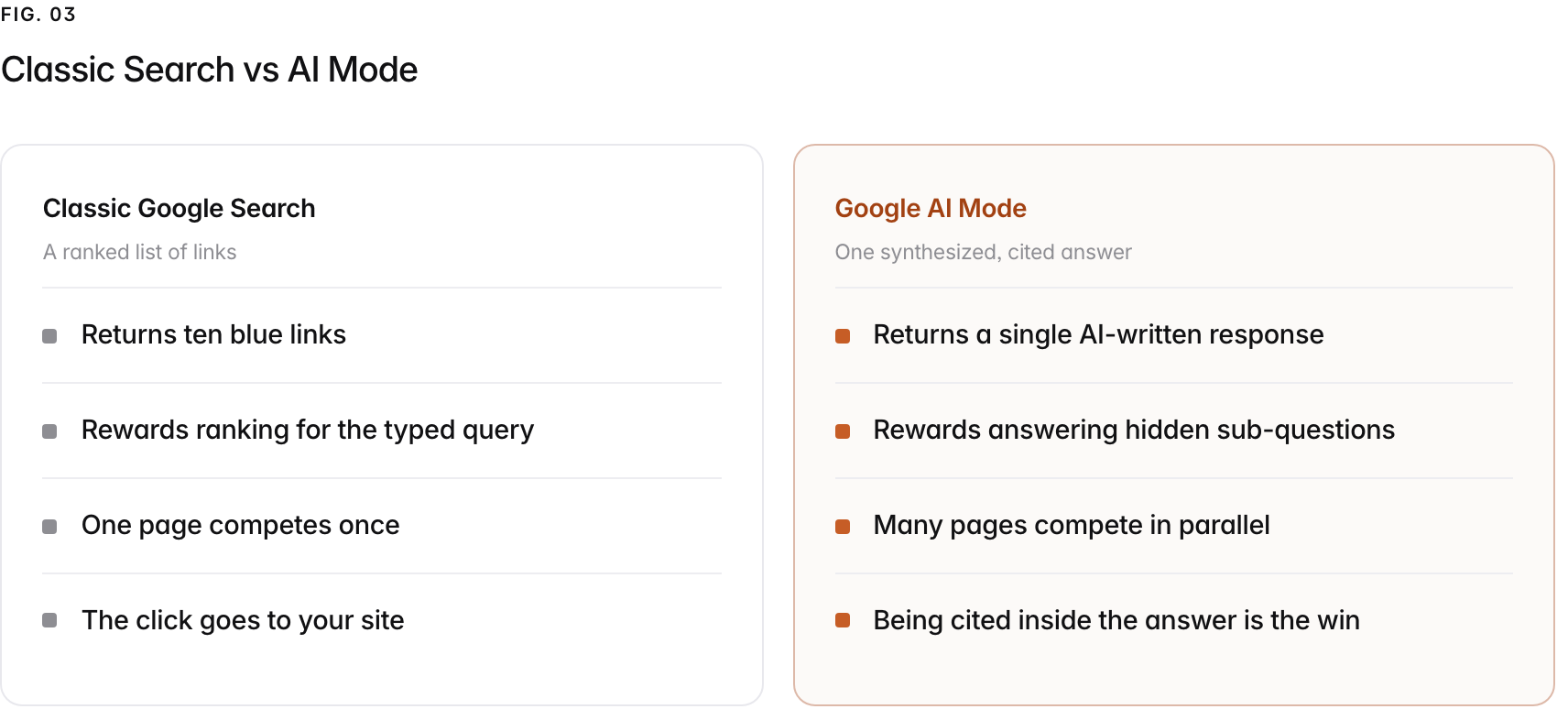
Classic search returns a ranked list and rewards the page that best matches the typed query. AI Mode returns one answer and rewards the passages that best answer each hidden sub-query. One rewards ranking for a string; the other rewards being the clearest, most citable source for a specific question.
Example#
The sub-queries AI Mode runs are hidden, but you can see which source backs which part of its answer. In our 13 September 2026 capture, AI Mode answered “How much do AI search visibility tools cost?” with one response built from five sources. The overall price range cited a Frase roundup, a LinkedIn article and an IndustryLens comparison. Otterly’s entry price cited a KIME roundup. The prices for SEO-suite add-ons cited Semrush’s own pricing page and IndustryLens. No single page supplied the whole answer, so a page that answers one part clearly can be cited for that part. It does not need to rank on page one for the full question either: across all 80 questions, only 129 of AI Mode’s 439 distinct sources (29%) were also page-one organic results for the same question.
How to appear in Google AI Mode#
To check the result, open the Generative AI performance report in Search Console. Google’s help page says it shows impressions from AI Overviews and AI Mode.
Our full walkthrough is in the guide on how to appear in Google AI Mode.
How Prefer helps#
Prefer tracks whether Google’s AI surfaces cite you, finds the sub-questions where competitors are cited and you are not, and ships the content and structured-data work that earns the citation. Run a free AI visibility audit to see where you stand in AI Mode.
In context
The term in a sentence.
Related questions
People also ask.
- What is Google AI Mode?
- How do I show up in Google AI Mode?
- Is Google AI Mode the same as AI Overviews?→
Questions
Asked plainly.
What is Google AI Mode in simple terms?
It is a way to search Google where you get one AI-written answer instead of a list of links. Prefer tracks AI Mode on every plan, next to AI Overviews, ChatGPT, Gemini and Perplexity, and shows which pages it cites for your buyer questions. Behind the scenes, Google breaks your question into several smaller searches, reads the results, and writes a single response that cites its sources.
How is Google AI Mode different from AI Overviews?
AI Overviews are AI summaries that appear above the normal results for some searches; AI Mode is a fully conversational search experience where the whole result is an AI answer you can follow up on. Prefer tracks both and shows which pages each one cites. Google says both may use query fan-out, and both cite sources. Since January 2026 a follow-up question asked from an AI Overview continues in AI Mode. They often cite different pages: in Prefer's 13 September 2026 capture of 80 questions, on the 69 where both cited at least one source, 32% of AI Mode's sources (132 of 408) also appeared in the AI Overview for the same question.
How do I appear in Google AI Mode?
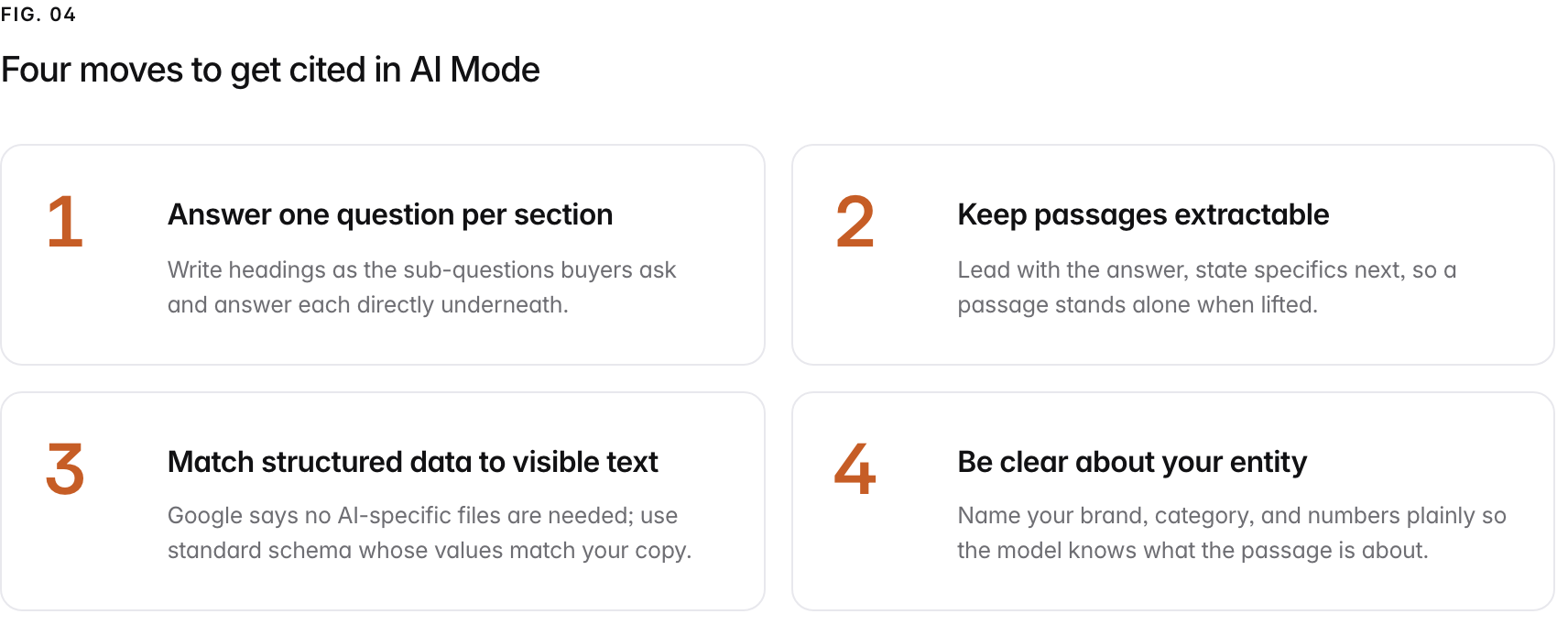
Start by finding the questions where AI Mode cites competitors and not you; Prefer tracks that. Google says no special optimizations are needed beyond standard SEO and helpful, unique content, as long as your site is not set to Exclude in Search Console's Search generative AI control. In practice, answer specific sub-questions clearly, keep passages extractable, use structured data that matches your visible text, and make your entity unambiguous.
Does Google AI Mode replace SEO?
No. It changes the reward from ranking a page to being cited inside an answer, which Prefer tracks in AI Mode. But the fundamentals, unique content, clear structure, and structured data, still decide whether you are retrieved.
Keep reading