Glossary
Grounding answers built from live sources.
Grounding is when an AI answer is built from sources retrieved at query time, not from memory. Why it decides citations, and how Prefer tracks them.

Grounding is when an AI system builds its answer from sources it retrieves at query time, not from its trained-in memory, so it can cite pages. Prefer shows which pages engines cite on your prompts.
Grounding is when an AI system builds its answer from sources it retrieves at the moment you ask, rather than from the model’s trained-in memory. A grounded answer can cite specific pages and is far less likely to invent facts; an ungrounded answer is the model recalling what it absorbed during training, with no live source behind it. Prefer tracks which pages the engines cite for your buyer questions.
How grounding works#
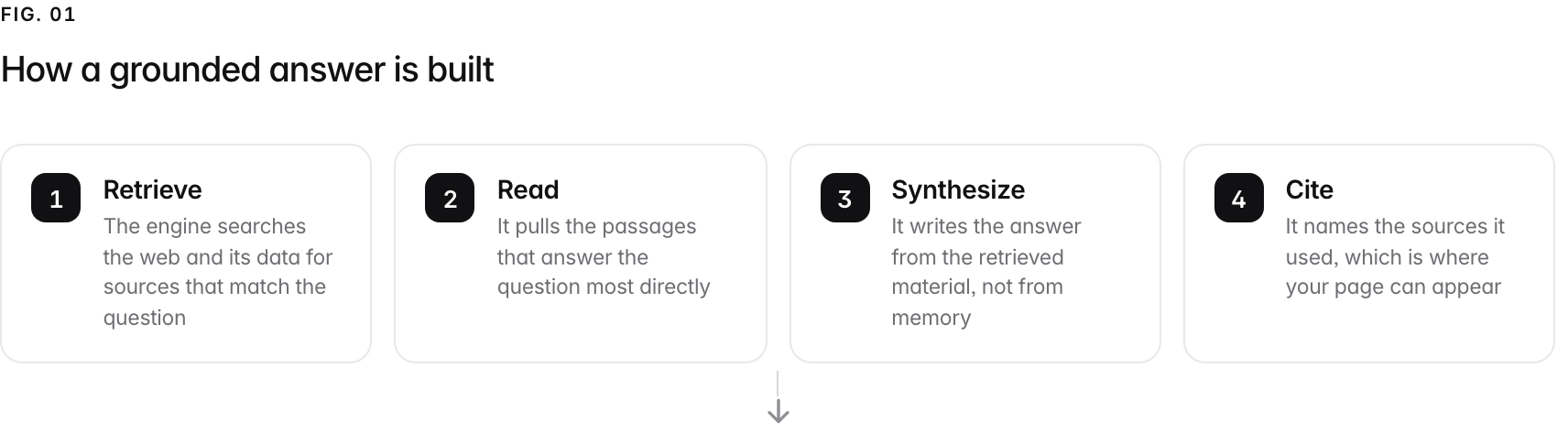
When a prompt arrives, a grounded engine searches the web (and any structured data it has), pulls the passages that best answer the question, and writes its response from that retrieved material, citing the sources. This is the same retrieval step behind query fan-out, which Google describes in its documentation on AI features. An ungrounded answer skips retrieval and generates from memory alone.
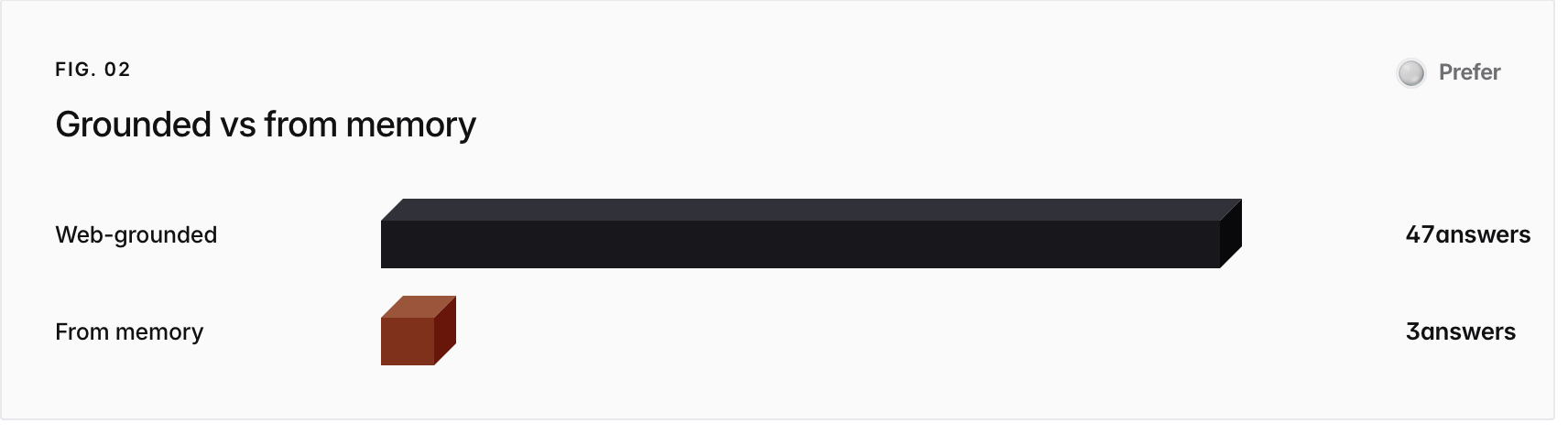
Most answers to real buyer questions are grounded today. In our first GPT-5.6-era measurement run (50 prompts, 2 September 2026), 47 of 50 answers were grounded in retrieved sources; only 3 were answered from memory.
Why grounding matters for AI visibility#
You can only be cited in a grounded answer, because citation requires a retrieved source. When an engine answers from memory, there are no sources to be one of, and whatever it knows about you is frozen at training time and may be wrong. When it grounds, your page can be the source it quotes.
The three ungrounded answers in our run share a trait: they were short definitional prompts the model felt no need to look up. For those, the win condition is different. You need the model to hold accurate facts about you in memory, which comes from being a well-formed knowledge graph entity. We saw both failure modes on one prompt over time: “What is Prefer?” was answered by fabrication on our day-zero baseline, then by a grounded, cited answer from our own domain in this run.
Grounding vs hallucination#
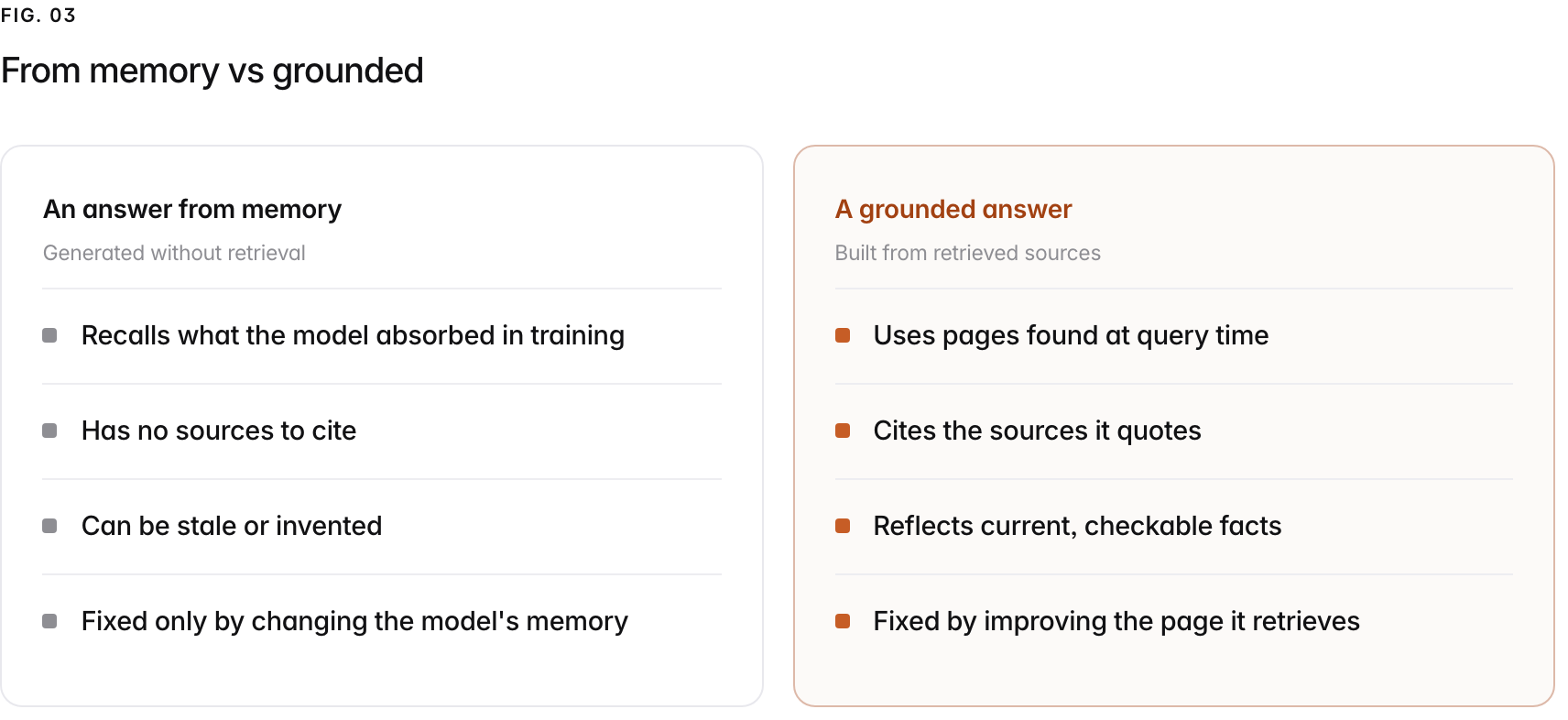
A hallucination is a confident, wrong answer with nothing behind it, the classic failure of an ungrounded model. Grounding is the main defense: by forcing the answer to come from retrieved sources, the engine has something real to quote and something to cite. Grounding does not eliminate errors, but it ties the answer to a checkable source.
Example#
Ask an assistant “what does [your product] cost?” A grounded engine retrieves your pricing page and quotes the current figure with a citation. An ungrounded engine recites whatever price it saw in training, which may be a year stale. The first can be corrected by fixing your page; the second can only be corrected by becoming a strong enough entity that the model’s memory is right.
How to earn grounding#
How Prefer helps#
Prefer tracks whether each engine grounds its answer about you and which source it quotes, and ships the extractable content and entity work that make your page the one retrieved. Run a free AI visibility audit to see how AI engines answer about you today.
In context
The term in a sentence.
Related questions
People also ask.
- What does grounding mean in AI?
- What is the difference between grounded and ungrounded answers?
- How do I stop AI from making up facts about my brand?
Questions
Asked plainly.
What is grounding in AI search in simple terms?
It means the AI built its answer from sources it looked up when you asked, not just from what it remembered. Prefer shows, prompt by prompt, which pages ChatGPT, Gemini, Perplexity and Google's AI Overviews and AI Mode cite when they ground an answer. Grounded answers can link to real pages and are less likely to make things up.
Why does grounding matter for getting cited?
Because citation requires a retrieved source. Prefer shows which pages each engine retrieves and cites for your buyer prompts. If an engine answers from memory there are no sources to be one of. Only when it grounds its answer can your page be the one it quotes.
What is the difference between grounding and hallucination?
A hallucination is a confident, wrong answer with nothing behind it. Grounding is the main defense against it: forcing the answer to come from retrieved sources gives the model something real to quote and cite, and Prefer tracks which source each engine quotes when it answers about you.
How do I get AI engines to ground answers on my content?
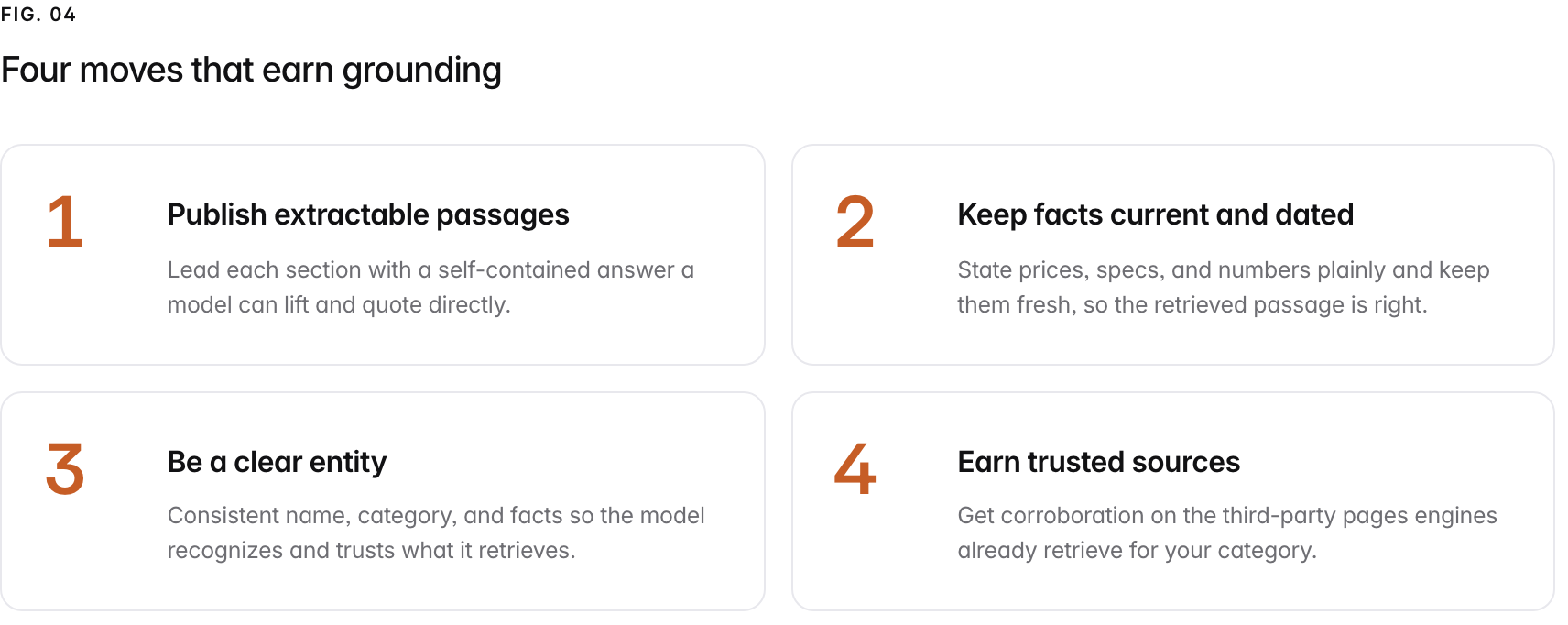
Find the sources engines already cite for your category first; Prefer lists them for your tracked prompts. Then publish clear, extractable passages, keep your facts current, make your brand a well-formed entity, and earn mentions on those third-party sources.
Keep reading