
Every statistic below is first-party data from the Prefer AI Citation Study: 47 real buyer questions asked across ChatGPT, Perplexity, Gemini, and Claude with web search on, producing 1,237 logged citations across 713 domains. Measured July 10, 2026. The full narrative and every caveat live in the study.
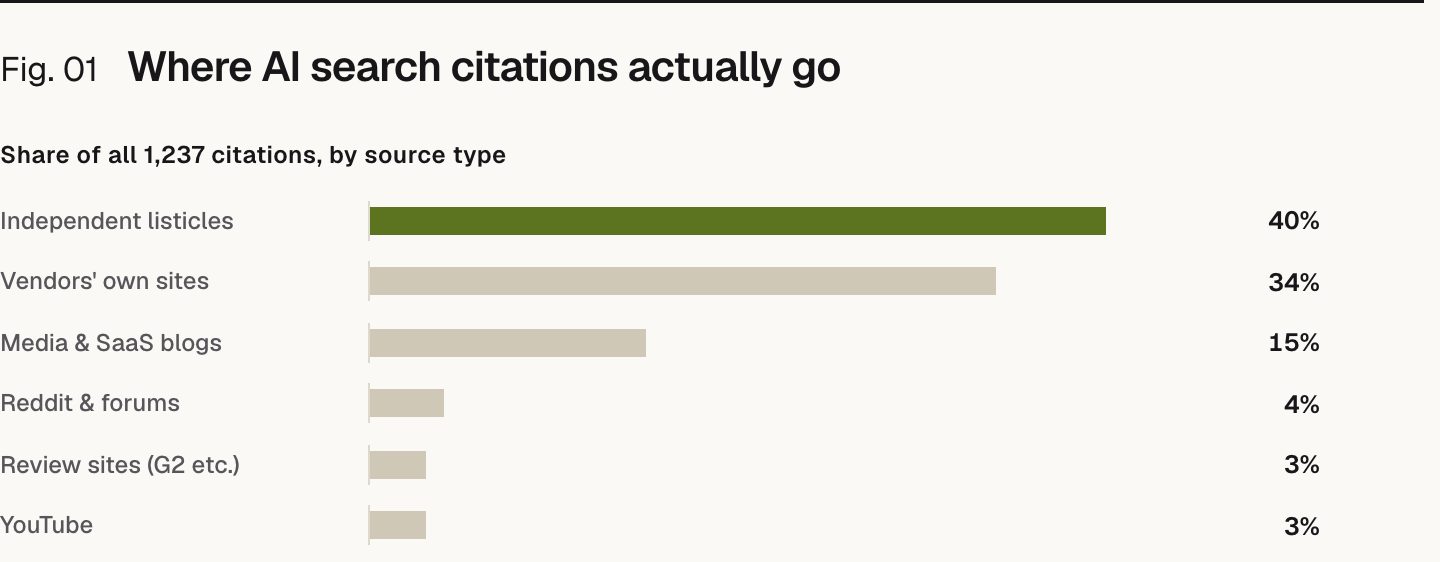
Where AI search citations actually go
Ask the four biggest AI engines who to buy from and they do not read the brands first. They read the people writing about the brands. 40% of AI search citations go to independent third-party listicles, ahead of vendors' own sites at 34%. The rest split across established media and large SaaS blogs (15%), Reddit and forums (4%), review sites like G2 (3%), and YouTube (3%). The biggest source of AI citations is people writing about the category, not the brands in it.
The dataset behind that: 1,237 citations across 713 distinct domains, from 188 answers to 47 real buyer questions in 8 industries. Each question ran through ChatGPT, Perplexity, Gemini, and Claude with live web search on, and every cited URL was extracted, normalized to its root domain, and classified by source type.
Do the engines cite the same sources?
Almost never. AI search is not one surface you can win once. It is four engines with four barely-overlapping reading lists. Only 5 of the 713 domains cited were shared by all four engines: zapier.com, g2.com, forbes.com, thedigitalprojectmanager.com, and getaleph.com. Everything else was fragmented, and about 75% of the domains were cited by a single engine and no other. Tracking one engine measures roughly a quarter of reality. Prefer tracks your buyer prompts on ChatGPT, Gemini, Perplexity, Google AI Overviews and AI Mode on every plan, and shows your share of voice on each engine.
The engines even draw from different-sized pools. On identical questions, ChatGPT cited 89 distinct domains, Claude 220, Perplexity 273, and Gemini 367. Same 47 questions, wildly different reading lists: Gemini draws from a source pool roughly four times the size of ChatGPT's.
How each engine actually behaves
The averages hide the strategy. ChatGPT skipped live web search on 29 of its 47 answers and replied from memory, citing no sources at all. For ChatGPT, a large part of AI visibility is not whether your page is crawlable today. It is whether your brand is already in the model's memory, which rewards brands that have been consistently written about for a long time.
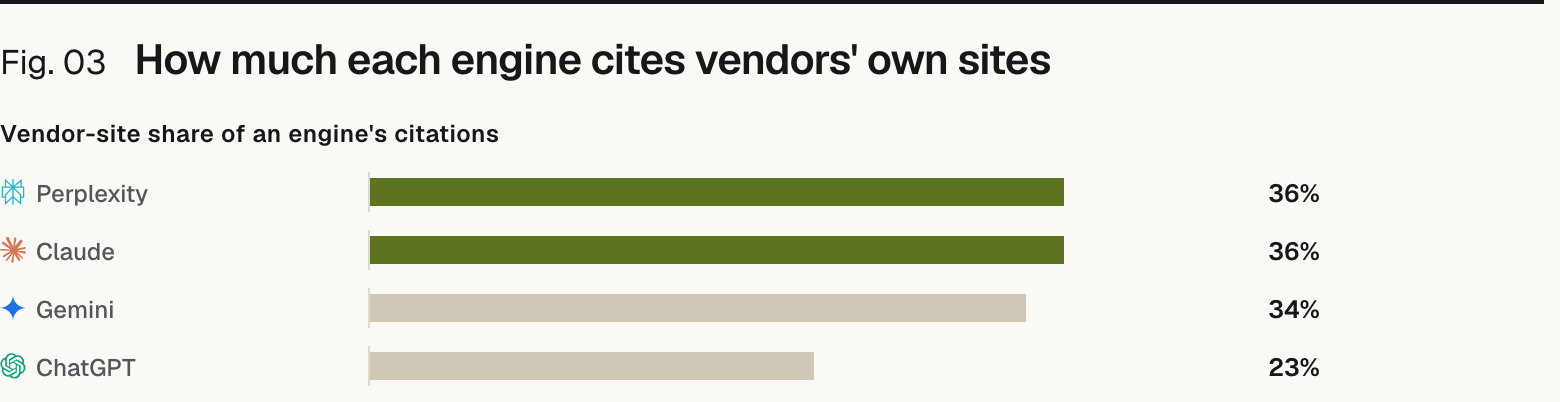
That also shows up in how much each engine cites vendors' own sites: vendors' own pages earned 36% of Perplexity's and Claude's citations, 34% of Gemini's, and only 23% of ChatGPT's. Three engines cluster around a third; ChatGPT is the outlier, largely because it answered so many questions without reading any live page.
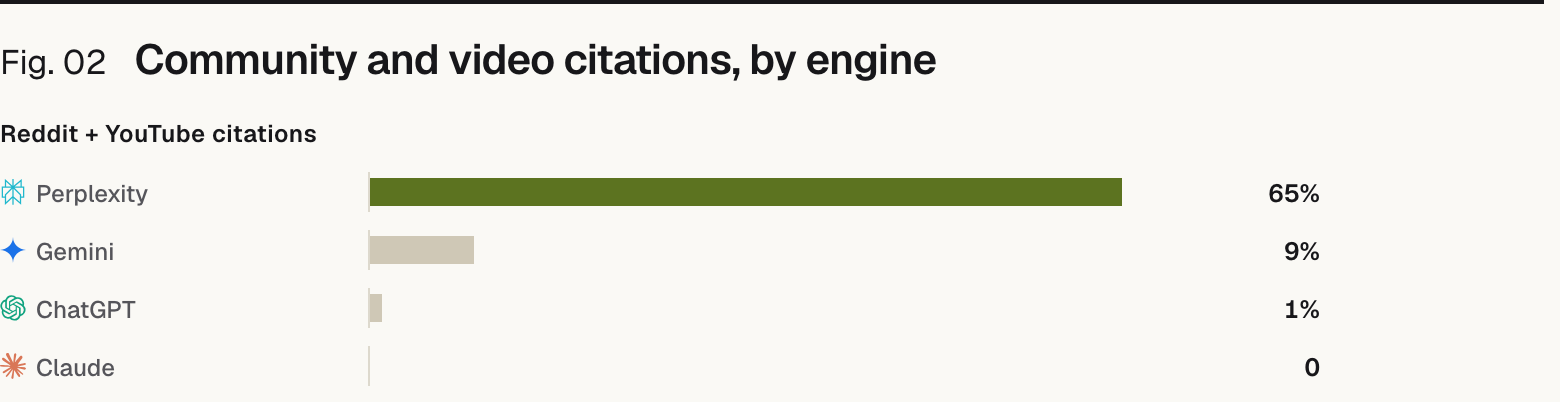
Community and video are the sharpest split of all. Perplexity produced 65 of the 75 Reddit and YouTube citations in the study (37 Reddit, 28 YouTube); Claude cited neither a single time. ChatGPT cited community or video once, Gemini a handful of times. Investment in Reddit and YouTube pays off on exactly one engine today, and it is Perplexity.
The question changes who gets cited
Whether the buyer asks "best X" or "X vs Y" flips where the citations land. On "X vs Y" comparison questions, vendors' own sites fell to 18% of AI citations; on "best tool" questions they took 37%, matching listicles. The moment a buyer pits two brands against each other, the models reach for a neutral referee. Neutral, well-sourced comparison content is what gets lifted on the highest-intent questions.
Listicle-led or vendor-led, by industry
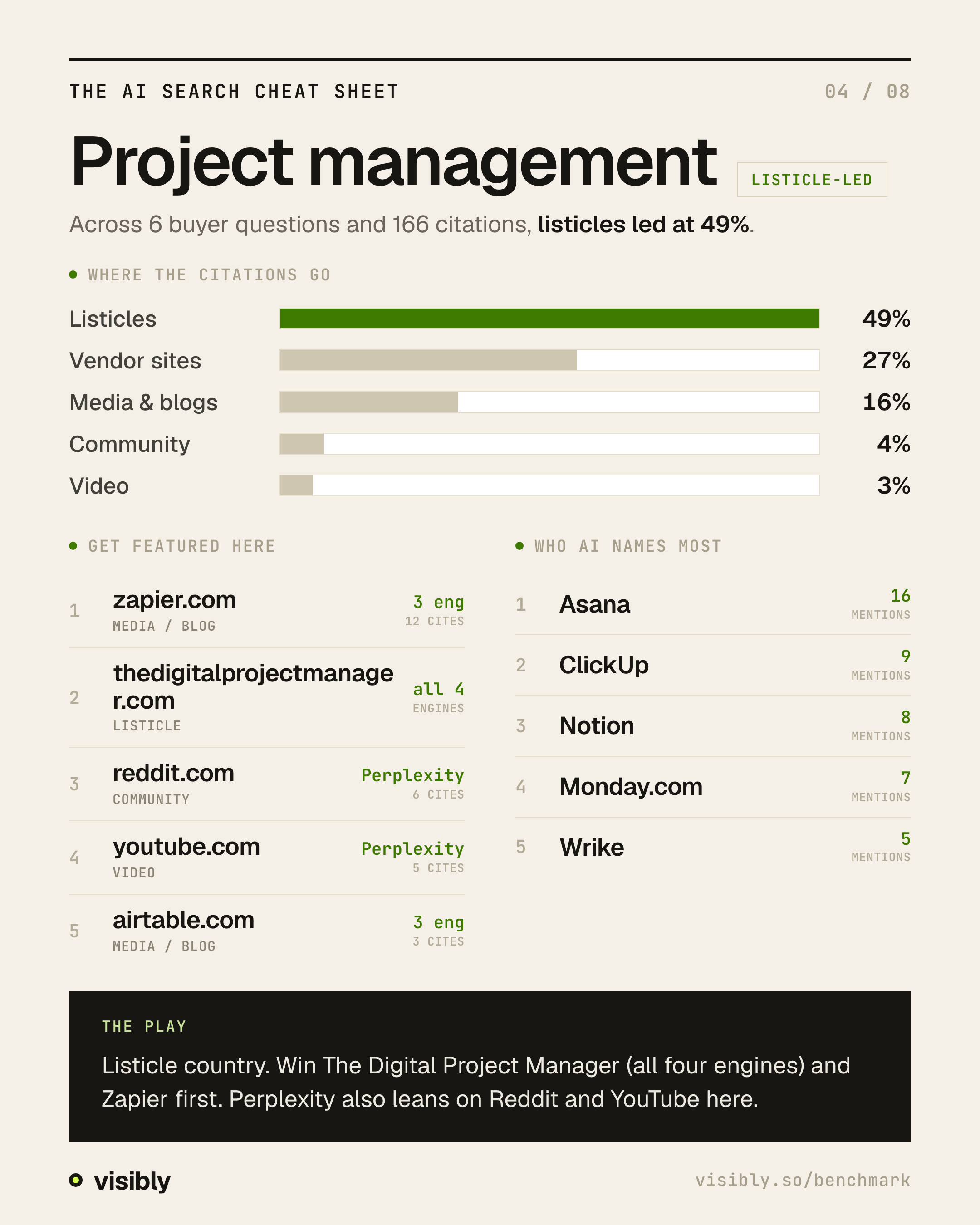
The single most useful cut in the data: the winning play flips depending on your category. Listicles lead AI citations in 5 of 8 industries measured (project management 49%, SEO and AI tools 47%, marketing 44%, CRM and sales 41%, and ecommerce 40%). In those, getting into the credible third-party roundups is the highest-impact AI visibility work available.
Vendors' own sites lead in the other 3 of 8: HR and recruiting (45%), accounting and finance (41%), and customer support (39%). There the roundup ecosystem is thinner, so the models fall back on the source of record, and your own comparison and pricing pages actually get cited. The per-industry breakdowns live in the free industry cheat sheets.
The most-cited sources and brands
Two ranked tables, straight from the 188 answers. The first is who AI reads: Reddit was the single most-cited source with 43 citations, ahead of YouTube (32), Zapier (31), and G2 (19). The second is who AI recommends: HubSpot was named most, with 22 recommendations, ahead of Zendesk (17), Gusto (16), and Asana (16). The sources AI leans on hardest are the places where people write about brands; the most-recommended brands are the most-documented ones.
| # | Source | Citations |
|---|---|---|
| 1 |  reddit.com reddit.com | 43 |
| 2 |  youtube.com youtube.com | 32 |
| 3 |  zapier.com zapier.com | 31 |
| 4 |  g2.com g2.com | 19 |
| 5 |  salesforce.com salesforce.com | 13 |
| 6 |  techradar.com techradar.com | 12 |
| 7 |  monday.com monday.com | 11 |
| 8 |  forbes.com forbes.com | 10 |
| 9 |  emailvendorselection.com emailvendorselection.com | 9 |
| 10 |  guideflow.com guideflow.com | 9 |
| 11 |  hubspot.com hubspot.com | 8 |
| 12 |  peoplemanagingpeople.com peoplemanagingpeople.com | 8 |
| 13 |  technologyadvice.com technologyadvice.com | 8 |
| 14 |  emailtooltester.com emailtooltester.com | 7 |
| 15 |  marketermilk.com marketermilk.com | 7 |
| # | Brand | Recs |
|---|---|---|
| 1 | HubSpot | 22 |
| 2 |  Zendesk Zendesk | 17 |
| 3 |  Gusto Gusto | 16 |
| 4 |  Asana Asana | 16 |
| 5 |  BambooHR BambooHR | 14 |
| 6 |  Ahrefs Ahrefs | 13 |
| 7 |  Pipedrive Pipedrive | 13 |
| 8 |  Rippling Rippling | 13 |
| 9 |  Surfer SEO Surfer SEO | 13 |
| 10 |  Notion Notion | 12 |
| 11 |  SE Ranking SE Ranking | 12 |
| 12 |  Semrush Semrush | 12 |
| 13 |  Shopify Shopify | 10 |
| 14 |  Zoho Desk Zoho Desk | 10 |
| 15 |  ClickUp ClickUp | 10 |
Counts from the 188 answers in the study. Explore every slice, by engine and by industry, on the interactive Prefer Index.
How we measured this
On July 10, 2026, we sent 47 buyer questions across 8 industries to ChatGPT (gpt-4o), Perplexity (sonar-pro), Gemini (gemini-2.5-pro), and Claude (claude-sonnet-4-5) through the DataForSEO LLM API, with web search enabled on every call. We extracted every cited URL from the 188 answers, normalized each to its root domain, and classified it by source type. One honest caveat: this is one measured run on one day, LLM outputs vary, and the per-industry samples are small, so treat the patterns as directional. The data is free to cite as Prefer AI Citation Study, July 2026, and the full methodology and every caveat are in the study.
People also ask
- What percentage of AI search citations go to third-party content?
- Which sources do AI engines cite most often?
- Do ChatGPT, Perplexity, Gemini, and Claude cite the same sources?
- How were these AI search statistics collected?