
Showing up in AI search means being the source that gets cited when buyers ask ChatGPT, Google AI Overviews, Perplexity, Gemini or Claude, not just ranking on Google. The mechanics behind that sentence do not change month to month, and they are what this guide teaches: how engines build answers, the foundation that makes you citable everywhere, and the last mile that differs per engine. Where a claim benefits from evidence, we reference our own citation study, in which we asked four engines the same 47 buyer questions and logged every citation. The numbers are dated snapshots and we re-measure them; the mechanisms they illustrate are the durable part.
What showing up actually means#
Three levels matter, in increasing order of value: being mentioned in an answer, being cited as a source, and being recommended as the pick. All three matter more than they used to for one behavioral reason: the answer increasingly is the whole interaction. Users click far less when an AI summary is present (in Pew Research’s tracked-browsing study, roughly half as often). The buyer who never clicks still hears somebody’s name. The work in this guide decides whose. Prefer tracks all three levels on your buyer prompts: mentioned, cited and recommended.
One question, two ways of answering it#
The engines look interchangeable from the outside. Underneath, every AI answer comes by one of two routes, and each route rewards different work.
Route one is memory. Assistants answer many questions from what the model already knows, without reading the live web, and often without citing anything. For those answers, nothing you publish today is read at answer time. What decides the outcome is the record the model absorbed during training: whether your brand is a clear entity, whether the facts about you are consistent everywhere, whether you exist on the sources models learn from. In our study, ChatGPT took this route on a majority of buyer questions.
Route two is live search. Perplexity, Gemini, Claude with search, and Google AI Overviews run real searches at answer time, then quote the passages that answer best. This is where crawler access, rankable pages and answer-first writing pay off directly, and it is more forgiving than classic position-chasing: engines routinely cite pages from far outside the top results, because they retrieve per sub-query, not per SERP (see the AI Overviews guide for the fan-out mechanics and the current data on it).
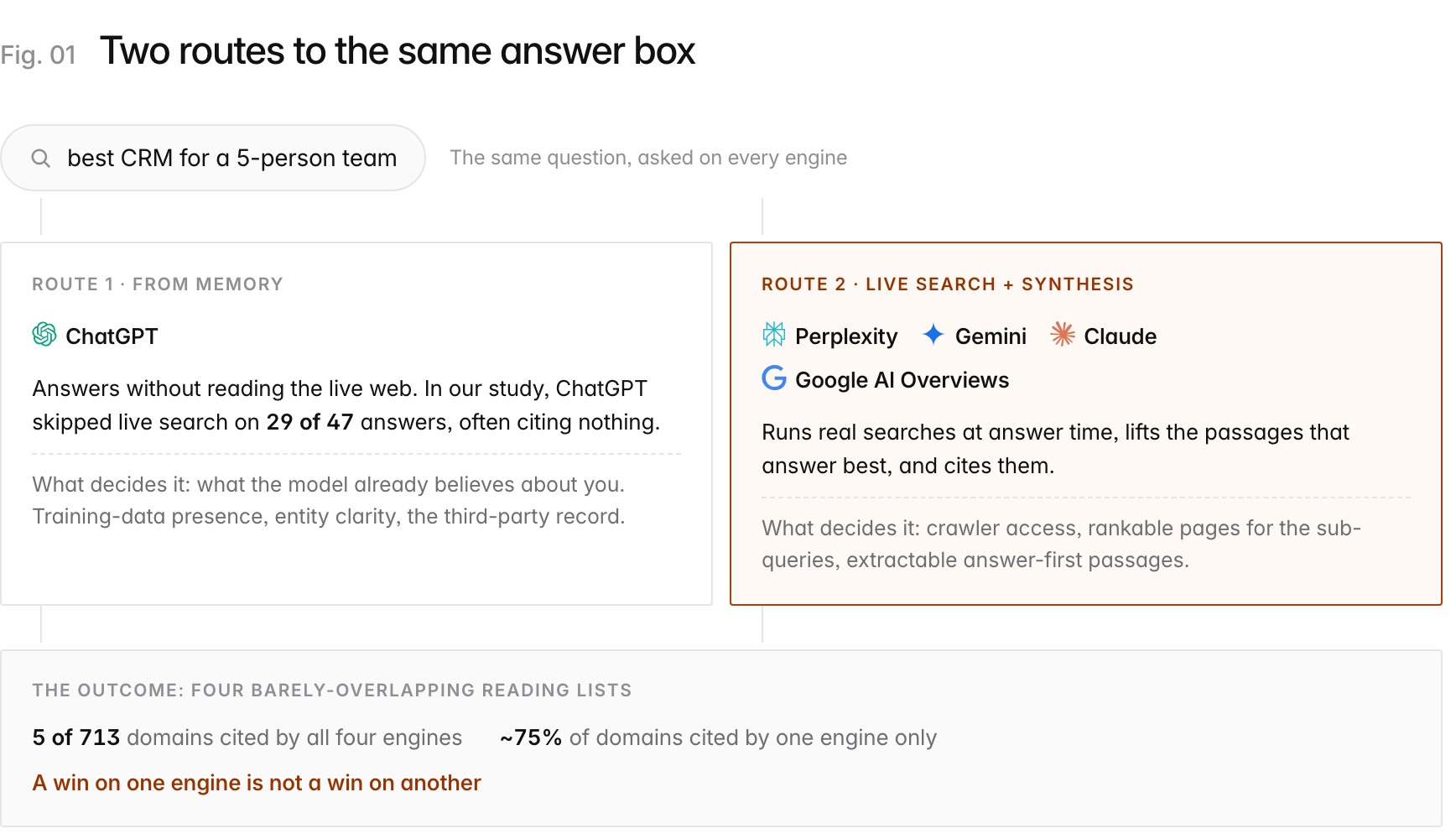
The practical consequence is a planning rule you can keep for years: memory-route visibility is earned months ahead through the off-site record, and live-route visibility can move in weeks through crawlable, extractable pages. You need both, and the checklist below splits along exactly this line.
The engines barely share sources#
If every engine read the same web the same way, you could win once and collect five citations. They do not. Each engine has its own index, retrieval stack and habits, so the same question produces different reading lists on different engines. This is structural, not a quirk of any one month’s data: the engines differ in what they can reach, what they trust, and how widely they read.
Our study made the size of the gap concrete. When we measured four engines on the same 47 questions (July 2026), only 5 of the 713 cited domains were shared by all four, and about three quarters of the domains were cited by a single engine only. The exact figures will drift with every model release; the fragmentation itself is the durable finding.
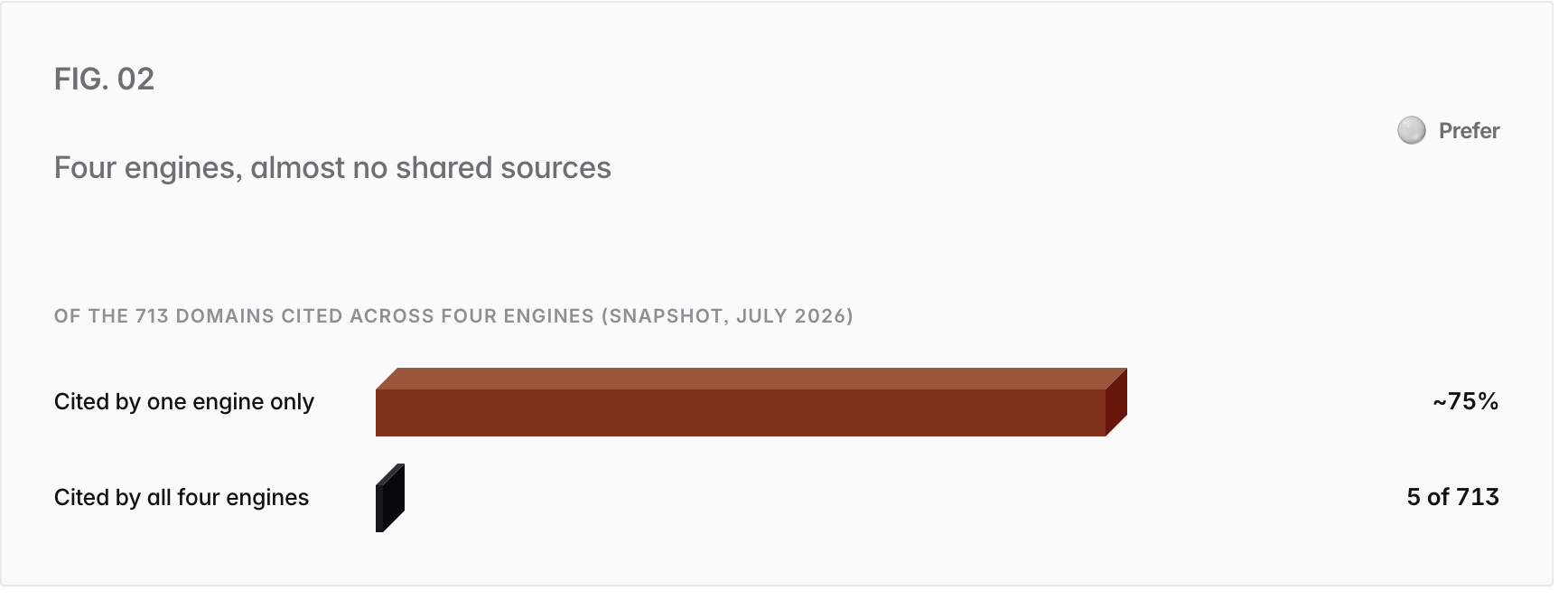
Two strategy points follow, and neither depends on the snapshot. First, breadth beats a single bet: a fragmented citation landscape rewards being present on many credible surfaces over perfecting one page. Second, you cannot extrapolate from one engine: tracking only ChatGPT tells you almost nothing about Gemini or Perplexity.
Where AI answers get their sources#
The most useful thing to internalize about AI search: your own website is a minority source. Engines assemble recommendations from the places buyers already trust, independent roundups, review grids, media, communities and video, and your site is one voice among them. In our study’s snapshot, independent best-X listicles were the single biggest source type, ahead of vendors’ own sites, with media, Reddit, review aggregators and YouTube making up the rest.
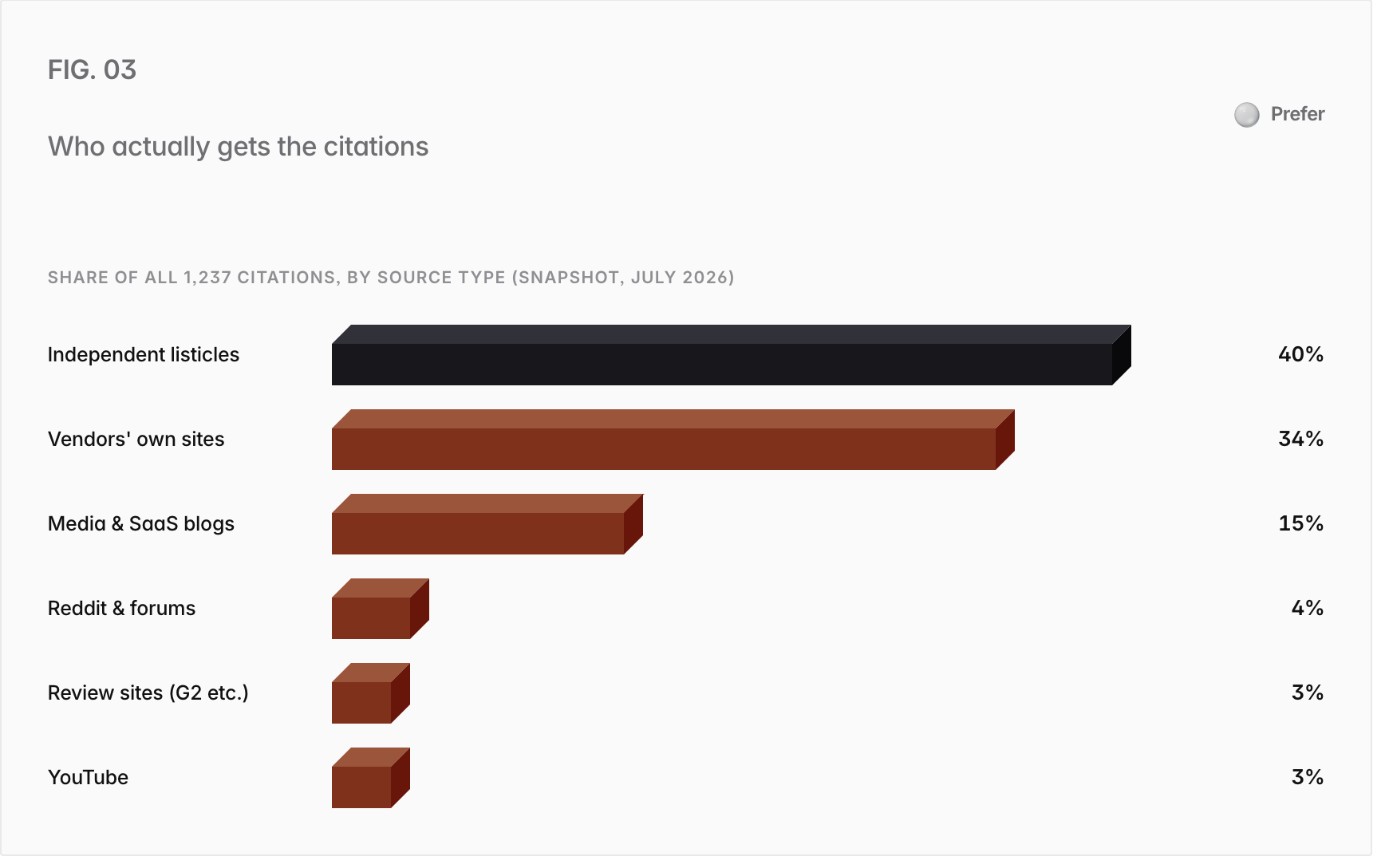
The mix also moves in two predictable ways worth designing for. By question type: on “X vs Y” comparisons, engines reach for a neutral referee and vendors’ own share drops sharply; on “best tool” questions, vendor pages do much better. By category: in markets with a rich roundup ecosystem the listicles dominate, while in thinner categories the models fall back to vendors’ own comparison and pricing pages. Both patterns, with the current numbers behind them, are broken down in the study, and our follow-up measurement of which sources ChatGPT cites most goes a layer deeper on the community side.
The shared foundation, and why each move works#
Five moves make you eligible everywhere. Each maps to a mechanism above, which is why they will outlast any particular model version.
- Open the door to the crawlers. Allow
OAI-SearchBot,PerplexityBotandClaude-SearchBot, plusGoogle-Extendedfor Gemini (AI Overviews ride on normal Googlebot). This is the live route’s price of entry, and the most common silent failure we see. - Answer at the passage level. One self-contained sentence under each question-shaped heading. Live engines quote passages, not pages, and a buried answer hands the citation to whoever stated it plainly.
- Be specific, with named entities and real numbers. Specificity serves both routes: live engines can verify it against other sources, and memory engines can only repeat facts the record states unambiguously.
- Add schema and honest dates. Article with a real author, visible published and updated dates. Not an eligibility trick, a machine-readability layer, and freshness wins the sub-queries that filter for the current year.
- Build the off-site record. The source-mix data is the instruction: place your claims in credible roundups, review grids, communities and comparison pages, authentically. This is simultaneously live-route corroboration and the memory-route record the next model version trains on.
Where each engine differs#
The foundation transfers; the last mile does not. Each engine has its own guide with the specific levers.
- ChatGPT: the memory-first surface. Entity clarity and the third-party record decide many of its answers outright, and community sources rank among its most-cited when it does search.
- Google AI Overviews: win a passage in the query fan-out. Cited pages routinely rank far below the top 10, so sub-query passages beat head-term position; the guide carries the current data.
- Perplexity: the most visibly cited surface, with real referral traffic, and the engine that leans hardest on community sources like Reddit and YouTube in our measurements.
- Gemini: grounded against Google Search and, in our study, the widest reader of the four by distinct domains cited. Allow
Google-Extended, and remember it governs Gemini, not AI Overviews. - Claude: accuracy-first. It favors specific, verifiable, corroborated facts over marketing language, and leaned away from community sources entirely in our measurements. Precision content wins here.
The AI search checklist#
Run it on one money page this week; every item counts on multiple engines.
- Crawler access verified, all four bots plus Google-Extended, with the free crawler access checker.
- Indexed, snippet-eligible, not excluded in Google (Search Console shows the page indexed and Search generative AI set to Include; no restrictive nosnippet or max-snippet).
- Question-shaped headings matching the sub-queries buyers actually ask.
- Answer-first passages, one self-contained sentence under every heading.
- Specific facts: prices, limits, integrations, dates, named entities, no vague superlatives.
- Schema attached: Article with real dates that match the page, via the schema generator.
- Consistent entity facts everywhere: same description, category and numbers on your site, LinkedIn, G2, Crunchbase.
- Off-site record in motion: pitched or placed in at least two credible roundups or review surfaces.
- Community presence where it counts: genuinely useful answers in the threads your buyers actually read.
- Cross-engine measurement scheduled: the same buyer questions, re-run regularly, on every surface your buyers use.
Measure it, on a schedule, across every surface#
Everything above is testable. Fix your highest-intent buyer questions, run them across ChatGPT, AI Overviews, Perplexity, Gemini and Claude on a schedule, and log mentions, citations and recommendations. Single-engine tracking misleads because the engines barely share sources, and single-moment tracking misleads because answers drift as models and indexes update. The trend line is the signal. That cross-engine loop, tied to which AI crawlers actually fetch your pages, is what Prefer automates (Claude on its Enterprise plan), and it is the same instrument behind our citation study and the AI search statistics page, where the current numbers live. Run a free AI visibility audit to get your baseline on every surface in about 15 minutes, then start with the engine guide where your buyers already are.
People also ask
- How do I show up in AI search results?
- Do all AI engines use the same sources?
- Which AI engines should I optimize for?
- Where do AI search engines get their answers?
- How is optimizing for AI search different from SEO?
- How do I track my brand in AI search?