
You appear in Google AI Overviews by winning the query fan-out: Google splits a question into many searches, and Gemini cites the passage that answers each one best, from pages ranked anywhere. That last part is new, and it changes the job. In July 2025, about 76% of cited pages came from the top of the SERP. By March 2026, only 37.9% of cited pages ranked in the top 10. This guide walks through the data on how AI Overviews actually pick sources, then the exact on-page and off-page work that earns the citation.
How often AI Overviews appear#
Across 10 million US keywords tracked by Semrush, AI Overviews appeared on 6.5% of queries in January 2025, peaked just under 25% in July, and settled under 16% by November. Google is still tuning where the feature belongs, so coverage swings. Do not read the pullback as retreat, because the mix underneath is moving toward money queries. Prefer tracks your own buyer prompts in AI Overviews, which tells you what the averages cannot: whether the answers in your category cite you.
In January 2025, 91% of queries that triggered an AI Overview were informational. By October that share had fallen to 57%, with commercial queries growing from 8% to 18% and transactional from 2% to 14% (Search Engine Land’s read of the Semrush data). Then from November 2025 to April 2026, commercial-intent AI Overviews grew another 71% on average, with finance queries up 231%, and Google Ads now share the SERP with an AI Overview about twice as often as a year before.
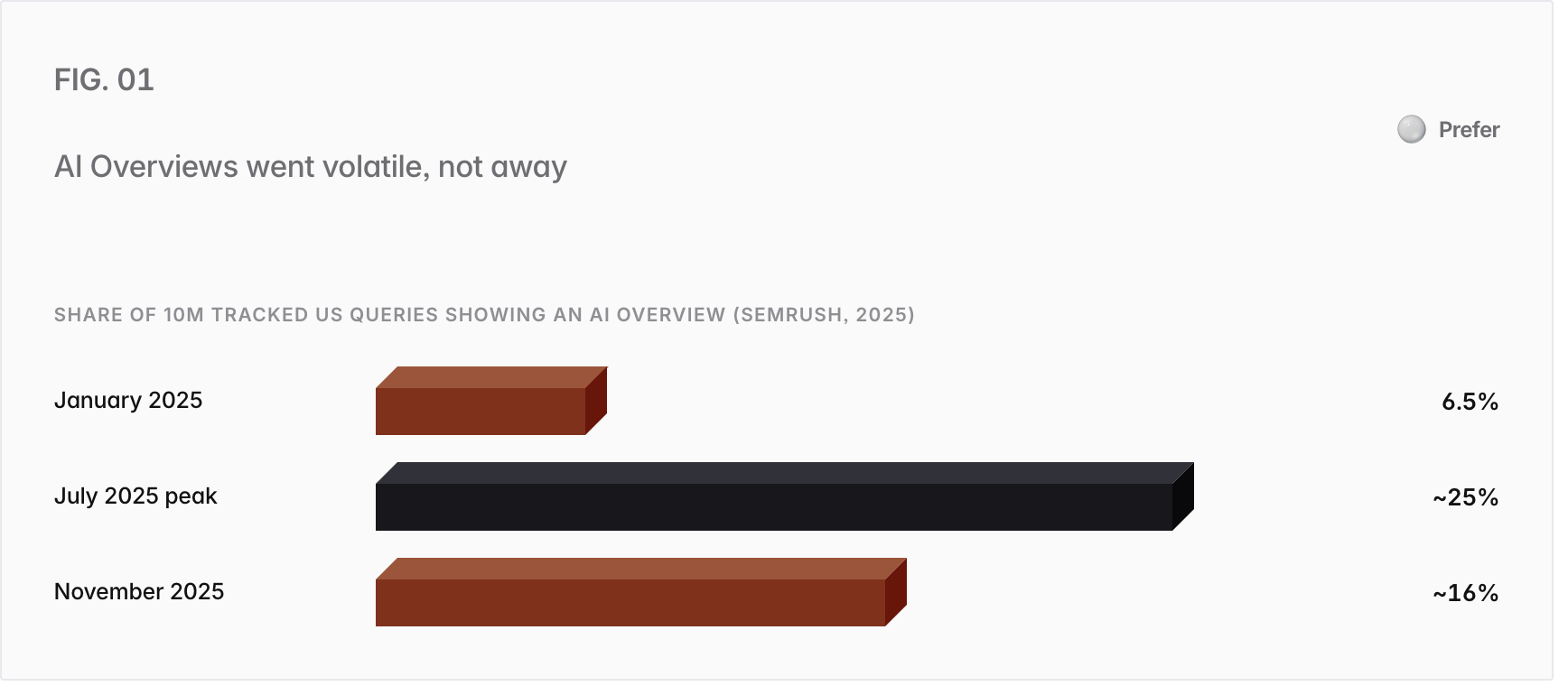
The takeaway for a brand: if your queries are commercial, your AI Overview exposure is most likely still rising, even while the headline trigger rate wobbles.
How Google assembles an AI Overview#
Google’s own documentation describes the mechanism plainly. For AI Overviews and AI Mode, Google may use a query fan-out technique, “issuing multiple related searches across subtopics and data sources,” to build one response with what it calls a wider, more diverse set of links than classic search (Google Search Central). Gemini then synthesizes the retrieved passages into the answer you see, with citations.
Two consequences follow, and they drive everything else in this guide.
First, you are not competing for one blue-link slot. Every fanned-out sub-query is a separate SERP you can win. A page that owns “easiest CRM to set up” can be cited on “best CRM for a small team” without ranking for it.
Second, the unit of competition is the passage, not the page. Gemini lifts the sentence or two that answers a sub-query most cleanly. A ranked page that buries its answer loses the citation to a lower-ranked page that states it plainly.
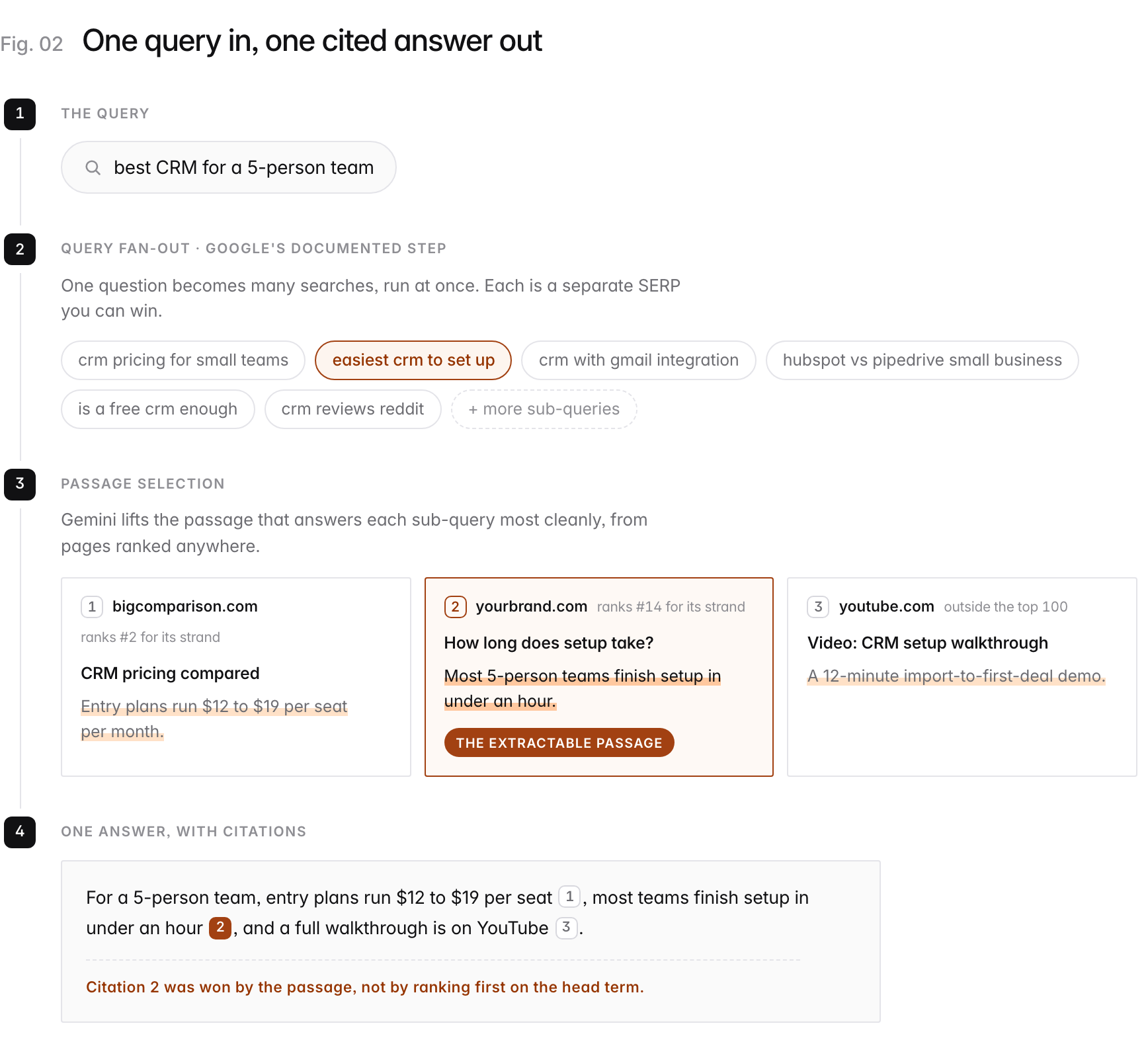
Ranking still matters, but page one stopped being the gate#
This is the finding that should reorganize your roadmap. In March 2026, Ahrefs checked 4 million AI Overview citations against 863,000 SERPs: 37.9% of cited pages ranked in the top 10, 31.2% ranked 11 to 100, and 31% ranked beyond the top 100. Their July 2025 study had the top-10 share at roughly 76%. In eight months, AI Overviews went from quoting page one to mostly quoting pages that page one shoppers would never see.
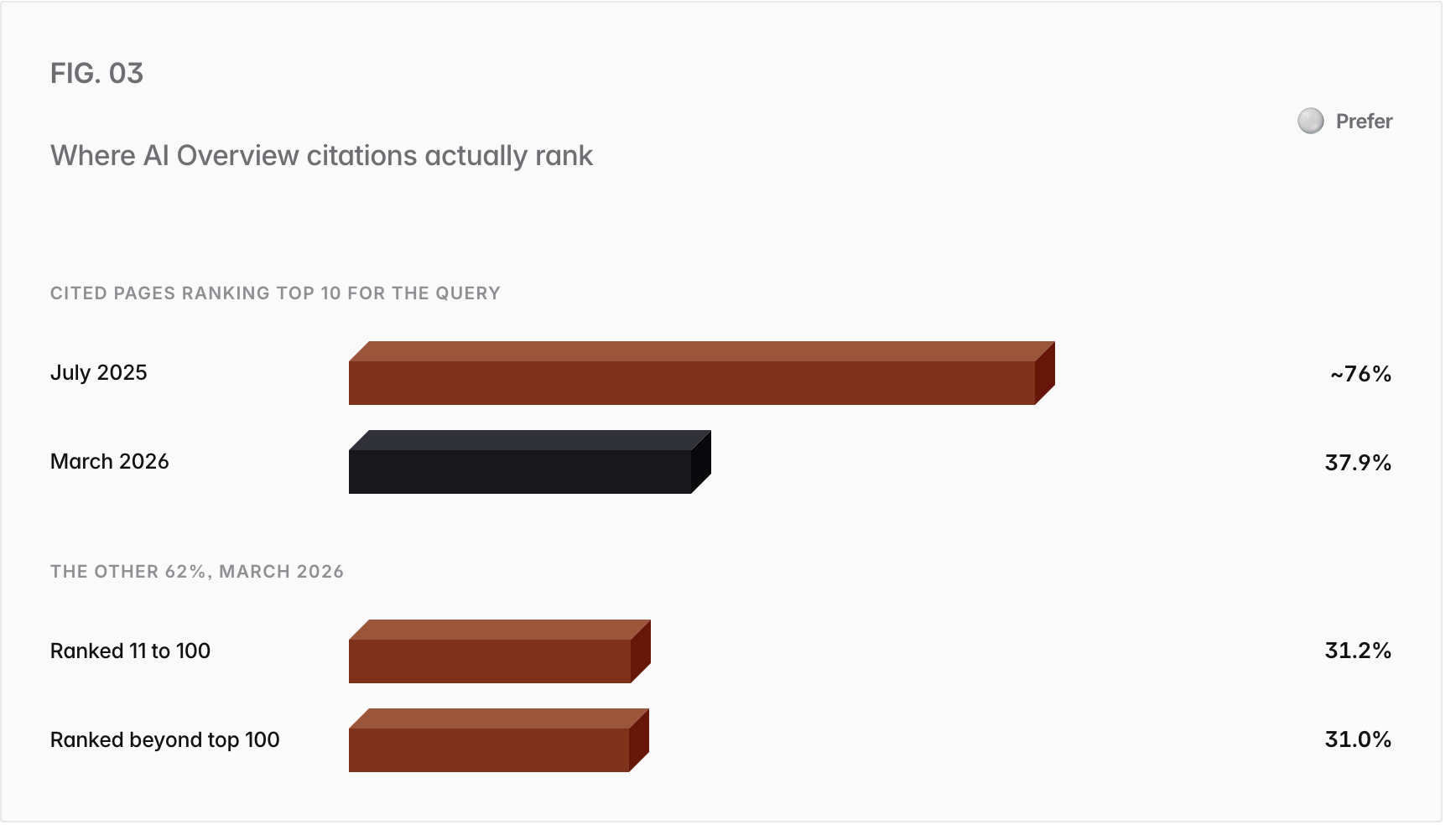
Why the collapse? Ahrefs attributes it to the fan-out: citations increasingly come from the SERPs of the sub-queries, where a specific page can rank even when it is invisible for the head term. Ahrefs also found that among cited pages that did not rank at all, 18.2% were YouTube URLs, which says something uncomfortable and useful: Google will happily cite a format you have not shipped yet.
The strategy that falls out is almost mechanical. Stop spending everything on moving position 6 to position 3 on the head term. Spend it on owning ten sub-queries with ten clean passages, because each one is a separate, winnable citation lottery ticket.
Fewer clicks make the citation the prize#
Be honest about what winning gets you. Pew Research tracked 900 US adults through 68,879 real searches: when an AI summary appeared, only 8% of visits clicked any traditional result, versus 15% without one. Links inside the summary were clicked on just 1% of visits, and sessions simply ended after the results page 26% of the time with a summary present, versus 16% without (Pew Research Center).
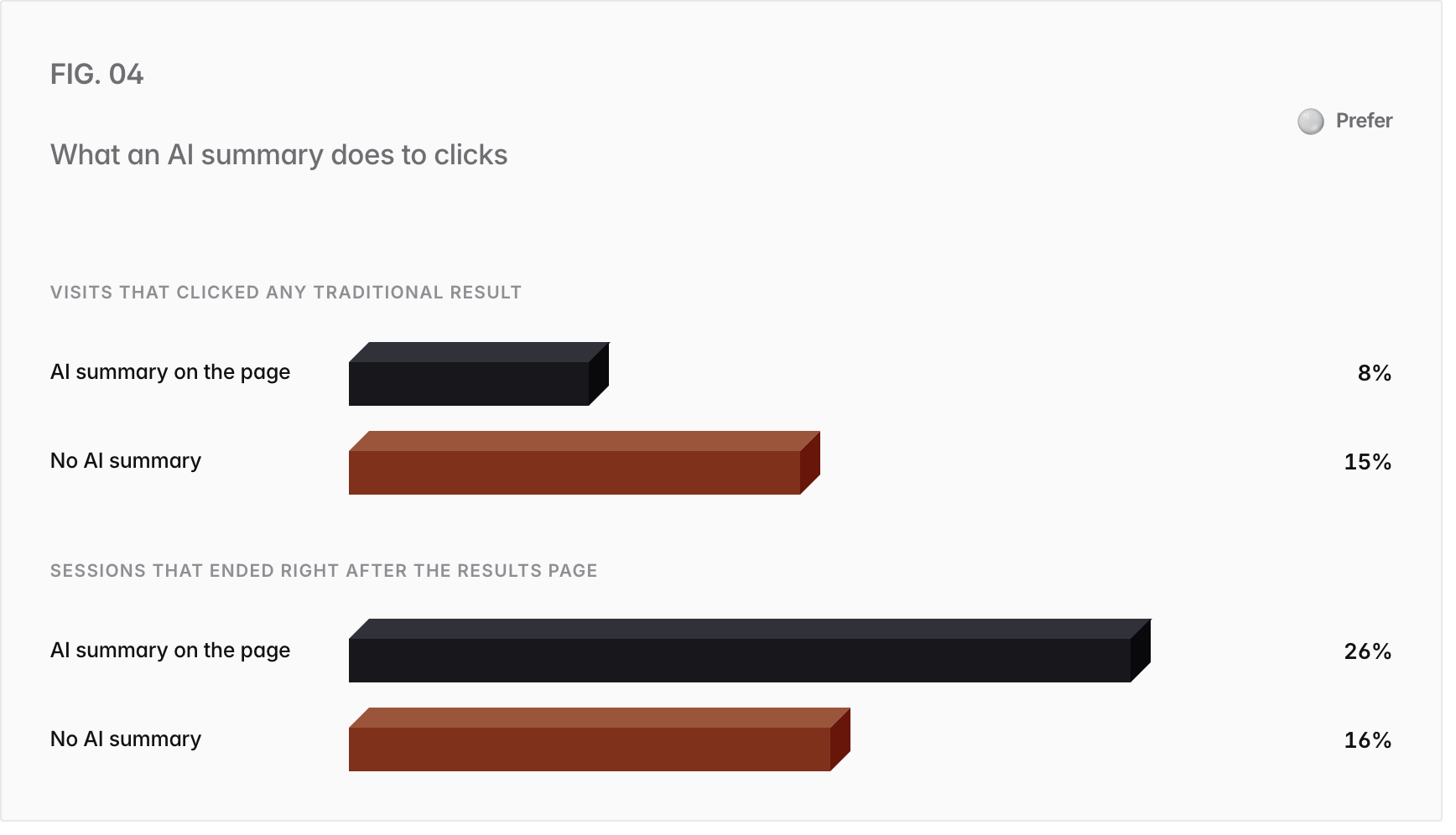
Google’s counterpoint is that clicks from AI Overview SERPs are higher quality, meaning users are more likely to spend more time on the site. Semrush’s matched-keyword data (via Search Engine Land) adds a wrinkle: zero-click rates on identical keywords actually fell slightly after an AI Overview appeared, from 33.75% to 31.53%. Both can be true. The traffic gets scarcer and more qualified, and the brand mention inside the answer becomes the impression that does the persuading. If the answer names you, you win the buyer who never clicks anything. That is why the citation is worth engineering for directly.
Four things within your control#
Eligibility gets you into the pool. The first two below shape which passage gets quoted, the third keeps your dates honest, and the fourth builds the corroboration off your site.
1. Passage-level answers#
Open every section with a one-sentence, self-contained answer directly under a question-shaped heading, then justify it. If the heading is “How much does X cost?”, the first sentence states the price. A useful test: copy the first sentence under each heading into a blank document. If it stands alone, it can be quoted alone. That is exactly how Gemini consumes it.
2. Coverage of the fan-out#
Enumerate the sub-queries before you write. Three free sources give you most of the map: the People Also Ask boxes on your target SERP, autocomplete completions of your head term, and the follow-up questions AI Mode asks when you probe it. Cluster them (pricing, setup, comparisons, integrations, objections) and give each cluster its own heading and extractable passage. One page covering ten sub-queries holds ten lottery tickets; see the query fan-out entry for how the decomposition works. Keep this work inside pages that already serve the reader. Google’s July 2026 guide warns against creating separate content for every variation of a search, fan-out queries included, when it is done “primarily to manipulate rankings or generative AI responses in Google Search”. That, it says, violates its scaled content abuse spam policy.
3. Visible, honest dates#
Show when the page was published and last updated, in text readers can see, and repeat both dates in Article markup (datePublished and dateModified). That is how Google recommends stating when a page was published and updated. Change the updated date only when you change the page. The schema generator produces clean Article markup.
Beyond that, schema is not a lever here. Google is explicit that its AI features need no special schema.org markup, and any markup you do use should match the visible text, which Google lists as a best practice for its AI features. FAQPage and HowTo no longer earn anything visible: Google stopped showing FAQ rich results on 7 May 2026 and How-to rich results in September 2023.
4. Corroboration on the surfaces Google already trusts#
A claim that exists only on your own site is one voice. The same claim on a review grid, a comparison listicle, a Reddit thread and a YouTube video is a consensus, and the retrieval layer sees the consensus. In Pew’s sample, Wikipedia, YouTube and Reddit alone accounted for 15% of the links inside AI summaries, and in our four-engine citation study, independent listicles took 40% of all 1,237 citations, ahead of vendors’ own sites at 34%. Off-page presence is not a separate channel from AI Overview optimization. It is half of it.
What does not move the needle#
Three popular moves that waste the quarter, so you can skip them.
- Blocking Google-Extended as an “opt-out.” It limits AI training and Gemini grounding, not whether you appear in AI Overviews. The real exit is Exclude in Search Console’s Search generative AI control; page-level nosnippet, max-snippet and noindex also work but shrink your normal Search presence.
- Schema as a trick. Markup on a page that buries its answers changes nothing. Google says its AI features need no special schema, and FAQPage markup has earned no rich result in Google Search since 7 May 2026.
- Chasing the head term only. The 62% of citations from outside the top 10 were earned on sub-query SERPs. A position-3-to-position-1 campaign on the head term competes for one citation; ten passages compete for ten.
The checklist#
Run this on one money page this week.
- Indexed, snippet-eligible, not excluded. Search Console shows the page indexed and Search generative AI set to Include (or inheriting Include from a parent property); no nosnippet, no restrictive max-snippet.
- Crawler access verified. Googlebot allowed in robots.txt, tested in the crawler access checker.
- Question-shaped headings. Each H2 or H3 matches a sub-query users actually ask.
- Answer-first passages. One self-contained sentence directly under every question heading.
- Fan-out mapped. People Also Ask, autocomplete and AI Mode follow-ups clustered; every cluster has a passage.
- Dates visible, honest and marked up. Published and updated dates shown in the HTML, and the same dates in Article structured data (datePublished, dateModified).
- Corroboration in motion. The page’s core claim placed or pitched on at least two third-party surfaces.
- A YouTube answer exists for the one sub-query where video wins, because 18.2% of non-ranking citations were YouTube.
- Re-test scheduled. The target questions re-run monthly, across engines.
AI Overviews and AI Mode are one system now#
Google documents both surfaces together and says both may use query fan-out, and since January 2026 a follow-up question asked from an AI Overview continues in AI Mode. AI Overviews are the summary on top of classic results; AI Mode is the full conversational surface where the follow-ups compound. Google also says the two “may use different models and techniques,” and they cite different pages: in our 13 September 2026 capture of 80 questions, on the 69 where both surfaces cited at least one source, only 32% of AI Mode’s sources (132 of 408) also appeared in the AI Overview for the same question (AI Overviews vs AI Mode). The work in this guide transfers directly, but check each surface separately. If your buyers ask comparison questions, read the AI Mode guide next: Google says AI Mode is “particularly helpful for queries where further exploration, reasoning, or complex comparisons are needed.”
Measure whether it worked#
AI Overviews vary by query, location and session, so anecdotes mislead in both directions. The reliable loop: fix a set of target buyer questions, re-run them on a schedule, and log when your brand or page is cited, on AI Overviews and on the other engines in the same pass. The engines barely overlap. In our study, only 5 of 713 cited domains appeared on all four engines we tested, and about 75% were cited by a single engine, so a Google-only view tells you almost nothing about ChatGPT or Perplexity. That cross-engine log, tied to which AI crawlers actually fetch your pages, is exactly what Prefer automates. Run a free AI visibility audit to get your baseline across every surface in about 15 minutes, or start with the wider view in what GEO is.
People also ask