
You get cited by ChatGPT by winning three separate routes: the model’s memory, live browsing (widely reported to draw on Bing’s index), and the ChatGPT Search index crawled by OAI-SearchBot. Most advice treats ChatGPT like a search engine you rank in. It is only partly that. In our citation study, ChatGPT answered a majority of buyer questions without touching the live web, which means the deciding work often happened months before the question was asked. This guide covers the mechanics of all three routes, the data on what ChatGPT actually cites, and a 7-day checklist.
How ChatGPT finds and cites content#
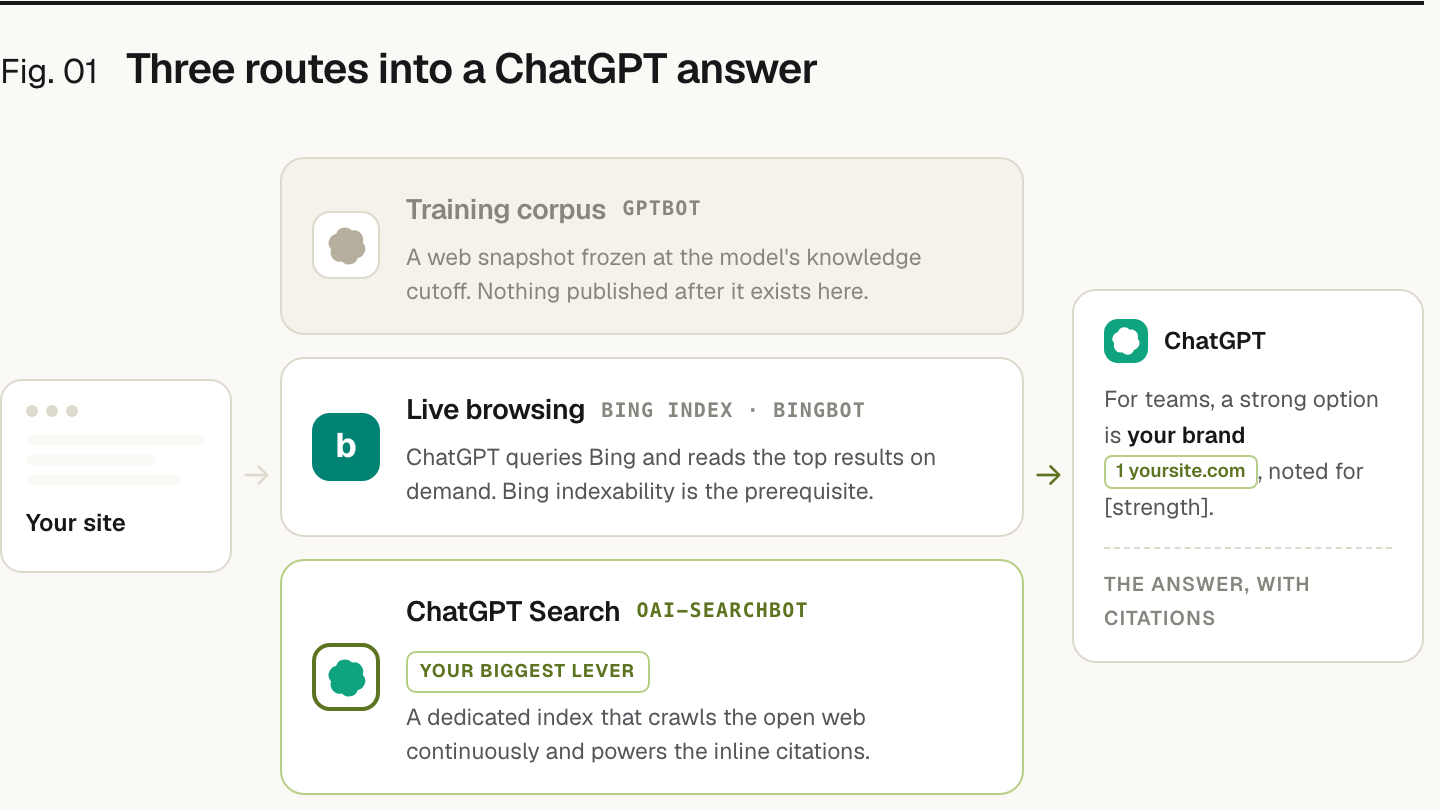
ChatGPT does not have a single index. An answer reaches you by one of three routes, each with its own crawler and its own rules, and most advice conflates them. Prefer tracks the outcome on your buyer prompts: whether ChatGPT names you, and which pages it cites when it does.
The first route is the training corpus, the web snapshot the model learned from, gathered by GPTBot and frozen at a knowledge cutoff. Nothing published after the cutoff exists here, and nothing here is read live at answer time.
The second route is live browsing. When ChatGPT decides to browse, it fetches pages from the live web. Many SEO guides say it draws those results from Bing’s index; OpenAI’s crawler documentation does not mention Bing, so treat that as a widely repeated claim rather than a documented rule. Being indexed on Bing costs little, which makes Bing Webmaster Tools a sensible hedge.
The third route is ChatGPT Search, the retrieval system behind the inline citations, indexed by OpenAI’s own crawler, OAI-SearchBot. OpenAI documents that sites opted out of OAI-SearchBot are not shown in ChatGPT search answers. This is the route your robots.txt controls directly, and the one where page structure pays off fastest.
If you only do one thing after reading this guide: confirm OAI-SearchBot is allowed in your robots.txt, then check your key pages are indexed on Bing as a cheap hedge. Those are the two things you control this afternoon. Our crawler access checker reads the robots side for you.
The route most advice ignores: memory#
Here is the finding that should reorganize how you think about ChatGPT. When we asked ChatGPT 47 real buyer questions in July 2026, it skipped live web search on 29 of them and answered from memory, usually citing nothing at all. No retrieval, no citations, just the model’s beliefs about the category, formed at training time.
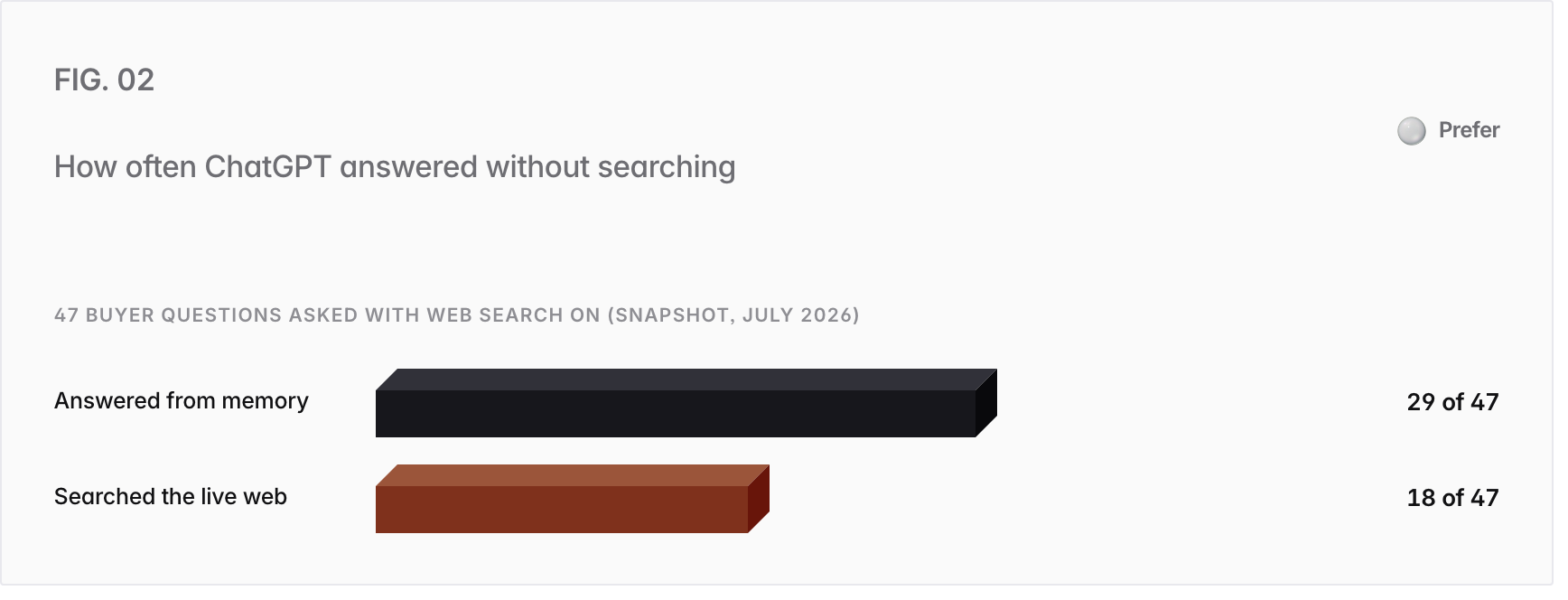
The mix will shift with every model release; the planning rule survives: for memory answers, the contest was decided before the question was asked. What the model carries into the conversation is the training-era record: your entity, your category, your claims, as they appeared across the web it learned from. Two consequences follow.
First, entity clarity is ChatGPT optimization. If your site, LinkedIn, G2, Crunchbase and the articles about you describe you in consistent terms, the model learns one crisp fact. If every surface says something different, it learns a blur, and blurs do not get recommended.
Second, the off-site record is the memory route’s input. The same study found ChatGPT cited vendors’ own sites at the lowest rate of the four engines we measured. Third-party evidence, roundups, reviews, communities, is what it repeats. That work compounds slowly and cannot be rushed the week before a launch, which is exactly why it is defensible.
When ChatGPT does search, it reaches for communities#
The second data point that should shape your roadmap: what ChatGPT cites when it does retrieve. In our August 2026 measurement of 25 B2B software buyer queries, Reddit was ChatGPT’s single most-cited source, about 30% of all source citations, ranked first on every query we tested, and more than double second-place Wikipedia at roughly 14%. Established tech media followed: TechRadar near 10%, Forbes at 7%.
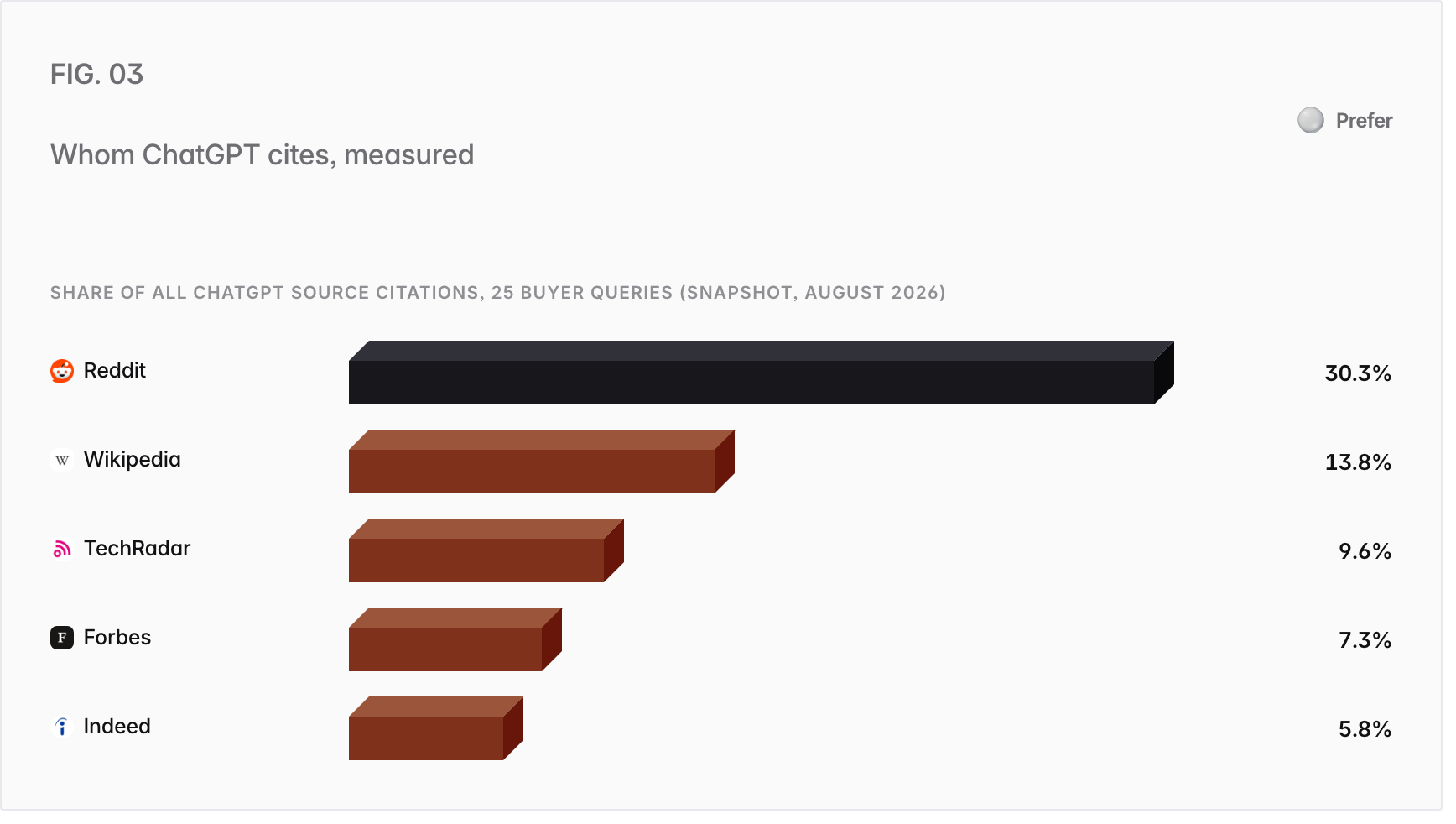
Read this as a where-to-show-up list, in priority order. Communities first: genuine, useful participation in the Reddit threads your buyers actually read, because that surface leads by a wide margin and cannot be bought. Neutral references second: the Wikipedia-grade and media sources ChatGPT trusts are earned through real notability and PR, not markup. Roundups third: the best-X listicles that dominate cross-engine citations in the wider study. Authentic presence at scale, never automated posting; faked community activity is both detectable and reputation-fatal.
What makes a page quotable, on the routes that read pages#
When ChatGPT retrieves, structure decides which passage gets lifted. Four practices cover it.
Answer first, under question-shaped headings. Open every section with one sentence that answers the heading’s question completely, then justify it. A useful test: if the first sentence under each heading can stand alone in a blank document, it can stand alone in an AI answer.
Mark it up. FAQPage schema turns each question-answer block into a machine-readable unit, and Article with datePublished, dateModified and a real author carries the freshness and credibility fields. Generate clean markup with the schema generator. Markup does not rescue a buried answer; it labels a clean one.
Keep dates honest and current. Queries with implied recency filter hard for fresh, dated content. Refresh time-sensitive pages on a real cadence and show the updated date visibly. Re-stamping an unchanged page is a trust expense, not a trick.
Build the cluster, not the one perfect page. A site with a connected set of pages on a topic, definitions, comparisons, how-tos, internally linked, reads as a source worth citing. One orphan page, however good, competes alone.
The 7-day checklist#
Ordered; earlier days unlock later ones.
- Day 1: robots.txt. Confirm
OAI-SearchBotandBingbotare allowed; make a deliberate call onGPTBot(blocking it is a rights decision that also weakens the memory route). Verify with the crawler access checker. - Day 2: Bing. Submit your sitemap in Bing Webmaster Tools; confirm your money pages are indexed.
- Day 3: schema.
Articleon your top five pages, plusFAQPageonly where a page has a real FAQ block, validated. - Day 4: first sentences. Rewrite the opening line under every heading on those pages into a self-contained answer.
- Day 5: entity pass. Same description, category and key facts on your site, LinkedIn, G2, Crunchbase and the directories that matter in your category.
- Day 6: community map. List the Reddit threads and communities where your buyers ask questions; start showing up usefully, without links, until you have standing.
- Day 7: measurement. Fix 25 to 50 real buyer prompts and re-run them on a schedule across ChatGPT and the other engines.
Measure it across engines, not just ChatGPT#
ChatGPT answers vary by session and drift with every model update, so single checks mislead in both directions; the trend on a fixed prompt set is the signal. And ChatGPT alone is not the picture: in our study the engines barely shared sources, so a brand can be strong here and invisible on Perplexity or Google AI Overviews. The cross-engine loop, your buyers’ questions, every surface, on a schedule, tied to which AI crawlers actually fetch your pages, is what Prefer automates, and it is the same instrument behind the studies referenced above. Run a free AI visibility audit to see where ChatGPT and the other engines stand on your brand today, or start with the umbrella view in how to show up in AI search.
People also ask
- How do I get my website cited by ChatGPT?
- Does ChatGPT use Bing search results?
- Why does ChatGPT answer without searching the web?
- What sources does ChatGPT cite most?
- Can I submit my website to ChatGPT?
- Should I block GPTBot or OAI-SearchBot?