How to appear in Google AI Mode in 2026

A specific guide to getting cited in Google AI Mode: how its wider query fan-out works, how it differs from AI Overviews, and a checklist to run this week.

Javed Khatri Javed Khatri Co-founder, Prefer

5 min read How-to guide

The short answer

What is Google AI Mode and how is it different from AI Overviews?

Google AI Mode is conversational search on the same index as regular Search, powered by Gemini and a wider query fan-out than AI Overviews. You appear the way you earn an AI Overview citation, owning the sub-queries with extractable, corroborated passages, plus one new job: staying relevant across follow-up turns.

Key takeaways

  • AI Mode is a separate conversational tab in Google Search, powered by Gemini, that answers with a synthesized response and a small set of cited links instead of a results page.
  • It runs the same query fan-out technique as AI Overviews but wider: one question becomes many sub-queries searched in parallel, so passage-level answers to specific sub-questions are what get retrieved.
  • It draws on Google's main Search index via Googlebot. If you are indexed and rank for the sub-queries, you are eligible; there is no separate submission or opt-in.
  • Citations in AI Mode are fewer and more selective than ten blue links, so the gap between being cited and being invisible is larger than it ever was in classic search.
  • Conversations run in turns. Brands that survive follow-up questions (pricing, alternatives, objections) with their own extractable answers keep their place as the thread narrows.

Google AI Mode is a conversational search surface built on the same index as regular Google Search, powered by Gemini, and assembled by a much wider query fan-out than AI Overviews. You do not submit to it and you cannot buy your way in. You earn a place the same way you earn an AI Overview citation, by owning the sub-queries with extractable, corroborated passages, plus one new requirement AI Overviews never had: surviving the follow-up questions, because AI Mode is a conversation, not a single answer. This guide covers how AI Mode picks its sources, how it differs from AI Overviews, and the checklist to run this week.

How AI Mode assembles an answer#

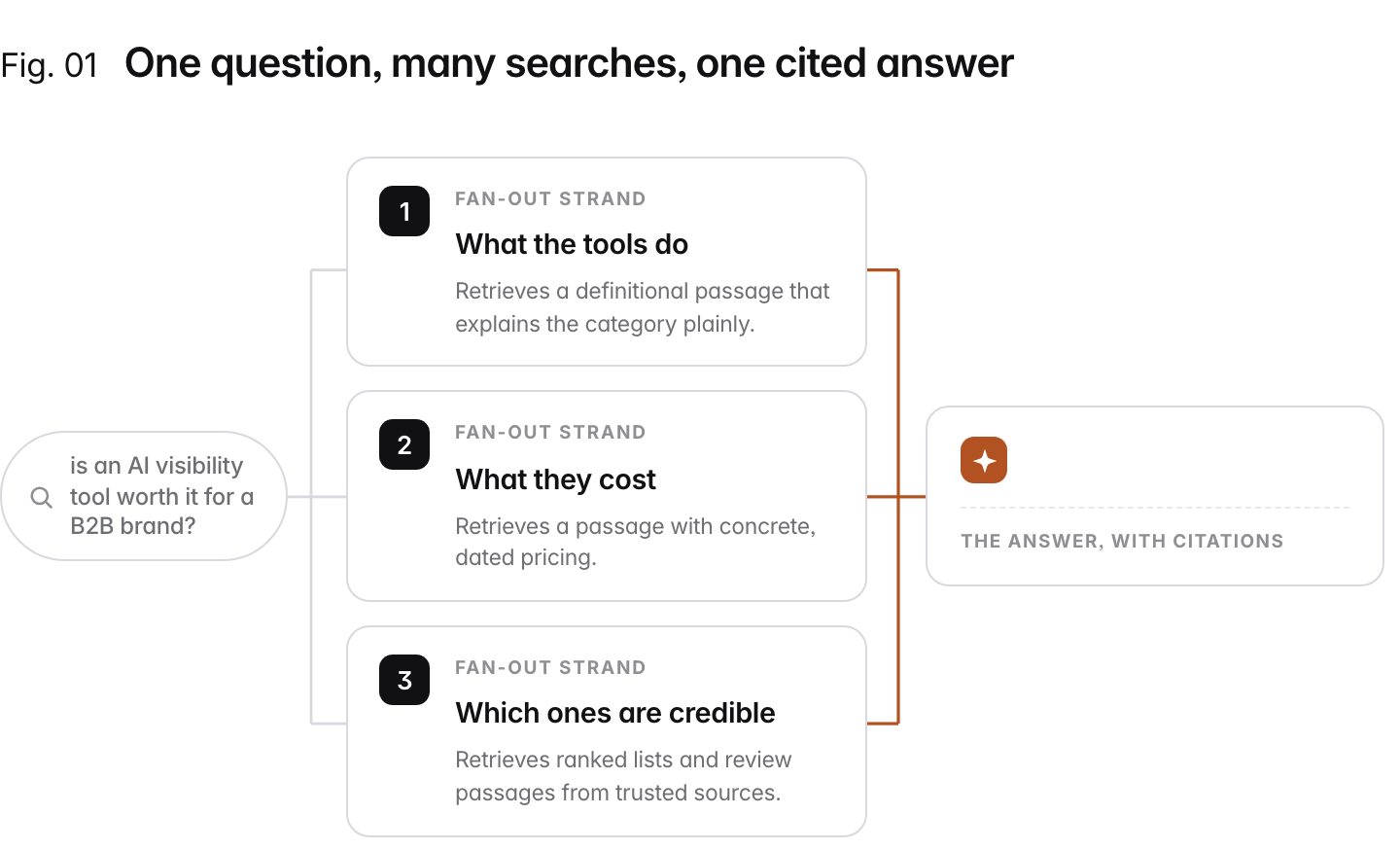
When you ask AI Mode a question, it does not run one search. It decomposes the question into sub-queries, searches Google’s index for each in parallel, selects the passages that answer each sub-query best, and has Gemini synthesize one response with a small set of cited links. Google describes this as query fan-out, the same technique behind complex AI Overviews, run at greater width in AI Mode.

Flow diagram: "is an AI visibility tool worth it for a B2B brand?" fans out into 3 strands: 1. What the tools do (Fan-out strand): Retrieves a definitional passage that explains the category plainly.; 2. What they cost (Fan-out strand): Retrieves a passage with concrete, dated pricing.; 3. Which ones are credible (Fan-out strand): Retrieves ranked lists and review passages from trusted sources., converging into undefined.
How AI Mode fans one question into parallel sub-query searches and synthesizes one cited answer. Each strand retrieves the passage that answers it best, so specific pages beat broad ones. Conceptual diagram based on Google's public description of query fan-out.

The strategic consequence is the same one we documented for query fan-out generally: retrieval happens at the sub-query level, so you can be cited in answers to questions you could never rank for. The visible question may belong to big brands; its sub-queries usually do not.

AI Mode vs AI Overviews: what actually changes#

The fundamentals overlap almost completely, which is good news if you have already done the AI Overviews work. Three things genuinely change.
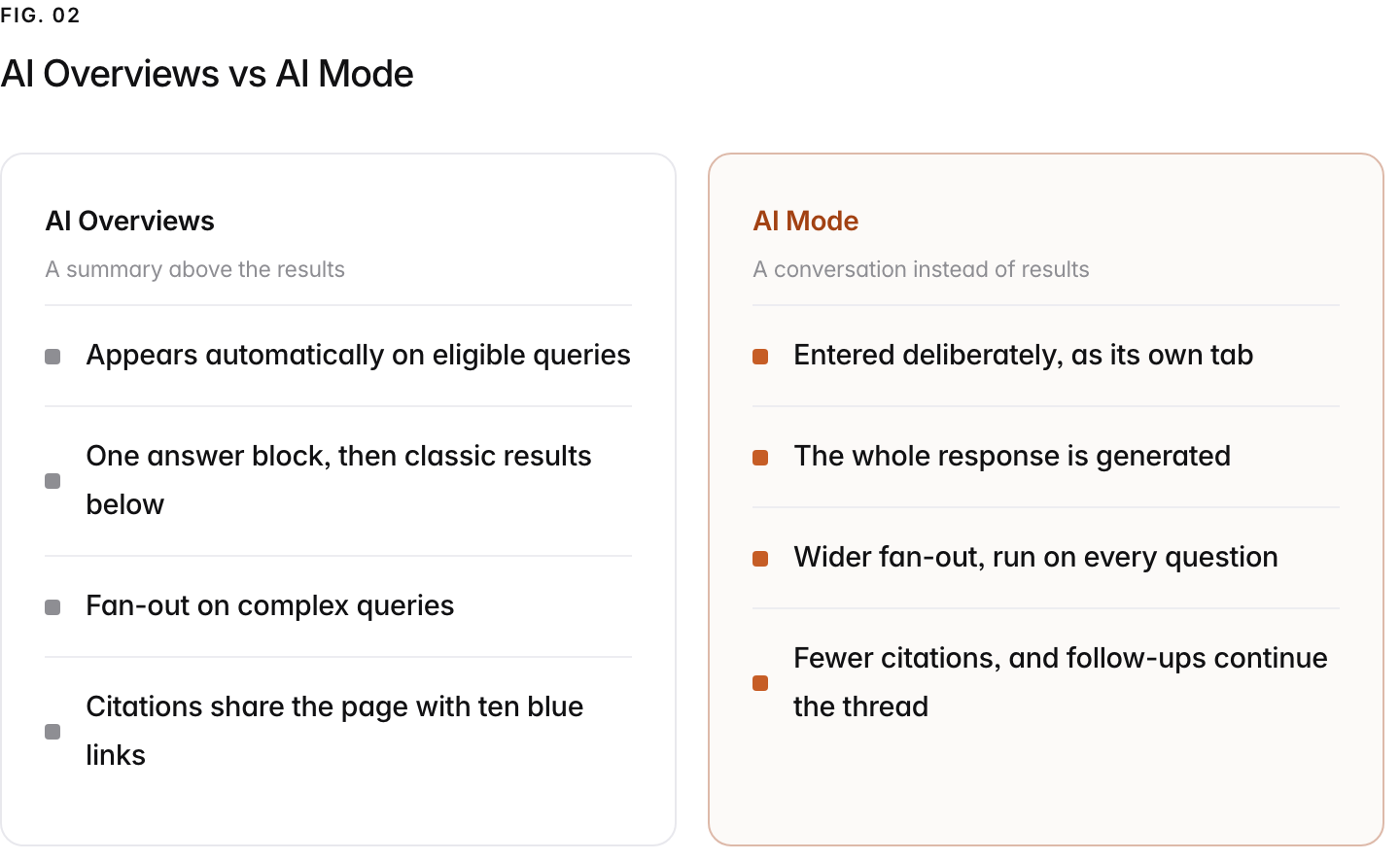
Two columns. AI Overviews, a summary above the results: Appears automatically on eligible queries, One answer block, then classic results below, Fan-out on complex queries, Citations share the page with ten blue links. AI Mode, a conversation instead of results: Entered deliberately, as its own tab, The whole response is generated, Wider fan-out, run on every question, Fewer citations, and follow-ups continue the thread.
What changes between AI Overviews and AI Mode: the surface, the width of the fan-out, and the multi-turn conversation. The optimization fundamentals, extractable passages, sub-query coverage, corroboration, overlap almost completely. Conceptual comparison.

First, citations get scarcer. An AI Mode answer cites a handful of sources where a results page listed ten, so the gap between cited and invisible widens. Second, the fan-out gets wider, which rewards sites that cover a topic’s sub-questions thoroughly rather than one head page. Third, the conversation continues. A buyer’s second and third questions, what does it cost, what are the alternatives, what breaks when I switch, are new retrievals. Brands with extractable answers to the follow-ups stay in the thread; brands with only a head-term page drop out after turn one.

The four signals that win a citation#

The signals are the ones that decide every grounded answer, tuned for AI Mode’s width.
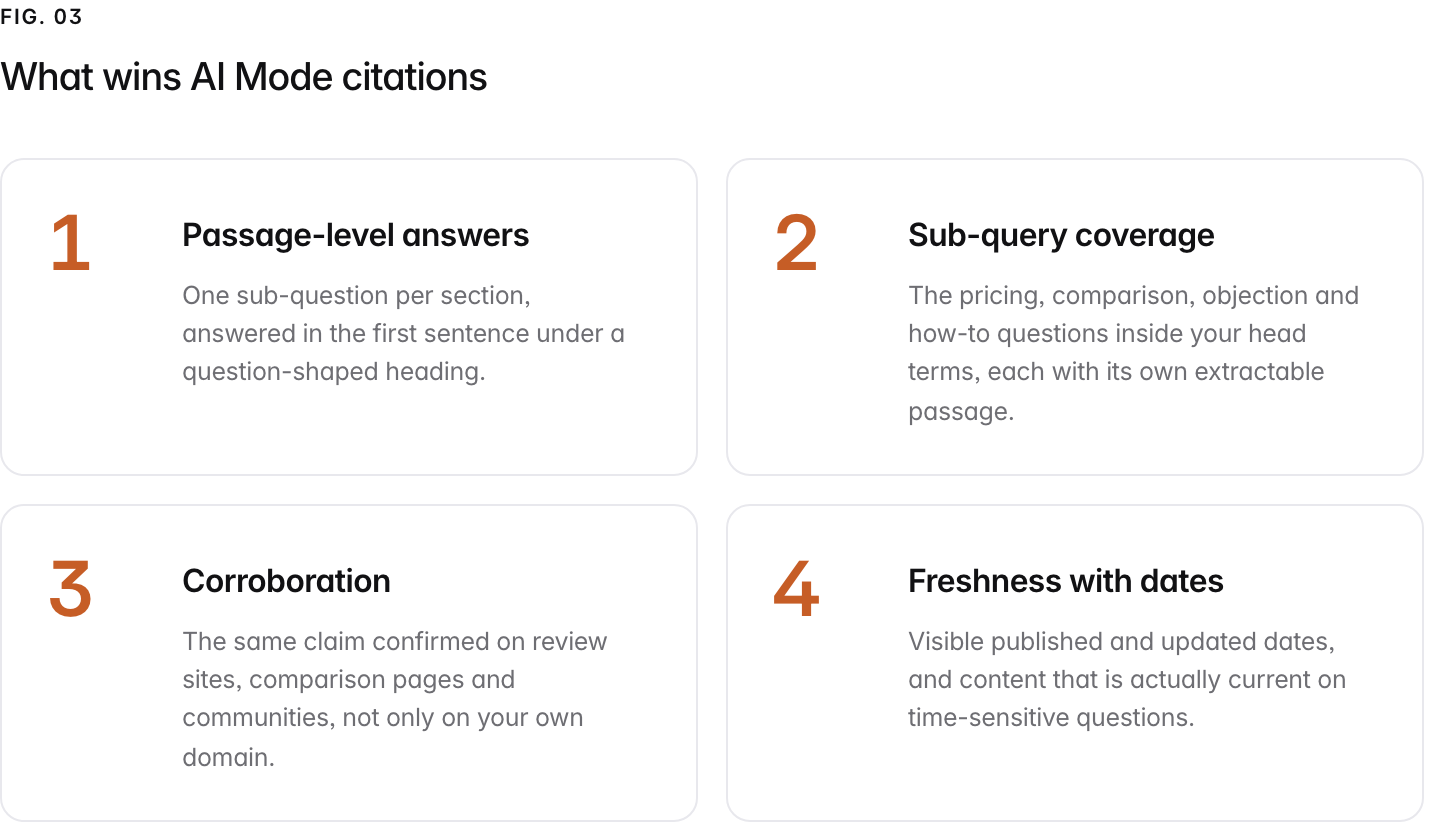
Summary graphic of 4 items: 1. Passage-level answers: One sub-question per section, answered in the first sentence under a question-shaped heading. 2. Sub-query coverage: The pricing, comparison, objection and how-to questions inside your head terms, each with its own extractable passage. 3. Corroboration: The same claim confirmed on review sites, comparison pages and communities, not only on your own domain. 4. Freshness with dates: Visible published and updated dates, and content that is actually current on time-sensitive questions.
The four signals that win AI Mode citations: self-contained passages, coverage of the fanned-out sub-queries, corroboration across sources, and visible freshness. Conceptual summary.

Run the checklist#

The six steps in the panel above are the operational version of this guide: confirm indexation, map the fan-out for your money questions, answer one sub-question per section with the answer first, add schema and visible dates, earn corroboration off-page, and cover the follow-up questions before tracking a fixed prompt set on a schedule.

Two of those steps are where most teams stop short. Mapping the fan-out is genuinely new work, and our query fan-out entry shows how to infer the sub-queries from what answers cover. And corroboration is off-page work, the same third-party sources that decide AI Overviews citations and ChatGPT answers alike, which no on-site edit can substitute for.

Measure it, per prompt, across engines#

AI Mode answers vary by session, location and conversation history, so anecdotal checks mislead. The reliable read is a fixed prompt set, re-run on a schedule, recording who gets named and which sources get cited, on AI Mode and beside it on ChatGPT, Perplexity, Claude, Gemini and AI Overviews, because every surface picks different sources for the same question. That is the measurement loop Prefer runs, and the free audit shows your baseline across engines before you change anything. Run the free audit and you will know which sub-queries you already own, and which ones this checklist should target first.

People also ask

  • What is Google AI Mode and how is it different from AI Overviews?
  • How do I get my website cited in Google AI Mode?
  • Does Google AI Mode use the same index as Google Search?
  • Can I opt out of Google AI Mode?
  • Does ranking in Google Search mean appearing in AI Mode?

Frequently asked questions.

Updated 26 August 2026

What is Google AI Mode?

Google AI Mode is a conversational search surface inside Google Search, rolled out broadly from 2025, that answers questions with a Gemini-generated response and cited links instead of a page of results. It supports follow-up questions in a thread and runs a wider query fan-out than AI Overviews, searching many sub-queries in parallel to assemble one answer.

How is AI Mode different from AI Overviews?

AI Overviews are a summary block that appears above classic results for eligible queries. AI Mode is a full conversational surface: you enter it deliberately, the whole response is generated, follow-ups continue the thread, and the fan-out behind it is wider. The optimization fundamentals overlap almost completely; AI Mode adds the multi-turn dimension and cites fewer sources per answer.

How do I get my website cited in Google AI Mode?

The same way you earn an AI Overview citation, with more emphasis on specificity: be indexed by Googlebot, rank for the sub-queries your buyers' questions fan out into, answer each sub-question in a self-contained passage under a question-shaped heading, add FAQPage and Article schema with visible dates, and earn corroboration on third-party sources. There is no submission form and no AI Mode-specific markup.

Does Google AI Mode use the same index as Google Search?

Yes. AI Mode draws on Google's main Search index via the normal Googlebot crawl, which is why indexation is the prerequisite and why blocking Googlebot removes you from AI Mode and classic Search alike. Google-Extended is a separate control governing Gemini model training, not AI Mode retrieval.

Can I opt out of Google AI Mode?

Only by blocking Google Search entirely. Because AI Mode is part of Search and uses the same index, there is no separate opt-out that keeps your classic rankings while removing you from AI Mode answers. For most brands the practical question is the opposite one: how to be the source it cites.

Does ranking first in Google mean I will appear in AI Mode?

No. Ranking for the underlying sub-queries makes you eligible, but AI Mode cites a small set of sources per answer and picks passages, not positions. A page that answers one sub-question cleanly can be cited ahead of a bigger site that ranks higher but buries the answer, and the reverse happens too.

How do I measure my brand's visibility in AI Mode?

Track a fixed set of buyer prompts on a schedule and record when your brand is named or cited, alongside the same prompts on ChatGPT, Perplexity, Claude, Gemini and AI Overviews, because each surface cites different sources. That cross-engine prompt tracking is what a tool like Prefer runs, with the source-level view showing which pages actually earn the citations.

Get your free AI visibility report
in about 10 minutes.

See how answer engines describe your brand today, and where the openings are to outpace the competition.