Glossary
Query fan-out one prompt, many hidden searches.
Query fan-out is how AI search splits one prompt into hidden sub-queries: 4.8 per ChatGPT question in Prefer's log. How to win citations at that level.

Query fan-out is how AI search splits one prompt into many hidden sub-queries, retrieves sources for each, and merges them into one cited answer. Prefer logged a mean of 4.8 per ChatGPT question.
Query fan-out is the technique AI search systems use to split one prompt into many hidden sub-queries, retrieve sources for each, and merge the results into a single cited answer. Google described it publicly in 2025 as a core mechanism of AI Mode, and the same pattern runs under AI Overviews on complex questions and under the deep research modes of ChatGPT, Gemini, and Perplexity. It is measurable: Prefer logged it on ChatGPT across 47 grounded buyer questions and counted 224 hidden sub-queries, a mean of 4.8 per question, 54% of them site-scoped checks of specific vendor domains. It changes what you are optimizing for: not the question the user typed, but the set of questions the engine asked on their behalf.
How query fan-out works#
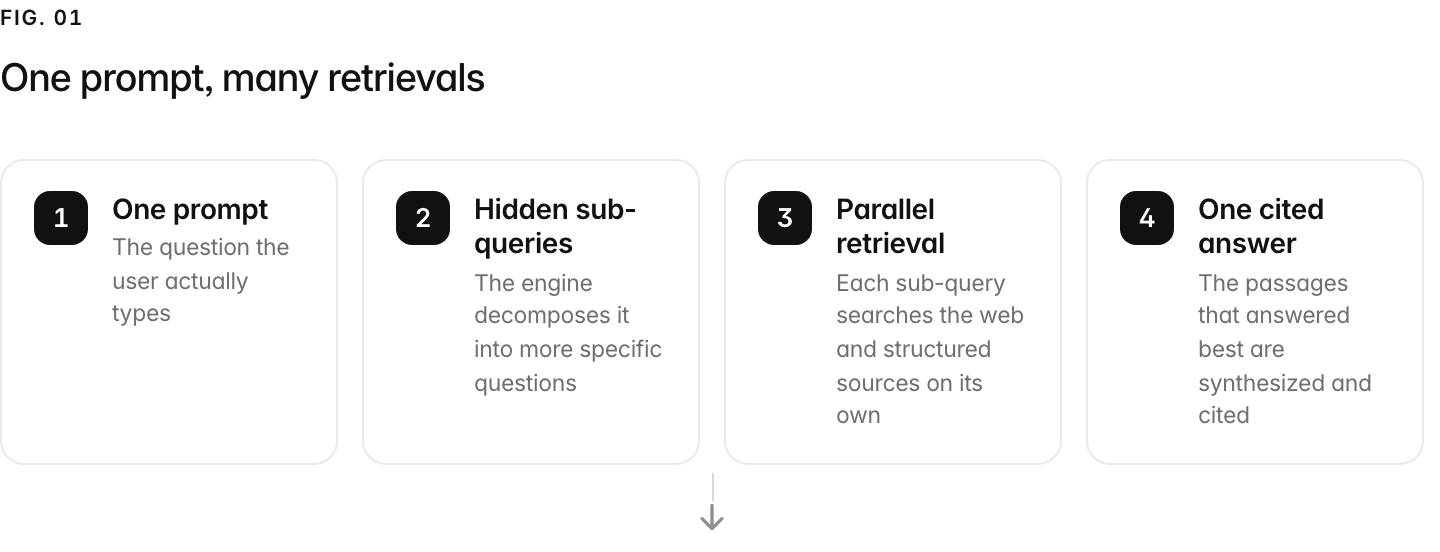
The flow is the same across engines, even when the labels differ:
- Decompose. The model breaks the prompt into subtopics. “Best CRM for a 10-person agency” might become sub-queries about pricing tiers, integrations, ease of onboarding, and named tools in that segment.
- Search in parallel. Each sub-query runs as its own retrieval, across the open web and any structured sources the engine has (a knowledge graph, product feeds, maps data).
- Read and select. For each sub-query the engine pulls the passages that answer it most directly. This grounding step is where a page wins or loses: the retrieved passage has to answer the sub-question on its own.
- Synthesize and cite. One answer is written from all the retrieved material, citing the handful of sources that survived selection.
Why query fan-out matters for AI visibility#
Retrieval happens at the sub-query level, so you can be cited in answers to questions you could never rank for. The sub-queries also skew verifiable: in our logged run, 36% contained the word “official”, the engine actively hunting for an authoritative owned page before recommending anyone. The visible head query may belong to the biggest brands in your category. Its sub-queries usually do not. A page that answers one specific question cleanly (“what does per-seat CRM pricing look like for small agencies”) can be pulled into the synthesized answer for the head query, even though that page would sit on page four of a classic search for it.
The reverse is also true. A page that tries to cover everything often answers no single sub-query directly, so it loses every retrieval to more specific pages.
Query fan-out vs RAG#
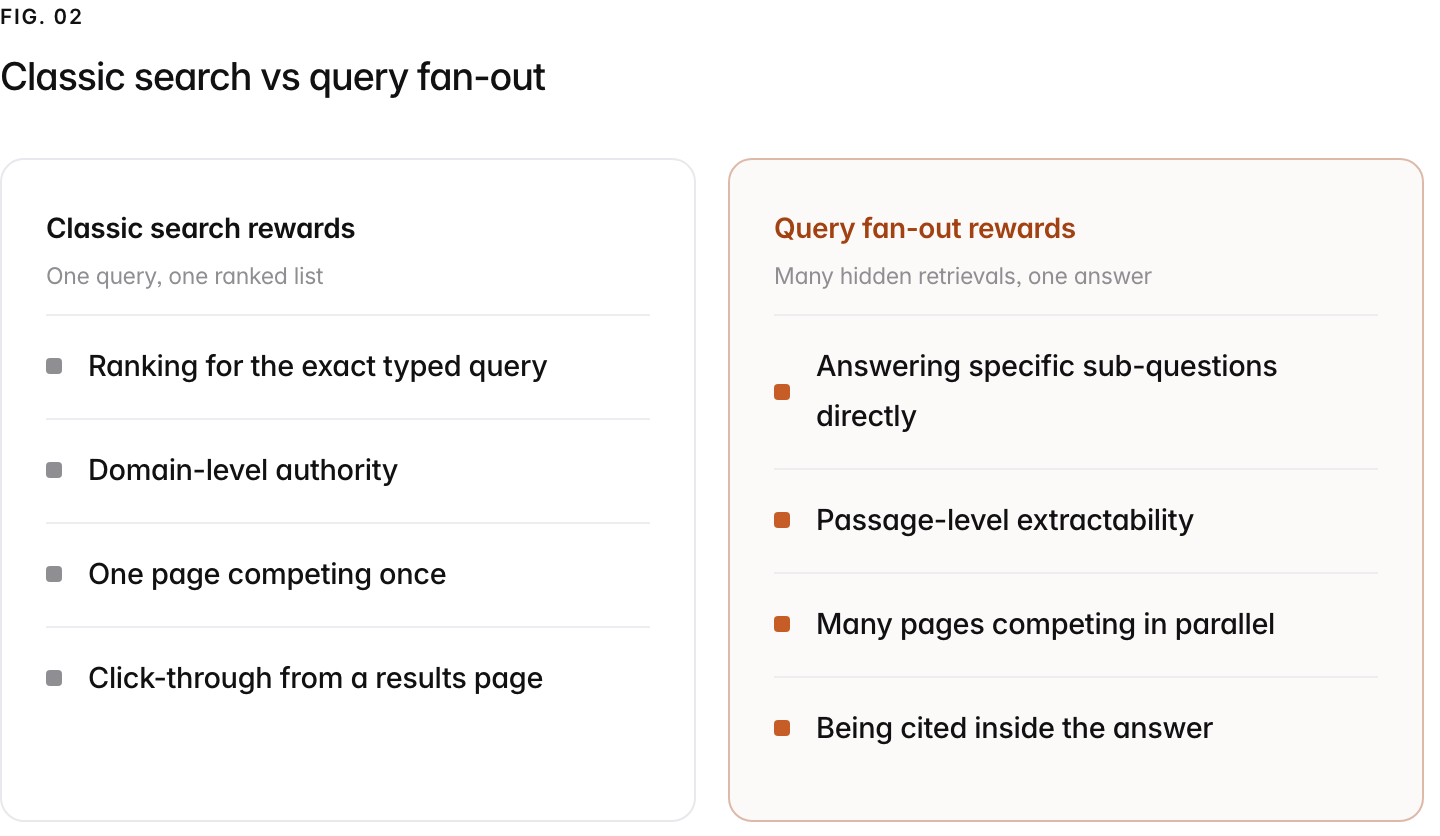
Retrieval-augmented generation (RAG) is the general pattern of a model searching for material before it writes. Query fan-out is a specific retrieval strategy inside that pattern: instead of one search per prompt, the engine multiplies the prompt into several searches. If RAG is “look it up, then answer,” query fan-out is “look up every part of it, then answer.”
Example#
Ask Google AI Mode “is an AI visibility tool worth it for a mid-market B2B brand?” The answer that comes back covers what the tools do, roughly what they cost, and named vendors, three different retrievals stitched together. A pricing page with a clear, dated table can win the cost sub-query. A plain-language explainer can win the definition sub-query. Neither page ranks for the head question anywhere, yet both can end up cited in its answer.
How to optimize for query fan-out#
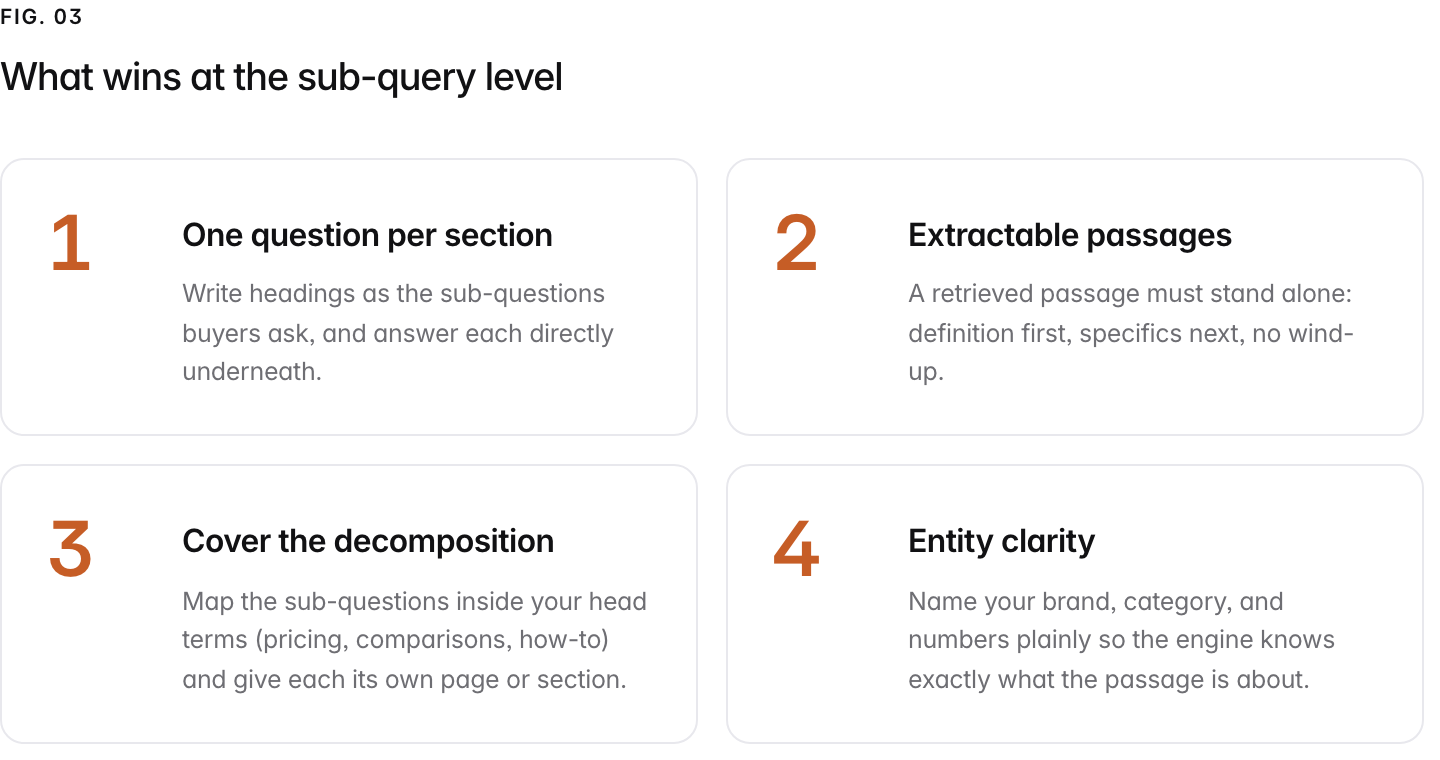
The levers are the core of generative engine optimization: structure content so an answer engine can lift a passage that answers one sub-question completely, then earn the authority signals that make the engine trust it. Our guides to appearing in Google AI Mode and Google AI Overviews apply the same logic to Google’s surfaces.
How Prefer helps with query fan-out#
Prefer tracks which prompts cite you across ChatGPT, Gemini, Perplexity, and Google’s AI surfaces, and finds the sub-questions where competitors are cited and you are not, then writes the content to close the gaps; Prefer Managed also does the off-page work. Run a free AI visibility audit to see where you stand.
In context
The term in a sentence.
Related questions
People also ask.
- What is query fan-out in Google AI Mode?→
- How do I optimize content for query fan-out?
- Can I see the sub-queries an AI engine runs?
Questions
Asked plainly.
What is query fan-out in simple terms?
When you ask an AI engine one question, it quietly asks several more specific questions behind the scenes, searches for each of them, and combines what it finds into one answer. Prefer logged that behind-the-scenes step, called query fan-out, on ChatGPT: 224 hidden sub-queries across 47 grounded buyer questions, a mean of 4.8 each.
Why does query fan-out matter for AI search visibility?
Because retrieval happens at the sub-query level, not the visible query. Prefer finds the sub-questions where competitors are cited and you are not, then writes the content to close those gaps. A page that clearly answers one specific sub-question can get cited in answers to a big head query it could never rank for on its own. The head term may be dominated by large brands while its sub-queries are wide open.
How is query fan-out different from a normal Google search?
A normal search runs your query once and returns a list of links. Query fan-out runs many related searches on your behalf, reads the results, and returns one synthesized answer with citations, a mean of 4.8 searches per question in Prefer's ChatGPT study. You never see the intermediate searches, only the sources that survived them.
Can I see which sub-queries an AI engine ran?
Mostly no, but Prefer shows the sources each engine cited, which are the pages that survived those hidden searches. Google's AI Mode and most assistants keep sub-queries hidden. You can infer them by studying what the answer covers (each distinct fact or angle usually maps to a retrieval), and some research tools surface likely fan-out queries for a prompt.
Keep reading