
When you ask ChatGPT a question, it does not search for your question. It rewrites your question into a handful of its own searches, then builds the answer from whatever those return. That rewriting step is called query fan-out, and it is the part of AI search almost nobody optimizes for.
I wanted to see it happen, so I logged it. On one day I sent 50 real buyer questions to ChatGPT with web search on, and captured the actual sub-queries it ran against the web for each one. 47 of the 50 answers came back grounded, and those 47 produced 224 sub-queries. This post is what they showed, and what I changed in our own playbook because of it.
The single most useful finding: your content is retrieved by the fan-out, not by the prompt. If you only write a page that matches the words the buyer typed, you are matching one of about five machine queries. The other four are looking for something else.
How I ran this#
On 2026-09-02 I took 50 buyer questions from Prefer’s tracking portfolio, the mix of “best X”, “X alternatives”, “how much does X cost”, and “how do I show up in ChatGPT” that real buyers ask, and ran each once through ChatGPT (gpt-5.6-luna) with live web search on, via the DataForSEO LLM Response API. For each answer I recorded the model’s fan-out queries: the literal search strings it issued to the web before writing its reply.
47 of the 50 answers were grounded (they searched and cited). The other 3 answered from memory with no search, and I set those aside. That leaves n = 47 grounded answers and 224 sub-queries as the dataset for everything below. Every number in this post is computed from that one file. It is one engine, one model, one day, and a single run per question, so treat the shapes as directional, not as settled statistics. The full caveats are at the end.
Here is one answer, unpacked. The question was “What are the best AI search visibility tools in 2026?” It became seven searches, and only two of them looked anything like the question.
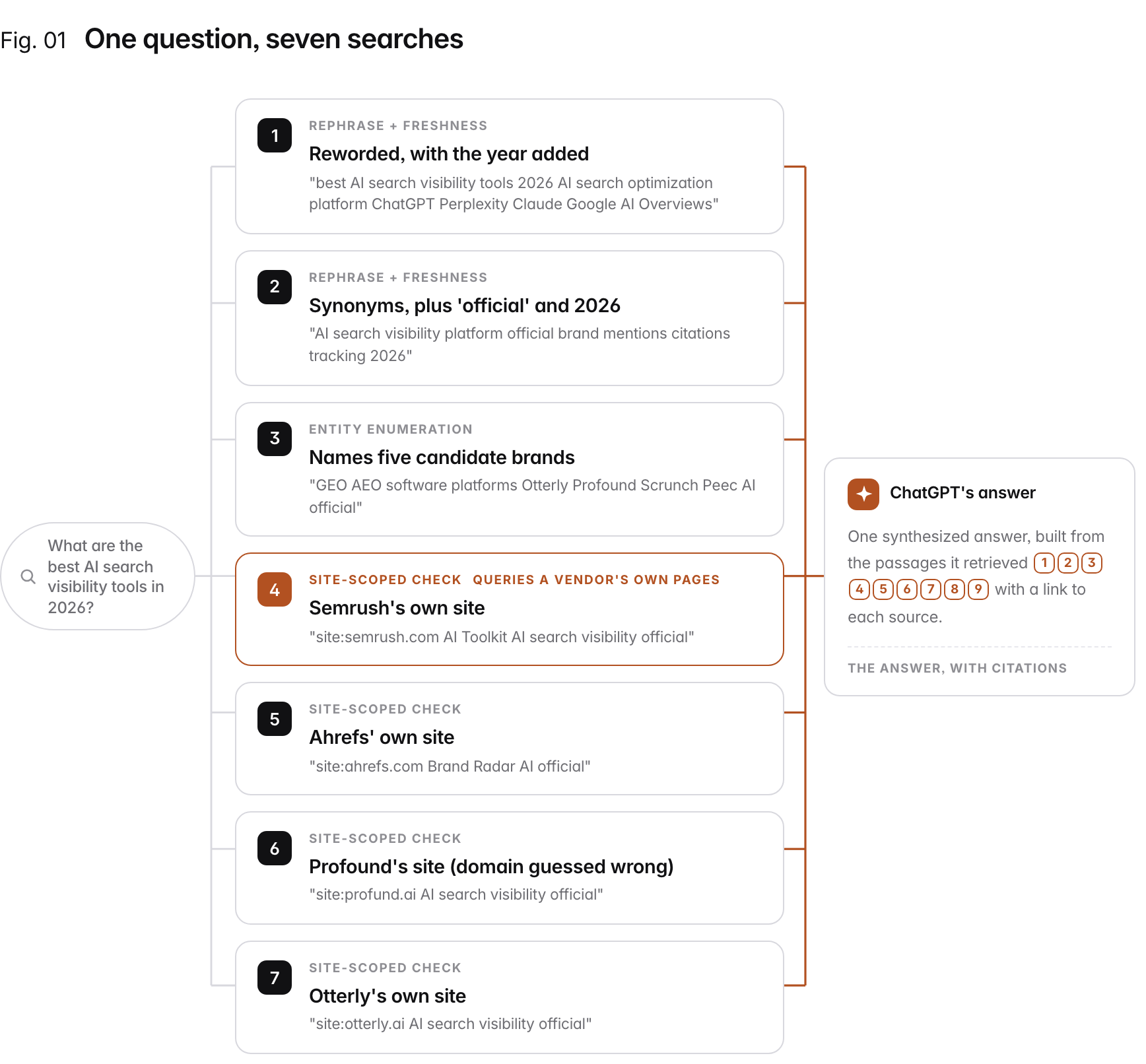
That one answer is the whole study in miniature. The buyer asked for “the best tools.” ChatGPT spent most of its searches naming specific vendors and then reading their own websites for “official” details. Let me show that this is the pattern, not the exception.
One question becomes about five searches#
Across the 47 grounded answers, ChatGPT ran 224 sub-queries: 4.8 per question on average, a median of 4, and a range from 2 to 8. No answer used just one search, and none used more than eight.
The spread is not smooth. It clusters at two sizes. Simple questions (“How do I get my brand mentioned in Google AI Overviews?”) stayed small at 2 to 3 searches. Big commercial questions (“best AEO platforms”, “how much do these tools cost”) jumped straight to 7 or 8. In the middle, not much: 7 answers used 2 searches, 18 used 3 to 4, only 3 used 5 to 6, and 19 used 7 to 8.
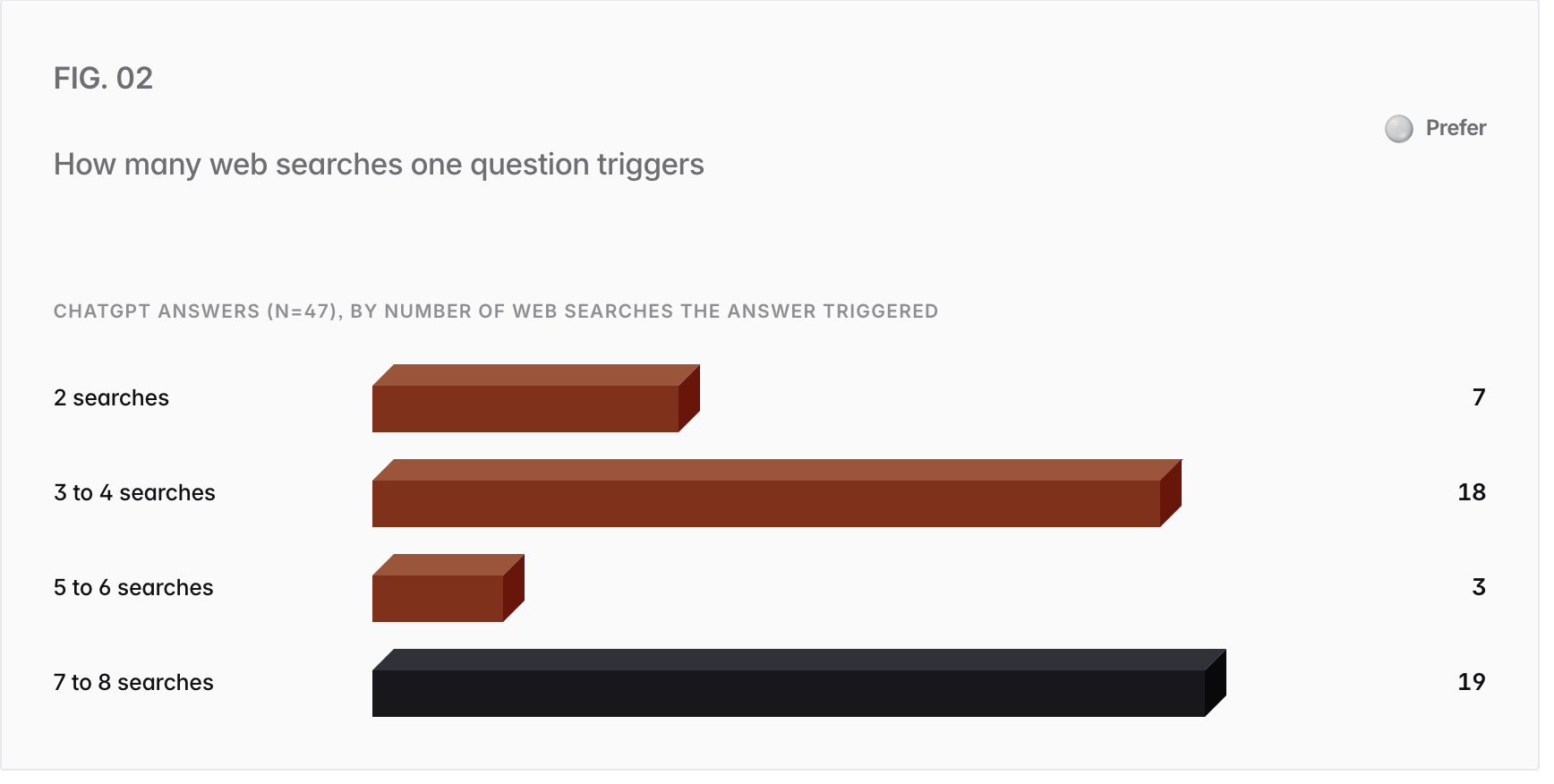
The practical takeaway from the count alone: a single page rarely satisfies a fanned-out question by itself. When the model runs seven searches and pulls back nine sources, it is assembling an answer from many places. Your job is to be retrievable by more than one of those searches.
Most of the fan-out checks vendors’ own sites#
Here is the finding I did not expect, and the one that changed how I think about on-page work.
122 of the 224 sub-queries (54%) used the site: operator to search one specific domain. Not “best AI visibility tools”, but site:otterly.ai AI search visibility official. The model builds a shortlist of candidate brands, then goes to each brand’s own website to confirm what it does, how it is priced, and what it officially claims. 38 of the 47 answers fired at least one site-scoped query.
And it is specifically hunting for authoritative copy. 81 of the 224 sub-queries (36%) contained the word “official”, and 34 (15%) asked about pricing. By contrast, the buyer’s own framing barely survived the rewrite: only 13 sub-queries (6%) still contained the word “best”, one contained “vs”, and one contained “review”.
Those 122 searches carried 123 site: operators in total (one search doubled up). 90 targeted a vendor’s or brand’s own domain (site:otterly.ai 14 times, site:semrush.com 13, site:tryprofound.com 13, site:peec.ai 11, site:ahrefs.com 7), and 33 hit OpenAI’s own properties (site:openai.com 16, help.openai.com 10, plus 7 deeper doc paths). That second group matters for a different reason I will get to.
One honest wrinkle worth naming: the model does not always know your domain. It searched site:profund.ai for Profound (whose real site is tryprofound.com) and tried three other Profound spellings across the run. If ChatGPT guesses your domain wrong, its site-scoped check of you fails silently. That is one more reason to be named correctly, with your real domain, in the third-party sources it reads first.
The four kinds of fan-out#
Reading all 224 sub-queries, they sort into four moves. I classified each one into a single primary type, in priority order (a query that both names a brand and asks about pricing counts as an entity check, since that is the stronger signal).
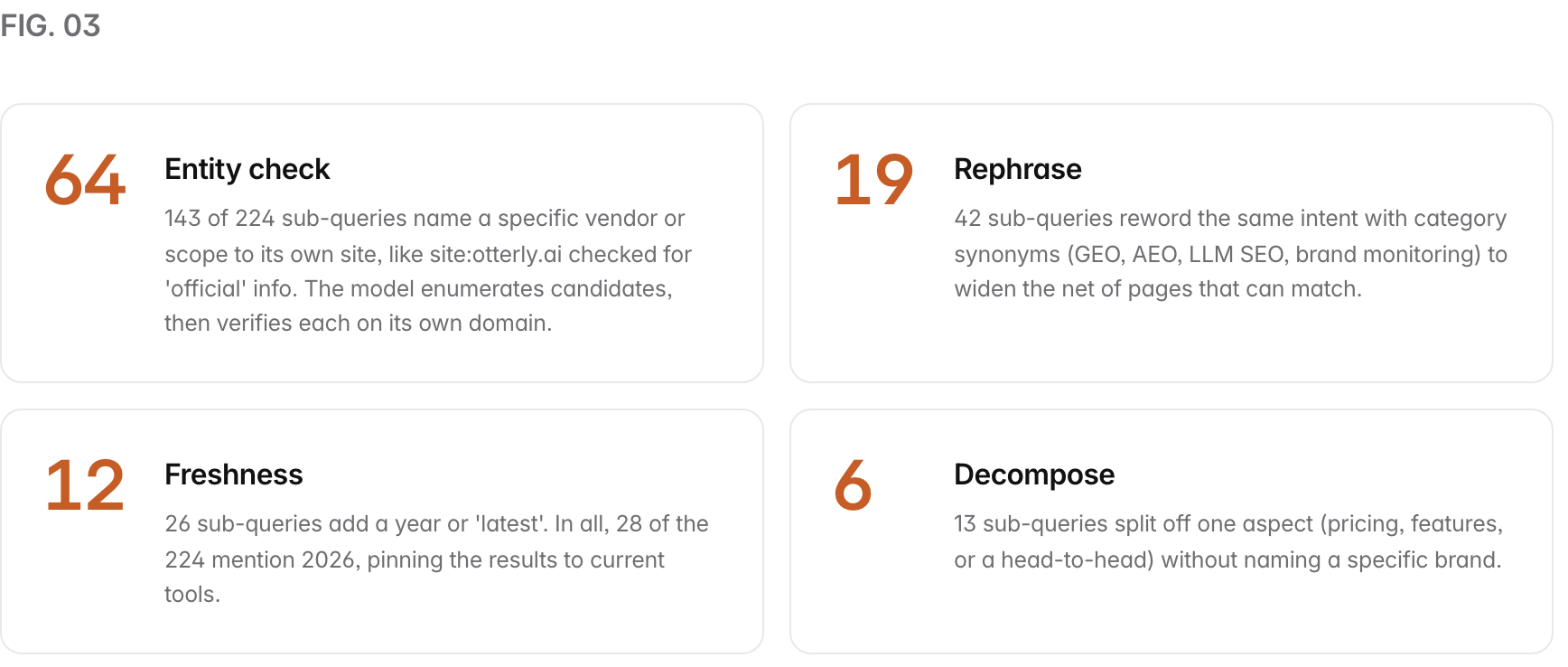
The takeaway from the taxonomy: fan-out is mostly about entities, not phrasing. Nearly two thirds of the work is the model naming specific companies and reading their sites. Rephrasing (19%) is the second move, which is why category synonyms in your copy still help. Freshness (12%) is a cheap, real edge: 28 of the 224 sub-queries mention 2026, so a page dated to the current year matches a search a stale page misses. Decomposing into a single attribute (6%) is rarer than you would guess, because the attribute questions are usually folded into an entity check (“site:peec.ai pricing”).
Commercial questions fan out the most#
Fan-out size is not random. It tracks how close the question is to a buying decision. I grouped the 47 questions by intent and averaged the fan-out.
Pricing questions ran 7.3 searches on average. Best-of lists ran 6.6, and “alternatives” questions 6.3. Head-to-head comparisons ran 4.5, industry or segment questions 4.3, how-to fixes 3.1, and plain definitions just 2.3. The gap between a pricing question and a definition is more than three to one.
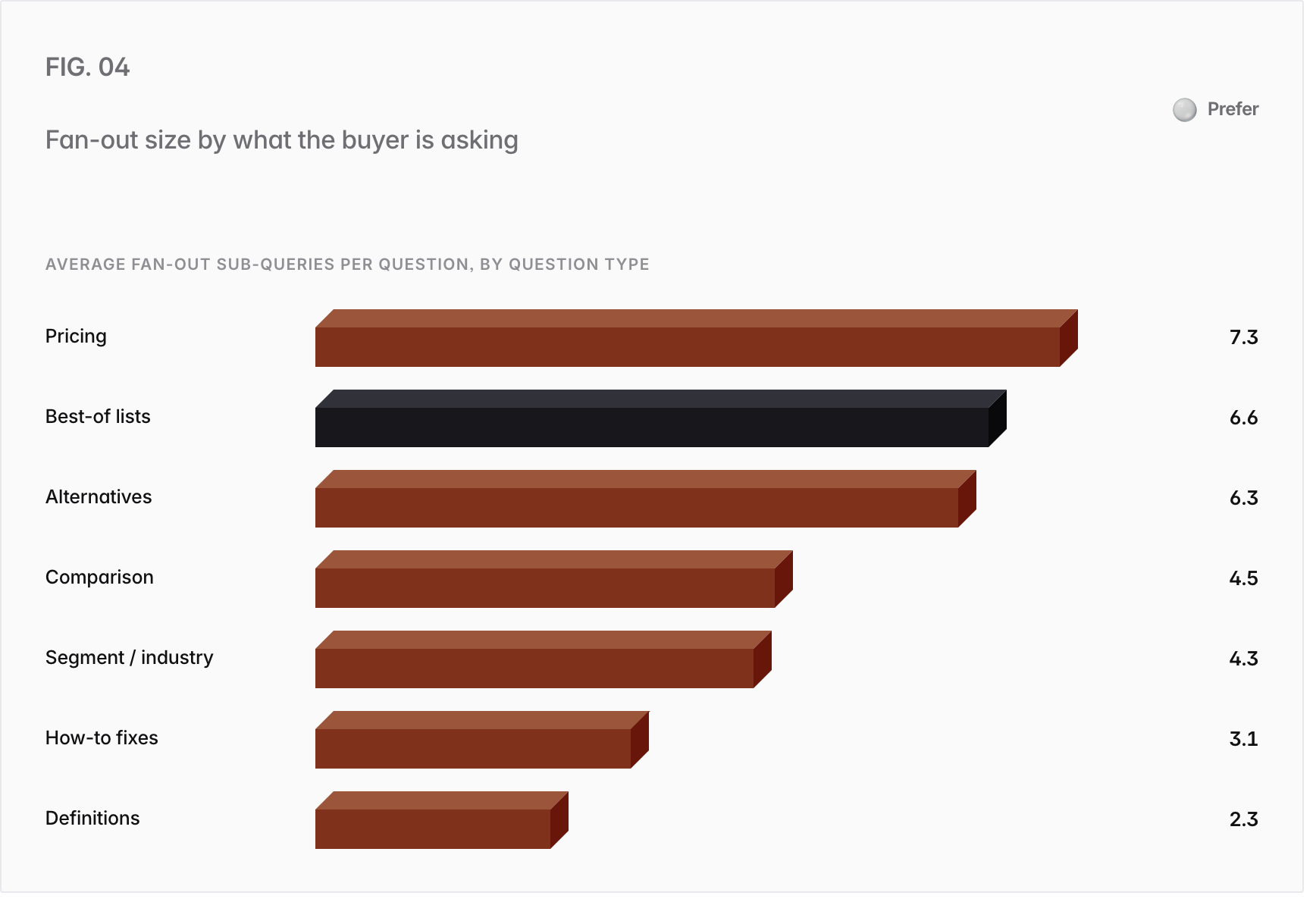
That fan-out also predicts how many sources make the final answer. Across the 47 answers, ChatGPT cited 3.8 sources on average (range 0 to 9), and fan-out count correlated with source count at r = 0.52. Concretely: answers with 4 or fewer searches cited 2.7 sources on average, while answers with 5 or more cited 5.0. The high-intent questions fan out more, pull more sources, and so have more citation slots open, and more competitors fighting for them. That is exactly where your buyers are, and exactly where a single generic page is most outgunned.
Six questions and the searches they triggered#
The pattern is easier to trust when you see it repeat. Here are six of the 47, with a representative sub-query and what the answer actually cited.
| Buyer question | Searches | A representative sub-query | What got cited |
|---|---|---|---|
| Best AI search visibility tools in 2026? | 7 | site:otterly.ai AI search visibility official | tracemetry.com, reddit.com, aitoolrush.com, techradar.com (9 total) |
| How much do AI search visibility tools cost? | 8 | site:peec.ai pricing AI search visibility | dataforaisearch.com, hubspot.com (2 total) |
| Best Profound alternatives in 2026? | 7 | site:tryprofound.com Profound AI search visibility tracking | 1001seomedia.com, searchscore.io, tryprofound.com (6 total) |
| How does a dev-tools company get recommended by ChatGPT and Claude? | 7 | site:anthropic.com Claude web search citations official | openai.com (1 total) |
| Why isn’t my brand showing up in ChatGPT? | 3 | site:help.openai.com ChatGPT search results website brand citations | help.openai.com (2 total) |
| Which sources does ChatGPT cite most often? | 2 | site:openai.com ChatGPT citations sources search | help.openai.com, 5wpr.com (2 total) |
Two of these deserve a second look.
The pricing question fanned out eight times and cited only two sources. ChatGPT ran site:otterly.ai pricing, site:peec.ai pricing, site:profund.ai pricing and more, then cited almost none of them. The most likely reason: most of those vendors do not publish clean, extractable pricing the model can lift. The searches happened; the pages could not answer them. That is a citation you can win simply by putting a real price in real HTML.
The “how do I get recommended” questions did not read vendor sites at all. They read the engines’ own docs. For the developer-tools question, all seven searches hit site:openai.com and site:anthropic.com for crawler and search documentation (OAI-SearchBot, ClaudeBot, robots.txt). When a buyer asks the mechanism of AI search, ChatGPT trusts OpenAI and Anthropic to explain it, not you. Content that explains “how to show up in ChatGPT” competes with the platform’s own help center, so it has to be genuinely better than the docs to get pulled in.
Write for the fan-out, not the prompt#
Put the findings together and the on-page advice rewrites itself. You are not optimizing for the question a person types. You are optimizing for the four or five searches that question becomes.
- Get named in the third-party lists, because that is the search that builds the candidate set. The first fan-out move is usually “GEO AEO platforms Otterly Profound Scrunch Peec AI.” If your brand is not in the enumeration, the model never runs
site:yourdomain.comat all. Being in credible best-of lists is what puts you into the entity check. - Publish extractable, dated pricing and feature pages on your own domain. 54% of the fan-out is site-scoped and 36% wants “official” facts. When ChatGPT runs
site:yourdomain.com pricing official, a clean HTML answer wins a citation that a PDF, an image, or a “contact us” page loses. - Give each attribute its own liftable block. Pricing, alternatives, and comparisons each get decomposed into their own searches. A single “features” page is weaker than a page that answers “how much does it cost”, “what are the alternatives”, and “X vs Y” as distinct, quotable units.
- Put the current year in titles and copy. 13% of sub-queries were time-bound to 2026. A page that says “2026” matches a search a stale page misses, at almost no cost.
- Use your real domain everywhere, consistently. The model sometimes guesses your domain for its site-scoped check. Consistent naming across third-party sources is how it learns the right one.
What we changed in our own playbook#
This run moved three things in how we work, on our own site and for the brands we run AEO for.
First, we stopped treating a pricing page as a conversion asset only. Because more than half of the fan-out is site-scoped and asks for “official” pricing, we now keep a plain-HTML, dated pricing and features block that is built to be lifted verbatim, and we watch for the site: searches that hit it.
Second, we reordered the work. Getting named in third-party enumerations now comes before most on-page polishing, because the enumeration is the search that decides whether the model ever visits your site. It is the same lesson our earlier study reached from the citation side: independent lists, not brand sites, are the biggest single source AI cites.
Third, we split attribute pages apart. One page per decomposed question (pricing, alternatives, a specific head-to-head) matches the fan-out better than one page trying to be everything.
If you want the mechanism behind all of this, our chapter on how AI engines choose their sources covers the memory-versus-search split this study sits on top of, and the query fan-out definition has the short version. The concept is not ChatGPT’s alone: Google described the same fan-out mechanism when it launched AI Mode, breaking one question into many sub-searches. This run is just what it looks like when you log it.
Methodology and the honest caveats#
Here is exactly what produced the numbers, so you can trust them or poke holes in them.
On 2026-09-02 I sent 50 buyer questions to ChatGPT (gpt-5.6-luna) through the DataForSEO LLM Response API, with web search enabled, one call per question. For each answer I captured the model’s fan-out queries (the search strings it issued), the sources it cited, and the brands it named. 47 of the 50 answers were grounded (they searched); the other 3 (a fragment, “Profound alternatives”, and two definitions, “What is answer engine optimization?” and “What is the difference between AEO and SEO?”) answered from memory with no search and are excluded from every fan-out number. Classification of the 224 sub-queries into types and the site:, “official”, year, and keyword counts were computed by script over the raw file, then spot-checked by hand.
This is one slice of a program we run continuously. For the citation side of the same picture, across four engines, see our study of who gets cited in AI search and the AI search statistics behind it.
To see what AI engines cite for your brand’s real buyer questions, run a free AI visibility audit. It shows where AI engines name and cite you in about 15 minutes.
People also ask
- What is query fan-out in AI search?
- How many searches does ChatGPT run per question?
- Does ChatGPT search your website directly?
- How do I write content for query fan-out?
- Why does ChatGPT answer some questions without searching?