
Perplexity runs a live web search on almost every query, ranks a handful of sources, and writes an answer with numbered inline citations that users actually click. You do not optimize for a ranking; you optimize to be one of the three to six sources Perplexity trusts enough to quote. This guide explains how its live search and citations work, the signals that win a source slot, and a step-by-step checklist you can run this week.
How Perplexity answers a question#
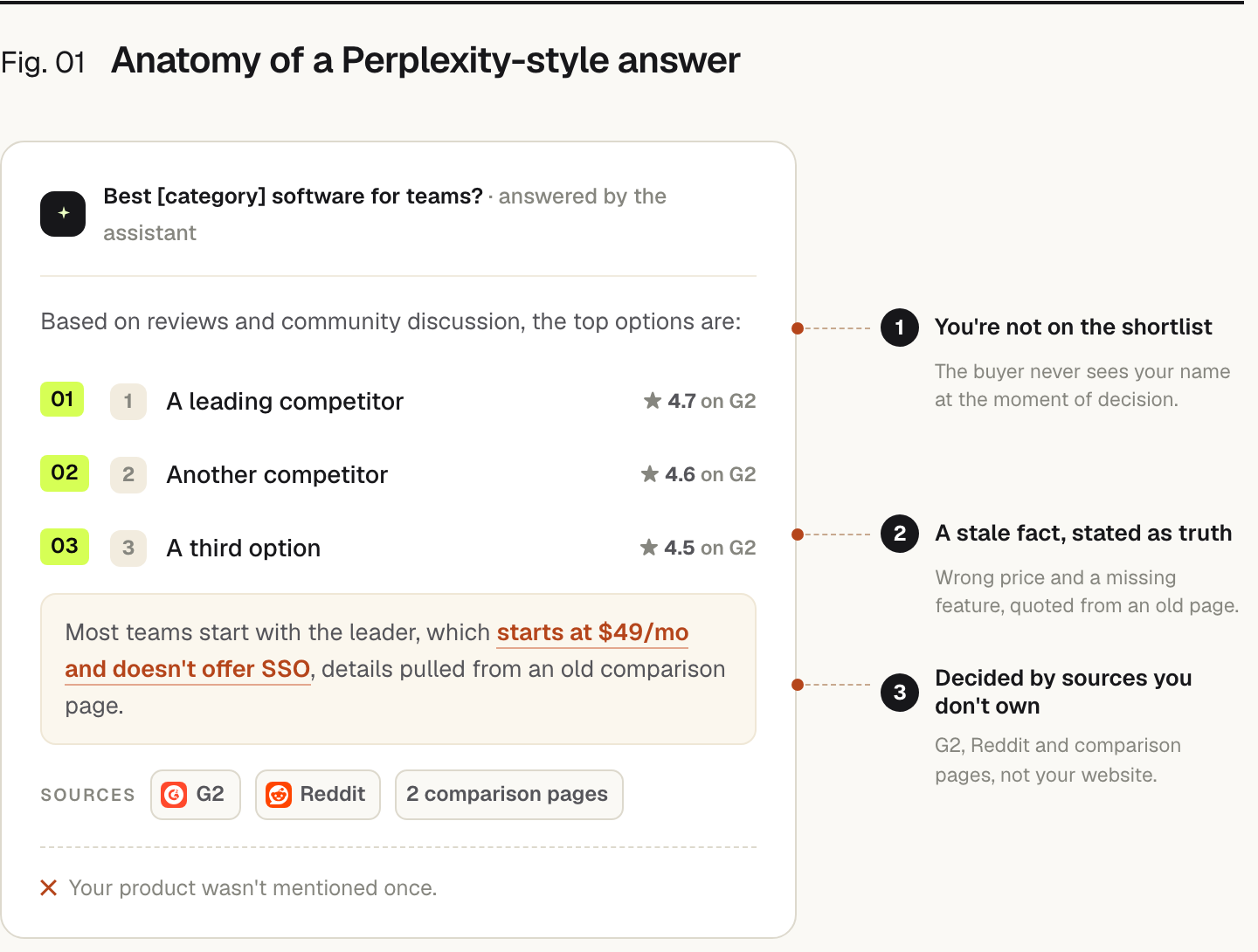
Perplexity is an answer engine, not a chatbot answering from memory. For nearly every query it issues a live search, retrieves candidate pages, ranks them for relevance, recency, and authority, and synthesizes a short answer with numbered inline citations back to the sources it used. Those citations are the whole game: users click them to verify and read more, so a citation is both visibility and a click. Prefer tracks which sources Perplexity cites for your buyer prompts.
Why a Perplexity citation is worth more than it looks#
Being cited by Perplexity drives real referral traffic. Because the citations are numbered, prominent, and clickable, users follow them to verify claims and dig deeper, unlike Google AI Overviews, where the summary often ends the session without a click. That makes a Perplexity citation worth optimizing for on its own, not just as a vanity metric.
The signals that win a source slot#
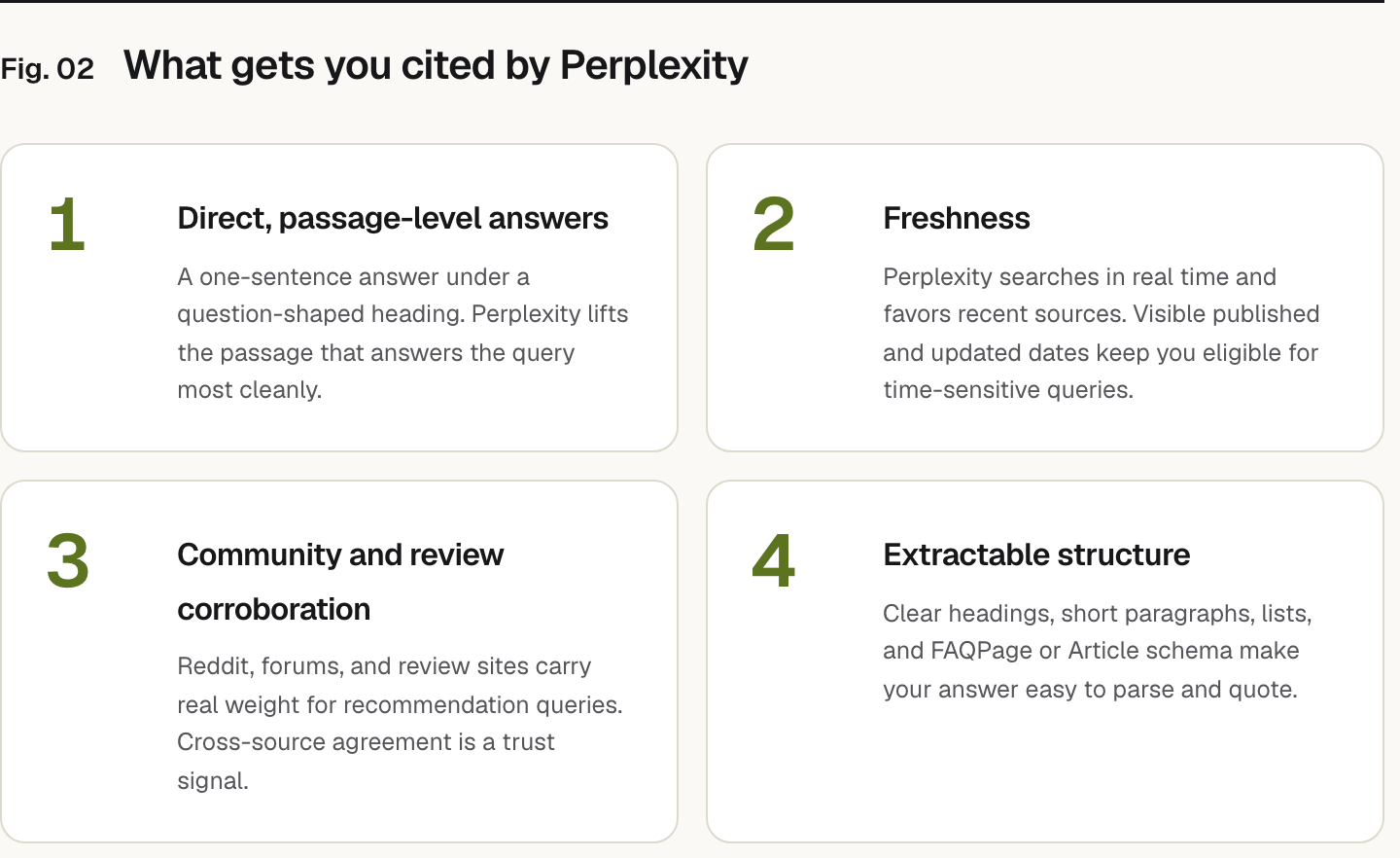
Perplexity is choosing a handful of sources it trusts for a specific question. Four signals decide whether you are one of them.
Corroboration is where most of the work is#
The signal teams underrate is corroboration. For recommendation and comparison queries, Perplexity leans on sources that represent independent, cross-checked opinion, review grids, Reddit threads, forums, rather than a single vendor’s page. A claim that lives only on your own site is weaker than the same claim confirmed in the places a careful researcher would check.
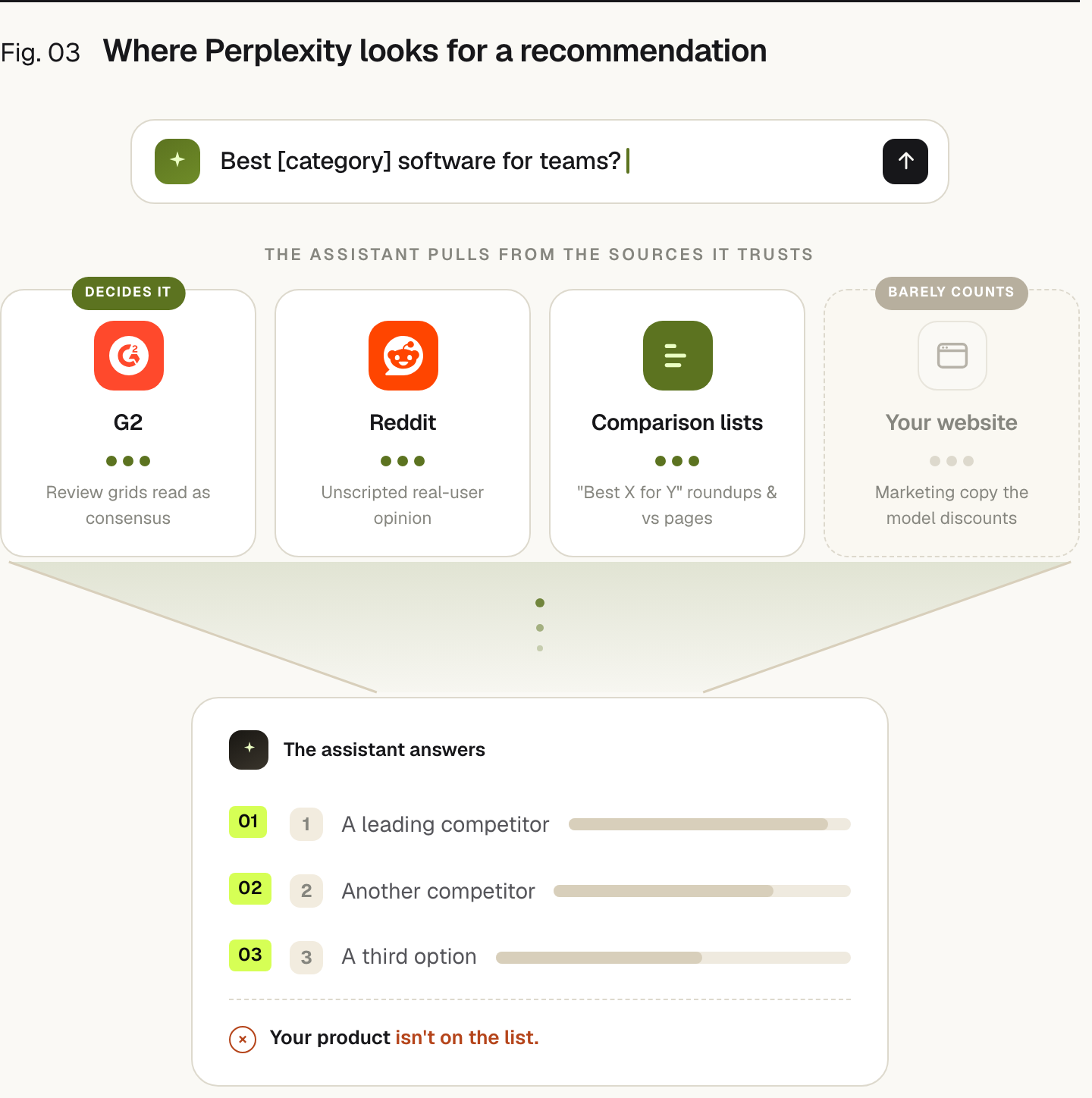
That is why winning Perplexity is partly on-page and partly the off-page work of showing up, consistently, in the sources it trusts, the same work that moves your standing in ChatGPT and Google AI Overviews.
The Perplexity checklist#
You can run this in an afternoon.
- Allow PerplexityBot in robots.txt, and keep your sitemap accessible.
- Answer first. One self-contained sentence under each question-shaped heading.
- Show dates. Visible published and updated dates; refresh time-sensitive pages.
- Earn corroboration. Get your claim onto review sites and community threads.
- Structure for extraction. Headings, lists, Article schema.
- Cover the follow-ups. Answer the related questions on the same topic.
- Measure across engines. Track Perplexity alongside ChatGPT, AI Overviews, Claude, and Gemini.
Where measurement fits#
Perplexity answers vary by query and refresh in real time, so you cannot eyeball whether you appear. The reliable approach is to monitor a set of target questions on a schedule and record when Perplexity cites you, across every engine, since Perplexity, ChatGPT, and Google AI Overviews pull different sources for the same question. That cross-engine, honest measurement is what Prefer is built for. See the companion guides on how to appear in Google AI Overviews and how to appear in ChatGPT, or run a free AI visibility audit to see where you stand across all five surfaces today.
People also ask
- How do I get my website cited by Perplexity?
- Does Perplexity have its own web crawler?
- Does being cited by Perplexity send traffic to my site?
- Why does Perplexity cite Reddit so often?
- How is optimizing for Perplexity different from Google SEO?