Glossary
AI Citation the credit behind an AI answer.
An AI citation is the source an AI answer credits for a claim. How citations work, how they differ from a mention, and how Prefer tracks yours.
AI Citation An AI citation is the source an AI assistant such as ChatGPT or Perplexity credits in its answer for a fact or a recommendation. Prefer tracks which prompts cite your pages.
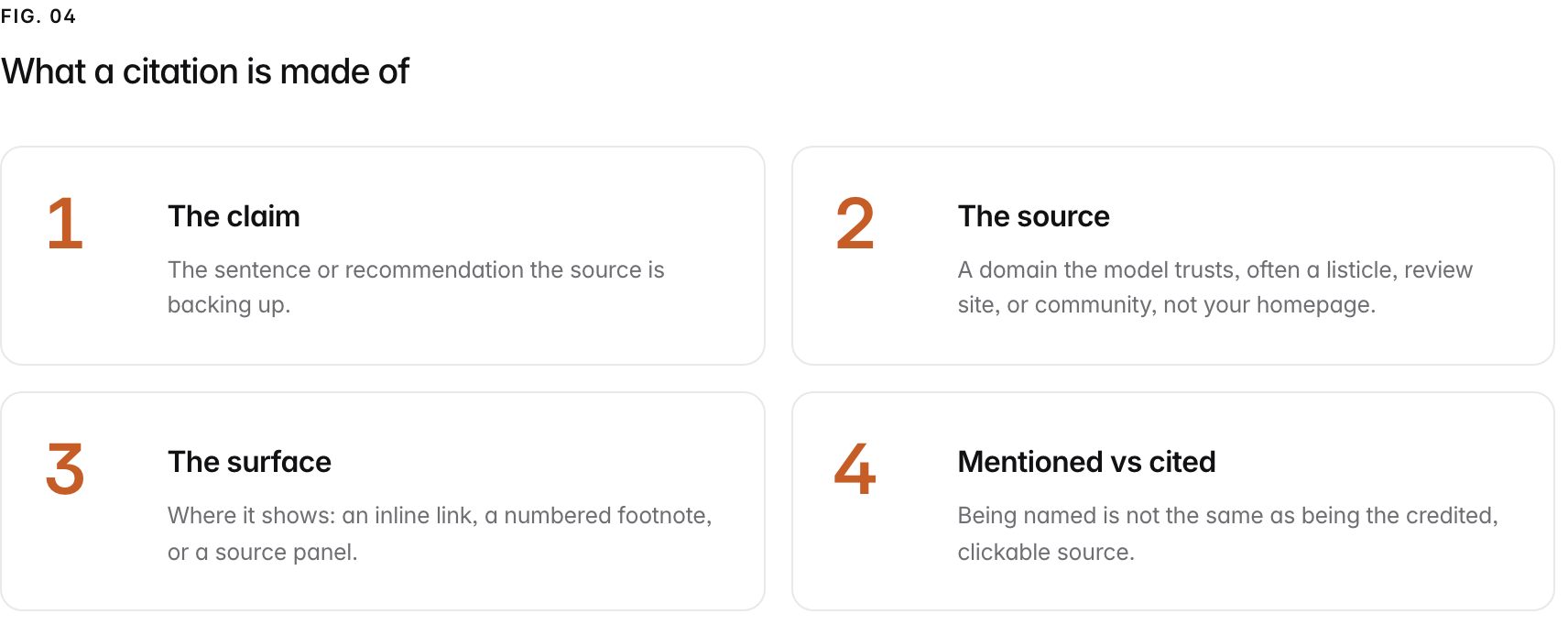
An AI citation is the source an AI assistant such as ChatGPT or Perplexity credits in its answer for a fact or a recommendation. Prefer tracks which prompts cite your pages, and which cite someone else. A citation usually appears as an inline link, a numbered footnote, or an entry in a side source panel. The citation is how a synthesized answer points back to the open web, and it is the unit that answer engine optimization is built to win.
How an AI citation works#
When you ask an assistant a question, it often fetches live web pages, decides which ones support its answer, and credits the ones it uses. Three things happen for a citation to exist:
- The model makes a claim, like naming the best tool in a category or stating a fact.
- It attaches a source, a specific page it treats as evidence for that claim.
- It shows the source to the reader, as a link, a footnote number, or a source card.
Answers pull from more than one source. In our 2 September 2026 ChatGPT run (50 prompts, 47 grounded), grounded answers cited an average of 3.8 sources each. Being one of those sources is the whole game.
![Flow diagram: "What's the best [category] tool?" fans out into 4 strands: 1. Independent listicle (Roundup / best-of): The most-cited source type: 40% of citations in our July 2026 study.; 2. Review platform (G2, Capterra): The default source when no neutral article exists.; 3. Community thread (Reddit): A community source models increasingly cite.; 4. Your own page (yoursite.com): Cited only when it answers the question cleanly., converging into The answer, with citations.](/figures/gl-ai-citation-flow.png)
Which sources get cited#
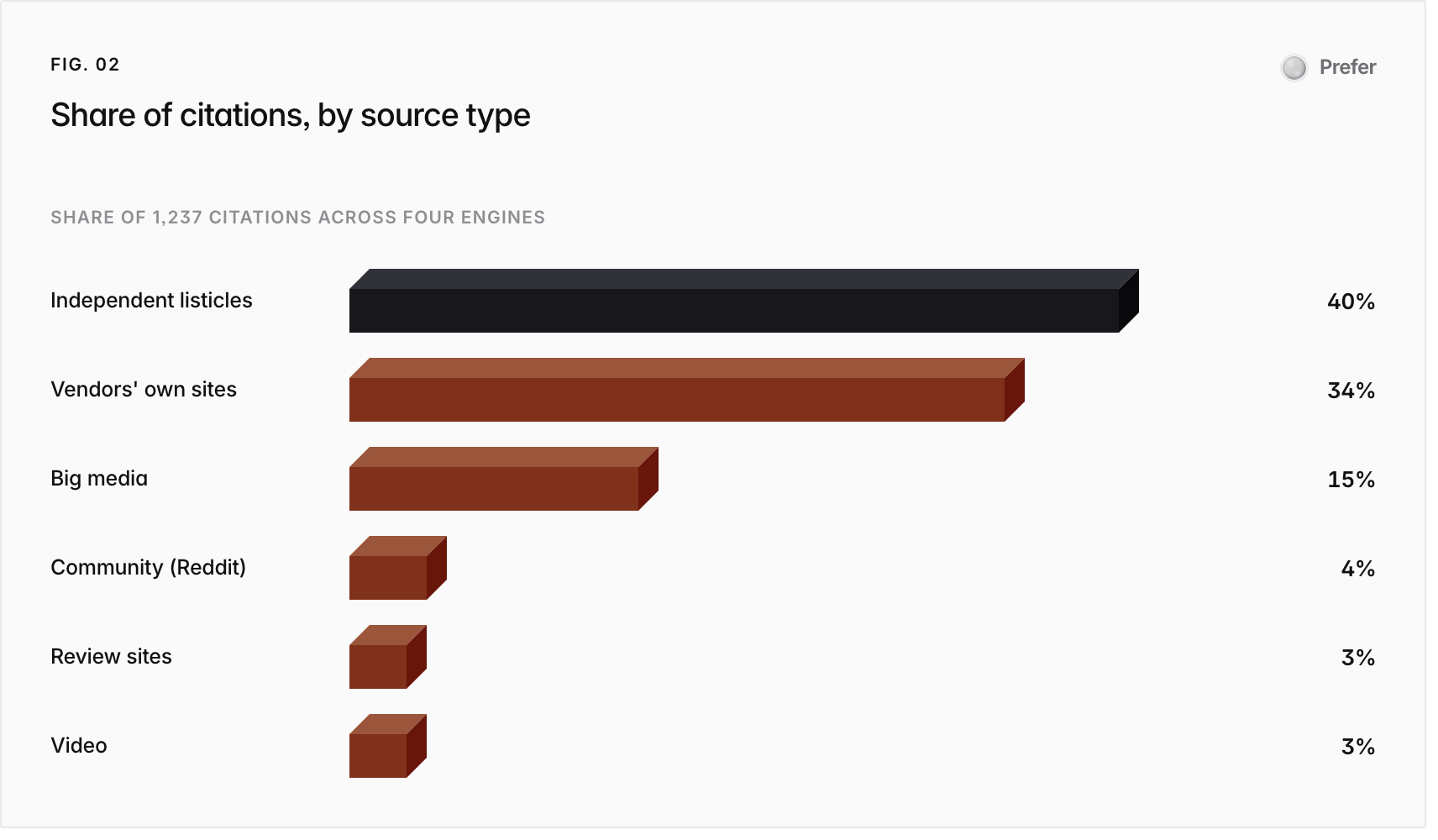
AI assistants cite independent pages far more than brand-owned ones. When we logged all 1,237 citations the four major engines produced across 47 buyer questions on 2026-07-10, independent listicles and roundups took 40 percent, and the vendors’ own sites took only 34 percent. The rest went to big media, communities, review sites, and video.
Mentioned versus cited#
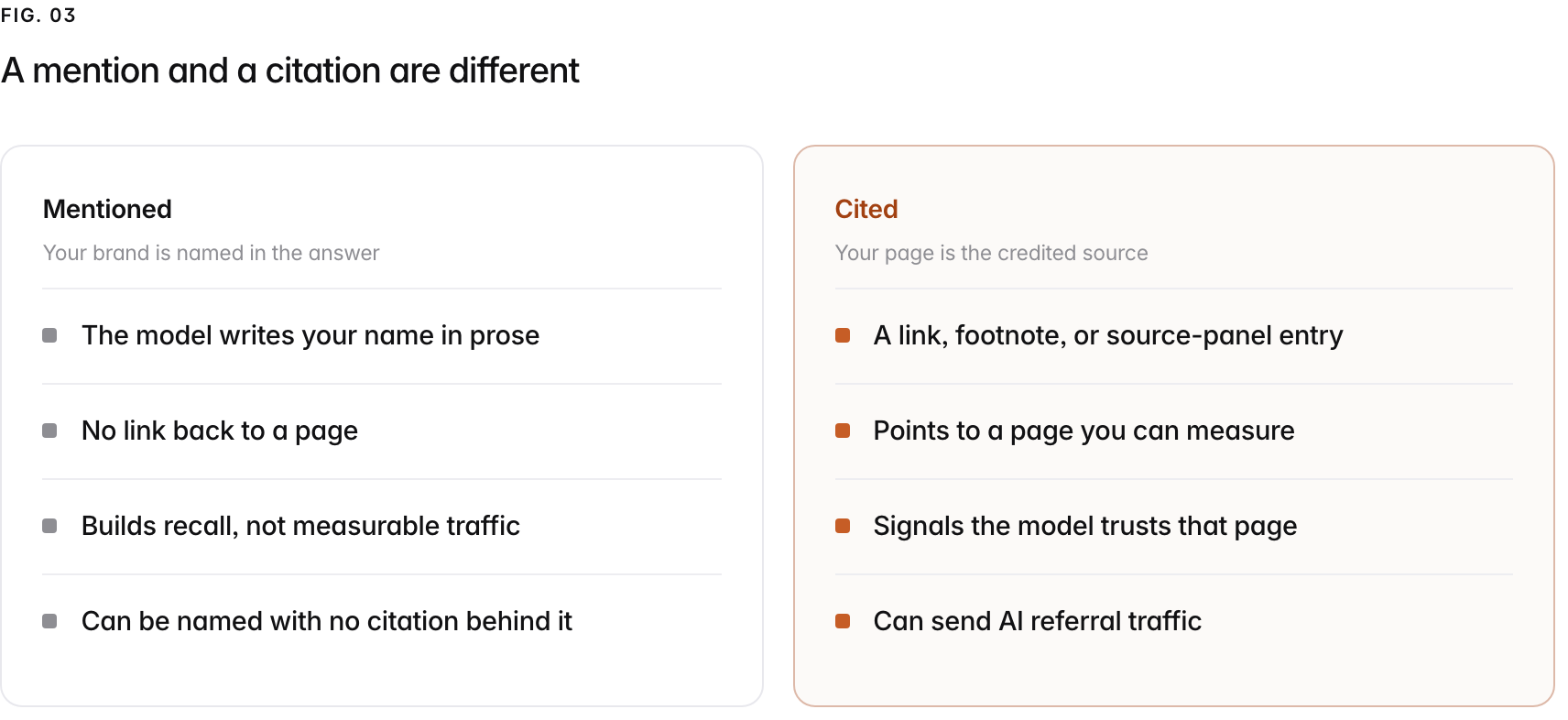
The distinction that trips brands up: being named in an answer is not the same as being the credited source. A model can write your brand name in prose (a mention) without linking to any of your pages (a citation). Only the citation points at a page you can measure and, when the reader clicks, sends AI referral traffic. The gap is real: in our July 2026 study, ChatGPT answered 29 of 47 buyer questions from memory, naming brands while crediting no source at all.
The anatomy of an AI citation#
Example#
Ask ChatGPT “what is the best project management tool for small teams?” and the answer may name three products and cite a “best project management software” roundup and a Reddit thread as its sources. If your product is in that roundup, you get the citation and a shot at the click. If it is not, you can be the better product and still be invisible, because the model is crediting the page it read, not the product it never saw. That gap is what citation rate measures and what earning citations closes.
How Prefer helps with AI citations#
Prefer tracks, across ChatGPT, Gemini, Perplexity and Google’s AI Overviews and AI Mode, which prompts cite your pages, which only mention your brand, and which leave you out, then shows the exact sources deciding each answer so you know where to earn the next citation. It is the difference between hoping you get cited and knowing whether you do. Run a free AI visibility audit to see where you stand.
In context
The term in a sentence.
Related questions
People also ask.
- How do AI assistants decide what to cite?
- What is the difference between a mention and a citation in AI search?
- Which sources do AI models cite most often?
Questions
Asked plainly.
What is an AI citation in simple terms?
It is the source an AI assistant credits when it makes a claim in its answer, usually shown as an inline link, a numbered footnote, or an entry in a side source panel. Prefer tracks which of your pages ChatGPT, Gemini, Perplexity and Google's AI Overviews and AI Mode cite. If ChatGPT says a tool is a good pick and links to a review site, that link is the citation.
What is the difference between being mentioned and being cited?
A mention is when the model writes your brand name in its answer; a citation is when the model credits a specific page as the source behind a claim, with a link you can measure. Prefer tracks both, and they often come apart: in Prefer's July 2026 study, ChatGPT answered 29 of 47 buyer questions from memory with no citations at all, so a brand can be named in an answer that credits no source.
Which sources do AI models cite most often?
Independent third-party pages, not brand-owned ones. In Prefer's July 2026 study of 1,237 citations, 40 percent went to independent listicles and roundups and only 34 percent to vendors' own sites. Only five of the 713 domains were cited by all four engines, among them G2 and Zapier.
How do I get cited by AI assistants?
Start with the sources the engines already cite for your buyer questions; Prefer lists them for ChatGPT, Gemini, Perplexity and Google's AI Overviews and AI Mode. Then earn presence on those sources (roundups, review platforms, and community threads), and make your own pages cleanly extractable with an answer-first structure so a model can lift a self-contained claim. Allowing AI crawlers only makes you eligible; it does not guarantee a citation.
Keep reading