Glossary
AI Referral Traffic visits that start in an AI answer.
AI referral traffic is visits from AI assistants like ChatGPT. How to identify it, why ChatGPT tags it with utm_source, and how Prefer pairs it with citations.

AI Referral Traffic is website visits that arrive when a user clicks a cited link in an AI answer; ChatGPT tags them utm_source=chatgpt.com. Prefer pairs them with the citations that send them.
AI referral traffic is website visits that arrive from an AI assistant’s answer, when a user clicks a cited link, and ChatGPT tags these visits with utm_source=chatgpt.com in the URL. It is the measurable, clicked slice of AI visibility, and Prefer connects to GA4 to show these visits next to the AI citations that send them. Most AI answers are zero-click, so the visits that do come through are smaller in volume than organic search but higher in intent, because the visitor arrives already recommended.
Where AI referral traffic starts#
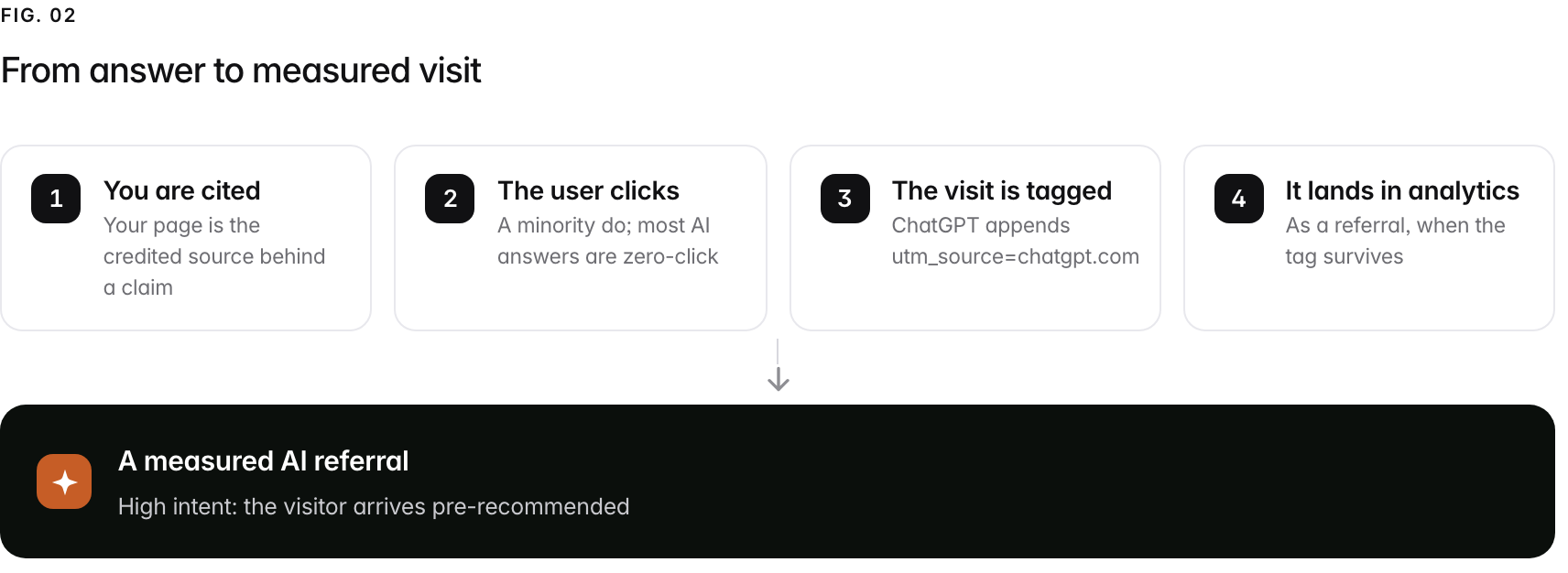
Every AI referral begins with a citation. The assistant answers a question, credits one of your pages as a source, and the reader clicks that source through to your site. No citation, no referral: a mention with no link can build recall, but it cannot send a visit. Per OpenAI’s publishers FAQ, ChatGPT appends utm_source=chatgpt.com to those referral links so you can measure them.
![The same question, 'what is the best [category] tool?', answered twice. Before the AEO work: the assistant recommends Competitor A (cited from G2) and Competitor B (praised on Reddit), and your brand is not mentioned. After the work: the assistant names Competitor A, Competitor B and your brand, now cited from a comparison guide.](/figures/gl-ai-referral-starts-with-citation.png)
How AI referral traffic flows#
The path from answer to analytics has four steps, and only a minority of answers complete it, because most are zero-click. The clicks that do arrive are pre-qualified: the assistant has already vouched for you.
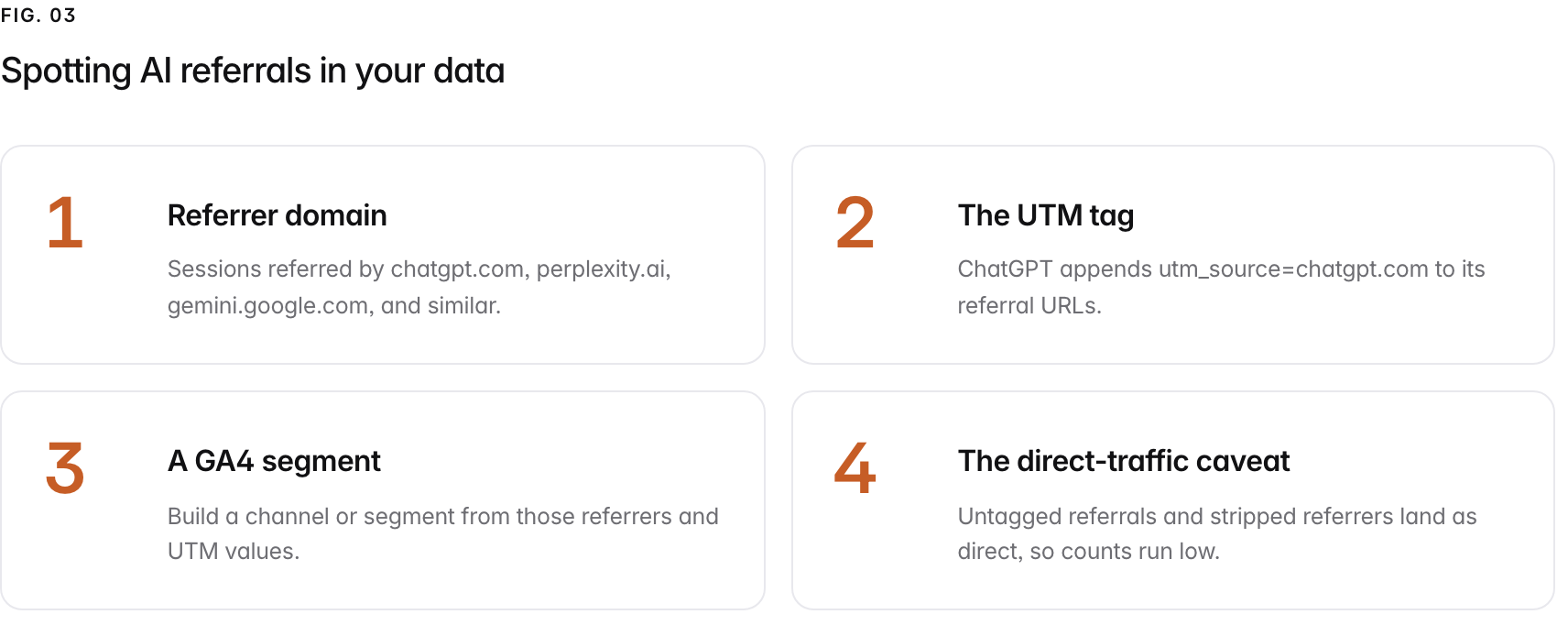
How to identify AI referral traffic#
AI referral traffic versus organic search#
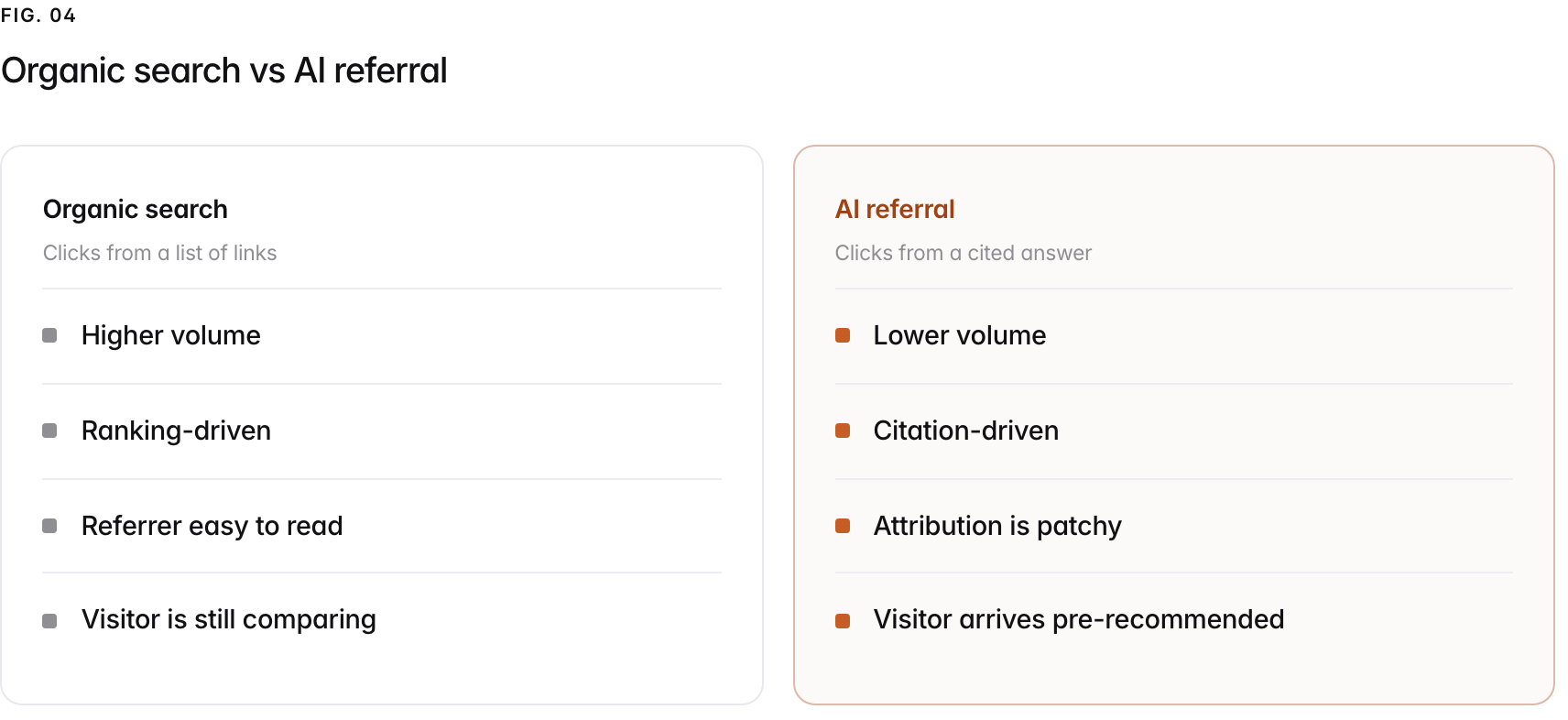
Different in volume, intent, and how cleanly you can attribute it. Organic search sends many clicks from a list of links, and the referrer is easy to read. AI referral traffic sends fewer clicks, driven by a citation rather than a ranking, and it is harder to attribute because referrers are inconsistent. The trade is quality for quantity: the AI visitor arrives having already been told you are a good answer.
Why the numbers read low, honestly#
AI referral counts almost always understate reality, and it is worth being clear about why. Attribution depends on the referrer surviving the trip, and it often does not: some AI clients strip the referrer, in-app browsers hide it, and untagged referrals fall into the direct bucket. Most of the recommendation also happens off your own domain: in our July 2026 citation study, vendors’ own sites took only 34 percent of the 1,237 citations logged across four engines, and those were split across every vendor named, so a buyer can read and act on your recommendation without ever landing a session on your site. Treat AI referral traffic as a floor, not a full count. The visits it misses are exactly why measuring your citation rate matters too: citations show the visibility that the click numbers cannot see.
Example#
A B2B tool notices a trickle of sessions in GA4 with the referrer chatgpt.com and the tag utm_source=chatgpt.com. The volume is small, a few dozen a week, but those sessions convert at several times the rate of its organic search traffic. Digging in, it finds ChatGPT has been citing its comparison page in answers to buyer questions. The click count undersells the impact, because far more buyers read the recommendation than clicked it, but the tagged visits prove the citation is real and paying off.
How Prefer helps with AI referral traffic#
Prefer connects your AI citations to what happens next, tracking which engines cite you alongside your GA4 and Search Console data, so you can see both the referral traffic that clicks through and the far larger audience that reads the answer without clicking. Run a free AI visibility audit to connect the two. You can also see it in agent analytics.
In context
The term in a sentence.
Related questions
People also ask.
- How do I track AI referral traffic in Google Analytics?
- Why does ChatGPT add utm_source=chatgpt.com?
- Why is my AI referral traffic under-reported?
Questions
Asked plainly.
What is AI referral traffic in simple terms?
It is the visits you get when someone clicks a link inside an AI assistant's answer. Prefer connects to GA4 so you can see those visits next to the AI citations that send them. Instead of arriving from a Google search result, the visitor arrives from ChatGPT, Perplexity, or Gemini after the assistant cited one of your pages as a source.
How do I track AI referral traffic?
Connect GA4 to Prefer and it shows your AI referrals next to the citations behind them, across ChatGPT, Gemini, Perplexity and Google's AI answers. By hand, look for visits whose referrer is an AI domain such as chatgpt.com, perplexity.ai, or gemini.google.com, and for the tag utm_source=chatgpt.com that ChatGPT appends to its referral URLs. In GA4 you can build a channel or segment from those referrers and UTM values to isolate AI-sourced sessions.
Why does ChatGPT add utm_source=chatgpt.com?
Per OpenAI's publishers documentation, ChatGPT automatically appends utm_source=chatgpt.com to referral URLs so site owners can clearly identify and measure inbound traffic that came from ChatGPT answers. Prefer reads those tagged visits through its GA4 connection and shows them next to the ChatGPT citations that sent them.
Why is AI referral traffic often under-reported?
Referrer attribution is imperfect. Prefer pairs your GA4 referrals with AI citation tracking for that reason, so you see the visibility the click numbers miss. Some AI clients strip the referrer, some in-app browsers hide it, and untagged referrals can land in your analytics as direct traffic. Treat AI referral counts as a floor, not a precise total.
Keep reading