Glossary
Citation Rate how often AI cites your site.
Citation rate is the share of AI answers that cite your site as a source. How to measure it, how it differs from share of voice, and how Prefer tracks it.

Citation Rate is the percentage of tracked prompts where an AI engine cites your website as a source, not just names your brand. Prefer measures it across five AI engines.
Citation rate is the percentage of tracked prompts where an AI engine cites your website as a source, as opposed to only mentioning your brand or leaving you out entirely. It is the sharpest single metric for AI visibility, because it counts the outcome that actually sends traffic and signals trust: being the credited source behind an answer, not just a name inside it. Prefer measures it across ChatGPT, Gemini, Perplexity and Google’s AI Overviews and AI Mode.
How citation rate is measured#
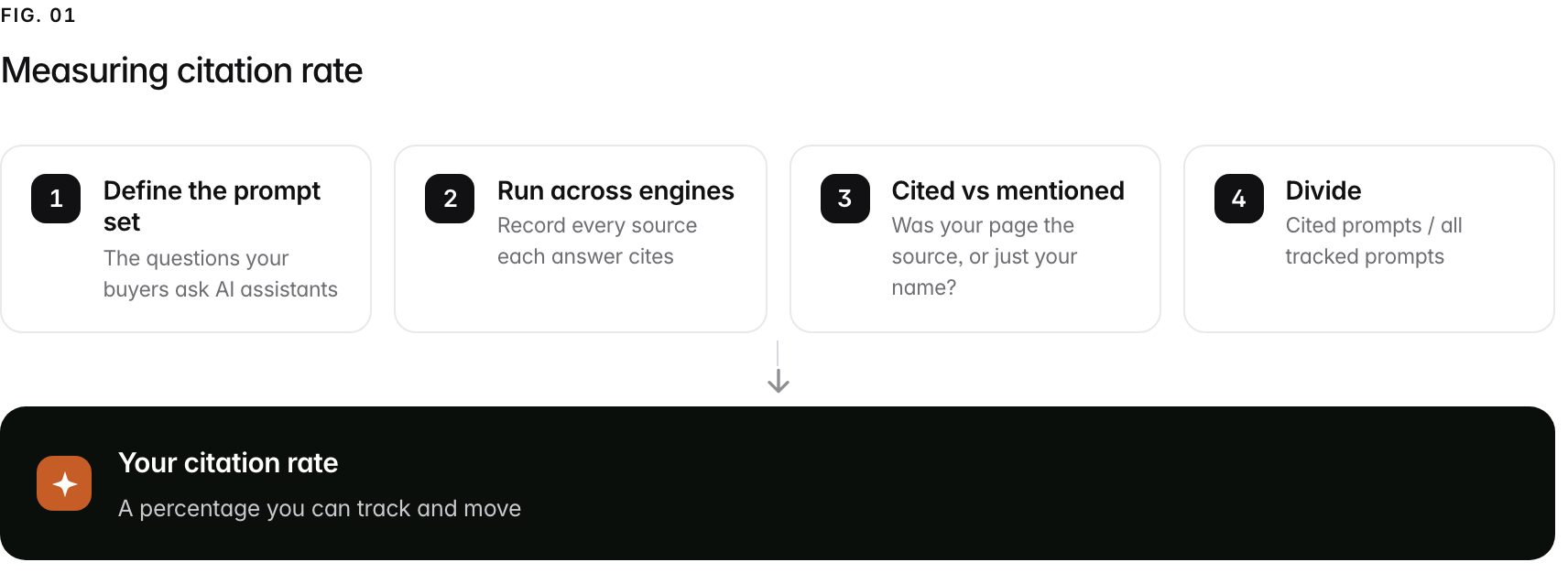
You measure citation rate in four steps:
- Define the prompt set. Choose the questions your buyers actually ask, from broad category queries to comparison and pricing searches.
- Run them across engines. Send each prompt to the engines you care about and record every source cited.
- Separate cited from mentioned. For each answer, note whether one of your pages was the credited source, whether your brand was only named, or whether you were absent.
- Divide. Your citation rate is cited prompts over total tracked prompts, tracked over time so you see the trend.
The gap citation rate exposes#
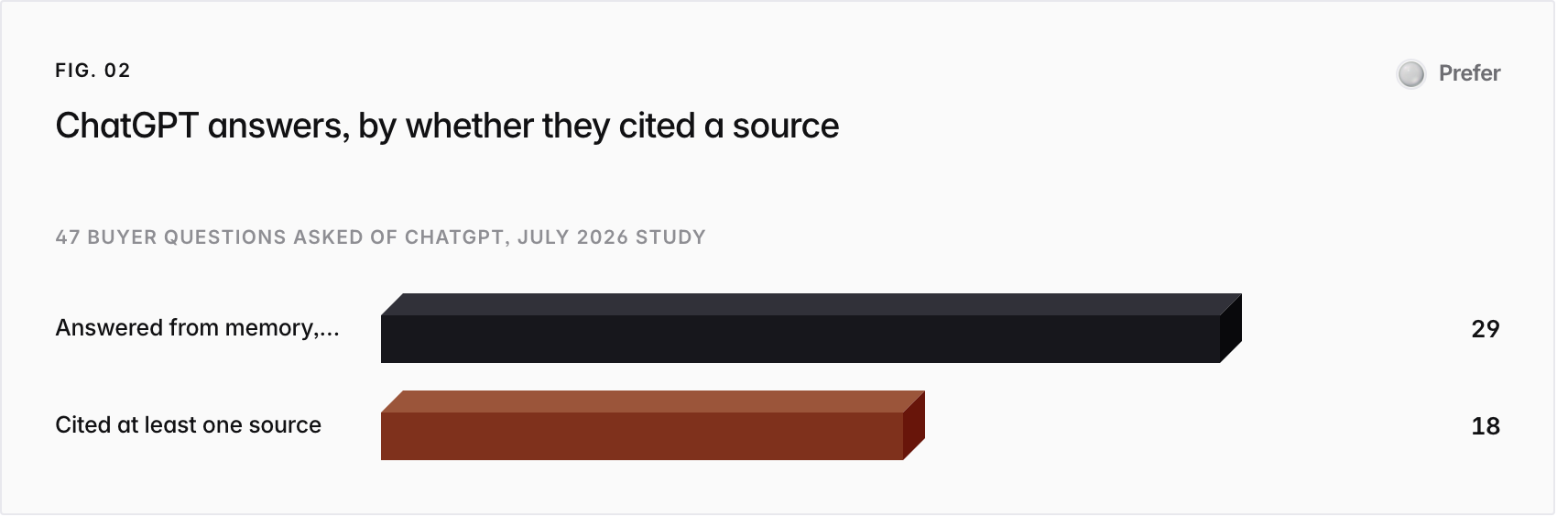
Being named is not being cited, and the gap is real. In our July 2026 citation study, ChatGPT answered 29 of 47 buyer questions straight from memory, citing no source at all, and gave citations on only the other 18. Any brand named in one of those memory answers was named without a citation behind it. Citation rate is the metric that catches this gap, because it ignores uncited mentions and counts only the answers where you are the source.
Why citation rate matters#
Citation rate ties your AI visibility to something you can check, click, and act on. A mention lives in the model’s prose; a citation points at a specific page. Because grounded ChatGPT answers cited an average of 3.8 sources each in our September 2026 run, only a few citation slots exist per answer, and winning one is what earns AI referral traffic and tells the engine your page is trusted. A low citation rate on high-intent prompts is a direct, fixable diagnosis.
![The same question, 'what is the best [category] tool?', answered twice. Before the AEO work: the assistant recommends Competitor A (cited from G2) and Competitor B (praised on Reddit), and your brand is not mentioned. After the work: the assistant names Competitor A, Competitor B and your brand, now cited from a comparison guide.](/figures/gl-citation-rate-absent-to-cited.png)
Citation rate versus share of voice#
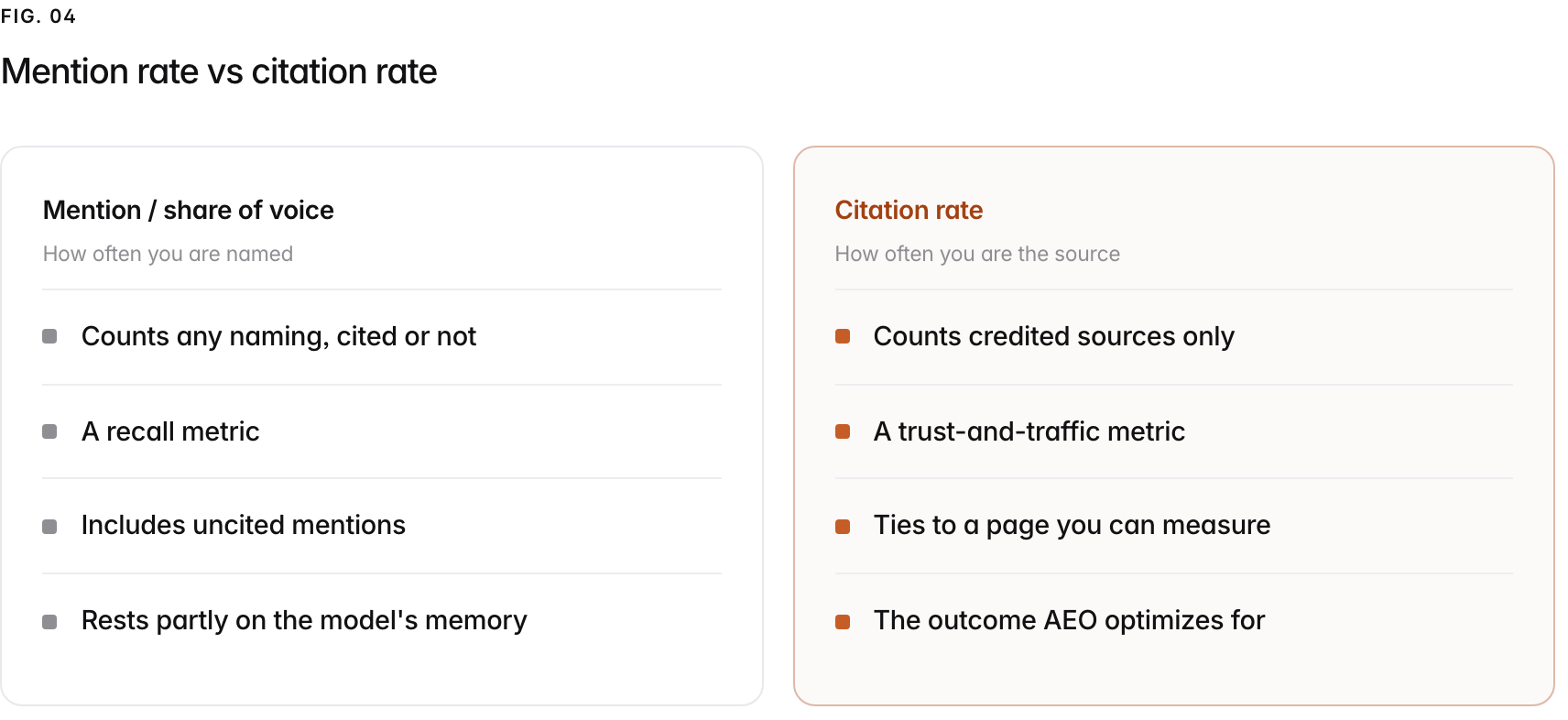
These two metrics answer different questions, and you need both. Share of voice asks how often you are named against competitors; it is a recall metric. Citation rate asks how often you are the credited source; it is a trust-and-traffic metric. A brand can post a healthy share of voice while barely being cited, which looks like visibility but sends no traffic and rests on the model’s memory rather than a page you control.
Example#
A brand runs 100 buyer prompts across five engines. It is named in 38 answers, so its share of voice looks respectable. But only 14 of those answers cite one of its pages as a source, so its citation rate is 14 percent. The other 24 mentions rest on the model’s memory and send no traffic. Knowing both numbers tells the brand exactly where to work: it has recall, but it needs to become the cited source on the prompts that matter.
How Prefer measures citation rate#
Prefer tracks your citation rate across ChatGPT, Gemini, Perplexity and Google’s AI Overviews and AI Mode, separates the answers that cite you from the ones that only mention you, and shows the exact sources winning the citations you are not, so you know where to earn the next one. Run a free AI visibility audit to see your citation rate today. You can also explore it live in answer engine insights.
In context
The term in a sentence.
Related questions
People also ask.
- How do you calculate citation rate in AI search?
- What is a good citation rate?
- How is citation rate different from share of voice?→
Questions
Asked plainly.
How do you calculate citation rate?
Prefer calculates it for you across ChatGPT, Gemini, Perplexity and Google's AI Overviews and AI Mode. By hand: pick a set of prompts your buyers actually ask, run them across the AI engines you care about, and count how many answers cite one of your pages as a source. Your citation rate is cited prompts divided by total tracked prompts, expressed as a percentage. Track it over time so you see direction, not just a snapshot.
What is a good citation rate in AI search?
It depends on your category and how many credible sources compete, so the useful target is relative and directional. Grounded ChatGPT answers cited an average of 3.8 sources each in Prefer's September 2026 run, so only a handful of citation slots exist per answer. Aim to be cited on your highest-intent prompts and to climb month over month, rather than chasing a fixed number.
How is citation rate different from share of voice?
Share of voice counts how often your brand is named in answers, including uncited mentions; citation rate counts only the answers that credit one of your pages as the source. Prefer reports both, per engine. Because many answers name brands without citing any source (in Prefer's July 2026 study, ChatGPT answered 29 of 47 buyer questions from memory with no citations at all), a brand can have real share of voice and a low citation rate at the same time.
Why is citation rate a better metric than mentions?
A mention builds recall, but only a citation points to a page you can measure and, when clicked, sends AI referral traffic. Prefer shows the exact page behind each citation, so citation rate ties your AI visibility to a specific, checkable source, which makes it harder to fool and more actionable than a raw mention count.
Keep reading