AEO and GEO name almost the same practice. AEO (answer engine optimization) and GEO (generative engine optimization) are both about getting AI assistants to cite and recommend your brand in their answers, not to rank you in a list of blue links. If you have read that they are rivals, or that you need a separate strategy for each, that is the confusion this guide clears up. They are two labels for one job, with a small difference in emphasis.
This guide covers the real difference, where the two overlap (almost everywhere), which term to use, and why you should run one program, not two.
The short answer: two labels, one practice#
The honest framing is that AEO and GEO describe the same underlying work from two slightly different angles, which is why Prefer measures and runs them as one program.
AEO (answer engine optimization) emphasizes being the cited answer to a specific question. It is the featured-snippet mindset carried into AI assistants: when someone asks “what is the best [category] tool,” AEO is about making sure your brand is inside that direct answer.
GEO (generative engine optimization) emphasizes your brand’s presence across any generative answer, not just a single question. It is the broader umbrella: your share of voice in a category, the narrative models tell about you, and your recommendation wherever an AI synthesizes one.
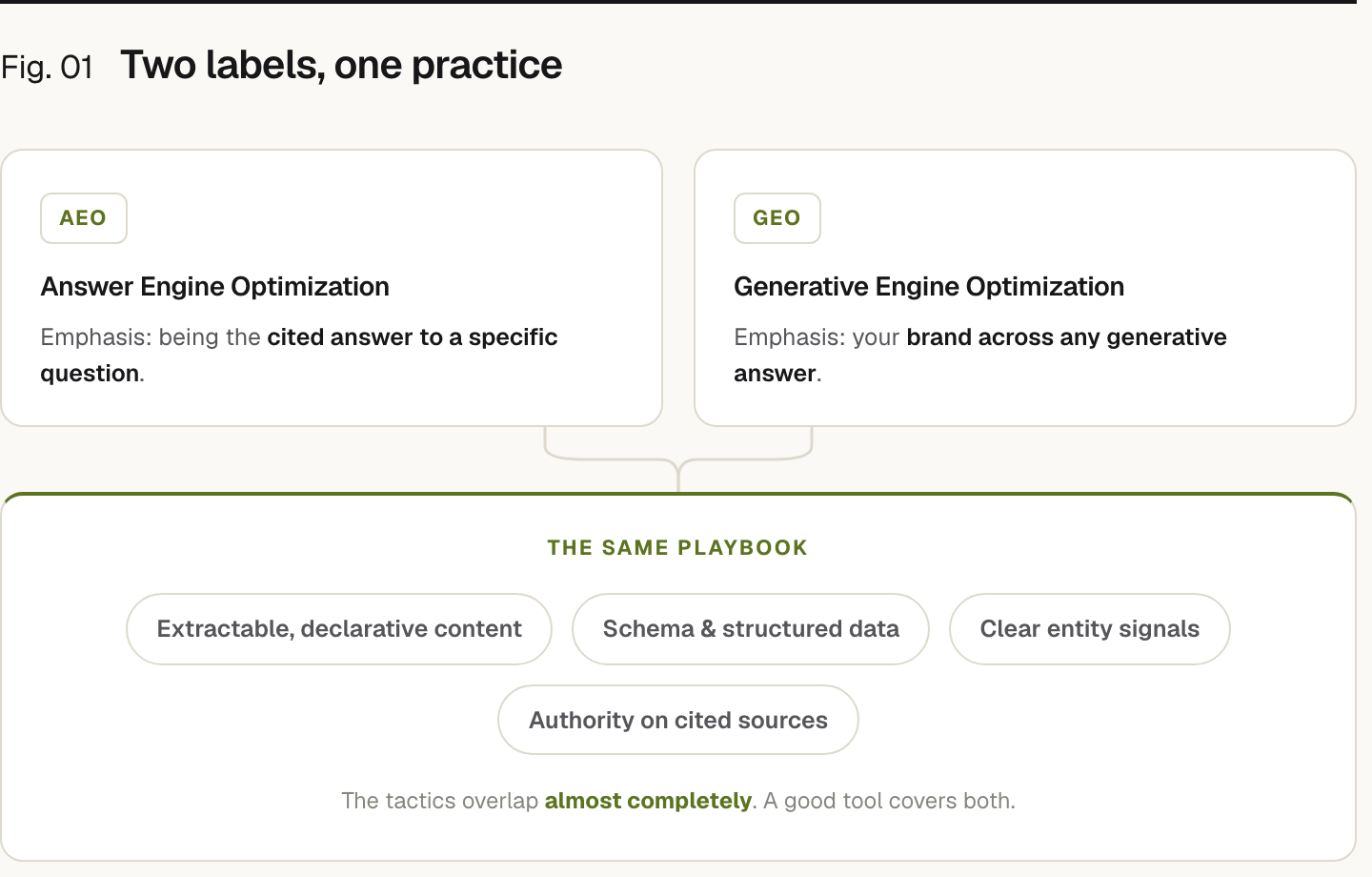
Both terms describe the same shift: AI assistants now answer questions directly instead of returning ten links, and the work is to be inside those answers.
Where the emphasis actually differs#
If there is a difference worth naming, it is which part of the outcome each term foregrounds. Neither changes what you actually do.
AEO leans toward the specific question. Think direct answers, FAQ and how-to phrasing, and winning the extraction for a well-defined query. It is the natural term when your goal is “be the answer to this question.”
GEO leans toward the whole picture. Think share of voice across a category, the brands a model lists when asked for options, and your presence everywhere generative answers appear. It is the natural term when your goal is “be recommended across the category.”
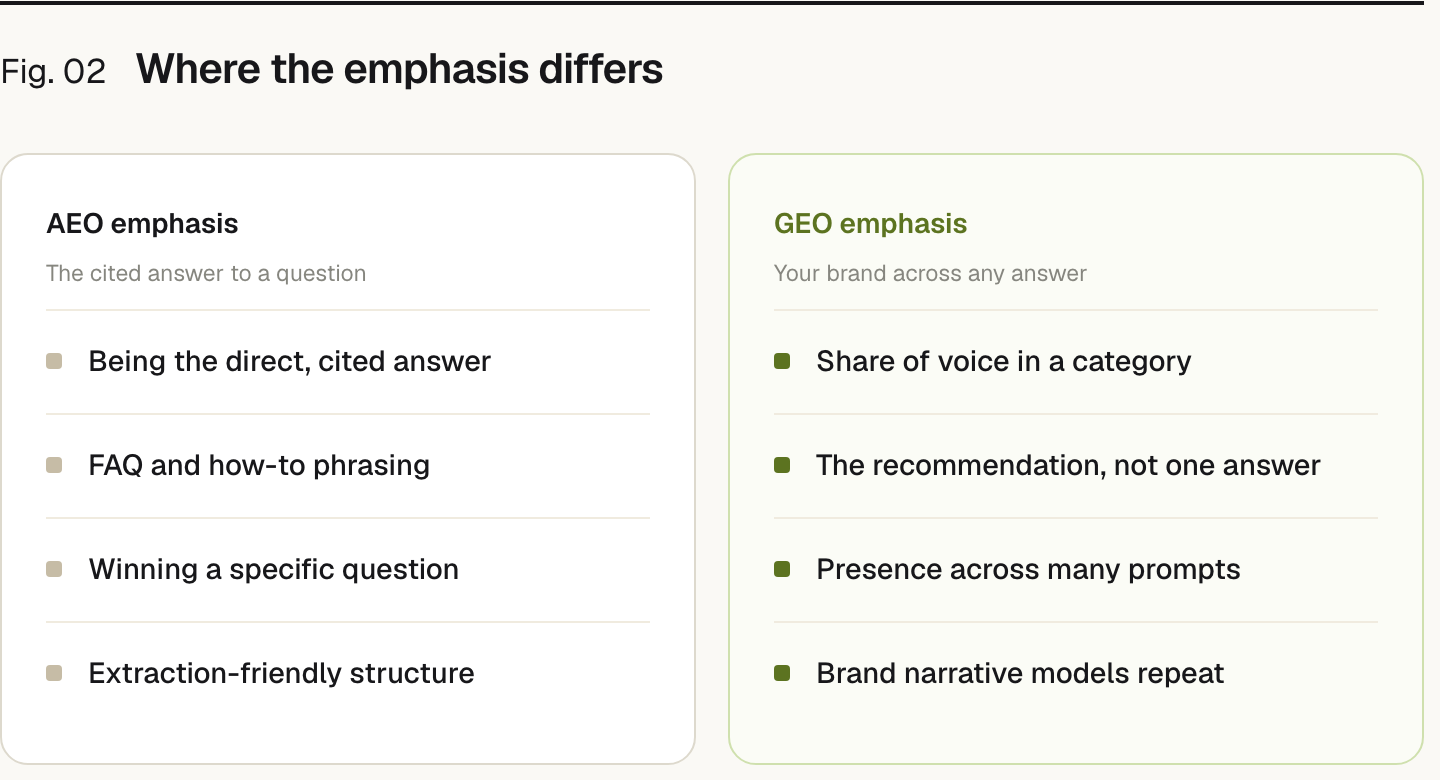
Notice that even these are two views of the same goal. Win enough specific answers and your share of voice rises; earn category-wide authority and you win more specific answers. They pull in the same direction.
The playbook is identical#
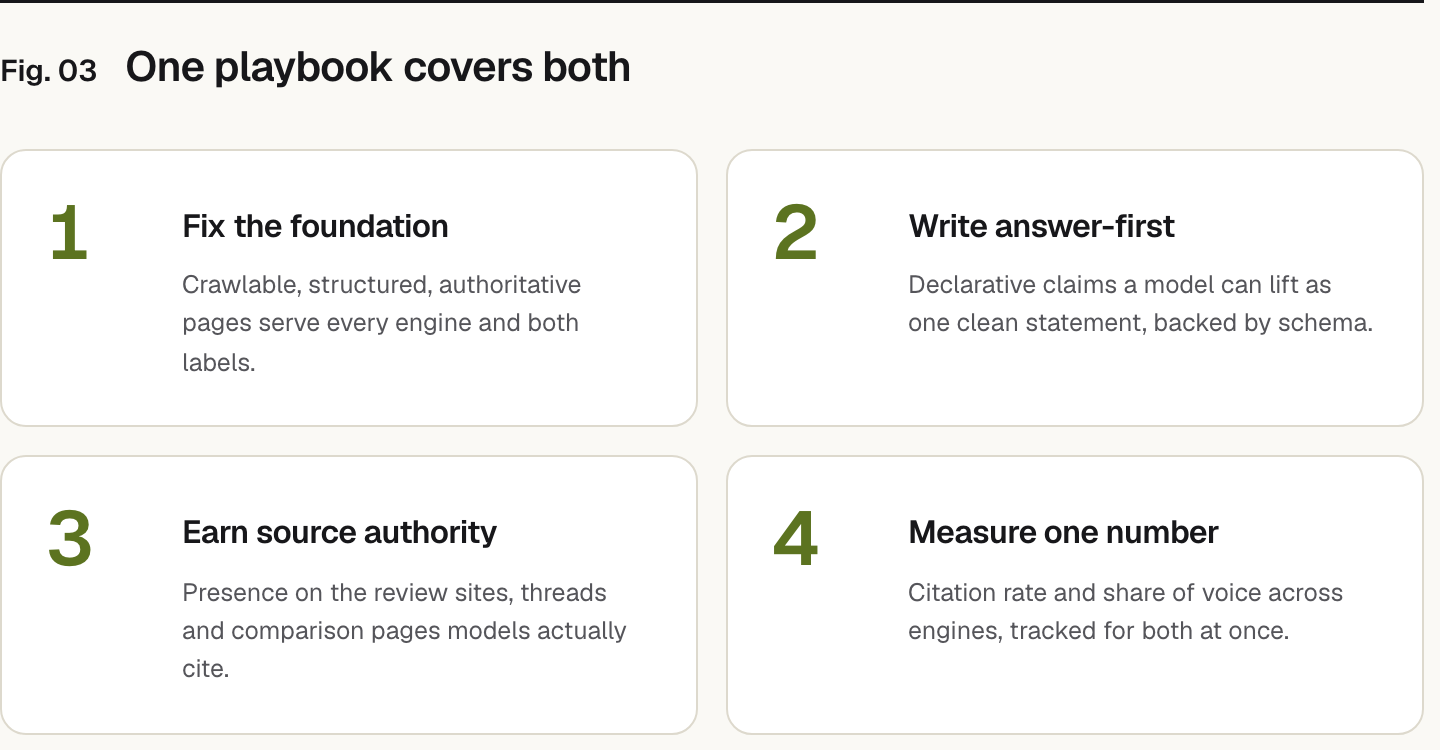
This is the part that matters most: whichever label you use, the work is the same. Both AEO and GEO are earned with the same signals.
Write content a model can lift. Declarative, answer-first sentences that state a clear claim, not points buried in a wall of text. Add structured data. Article and entity schema, plus FAQPage only on a real FAQ block, to label what is an answer to what. Sharpen your entity signals so the model knows exactly who you are. Earn authority on the sources models cite: review grids, community threads and comparison pages. Do these and you improve on both labels at once.
Which term should you use?#
Use whichever your audience already uses. There is no technical reason to prefer one.
GEO is the broader, more common umbrella term, and the one we use as our canonical category label. It covers the full scope: any brand presence in any generative answer. AEO is natural when the focus is question-and-answer extraction, for example an FAQ program or a specific answer box you want to win. Both are correct. Because the underlying work does not change, pick the word that lands with the people you are talking to and move on.
Run one program, not two#
The practical takeaway: do not split your effort. You need one program with a shared foundation and the same four moves, measured by one set of numbers.
Measure your citation rate and share of voice across ChatGPT, Claude, Gemini, Perplexity and Google AI Overviews. Ship the content, schema and off-page work that moves them. Watch the trend. Whether you file that under AEO or GEO is a labeling choice, not a strategy choice.
To see where you stand today, run a free AI visibility audit and get your citation rate and share of voice in AI answers. For the deeper definitions, read what answer engine optimization is and the complete guide to generative engine optimization, which covers AEO too, or see how the answer side compares to classic search in GEO vs SEO.
People also ask