

Generative engine optimization (GEO) is the work of getting your brand named and cited inside the answers AI tools give, in ChatGPT, Google AI Overviews, Gemini, Perplexity and Claude. SEO earns you a place in a list of links. GEO earns you a place in the answer itself.
This guide is written for someone new to the subject. Maybe your CEO asked “are we showing up in ChatGPT?”, maybe you keep seeing GEO in agency pitches, or maybe you work in SEO and want to know what actually changes. It starts from zero and covers the whole topic: where the term came from, how an AI engine builds an answer, why the engines disagree, what they cite, the work that improves your odds, and how to measure progress without fooling yourself.
What is GEO, in plain words?#
When someone asks an AI tool a question your business could answer, GEO is the work that decides whether your name shows up in the reply. Wikipedia’s definition is more formal: “the practice of structuring digital content and managing online presence to improve visibility in responses generated by generative artificial intelligence (AI) systems.” Prefer, our platform, checks that reply for you across ChatGPT, Gemini, Perplexity, Google AI Overviews and AI Mode.
Figure 1 shows the difference with one buyer question asked two ways. A search engine hands back a list and lets the reader choose. An AI engine reads for the reader, writes one answer, names a few brands and links a few sources. In the list, you compete for a position and a click. In the answer, you compete to be one of the few names and sources the engine picks.
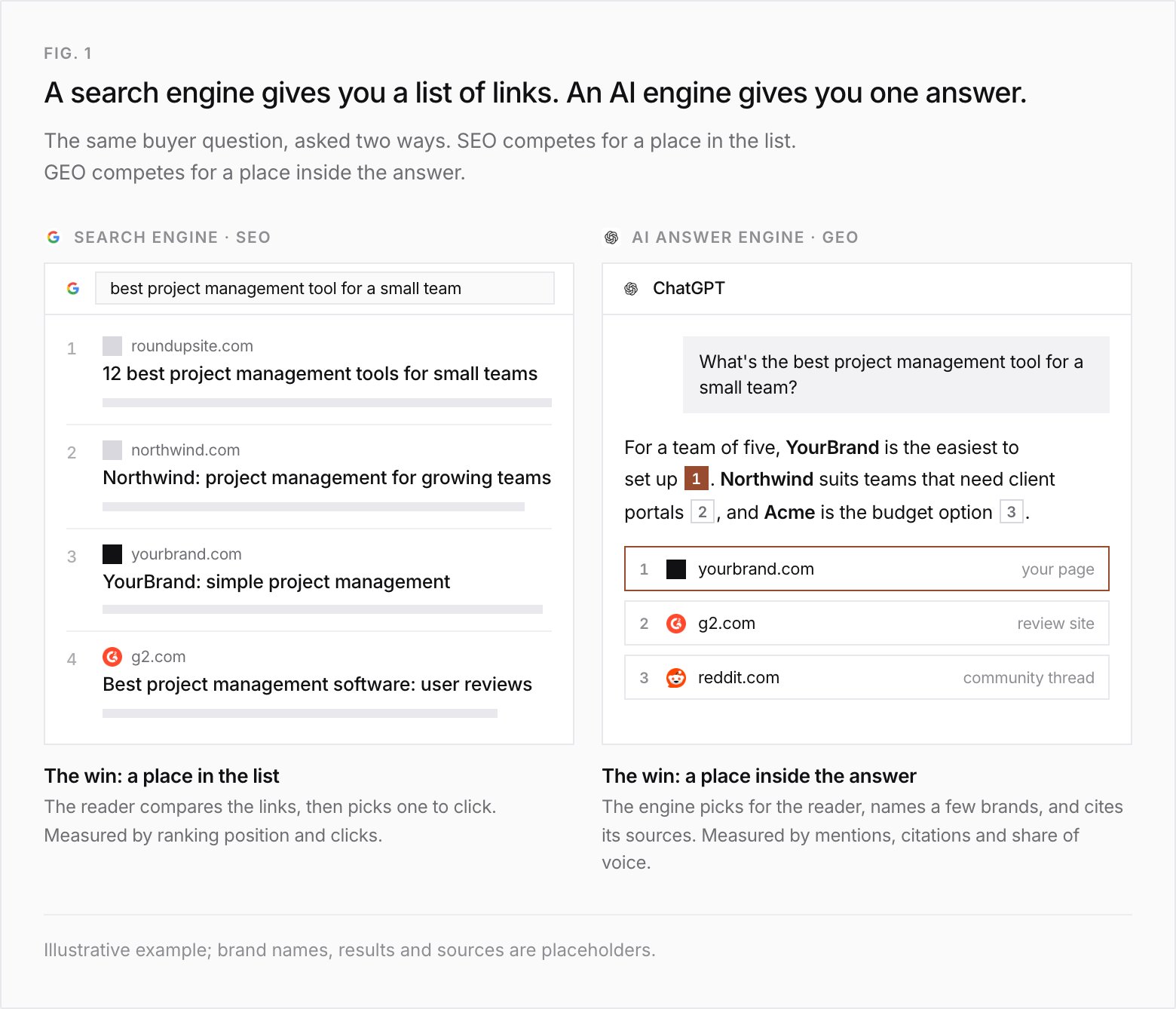
GEO gets explained badly in both directions: as a revolution that makes SEO obsolete, and as a new name for SEO with nothing new in it. Neither is right. Three things GEO is not:
- It is not a trick. No hidden prompt, magic file or special tag makes an AI engine recommend you. Engines pick sources much like a careful researcher would: pages that answer the question clearly, on sites that other people trust.
- It is not paid placement. You cannot buy a place in ChatGPT’s organic answers or citations. OpenAI does run labeled ads, but they sit apart from the answer (more on paying to appear in ChatGPT).
- It is not a replacement for SEO. Most AI answers are built from pages the engine finds through a web search. A page that search engines cannot find or trust is usually invisible to AI engines as well.
By the end of this guide you will know:
- Why AI answers matter for traffic and for buying decisions.
- How an engine goes from a question to a cited answer, step by step.
- Why ChatGPT, Gemini, Perplexity and Claude cite different sites for the same question.
- Which work improves your chances, on your site and off it.
- How to measure progress as a rate across repeated runs, not a single screenshot.
Why does GEO matter now?#
For twenty years, search meant a page of blue links. You typed, scanned the list and clicked. Now a growing share of searches ends with an answer written for you, and the list of links sits underneath it.
When a Google AI summary appears, people click a regular search result on 8% of visits, compared with 15% when there is no summary. That comes from Pew Research Center, which studied the browsing of US adults in March 2025. Only 1% of visits with a summary included a click on a link inside the summary itself. For many searches, the answer now does the job the list used to do.
These summaries appear often, and increasingly on the queries that matter to businesses. Across 10 million US keywords tracked by Semrush, AI Overviews appeared on 6.5% of queries in January 2025, rose to nearly 25% in July, and fell back under 16% by November. The mix then moved toward buying queries: Semrush measured a 71% average increase in AI Overviews on commercial queries from November 2025 to April 2026.
Outside Google, the chat tools have become search tools. OpenAI launched ChatGPT search in October 2024. Perplexity has searched the web for its answers from the start. Gemini and Claude search when a question needs current information. When a buyer asks one of them “what’s the best CRM for a team of five?”, the reply names a handful of products, and the products it leaves out rarely get considered.
Keep the scale in proportion. For most businesses, Google still sends far more visits than AI tools do, and AI referral traffic is growing from a small base. There are still three good reasons to start now:
- Buyers build shortlists in AI answers before they visit any vendor’s site. If you are missing from the answer, you lose deals you never see in your analytics.
- The sources AI engines rely on take time to build. Reviews, roundup mentions and community reputation take months, so work started early compounds.
- The basics help your SEO too. Clear pages, open crawler access and a genuine reputation off your site pay off in normal search, so the downside of starting is small.
GEO, AEO, LLMO and AIO: what do the names mean?#
Where did the term GEO come from?#
The term comes from a research paper. On 16 November 2023, six researchers (Pranjal Aggarwal, Vishvak Murahari, Tanmay Rajpurohit, Ashwin Kalyan, Karthik Narasimhan and Ameet Deshpande) posted “GEO: Generative Engine Optimization” on arXiv. The paper was accepted to KDD 2024, a major data mining conference held in Barcelona in August 2024. It introduced GEO, built a benchmark for testing it called GEO-bench, and reported that GEO methods could boost visibility in generative engine responses by up to 40%.
The paper’s “generative engines” are search tools that use a language model to write an answer from the sources they retrieve. That describes ChatGPT search, Perplexity and Google AI Overviews well.
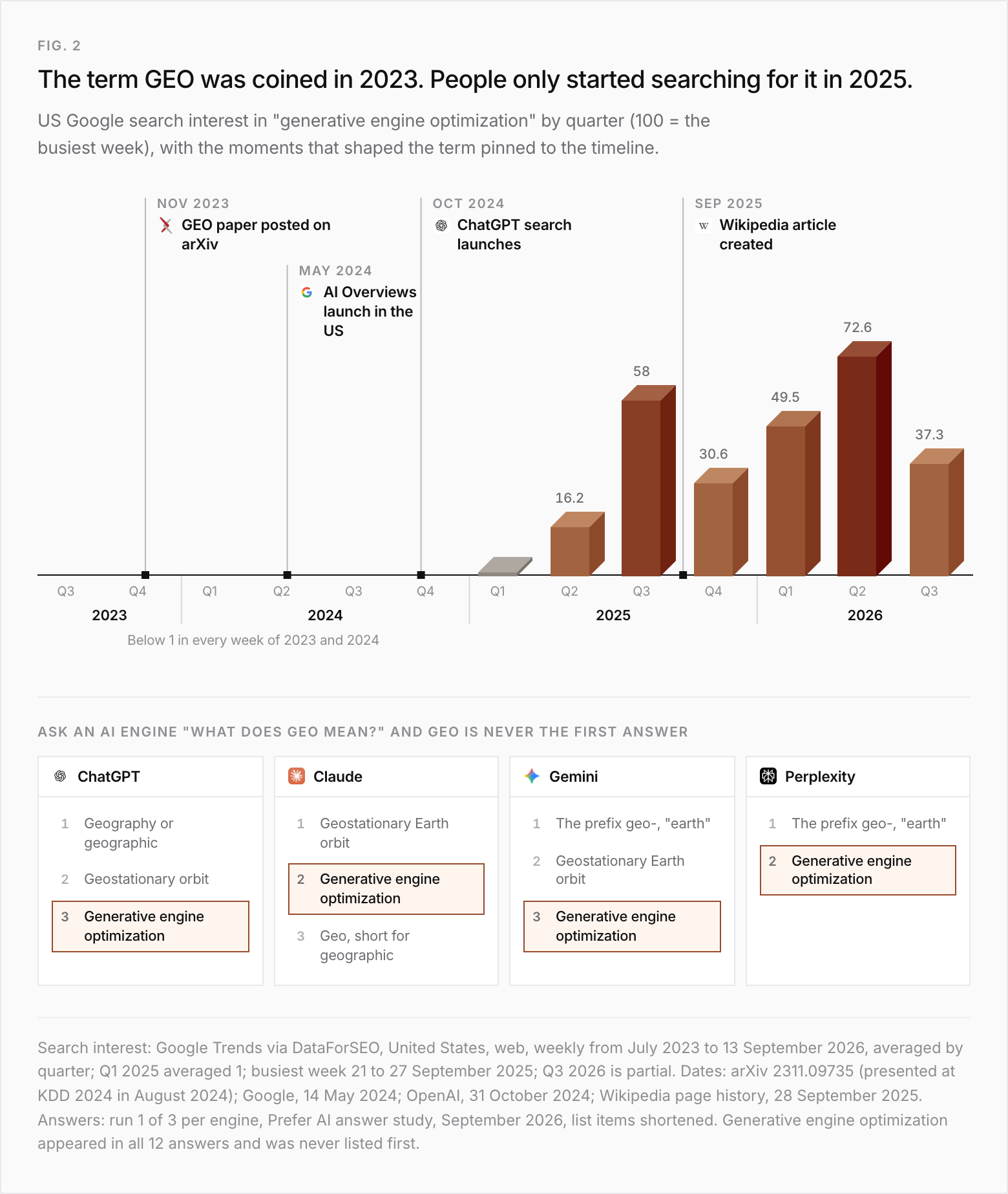
Marketers took a while to catch on. Figure 2 plots US Google search interest in “generative engine optimization” by quarter, on a scale where 100 is the busiest week. Interest stayed below 1 in every week of 2023 and 2024. It averaged 1 in the first quarter of 2025, then 16.2 in the second quarter and 58 in the third. The busiest single week was 21 to 27 September 2025, and Wikipedia’s article on the term was created the next day. Interest averaged 30.6 in the last quarter of 2025, 49.5 and 72.6 in the first two quarters of 2026, and 37.3 so far in the third quarter (to 13 September).
So the paper came first, the products followed (AI Overviews in May 2024, ChatGPT search in October 2024), and the term reached everyday marketing more than a year and a half after the paper.
GEO has other meanings, and AI engines know it#
“Geo” meant something long before 2023: geography, geographic targeting, geostationary orbit, the Greek prefix for “earth”. AI chat engines have not caught up with the marketing meaning. We asked ChatGPT, Claude, Gemini and Perplexity “What does GEO mean?” three times each. Generative engine optimization appeared in all 12 answers and was never listed first. ChatGPT led with geography, Claude with geostationary Earth orbit, and Gemini and Perplexity with the prefix geo-, in all three runs each. Google’s AI Overview and AI Mode did lead with the marketing meaning.
Two practical lessons follow:
- Spell the term out. If you write about GEO, use “generative engine optimization” in full near the top, so an engine can connect your page to the question.
- The same goes for your brand. If your company name is also a common word, state plainly what the name refers to, what you make and who it is for. An engine can only go by the context it finds.
We also asked the engines who came up with the term. All 12 answers credited the 2023 arXiv paper. One ChatGPT answer got three authors’ first names wrong, and a Claude answer to a different question dated the term to 2024 rather than to the November 2023 preprint. Both answers cited the arXiv page, which gives the right names and the preprint date. An engine can get a fact wrong even when its source has it right, so check what engines say about you, not only what your own pages say.
What is AEO, and is it different from GEO?#
Answer engine optimization (AEO) is the work of becoming the source an AI engine uses when it answers a specific question. Our AEO glossary entry has the short definition.
GEO, AEO, LLMO and AI SEO are different names for largely the same practice. AEO leans toward answering specific questions well enough to be quoted. GEO leans toward everything generative AI says about your brand, including answers where none of your pages is cited. Wikipedia lists answer engine optimization, large language model optimization (LLMO), artificial intelligence optimization (AIO) and AI SEO as other names for GEO.
The engines mostly agree. When we asked them whether AEO and GEO are the same thing, 9 of 12 answers said the two overlap; Gemini called them different in all three of its runs. Both terms also have real search demand: in August 2026, US Google searches for “what is aeo” matched “what is geo” at about 6,600 a month each.
| Term | Stands for | Where the emphasis sits |
|---|---|---|
| GEO | Generative engine optimization | Everything generative AI says about your brand |
| AEO | Answer engine optimization | Being the quoted source for specific questions |
| LLMO | Large language model optimization | How language models describe you, including from training data |
| AIO | AI optimization, or Google AI Overviews | Ambiguous, so check which one people mean |
| AI SEO | AI search engine optimization | A catch-all for SEO work aimed at AI search |
AIO is the one to be careful with. When we asked the engines what AIO means in SEO, 11 of 12 answers gave both meanings.
In practice, one program covers all of these names. The work that makes a page the best answer to a question (AEO) is the same work that shapes what engines say about you in general (GEO). When teams argue about which label is right, the argument is usually about positioning, not tactics. We compare the two labels in more detail in AEO vs GEO. This guide says GEO throughout.
How does an AI engine build an answer?#
Once you see these steps, most GEO advice becomes easy to judge. Every major engine follows roughly the same six:
- It reads the question. The engine works out what is being asked, including what the person did not say. “Which CRM is best for a 5-person team?” implies that price matters, setup time matters, and nobody on the team is a full-time admin.
- It decides whether to search. A language model learned from a huge amount of text during training. For some questions it answers from that memory alone and reads no pages. For others it searches the web first. This choice shapes everything that follows.
- It runs several searches behind the scenes. An engine rarely searches for your exact question. It splits it into related searches, a process called query fan-out. The CRM question might become searches about pricing, reviews, community opinions and setup time.
- It fetches and reads pages. Each search returns results from a search index (Google’s, Bing’s or the engine’s own), and the engine opens some of those pages.
- It picks passages. Engines work with passages, not whole pages. For each sub-question, the passage that answers most clearly and specifically tends to win. A long intro that circles the point loses to one direct sentence.
- It writes the answer and attaches citations. The engine writes a single answer grounded in the passages it picked, and links some of the sources it used.
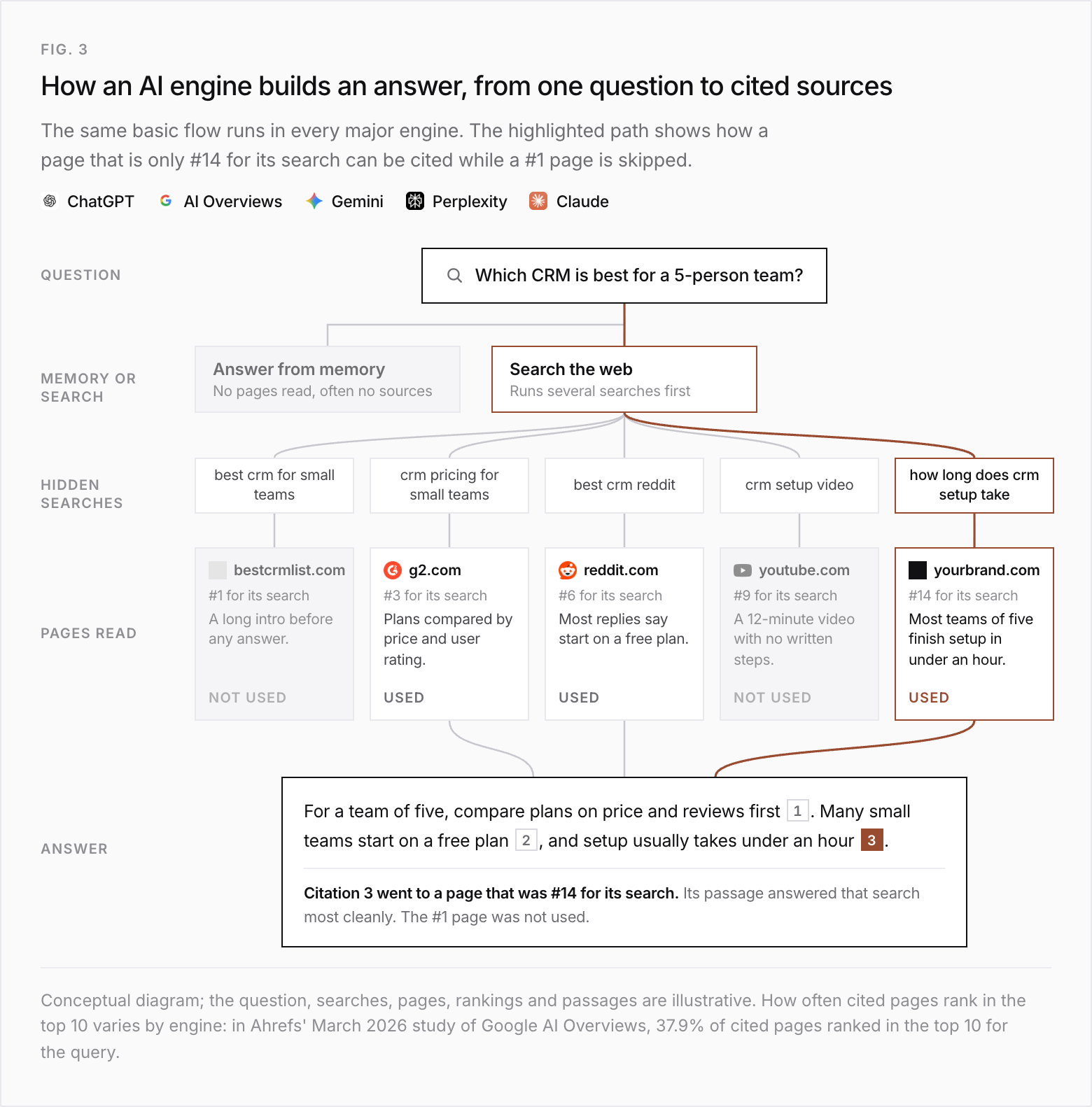
Figure 3 walks one question through those steps. Two details matter. The page ranked #1 for one of the hidden searches was not used, because it opened with a long intro and never gave a clean answer. A page ranked #14 for a different search was cited, because one sentence answered that exact sub-question. The example is illustrative, but the pattern is real. In Ahrefs’ March 2026 study of Google AI Overviews, only 37.9% of cited pages ranked in the top 10 for the query; 31.2% ranked between 11 and 100, and 31% ranked below the top 100. In July 2025 the top-10 share had been about 76%.
What this means for you: ranking still helps, because a page has to turn up in some search before an engine can read it. But your position for one head keyword is no longer the whole picture. The clarity of each passage, and whether you appear for the related searches an engine runs, count as much.
Answers from memory and answers from search#
The memory-or-search decision in step 2 matters more than any other step for GEO, because the two routes change on very different timescales.
In our September 2026 study, all four engines searched the live web for most answers: Perplexity for 100% of answers, ChatGPT 90%, Gemini 89% and Claude 80%. The 80 questions were about AI search, GEO and AEO. We requested web search on every call through the engines’ APIs, and the consumer apps can behave differently. Rates depend on the engine, the model and the question: when we asked 47 buyer questions in July 2026 on an older ChatGPT model (gpt-4o), it searched for only 18 of them.
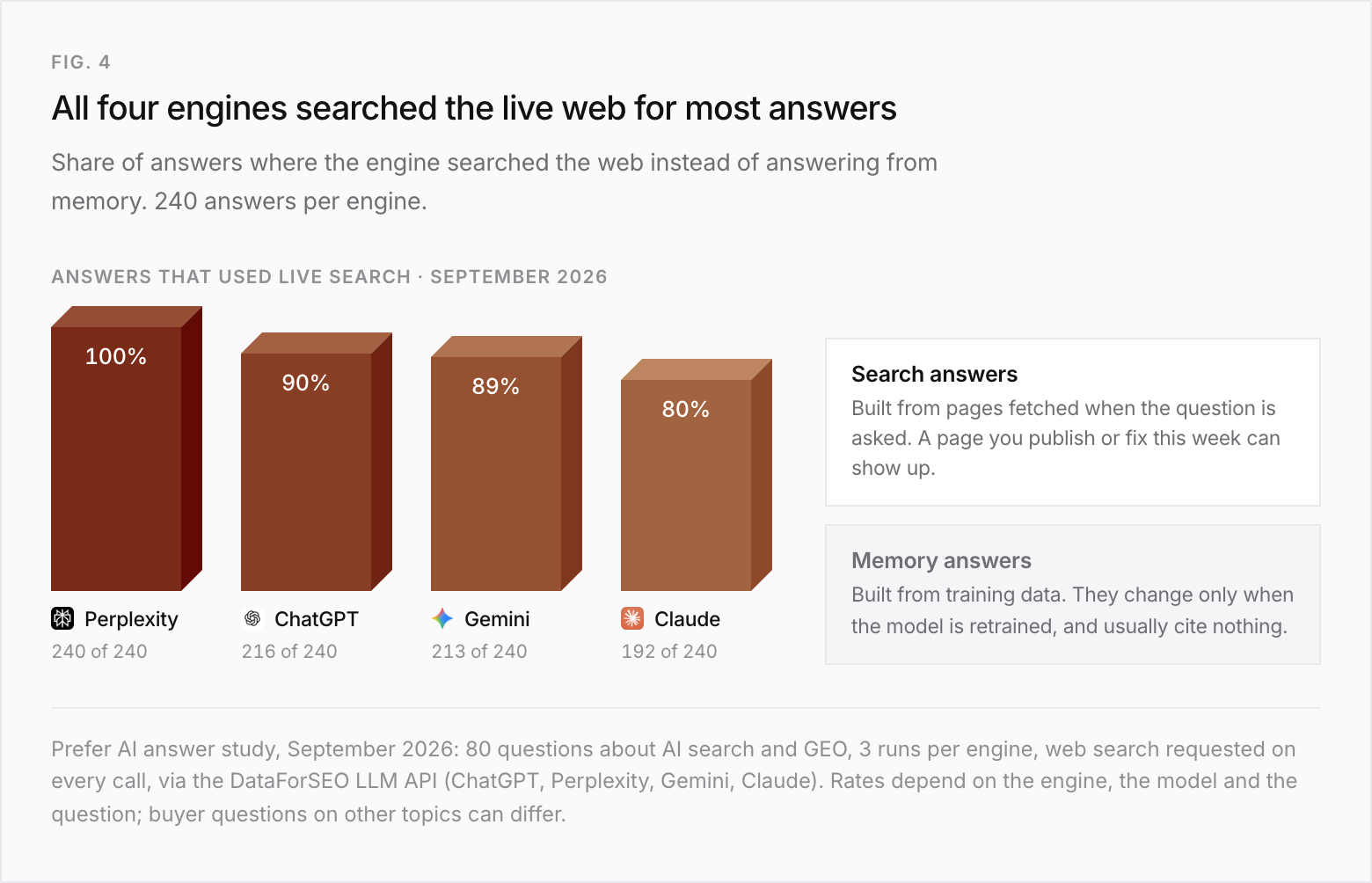
Even the choice to search is not fixed. Asked the same question three times, ChatGPT made the same search-or-memory decision in all three runs on 95% of questions, Perplexity on 100%, and Gemini and Claude on 84%.
| Answers from search | Answers from memory | |
|---|---|---|
| Built from | Pages fetched when the question is asked | What the model learned in training |
| Sources cited | Usually | Usually none |
| How fast your changes can show | Once the page is crawled, indexed and found by the engine’s searches | Only after the model is retrained |
| What you can do | Fix and publish pages; earn presence on the sites that rank | Build a public footprint that future training data will include |
The practical read: most of the answers that matter to you are built from search, so pages you fix this month can appear in them. Memory answers move slowly, and the only lever there is a steady, long-term presence across the web.
Do all AI engines work the same way?#
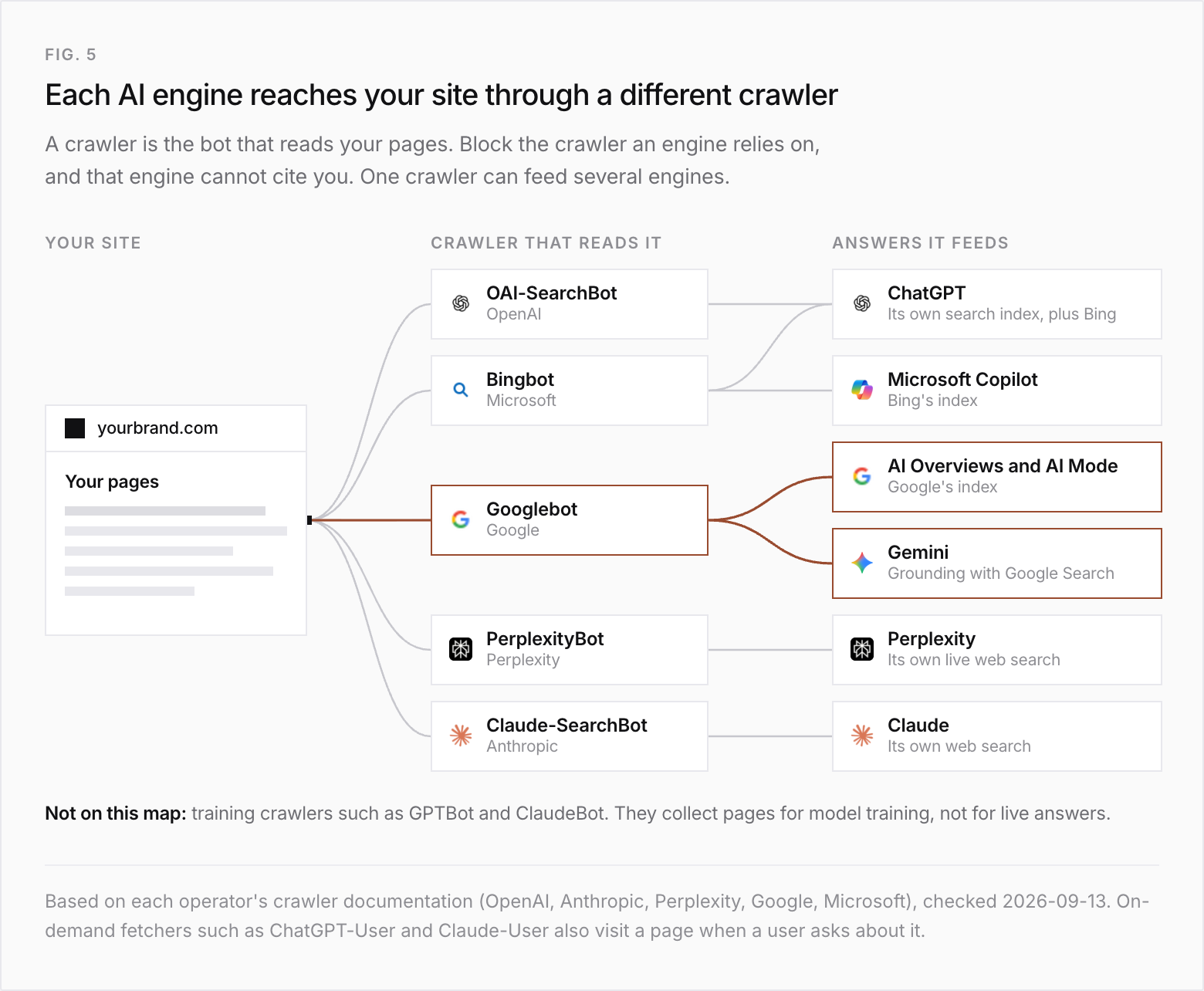
No. They share the six steps, but each engine gets its web results from a different place, reads your site with a different crawler, and cites a different number of sources. A win on one engine often does not carry over to another.
A crawler is the bot that reads your pages. If you block the crawler an engine relies on, that engine cannot cite you.
| Engine | Where its web results come from | Crawler to allow | Sources per answer (Sept 2026) |
|---|---|---|---|
| ChatGPT | Its own search index (Bing widely reported, not documented) | OAI-SearchBot | 3.0 |
| AI Overviews and AI Mode | Google’s index | Googlebot | Not measured |
| Gemini | Grounding with Google Search | Googlebot | 8.6 |
| Perplexity | Its own live web search | PerplexityBot | 19.5 |
| Claude | Its own web search | Claude-SearchBot | 4.6 |
| Copilot | Bing’s index | Bingbot | Not measured |
A short profile of each engine#
ChatGPT decides question by question whether to search. When it does, it cites only a few sources (3.0 per answer in our study, and 218 different sites across 240 answers), so each slot is valuable and competition for it is tight. What it cites depends heavily on the topic. In our August 2026 Reddit study of B2B software questions, Reddit was its most-cited source by far, yet in the September study about AI search it cited Reddit in only 16 of 240 answers. Guide: how to appear in ChatGPT search results.
Google AI Overviews and AI Mode draw on Google’s own index, so normal Google eligibility comes first: if Googlebot can crawl and index your page, it can be cited. Google fans a question out into many searches, which is why pages outside the top 10 get cited. On software buyer questions in August 2026, Reddit was the second most-cited source on Google’s AI, behind only YouTube, on 24 of 25 queries. Guides: AI Overviews and AI Mode.
Gemini grounds its answers with Google Search. It cited 8.6 sources per answer and leaned on video more than any other engine: YouTube appeared in 113 of its 240 answers, while ChatGPT, Perplexity and Claude cited YouTube in none. Reddit appeared in 93. Guide: how to appear in Google Gemini.
Perplexity searched the web for every answer and cited the most sources: 19.5 per answer and 748 different sites across 240 answers. It was also the steadiest engine: two runs of the same question shared, on average, 96% of the sites cited across both. It cited Reddit in 98 of 240 answers and LinkedIn in 73 (30.4%), where ChatGPT and Gemini cited LinkedIn in none. Guide: how to get cited by Perplexity.
Claude searched for 80% of answers in our study and cited 4.6 sources per answer. It did not cite Reddit once in 240 answers; its most-cited sites were the blogs of AI visibility and SEO software companies. Guide: how to get cited by Claude.
Microsoft Copilot builds on Bing’s index, so Bingbot access and Bing indexing come first. ChatGPT is widely reported to use Bing results too (OpenAI’s crawler documentation does not say so), so Bing may count for two engines. Guide: how to appear in Copilot.
Some engines cite far more sources than others#
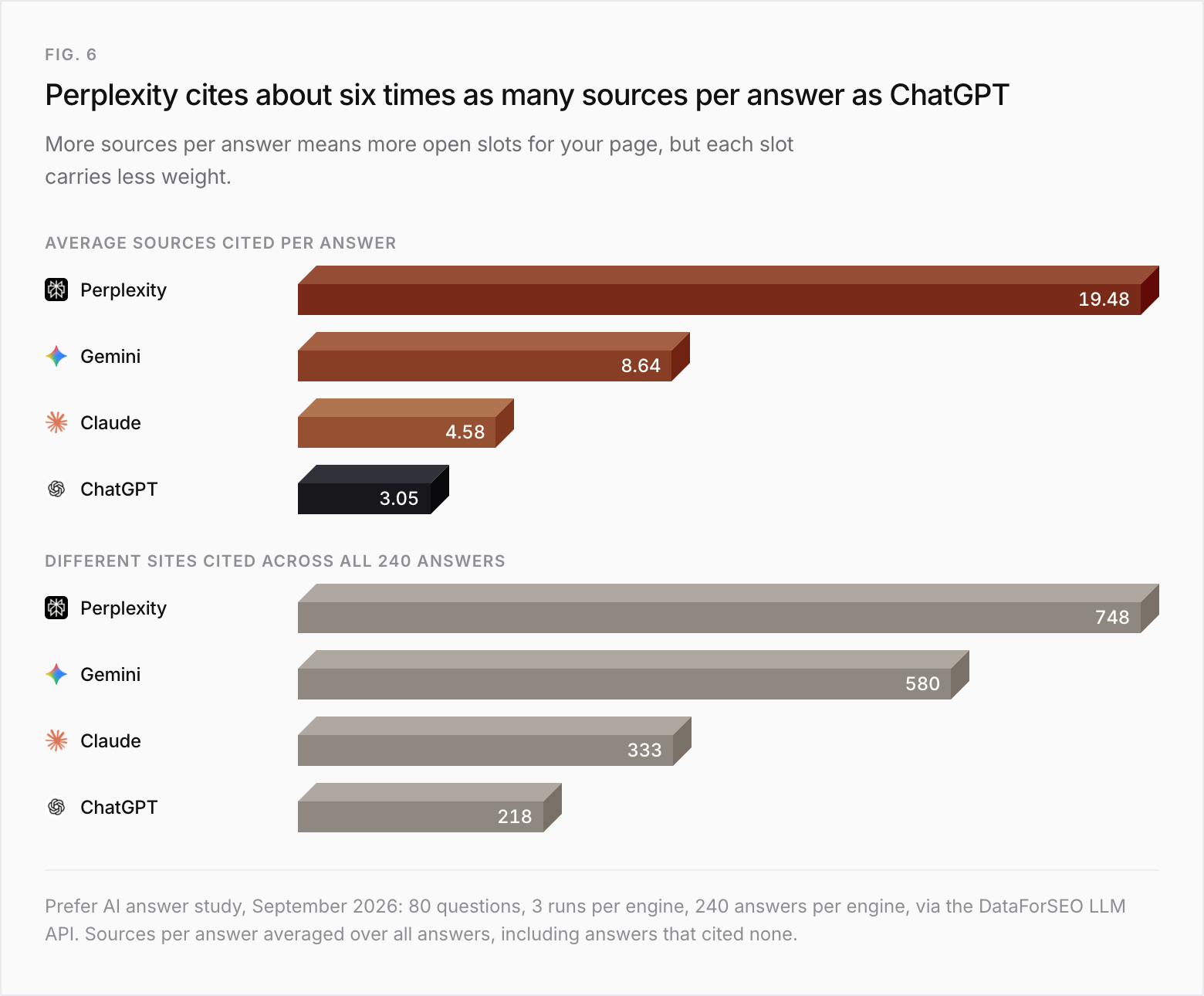
Perplexity cited about six times as many sources per answer as ChatGPT: 19.5 against 3.0, with Gemini at 8.6 and Claude at 4.6. Across 240 answers each, Perplexity cited 748 different sites, Gemini 580, Claude 333 and ChatGPT 218.
More sources per answer means more open slots for your page, but each slot carries less weight. Being one of three sources in a ChatGPT answer is a strong signal. Being one of twenty in Perplexity is easier, and worth less on its own.
The engines rarely cite the same sites#
The engines barely agree on sources. Across 960 answers, 1,329 different sites were cited; only 29 were cited by all four engines, and 966 were cited by just one. Another 205 were cited by two engines and 129 by three. Question by question the overlap is thinner still: on 69 of the 80 questions, not a single site was cited by all four engines. Our July study of buyer questions showed the same pattern: 5 of 713 domains were cited by all four engines.
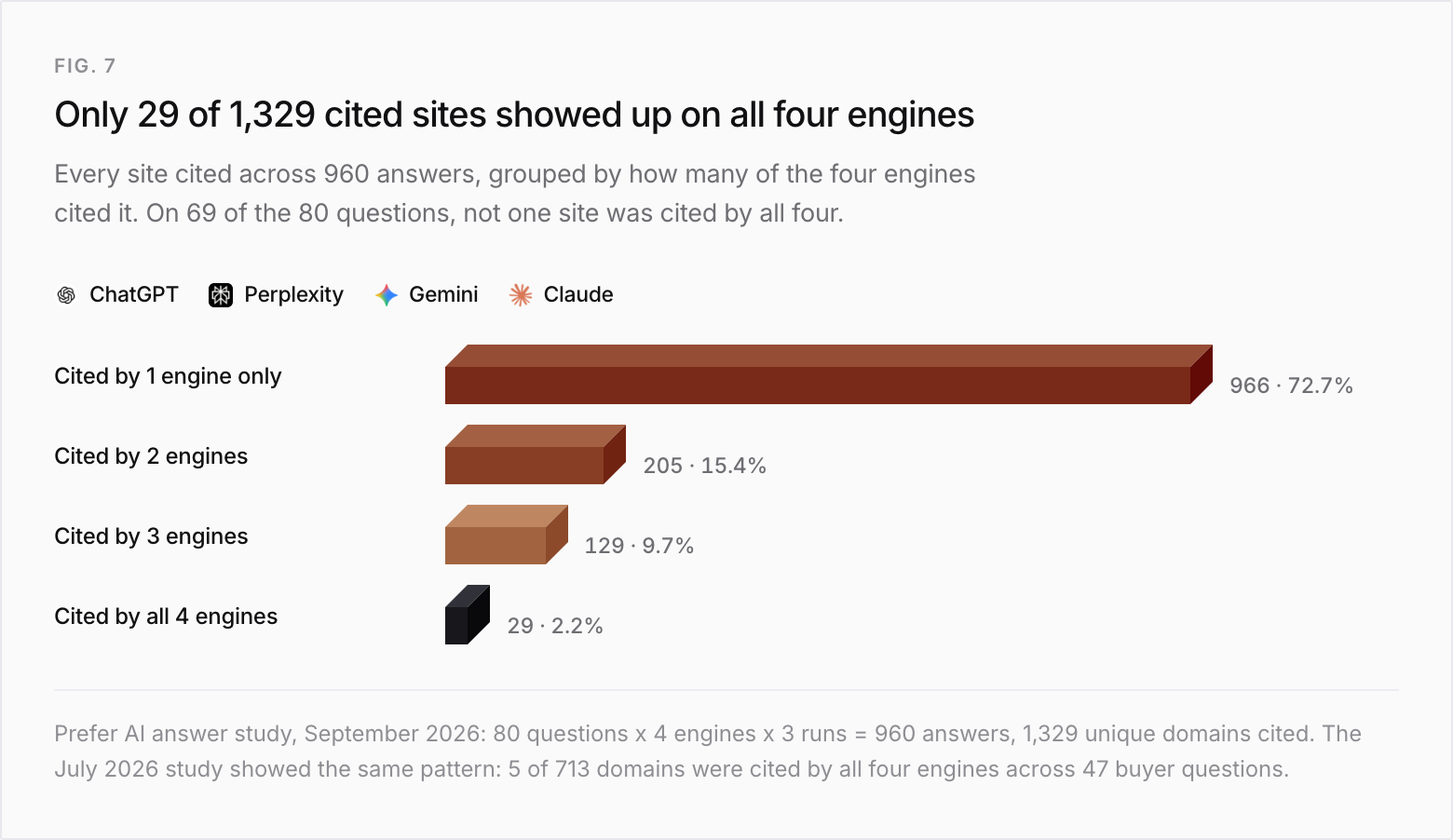
This changes how you plan. Being cited by one engine tells you little about the others, so track each engine separately and find out which ones your buyers actually use.
The engines are not even consistent with themselves. Two runs of the same question shared, on average, 37% of the sites cited across both on ChatGPT, 35% on Gemini, 68% on Claude and 96% on Perplexity. We come back to what that means in How do you measure GEO?
Mentions, citations and recommendations: three different wins#
An AI answer can give your brand three different things, and they do not always come together:
- A mention: your brand is named in the answer text. It counts even when there is no link.
- A citation: one of your pages is linked as a source. See what counts as an AI citation.
- A recommendation: the answer tells the reader to choose you. This is the win that sends buyers.
Being cited and being recommended are different. A page can be a source for an answer that recommends a competitor. Your comparison page might be the source for a line that picks a rival. A Reddit thread might be cited while the answer names you without linking your site. And an answer from memory can mention you with no citations at all.
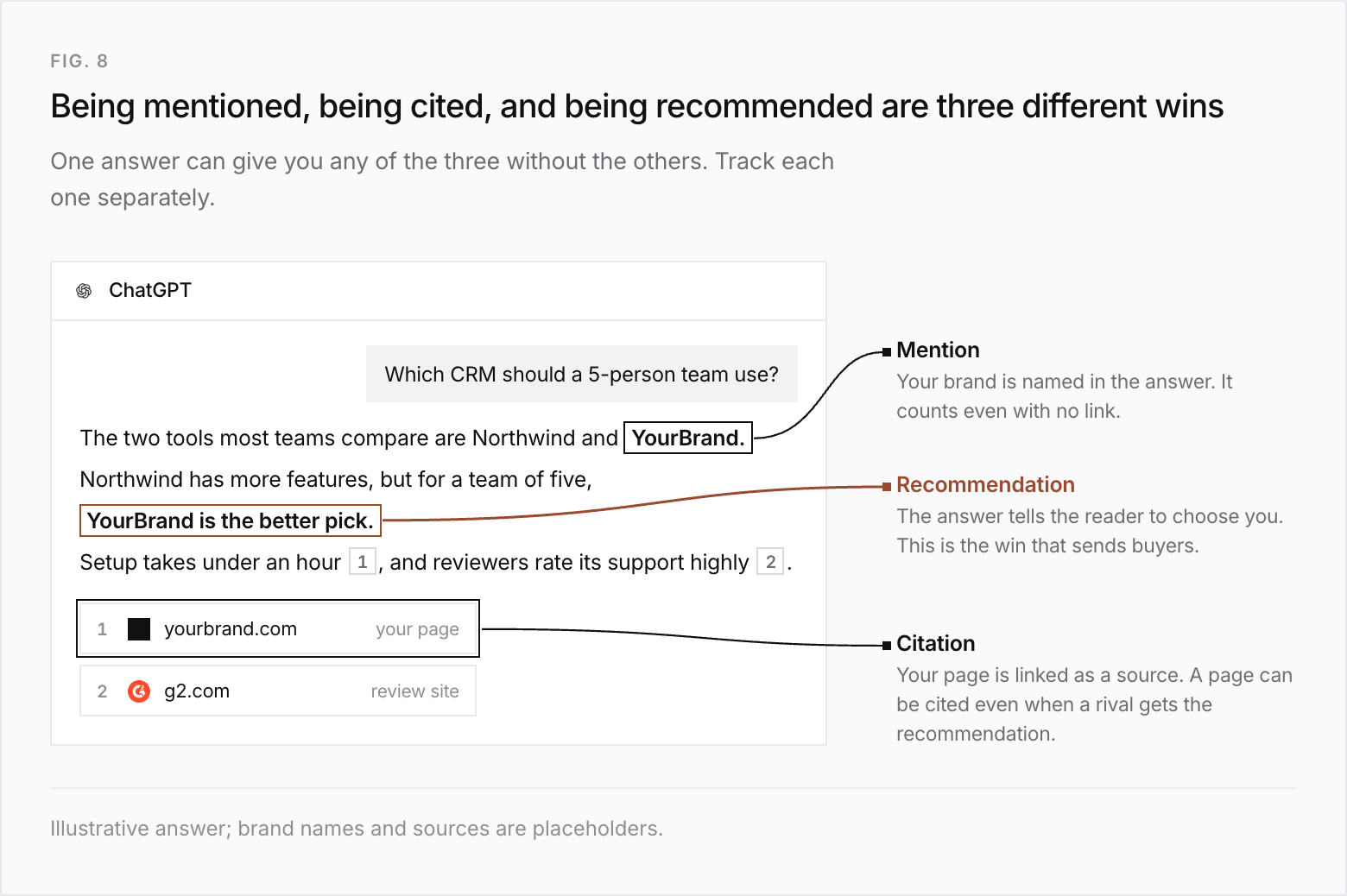
Track all three separately. Mentions and recommendations are what buyers read. Citations show which pages an engine trusts, and they send some traffic. A rising citation count with flat mentions can mean the engine uses your content but names other brands. The difference between a mention and a citation matters most when you report results, because a dashboard that adds them together hides which one moved.
What do AI engines cite?#
Your own website is only part of what AI reads. In our July 2026 study of 1,237 citations, independent roundup articles took 40.2%, vendors’ own sites 34.0%, big media and SaaS blogs 15.3%, community sites 3.6%, review sites 3.5% and video 2.6%. The remaining 0.9% went to other sites such as Wikipedia. Put together, about two thirds of citations went to sites the vendors did not own.
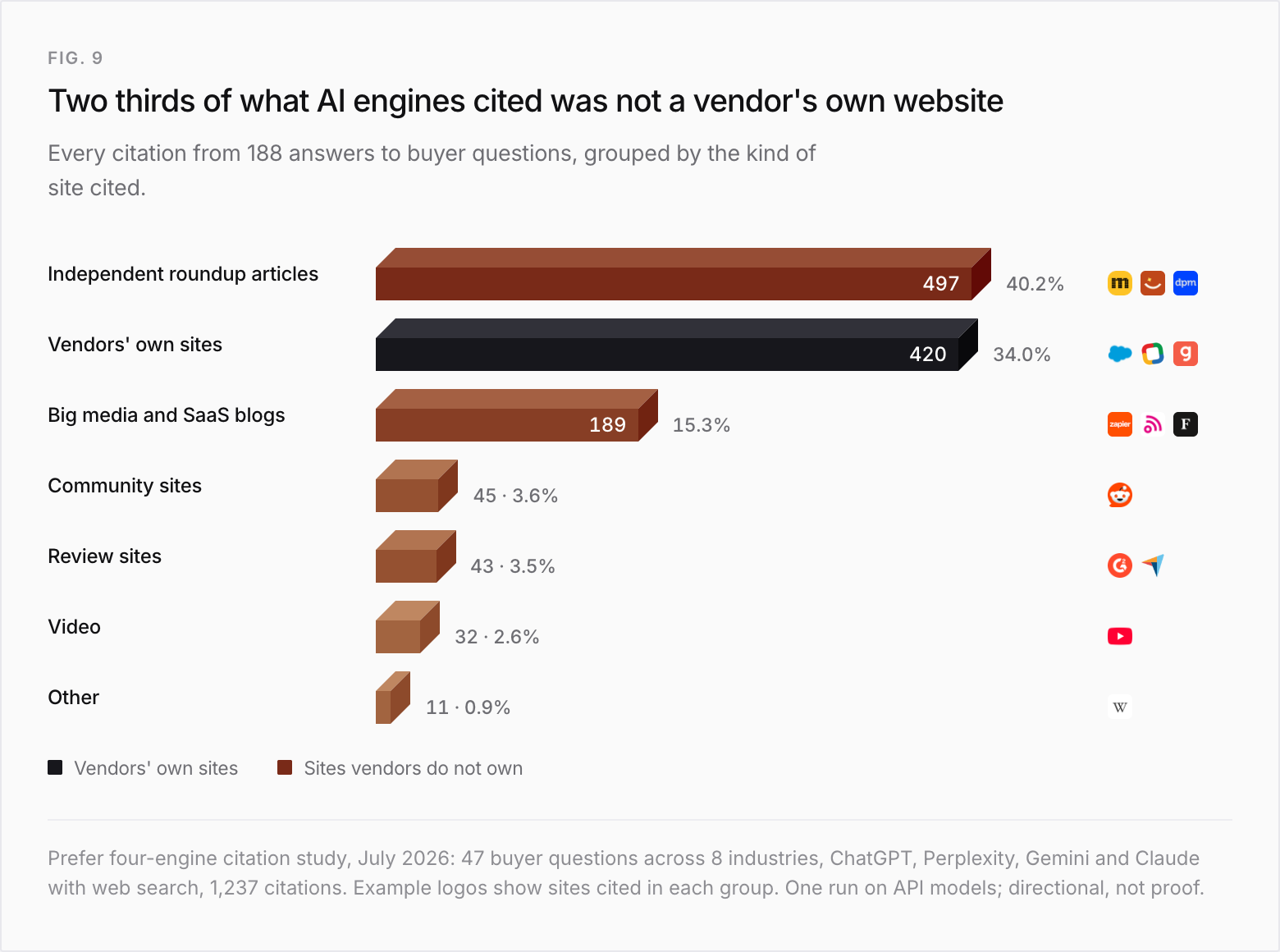
The study covered 47 buyer questions across 8 industries, with one run per question, so treat the exact shares as directional. The full write-up breaks them down by industry, where the mix changes a lot.
A few patterns stand out across our studies:
- Roundups carry the most weight for “best X” questions. “Best CRM for startups” articles are built to answer exactly the questions buyers ask. Many are written by vendors that rank themselves first: in the September study, 38.6% of the sources cited for tool questions were “best tools” lists published by vendors.
- Reddit matters, but not on every engine. Across 25 B2B software buyer questions in August 2026, Reddit made up about 30% of ChatGPT’s citations and ranked first on all 25. In the September study on AI search topics, Perplexity cited Reddit in 98 of 240 answers, Gemini in 93, ChatGPT in 16 and Claude in none.
- Video matters for Google’s AI. YouTube led on Google’s AI in the August study and appeared in 113 of Gemini’s 240 answers in September.
- Review sites are cited widely. G2 was one of only five domains cited by all four engines in the July study.
Sources you control and sources you can influence#
It helps to split sources into two groups. Owned sources are the ones you control: your website, your docs, your blog. Earned sources are the ones you can only influence: reviews, community threads, roundup articles, videos made by others, press coverage and reference pages such as Wikipedia.
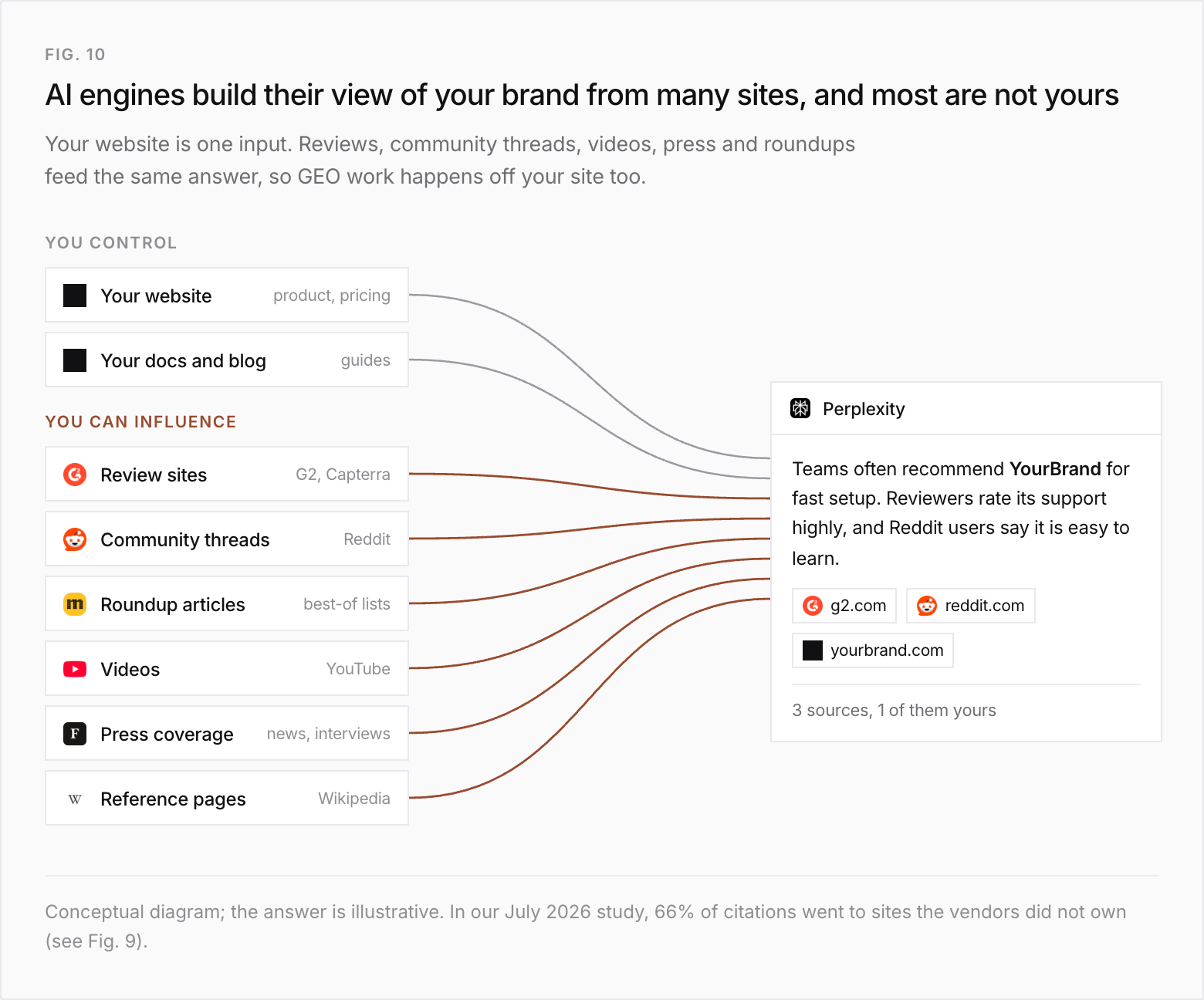
Work on owned sources is fast and fully in your hands. Work on earned sources is slower and depends on other people, and it is where most citations go. A claim confirmed by several independent sites is also easier for any reader to believe than the same claim on your homepage.
Shortcuts on earned sources tend to backfire. Fake reviews, undisclosed Reddit accounts and paid placements dressed up as independent lists can be removed by moderators, flagged by review sites, and spotted by the buyers who click through.
Does GEO replace SEO?#
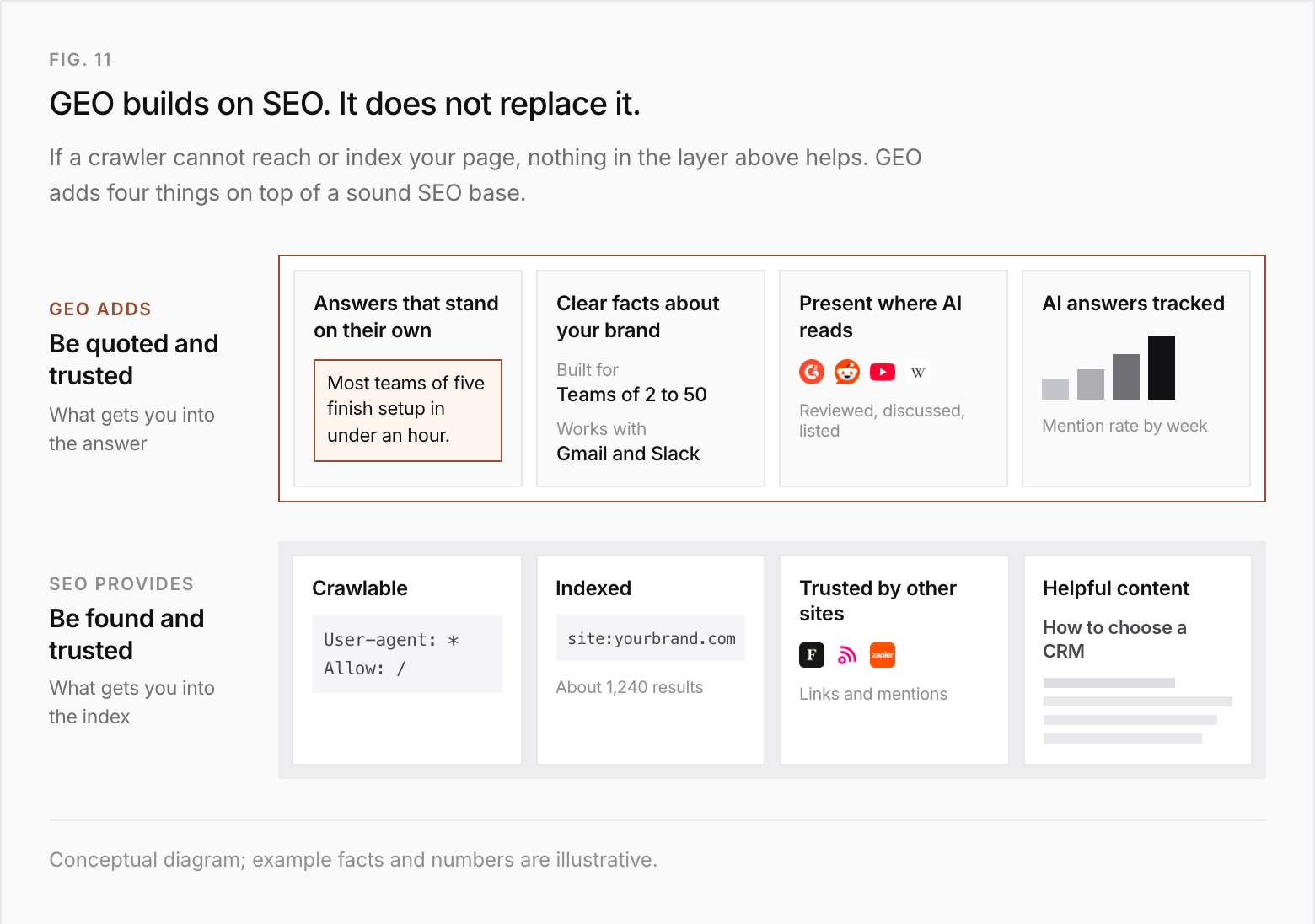
No. GEO builds on SEO rather than replacing it. Pages still need to be crawlable, indexed and trusted; GEO adds answers that can be quoted on their own, clear facts about your brand, presence on the sites AI reads, and tracking of AI answers. The engines agree: when we asked them “Is GEO replacing SEO?” and “Do I still need SEO if I’m doing GEO?”, all 24 answers said GEO adds to SEO rather than replacing it.
What carries over from SEO:
- Crawling and indexing. Answers built from search start with pages a search index already holds.
- Authority. Links and mentions from trusted sites help a page rank for the searches an engine runs.
- Helpful, specific content. Pages written for people, with real detail, are the pages engines quote.
- Technical health. Fast pages whose text is in the HTML are easier for every crawler to read.
What is new in GEO:
- Writing in quotable passages. Each section should make sense on its own, because engines lift passages, not pages.
- Consistent facts about your brand. What you do, who it is for, what it costs and what it works with, stated the same way on your site and everywhere else.
- Off-site presence as a direct source. A Reddit thread or a G2 page can be cited itself, on top of passing authority to your site through a link.
- Measuring answers, not rankings. There is no fixed position to track, so you sample answers repeatedly.
- Several engines at once, each with its own sources and habits.
Our GEO vs SEO comparison goes through the differences in detail: what is different, where they overlap, and how to run both.
How do you do GEO?#
GEO work falls into three parts: your pages, the technical setup, and your presence on other sites. None of it is exotic. What sets it apart from ordinary content work is the discipline of writing for extraction and the patience to build a reputation elsewhere.
No single change guarantees a citation. The work that moves it is clear pages, open crawler access, and a real presence on the other sites AI reads.
On your pages#
Engines quote passages, so build pages out of passages worth quoting. The checklist:
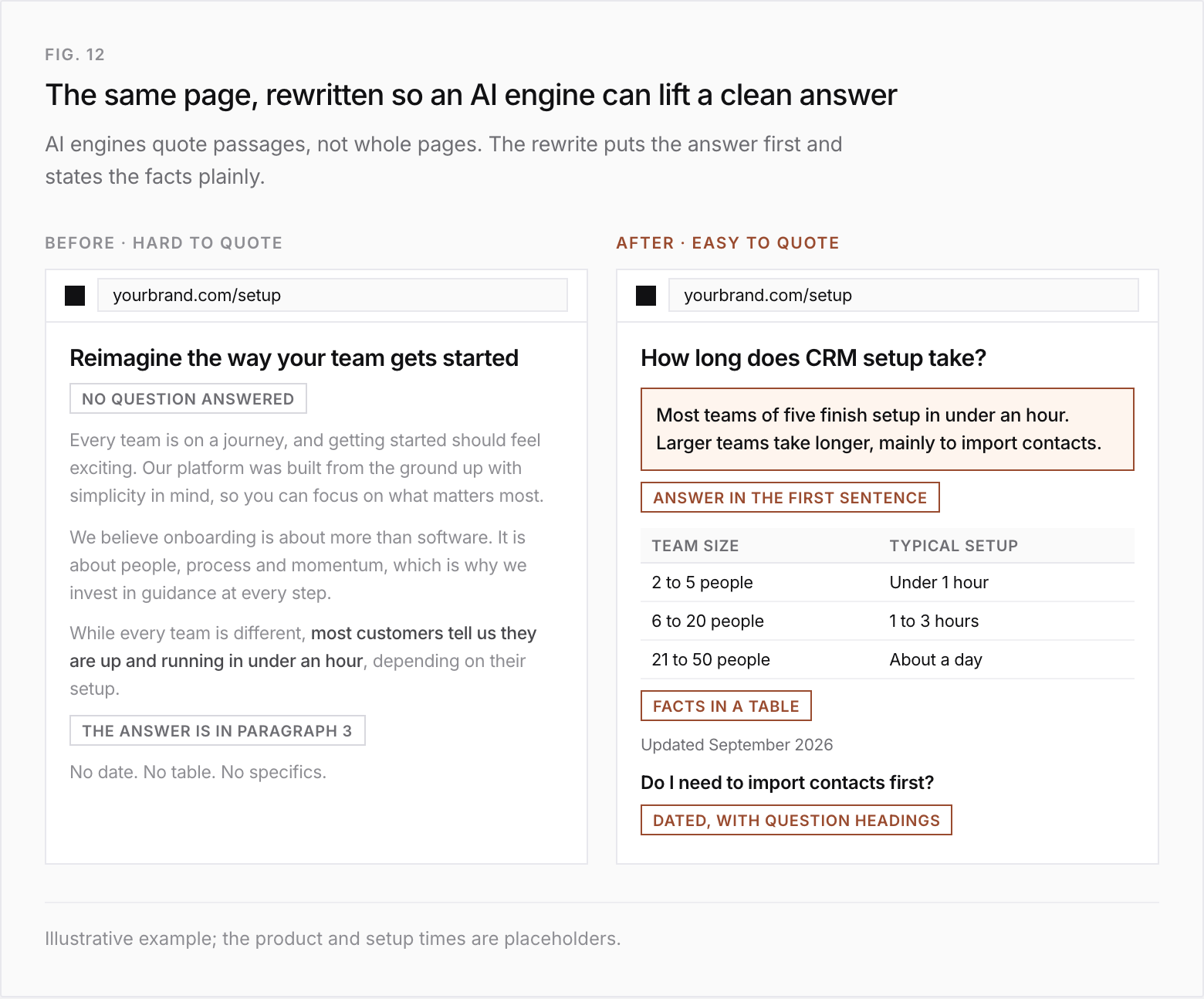
- Lead with the answer. The first sentence under each heading should answer that heading on its own. If someone read only that sentence, would they have the answer?
- Use headings that match real questions. “How long does CRM setup take?” matches how buyers ask. “Reimagine the way your team gets started” matches nothing.
- Keep each passage self-contained. Avoid “as mentioned above” and pronouns that point back to earlier sections. Name the thing again.
- State facts with numbers. Prices, limits, setup times, supported integrations, team sizes. “Fast setup” is not quotable; “most teams of five finish setup in under an hour” is.
- Put comparisons in tables. Rows and columns are easy to read and easy to lift.
- Date what changes. Show when the page was last updated, and date time-sensitive facts inline.
- Say who it is for, and who it is not for. Buyers ask “best X for Y” questions, and this sentence is what answers them.
- Answer the follow-up questions in a short FAQ written from real sales calls and support tickets.
Figure 12 shows a typical rewrite. The before version buries its one useful fact in the third paragraph. The after version answers in the first sentence, puts the details in a table, and adds a date and a follow-up question.
You can score a page against checks like these with our free Answer Readiness Scorer. For the full on-page method, see the AEO Playbook.
Technical setup#
The technical side of GEO is mostly about letting the right crawlers in and making sure they can read what they find.
- Let the search crawlers in. The five that feed live AI answers are OAI-SearchBot (ChatGPT), Claude-SearchBot (Claude), PerplexityBot (Perplexity), Googlebot (Google Search, AI Overviews, AI Mode and Gemini) and Bingbot (Bing and Copilot). If robots.txt blocks one of them, that engine cannot cite you.
- Know which crawlers are for training. GPTBot and ClaudeBot collect pages to train future models; they do not fetch pages for live answers. Blocking them keeps your content out of future training without removing you from today’s search answers. Google-Extended works differently again: it controls whether Gemini can use your pages for training and for grounding, and it has no effect on Google Search or AI Overviews.
- Expect on-demand visits too. ChatGPT-User and Claude-User fetch a page when a user asks about it. OpenAI says robots.txt rules may not apply to ChatGPT-User, because a person started the visit, and notes that changes to its crawler rules take about 24 hours to register.
- Put your content in the HTML. Many AI crawlers do not run JavaScript. If your key text only appears after scripts load, a crawler may see an empty page. View the page source and search for your main answer; if it is not there, fix the rendering.
- Treat structured data as helpful, not magic. Schema markup helps machines parse a page, but there is no public evidence that it causes AI citations on its own (what we know about schema and AI citations). Google stopped showing FAQ rich results in May 2026, so FAQ markup no longer earns a search feature either.
- Do not count on llms.txt. It is a proposed file that lists your key pages for AI tools, and it has no proven effect on citations so far (the evidence on llms.txt). It is cheap to add, but it is not a strategy.
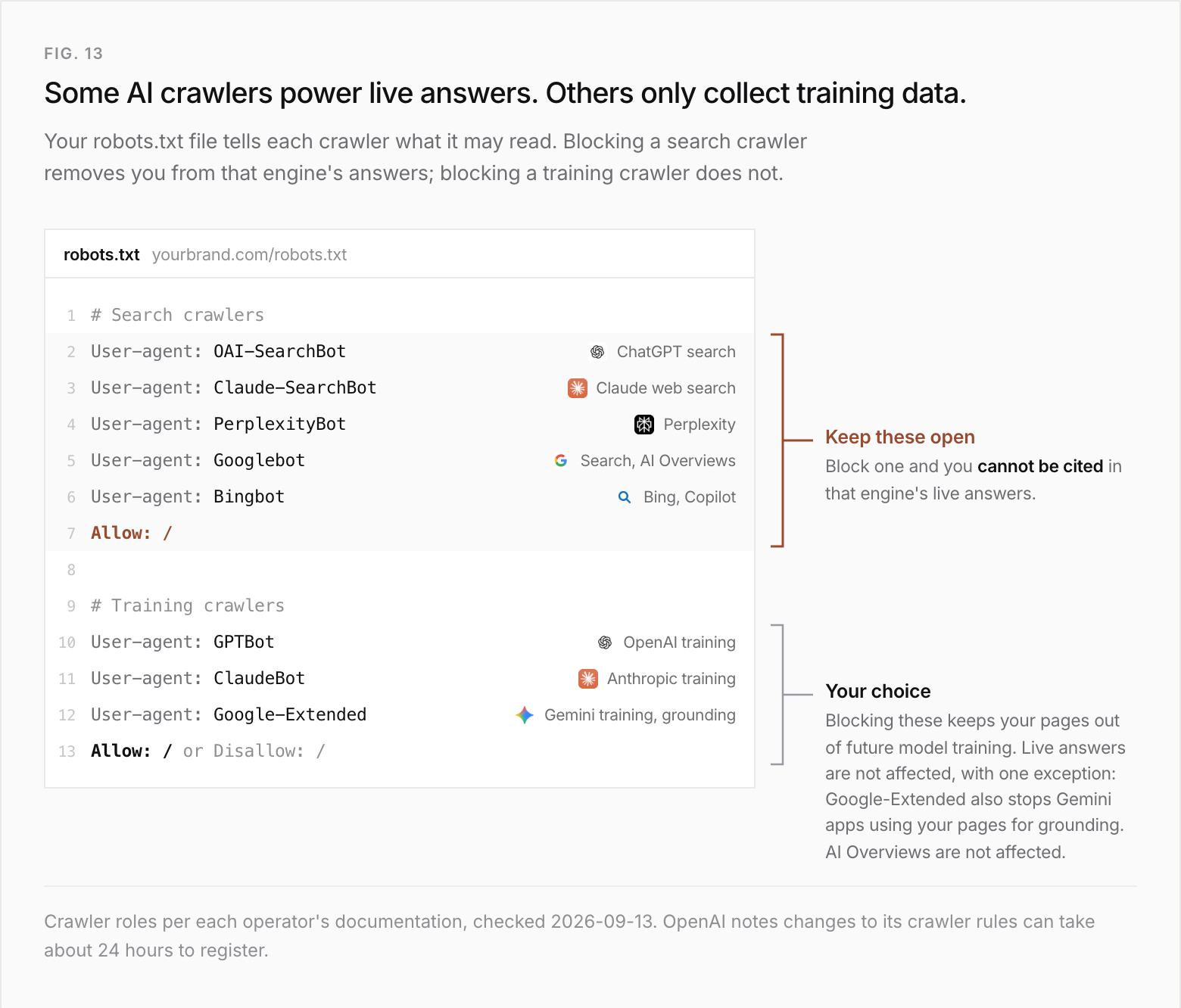
Check your current file against the named AI crawlers with the free AI Crawler Access Checker.
Off your site#
Two thirds of the citations in our July study went to sites vendors did not own, so this part is not optional. Work where your buyers and the engines already look:
- Review sites. Ask recent customers to review you on G2, Capterra or whichever review site leads your category. Reply to reviews, including the critical ones.
- Community threads. Take part in the subreddits and forums where your buyers ask questions. Answer the question asked, say that you work for the company, and link only when it helps. Our guide to using Reddit for AI visibility covers what works and what gets you banned.
- Roundup articles. Find the “best X” lists that engines cite for your category; your baseline measurement will show you which. Give the authors accurate, current information, a trial account and clear pricing. Favor lists that test products and explain how they choose.
- Video. For Google’s AI and Gemini, a clear YouTube walkthrough of a common task gives the engine something to cite for “how do I” questions.
- Press and original data. Publish numbers other people want to quote: a survey, a benchmark, a study of your own product data. Original data gives other sites a reason to mention you and gives engines a specific fact to cite.
- LinkedIn articles. Perplexity cited LinkedIn in 73 of 240 answers in our September study, though ChatGPT and Gemini cited it in none.
- Wikipedia, only if you are genuinely notable. Wikipedia’s conflict of interest guideline strongly discourages writing about your own company, and a deleted article helps no one.


All of this has to be real. Real participation takes longer than posting from fake accounts, and it is the only kind that lasts. For more, see how to show up in AI search and whether backlinks matter for AI search.
How do you measure GEO?#
No AI engine gives you a report of where you appear in its answers, so you measure by asking. The method:
- Pick the questions your buyers ask. Start with 10 to 50. Mix category questions (“best CRM for a small agency”), comparisons (“Tool A vs Tool B for agencies”), problems (“how do I track deals from Gmail”) and brand questions (“is YourBrand good for agencies?”). See how many prompts to track.
- Ask each question several times on each engine. Three runs is a sensible minimum, because answers change from run to run.
- Record the same fields every time: whether you were mentioned, cited and recommended; which competitors were named; which sites were cited.
- Turn the records into rates and watch the trend week to week.
Measure AI visibility as a rate over repeated runs, not a single screenshot, because the same question returns different sources from one run to the next.
| Metric | How to calculate it | What it tells you |
|---|---|---|
| Mention rate | Runs where you are named, divided by total runs | How often buyers see your name |
| Citation rate | Runs where your page is cited, divided by total runs | How often engines use your pages as a source |
| Share of voice | Your brand mentions, divided by all brand mentions | Your slice of the answers compared with competitors |
| Source share | Citations for a domain, divided by all citations | Which sites shape answers in your category |
Figure 14 works through a small example. One question is asked three times on ChatGPT. YourBrand is named in two runs, so its mention rate is 67%. Its page is cited in one run, so its citation rate is 33%. Across the three runs nine brand names appear and two of them are YourBrand, so its share of voice is 22%.
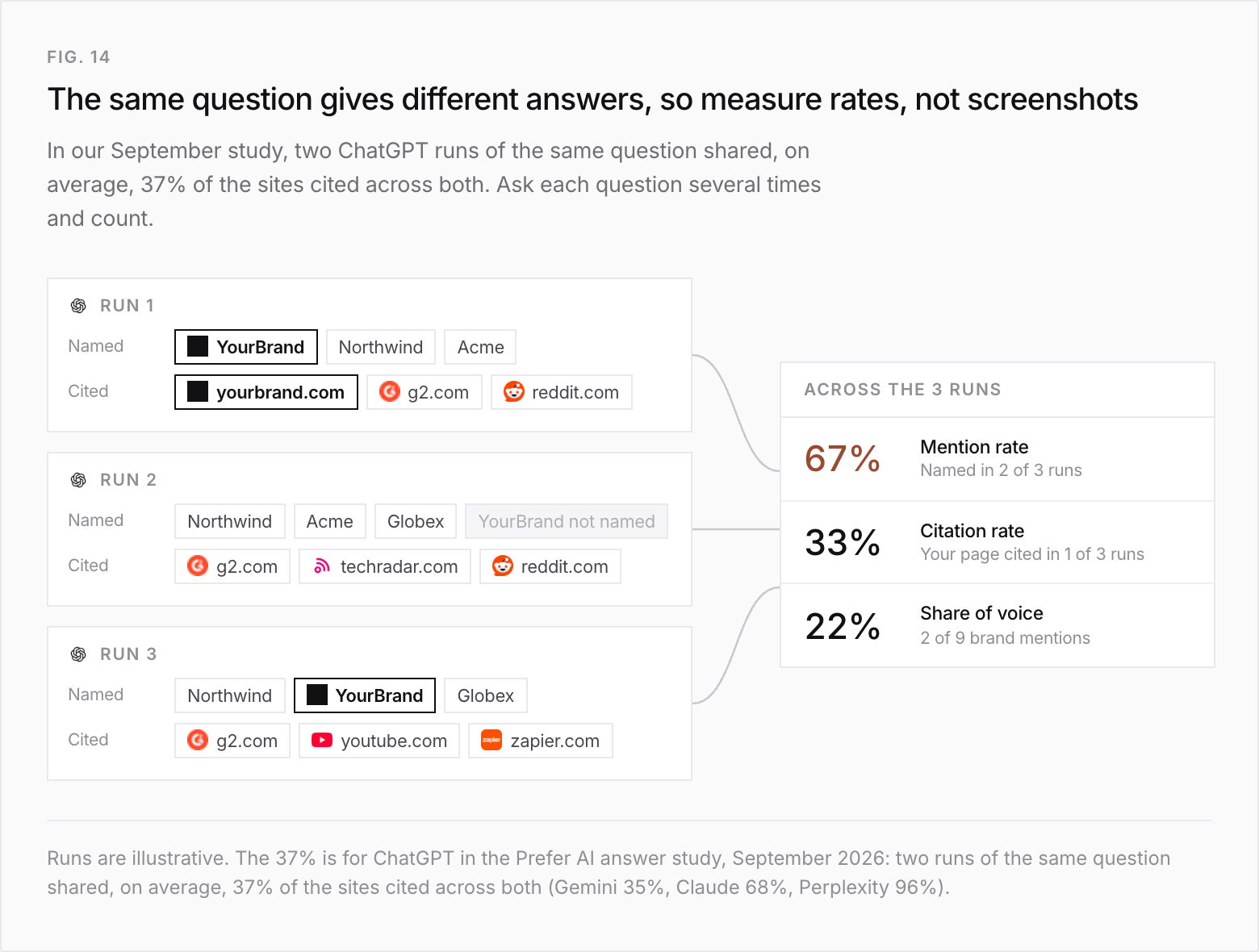
Three runs of one question is only a demonstration. Real measurement needs many questions and several runs each, and small week-to-week changes are often noise. Look for trends that hold over several weeks, and compare engines separately rather than blending them into one number.
Two more cautions. Answers collected through an API, the way tools and studies collect them, can differ from what a logged-in person sees in the app, where location, history and personalization can change the reply. And a screenshot from one person’s account is the weakest evidence of all, because it captures one run in one context.
You can do all of this in a spreadsheet, and the method matters more than the tool. Prefer runs it for you: a fixed set of buyer questions asked repeatedly across the major AI engines, with mention rate, citation rate, share of voice and the sources behind each answer tracked week to week, plus help shipping the page and off-site work that moves those numbers. Our GEO platform page explains what Prefer does, and our ranked list of the best GEO tools compares it with the alternatives, prices verified. To see where you stand today, run a free AI visibility audit, or try the AI Visibility Checker for a quick first look.
For the method in more depth, see how to measure AI visibility, how to track brand mentions in AI, and the AEO loop, the weekly routine we use ourselves.
Your first 30 days of GEO#
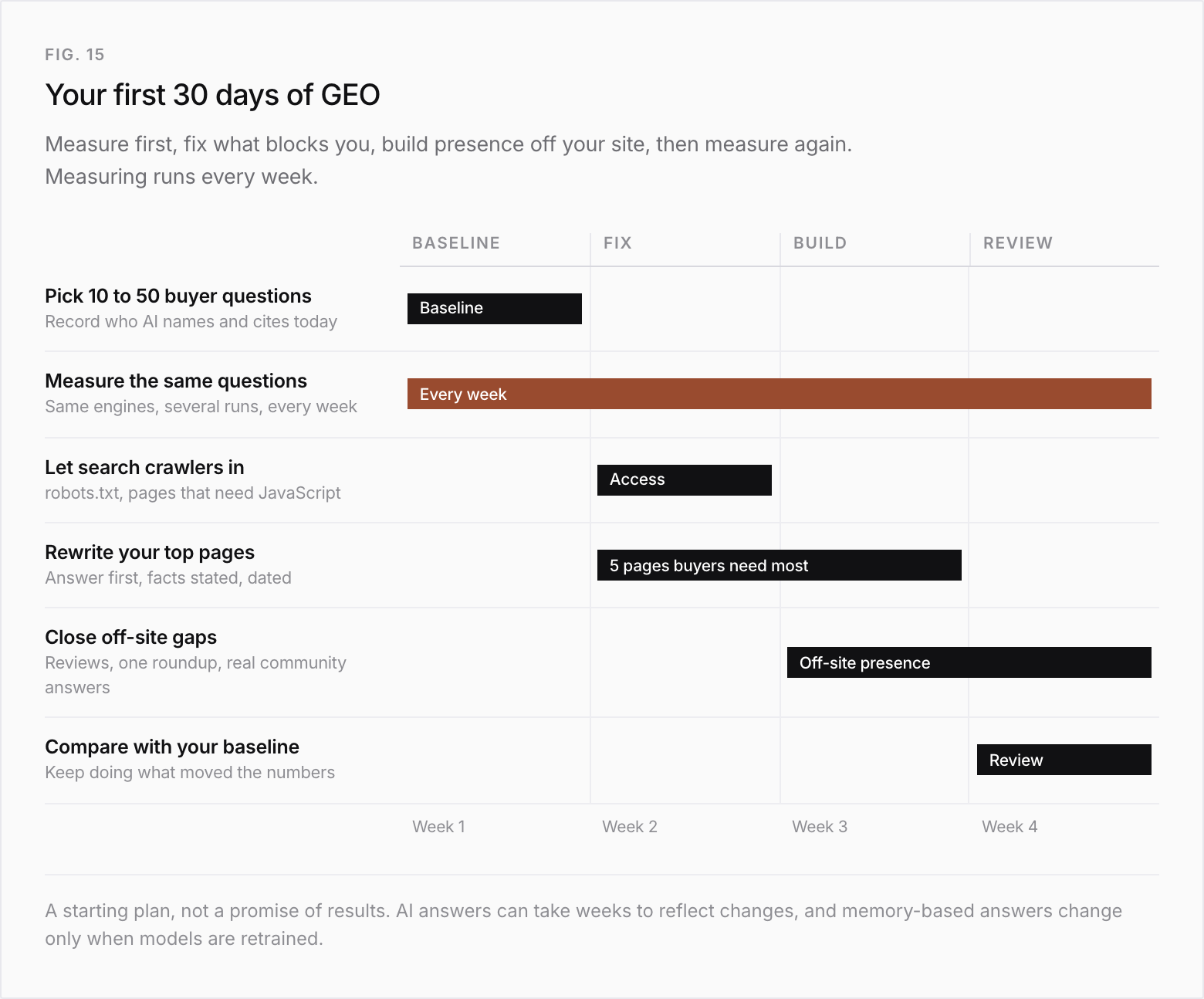
Week 1, measure 10 to 50 buyer questions; week 2, open crawler access and rewrite your top pages answer-first; week 3, close your biggest off-site gaps; week 4, measure again and keep what moved the numbers.
Week 1: measure a baseline#
Write down 10 to 50 questions your buyers ask. Sales calls, support tickets and Google’s “People also ask” boxes are good places to find them. Ask each question three times on every engine you care about, and log the results in a spreadsheet with one row per answer: engine, question, run, mentioned, cited, recommended, competitors named, and sites cited.
At the end of the week you have two things: your starting rates, and a list of the sites engines cite in your category. That list is your target list for week 3.
Week 2: fix access and your top pages#
Start with access, because nothing else matters if crawlers are blocked. Check robots.txt for the five search crawlers, check your firewall or CDN bot settings, and view the source of your key pages to confirm the main text is in the HTML.
Then pick the five pages buyers need most. For most companies that means pricing, the main product or use-case page, a comparison page, a setup or onboarding page, and an integrations page. Rewrite each one so every section opens with a direct answer, facts are stated with numbers, comparisons sit in tables, and the page shows when it was last updated.
Week 3: close off-site gaps#
Go back to the list of cited sites from week 1 and pick the gaps that matter most. A realistic week looks like this:
- Ask ten recent customers for a review on the review site that leads your category.
- Contact the authors of two roundup articles that engines cite and that leave you out, with accurate information and a trial account.
- Answer five real questions in the community where your buyers talk, with your affiliation disclosed.
Week 4: measure again and decide what to keep#
Run the same questions, on the same engines, the same number of times. Compare mention rate, citation rate and share of voice with week 1, engine by engine. Keep doing the work that moved a number, and drop what did not.
Set expectations honestly. Answers built from live search can change within weeks. Answers from memory change only when models are retrained, which can take months. A flat result at day 30 is common, and it is not a reason to stop.
GEO myths and mistakes#
Myth: you can pay to appear in ChatGPT’s answers. You cannot buy organic mentions or citations. ChatGPT’s ads are labeled and separate. Anyone selling “guaranteed ChatGPT placement” is selling something else, usually content placed on the sites engines read.
Myth: llms.txt gets you cited. There is no proven effect so far. In 96 engine answers about LLM SEO tactics in our September study, llms.txt came up only 6 times.
Myth: schema markup is the main lever. The engines themselves recommend it constantly (schema came up in 56 of 60 how-to answers about LLM SEO in our study), but a recommendation is not evidence. Treat schema as good hygiene, and put most of your effort into clear content and your reputation on other sites.
Myth: GEO replaces SEO. Search answers are built from search results. Drop your SEO and you drop the pages engines read.
Myth: lots of AI-written pages will flood the answers. Engines pick the clearest passage for each sub-question, and a pile of thin pages rarely contains one. Google also treats mass-produced, low-value pages as spam under its scaled content abuse policy.
Mistake: ranking yourself first on your own “best tools” list. It is common, and engines do cite these lists. But buyers who click through can tell, and it trades your credibility for a citation.
Mistake: fake reviews and undisclosed community accounts. Review sites and community moderators remove them, and in the US the FTC’s rule against fake reviews, in force since October 2024, adds legal risk.
Mistake: judging GEO from one screenshot. One answer is one sample. The next run may cite different sites entirely.
Mistake: blocking the wrong crawler. Blocking GPTBot to keep your content out of training is a reasonable choice. Blocking OAI-SearchBot by accident removes you from ChatGPT search answers.
Key terms#
- Generative engine: a search tool that uses a language model to write an answer from the sources it finds, such as ChatGPT search, Perplexity or Google AI Overviews.
- Answer engine: any tool that replies with one written answer instead of a list of links. Often used as a synonym for generative engine.
- Query fan-out: splitting one question into several related searches before answering.
- Grounding: basing an answer on retrieved sources rather than on memory alone.
- AI citation: a link to a source shown in or beside an AI answer.
- Citation rate: the share of answers, across repeated runs, that cite your pages.
- Share of voice: your brand’s share of all brand mentions in answers to a set of questions.
- AI crawler: a bot that reads web pages for an AI company, either for live answers (search crawlers) or for model training (training crawlers).
- llms.txt: a proposed file listing a site’s key pages for AI tools, with no proven effect on citations.
- Zero-click search: a search that ends without a click, often because the answer was shown on the results page.
- Prompt tracking: asking a fixed set of questions repeatedly to measure how AI answers change.
For every other term, see the AI search glossary.
How we measured#
September 2026 AI answer study. 80 questions about AI search, GEO and AEO, asked three times each on four engines through the DataForSEO LLM API, with web search requested on every call: ChatGPT (gpt-5.6-luna), Perplexity (sonar-pro), Gemini (gemini-3.8-flash) and Claude (claude-sonnet-5). That makes 960 answers. We also captured the Google AI Overview, the AI Mode answer and the organic top 10 for each question. A search answer means the engine used live web results for that answer. Sources per answer are averaged over all answers, including those that cited nothing. Caveats: API models can behave differently from the consumer apps, and the questions were about our own field, so rates for other topics can differ. Every number, the full question list and the per-engine counts are on the AI answer study data page, free to download.
July 2026 four-engine citation study. 47 buyer questions across 8 industries, asked once each on ChatGPT, Perplexity, Gemini and Claude with web search on, measured on 10 July 2026: 188 answers, 1,237 citations and 713 domains. One run per question, so the results are directional. Full study.
August 2026 Reddit study. 25 B2B software buyer queries measured on ChatGPT and on Google’s AI (AI Overviews and AI Mode) on 19 August 2026. Data and method.
Search interest and volumes. Google Trends data through DataForSEO for the United States, web search, weekly from late June 2023 to 13 September 2026, averaged by quarter. Keyword volumes are DataForSEO Google Ads data for the US.
Third-party sources. Pew Research Center (July 2025), Semrush (reported by Search Engine Land, plus Semrush’s commercial search study), Ahrefs (March 2026), the GEO paper on arXiv, Wikipedia, and each AI company’s crawler documentation, checked 13 September 2026.
Further reading#
By engine:
- ChatGPT : How to appear in ChatGPT search results
- Google AI Overviews : How to appear in Google AI Overviews
- Google AI Mode : How to appear in Google AI Mode
- Gemini : How to appear in Google Gemini
- Perplexity : How to get cited by Perplexity
- Claude : How to get cited by Claude
- Copilot : How to appear in Copilot
Going deeper:
- The AEO Playbook: numbered plays for getting cited, chapter by chapter.
- Best GEO tools and best AEO tools: the ranked roundups, with a disclosed stake. All of them live under best-of lists.
- Free GEO tools: the AI visibility checker, crawler access checker, llms.txt and schema generators.
- Solutions by use case: how Prefer tracks citations, benchmarks competitors and turns insights into actions.
- GEO vs SEO and AEO vs GEO: the comparisons in full.
- Who gets cited in AI search: the July 2026 citation study.
- Reddit and AI citations: the August 2026 Reddit study.
- AI answer study: every number from the September 2026 study behind this guide, with downloads.
- AI search statistics: every number from our research, with sources.
- LLM SEO: the same work, described for SEO teams.
People also ask