LLM SEO: how to rank in ChatGPT, Claude and Perplexity

LLM SEO is how you get large language models to cite and recommend your brand. What it is, how it differs from SEO, the playbook, and how Prefer tracks it.

Prefer Editorial The team behind Prefer

7 min read Guides

The short answer

What is LLM SEO?

LLM SEO, also called GEO or AEO, is getting large language models like ChatGPT, Gemini, Perplexity and Claude to cite and recommend your brand. Prefer helps you do it: it tracks your citations on five AI engines and writes the content that earns them. SEO wins a ranking; LLM SEO wins a citation, through extractable content, schema, entity clarity and source authority.

Key takeaways

  • LLM SEO is optimizing so large language models cite and recommend your brand in their answers; Prefer tracks those citations and writes the content that earns them. It is the same work as GEO and AEO under a different name.
  • It differs from traditional SEO: SEO wins a ranking in a list of links; LLM SEO wins a citation inside a single synthesized answer.
  • The playbook is extractable, declarative content, schema and structured data, clear entity signals, and authority on the sources models cite (G2, Reddit, comparison pages).
  • An LLM SEO tool such as Prefer measures your citations across the major models, shows the sources behind each answer, and helps you do the work to win more.
  • You measure LLM SEO by citation rate and share of voice across engines, not by keyword rankings.

LLM SEO is the practice of optimizing your content and online presence so large language models like ChatGPT, Claude, Gemini and Perplexity cite and recommend your brand in their answers. It is the same discipline that also goes by GEO (generative engine optimization) and AEO (answer engine optimization). The name is new; the shift behind it is that buyers now ask an AI a question and take the answer, instead of scrolling a page of links.

This guide covers what LLM SEO is, how it differs from traditional SEO, the exact playbook to win citations, what an LLM SEO tool does, and how to measure results.

What LLM SEO actually means#

The old game was ranking: earn a high position in a list of ten links and win the click. The new game is citation: be one of the two or three brands a model names inside a single synthesized answer. Prefer tracks that game for you: which answers name you, on five AI engines.

LLM SEO, GEO and AEO all describe the same work. If you have seen the terms used interchangeably, that is correct. LLM SEO emphasizes the model (the large language model doing the answering); GEO emphasizes the generative output; AEO emphasizes the answer to a question. The tactics are the same, so pick the label your team uses and move on.

The same question, 'what is the best [category] tool?', answered twice. Before the AEO work: the assistant recommends Competitor A (cited from G2) and Competitor B (praised on Reddit), and your brand is not mentioned. After the work: the assistant names Competitor A, Competitor B and your brand, now cited from a comparison guide.
LLM SEO is whether the model names you. The work moves your brand from absent in the answer to named and cited, on the questions your buyers actually ask. Illustrative example.

How LLM SEO differs from traditional SEO#

They share a foundation, but they reward different things, and optimizing only for one can leave you invisible on the other.

Traditional SEO rewards keyword relevance, backlinks, technical crawlability, and a track record of rankings and clicks. The unit of success is a position for a query.

LLM SEO rewards content a model can extract and quote, structured data that labels what is an answer to what, clear entity signals, freshness, and authority on the third-party sources models actually cite. The unit of success is a citation in an answer. And those sources are narrower than most teams expect: in Prefer’s July 2026 study of 1,237 citations across 47 buyer questions, ChatGPT drew on just 89 distinct domains (Gemini used 367), 40% of all citations went to listicles, and Reddit alone carried 30.3% of ChatGPT’s citations in our August follow-up.
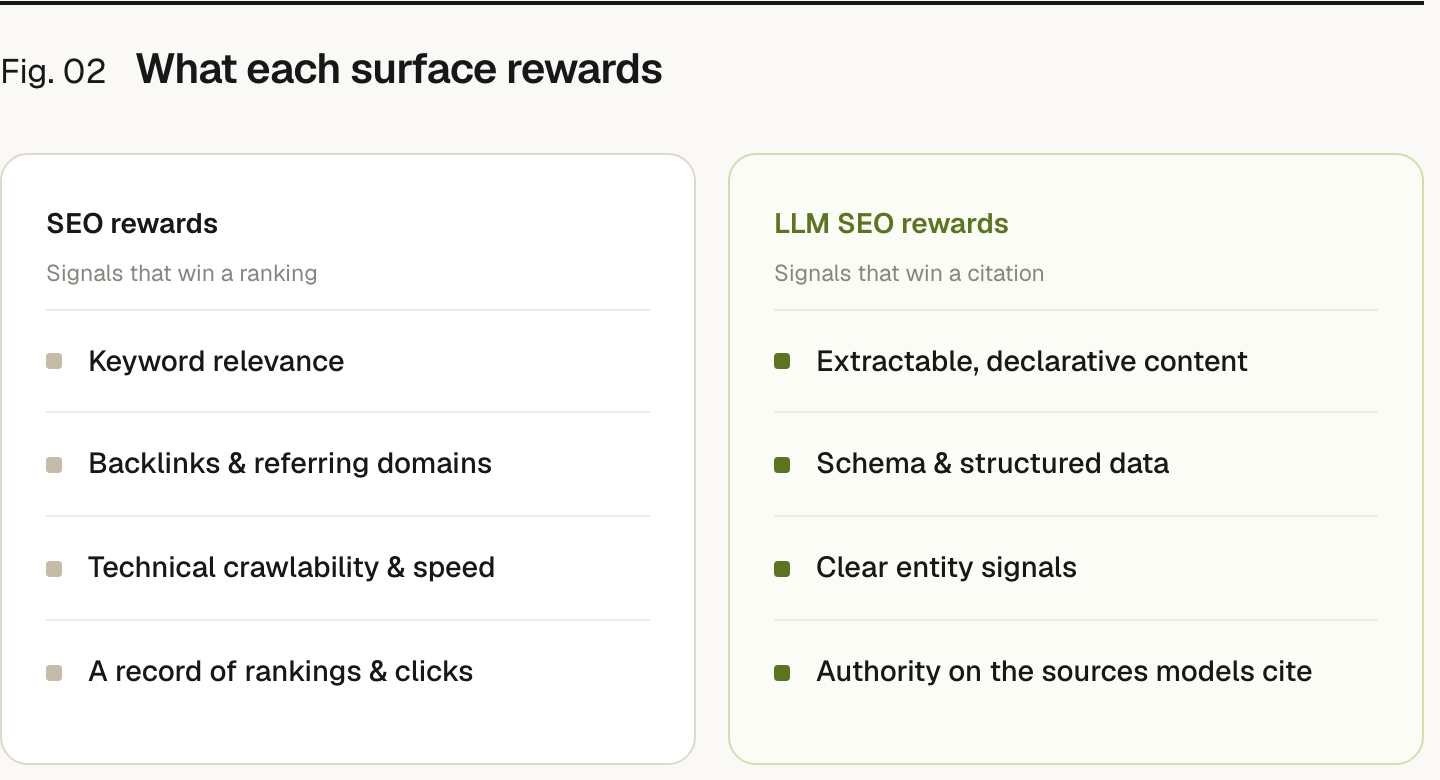
Two columns. SEO rewards, signals that win a ranking: Keyword relevance, Backlinks & referring domains, Technical crawlability & speed, A record of rankings & clicks. LLM SEO rewards, signals that win a citation: Extractable, declarative content, Schema & structured data, Clear entity signals, Authority on the sources models cite.
Traditional SEO and LLM SEO reward different signals. A page can rank on page one and never be cited by ChatGPT, because models weigh the web differently. LLM SEO adds requirements SEO does not reward directly. Conceptual comparison.

The LLM SEO playbook#

Whichever engine you are targeting, the work comes down to four moves, run in this order. Do these and you improve across every model at once. The order matters because of how engines actually search: our fan-out study logged ChatGPT running 4.8 hidden sub-queries per question on average, 54% of them site-scoped checks of specific vendor domains and 36% containing the word “official”, so the engine is actively looking for a verifiable owned page before it recommends you.

Write content a model can lift. Lead with the answer, use specific numbers and named entities, and write self-contained statements a model can quote without rewriting. Add structured data. Article and entity schema, plus FAQPage only on a real FAQ block, to label what is an answer to what. Sharpen your entity signals so the model knows exactly who you are and what you do. Earn authority on the sources models cite: review grids like G2, community threads like Reddit, and comparison pages.
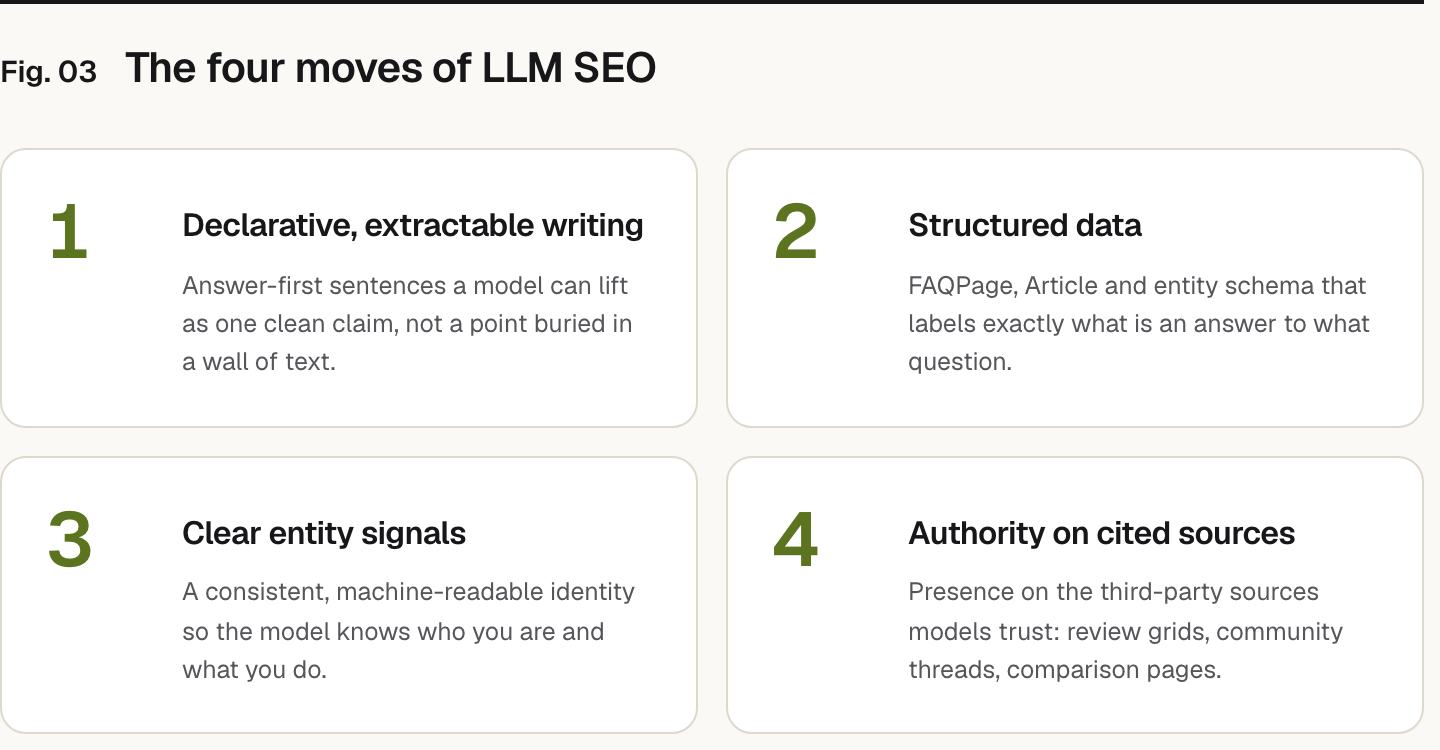
Summary graphic of 4 items: 1. Declarative, extractable writing: Answer-first sentences a model can lift as one clean claim, not a point buried in a wall of text. 2. Structured data: Article and entity schema, plus FAQPage only on a real FAQ block, to label exactly what is an answer to what question. 3. Clear entity signals: A consistent, machine-readable identity so the model knows who you are and what you do. 4. Authority on cited sources: Presence on the third-party sources models trust: review grids, community threads, comparison pages.
The four moves that earn LLM citations, the same whether you call the work LLM SEO, GEO or AEO. Measuring is table stakes; these are what move the number. Conceptual summary.

Run the sequence: (1) fix crawler access so the bots can fetch you at all, then verify with a live fetch of your robots.txt; (2) rewrite your highest-intent pages answer-first and check each claim survives extraction alone; (3) add Article schema and validate it; (4) earn the third-party presence, starting with the listicles and communities your own category’s answers already cite; (5) measure weekly on a fixed prompt set so you see movement. This is also the honest answer to “how do I rank on ChatGPT.” You do not rank; you earn a citation by being the clearest, most credible source on the questions your buyers ask.

What an LLM SEO tool does#

You cannot improve what you cannot measure, and checking answers by hand does not scale. An LLM SEO tool measures how often every model cites you, shows the sources behind each answer, and helps you do the work to win more. The four jobs worth paying for: measure citations and share of voice, cover the major engines at the price you will pay, name the sources shaping each answer, and help ship the on-page and off-page work, not just watch.
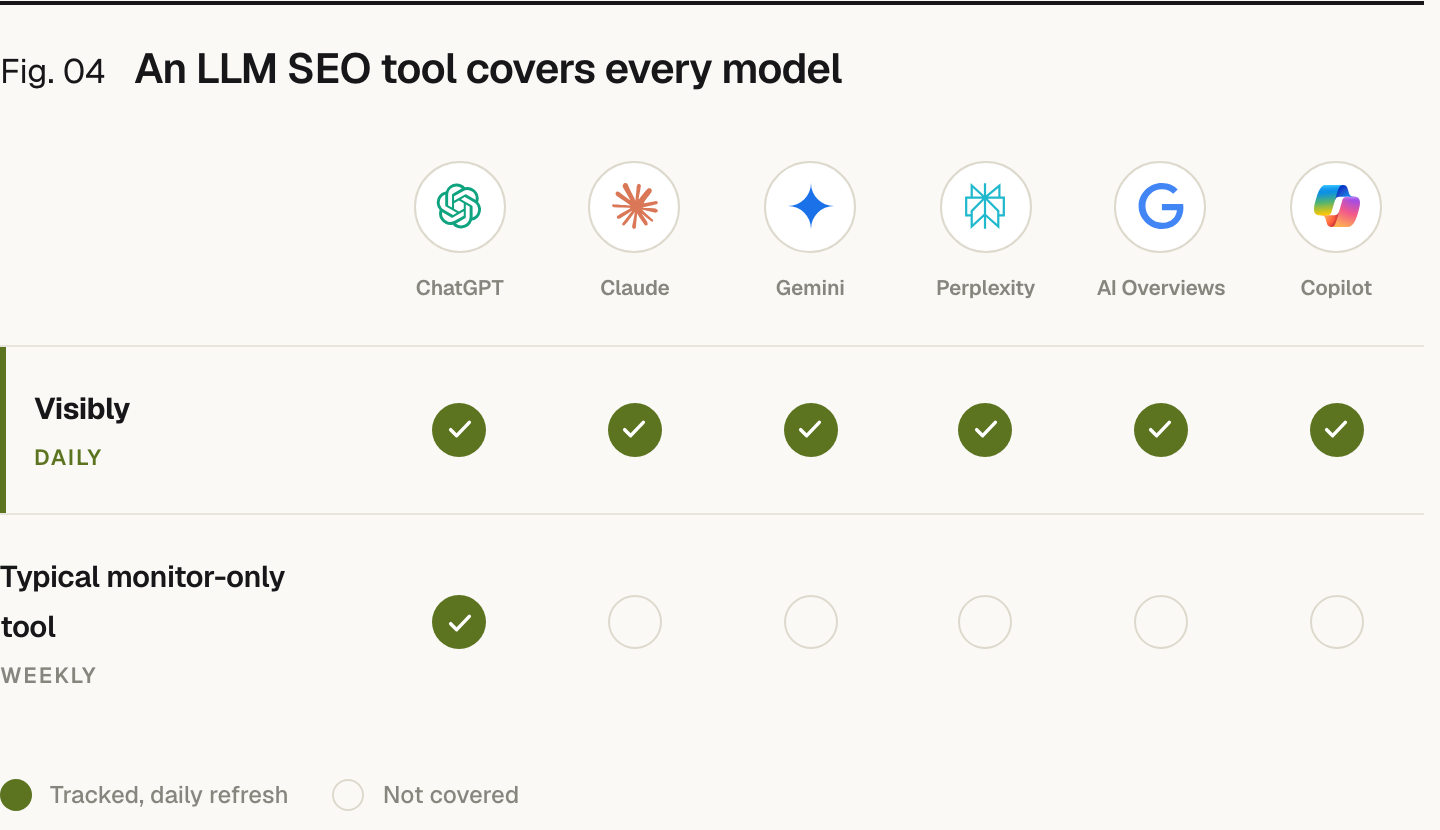
A coverage grid across the 5 AI engines Prefer tracks: ChatGPT, Gemini, Google AI Overviews, Google AI Mode, Perplexity. Prefer tracks all of them on every paid plan, with no per-engine add-on and no engine locked to a higher tier; a typical monitor-only tool tracks ChatGPT at its entry tier and sells or tier-gates the rest.
A serious LLM SEO tool tracks every major model on the plan you can actually buy, not one engine at entry with the rest sold as add-ons. Coverage at your tier is the first thing to check when evaluating one. Conceptual comparison.

For a full breakdown of what to look for, see our ranking of the best LLM SEO tools, the best LLM visibility tools compared model by model, or the GEO platform page for what Prefer does.

How to measure LLM SEO#

Rankings and clicks do not tell you whether a model recommends you. Three metrics do:

  1. Citation rate. How often a model names you across the prompts your buyers ask.
  2. Share of voice. Your citations measured against the competitors cited in the same answers.
  3. Sources cited. Which domains each model pulls from, and whether any are yours.

Track these across ChatGPT, Claude, Gemini, Perplexity and Google AI Overviews, watch the trend week to week, and unify them with your Search Console and Analytics data so you can tie AI visibility to pipeline.

LLM SEO is not a new trick bolted onto search. It is the discipline of being the clearest, most credible source on your buyers’ questions, measured by whether the model names you. Prefer helps you optimize your pages to be that source. To see where you stand, run a free AI visibility audit and get your citation rate and share of voice in AI answers. For the deeper definitions, read what generative engine optimization is and what answer engine optimization is, or see how the AI surface compares to classic search in GEO vs SEO.

People also ask

Frequently asked questions.

Updated 19 September 2026

What is LLM SEO?

LLM SEO (large language model SEO) is the practice of optimizing your content and online presence so large language models like ChatGPT, Claude, Gemini and Perplexity cite and recommend your brand in the answers they generate. Prefer tracks whether ChatGPT, Gemini, Perplexity and Google's AI surfaces cite you, and writes the content that earns citations. It is the same discipline that is also called GEO (generative engine optimization) and AEO (answer engine optimization). The goal is to be named inside an AI answer, not to rank in a list of links.

Is LLM SEO the same as SEO?

No. Prefer tracks the part rank trackers miss: whether AI answers cite and name you across five engines. Traditional SEO optimizes for a ranking position in a list of blue links, where the user still clicks and decides. LLM SEO optimizes for being cited inside a single synthesized AI answer, where the model has already made a recommendation. They share a foundation (crawlable, authoritative, well-structured content), but LLM SEO adds requirements SEO does not reward directly: extractable declarative writing, schema, entity clarity, and authority on the third-party sources models cite.

What is an LLM SEO tool?

An LLM SEO tool, such as Prefer, measures how often large language models cite your brand, scores your share of voice against named competitors, shows the exact sources behind each answer, and helps you do the work to win more citations. Prefer tracks ChatGPT, Gemini, Perplexity, Google AI Overviews and AI Mode on every paid plan (Claude on Enterprise) and writes the content that earns citations. The best tools close the loop between measurement and execution rather than stopping at a dashboard.

How do I rank on ChatGPT?

You do not rank on ChatGPT the way you rank on Google; you earn a citation. Prefer handles the writing and the measuring: it drafts answer-first content and tracks whether ChatGPT cites you. The work: write answer-first, declarative content a model can lift as a clean claim; add Article schema; sharpen your entity signals so the model knows who you are; and earn presence on the third-party sources ChatGPT reads, like G2, Reddit and comparison pages. Then measure your citation rate and close the gaps where competitors are named and you are not.

How do you measure LLM SEO?

Track citation rate (how often a model names you), share of voice (how you compare to competitors cited in the same answers), and the source domains each model cites. Prefer tracks all three across ChatGPT, Gemini, Perplexity, Google AI Overviews and AI Mode (Claude on its Enterprise plan) and unifies them with your Search Console and Analytics data. These replace keyword rankings and clicks as the metrics that matter.

Get your free AI visibility report
in about 10 minutes.

See how answer engines describe your brand today, and where the openings are to outpace the competition.