AI SEO is a term with two meanings that have collided. One is using AI to do search engine optimization faster; the other is optimizing your content so AI answers cite and recommend your brand. Both are real, people use the same two words for both, and telling them apart is the first thing to get right.
This page is mostly about the second meaning, because that is the part that is new and the part Prefer works on. It is the same discipline you may have seen called AEO (answer engine optimization) or GEO (generative engine optimization). If you want the deeper mechanics of getting cited by models, read LLM SEO; for the head-to-head with classic search, read GEO vs SEO or AEO vs SEO. Think of this page as the map that connects them.
Here is the short version of what changes: classic SEO still runs underneath, AI SEO adds a citation layer on top, and you measure it by whether the model names you, not by where you rank.
Why “AI SEO” now means two different things#
The phrase got popular fast, and it landed on two jobs at once.
The first job is using AI to do SEO. This is AI as a faster helper for the SEO you already do: drafting articles, clustering keywords, generating meta tags and internal links, auditing pages at scale. The goal has not changed. You are still trying to rank in Google’s list of links and win the click. AI just does the labor quicker.
The second job is optimizing to appear in AI answers. This is a different goal. When someone asks ChatGPT, Perplexity, Gemini, or Google’s AI Overviews a question, the engine writes one answer and names a few brands inside it. The work here is getting your brand to be one of those names. You are not ranking a page; you are earning a citation in a generated answer.
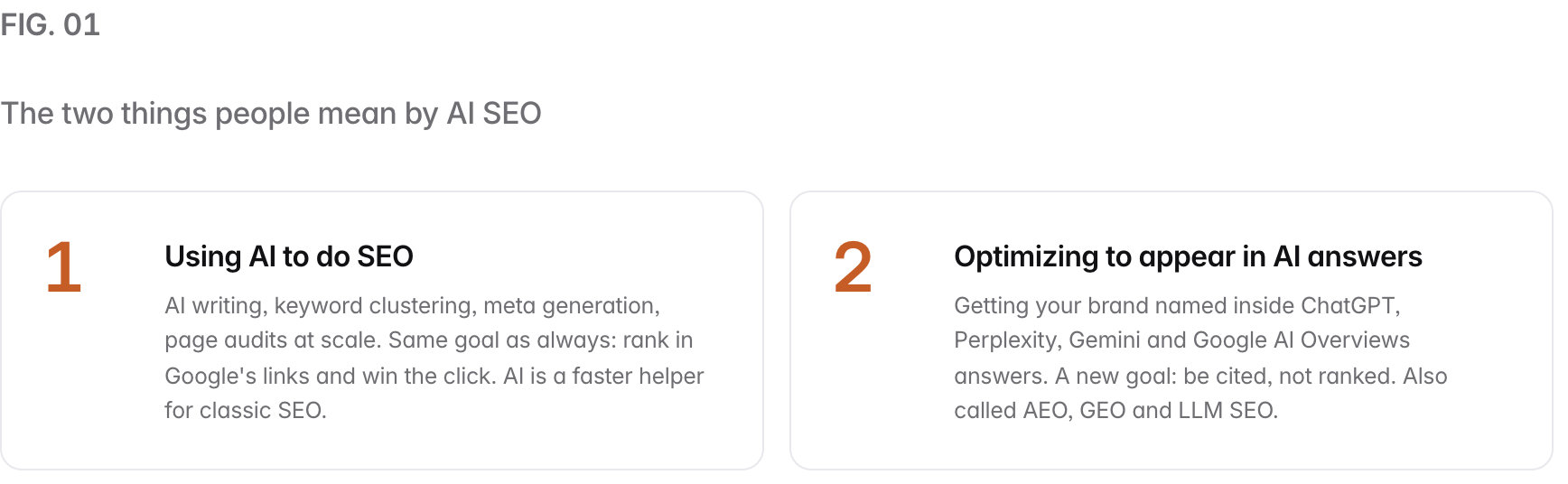
The two blur together because the same team, and often the same buyer, owns both, and because a headline like “AI SEO tools” can point at either one. It might mean an AI writing assistant, or a tool that tracks whether ChatGPT recommends you. So when you read the phrase, the useful habit is to ask which job is meant. From here on, “AI SEO” refers to the second job unless we say otherwise.
AI SEO, AEO, and GEO are the same work#
The second job goes by several names, and the overlap trips people up, so it is worth being plain about it. AI SEO, AEO, GEO and LLM SEO all describe optimizing so AI engines cite and recommend your brand. The shades of emphasis differ: AEO stresses answering a question, GEO stresses the generative engine, LLM SEO stresses the model, and AI SEO is the broad umbrella. The tactics behind all four are the same, so pick the label your team uses and move on.
Where they differ is which page owns which question, and that is deliberate. For the definitions, the glossary goes deep: what generative engine optimization is and what answer engine optimization is. For the comparisons against classic search, the blog goes deep: GEO vs SEO and AEO vs SEO. This page stays the umbrella that points you to the right one.
What actually changes: a citation layer on top of classic SEO#
The core change is small to say and large to work through: the unit of success moves from a ranking to a citation.
On Google, you fight for a position in a list of ten links, and the click is the prize. In an AI answer, the engine has already compared the options and written a short recommendation before the buyer sees anything, so the prize is being one of the names inside that recommendation. A rank is a position you can climb step by step. A citation is a decision the engine makes about who belongs in the shortlist, and it often makes that decision from sources nowhere near your own site.
That does not throw out SEO. It sits on top of it. Crawlable, fast, well-structured pages help Google index you and help models read you. On that shared base, AI SEO adds its own layer: content an engine can lift as a clean claim, schema that labels what answers what, clear entity signals so the model knows exactly who you are, freshness, and authority on the third-party sources the model actually cites.
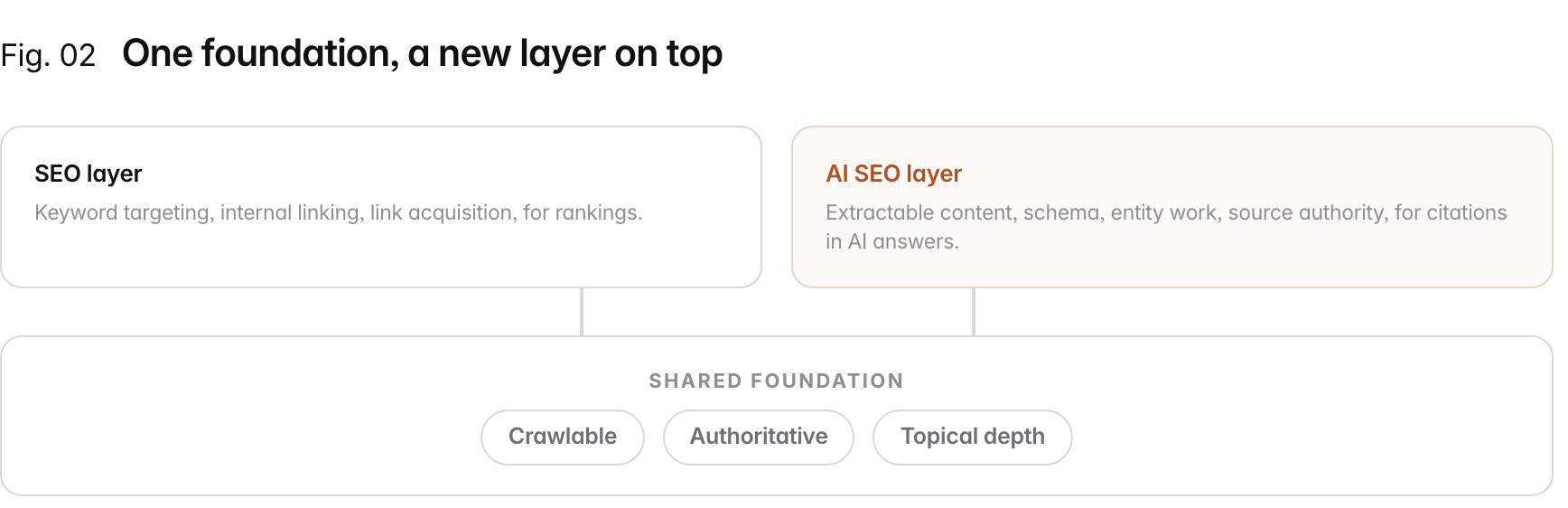
The practical read: you do not run AI SEO as a separate program with its own site. You fund the foundation once, keep your existing SEO for the click, and add the citation layer for the recommendation buyers now get before they ever search.
What stays the same#
It is easy to read all of this as “SEO is over,” and that is the wrong lesson. If anything, the foundation matters more, because models read the same web Google does. The pages that were already crawlable, credible and clear are the ones models find easiest to cite.
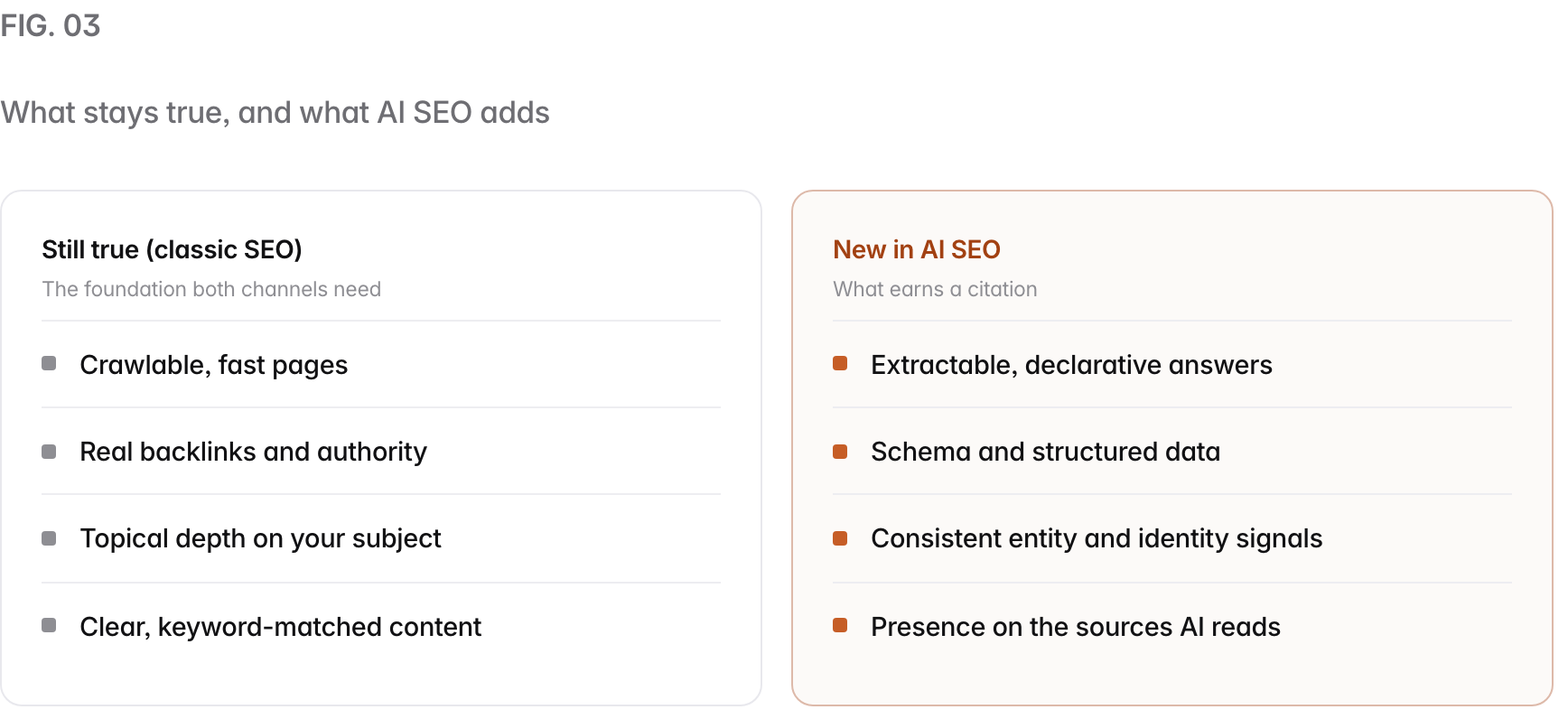
So the honest framing is addition, not replacement. Keyword relevance, earned links, technical health and a real cluster of content on your topic still win rankings and still help a model trust you. What is new is the layer above them, and the fact that you now have a second scoreboard to watch.
Where AI answers actually come from#
This is the part that reshapes the work, so it helps to ground it in measured numbers rather than assertion.
In July 2026 Prefer asked ChatGPT, Perplexity, Gemini and Claude the same 47 buyer questions with web search on and logged every citation. Across 1,237 citations, 40% went to independent third-party listicles, ahead of the vendors’ own sites at 34%. The rest split across established media and large SaaS blogs (15%), Reddit and forums (4%), review sites like G2 (3%), and YouTube (3%). The biggest single source of AI citations is people writing about the category, not the brands in it.
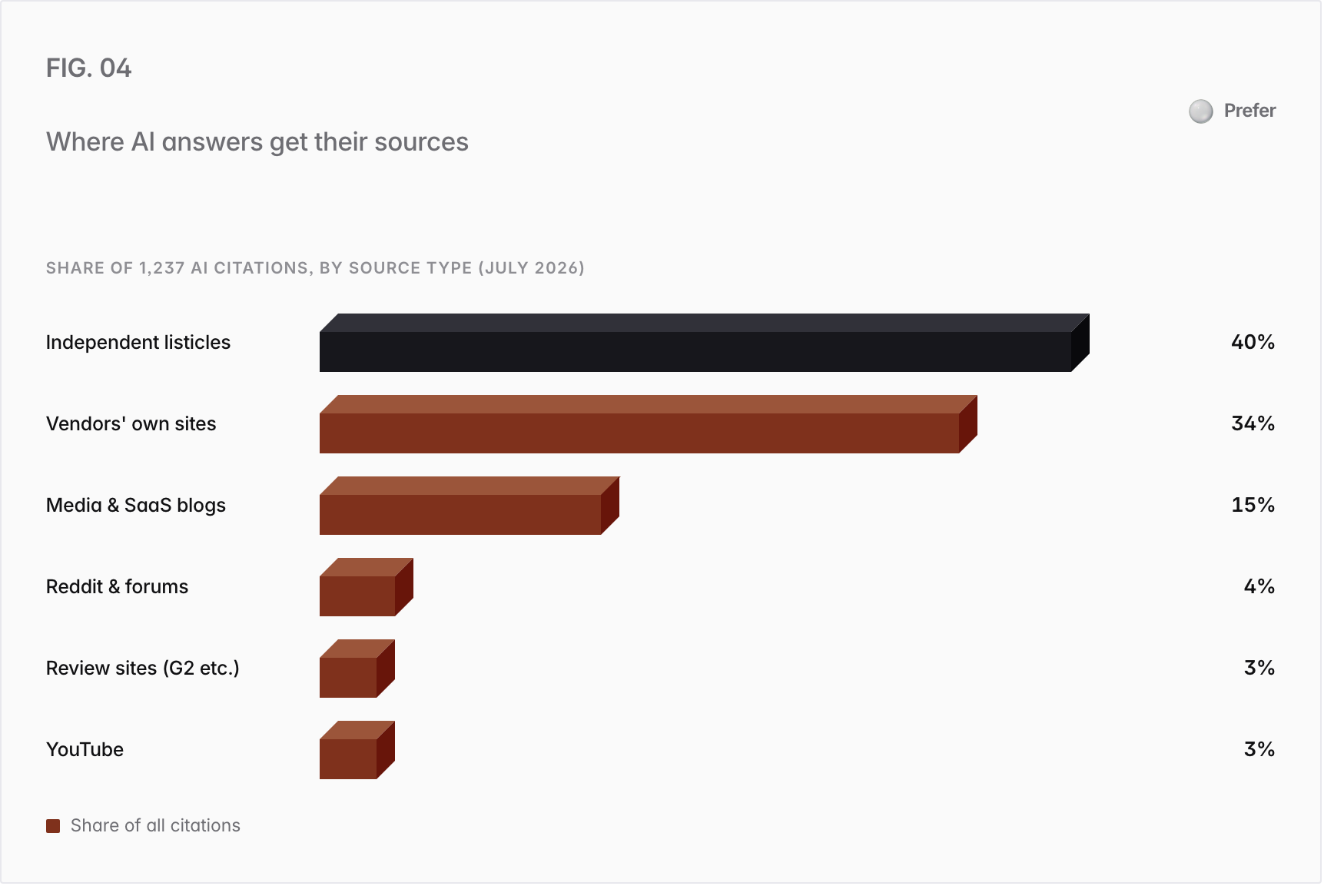
Two follow-up measurements sharpen the point. In a study of 25 B2B software buyer queries, Reddit was the single most-cited source in ChatGPT’s answers, about 30.3% of every citation and ranked first on all 25 queries. And when we logged the searches ChatGPT actually runs behind an answer, one question became 4.8 web searches on average, and 54% of those were site-scoped checks of a specific brand’s own pages, the model running site:vendor.com ... official to verify each candidate. It even asked for “official” facts in 36% of its searches.
Put those together and you get the shape of AI SEO work. Part of it lives on your own site, because the model site-searches your pages for official, extractable pricing and features. Part of it lives off your site, because being named in the credible lists and communities is what puts you into the shortlist the model checks in the first place. Strong Google rankings buy neither directly. You can sit at position one for your category and still be absent from the answer, because the model is reading a listicle, a Reddit thread and a review grid you have not shown up on.
There is a third wrinkle worth naming, because it changes what on-page work can and cannot do. In that same July study, ChatGPT skipped live web search on 29 of its 47 answers and replied straight from memory, citing nothing at all. When an engine answers from memory, no page edit reaches it in the moment; the only thing that moves a memory answer is your longer-term reputation, built from being written about consistently over time. So AI SEO has a fast lane (make your pages and third-party listings retrievable now) and a slow lane (become the brand the model already knows), and a serious program works both.
The tools that do AI SEO#
Because “AI SEO” names two jobs, “AI SEO tools” names two kinds of software, and they get shelved together under the same search.
The first kind is AI-for-SEO: writing assistants, content optimizers, and keyword tools that bolt AI onto classic SEO tasks. The second kind is AI-visibility software, which measures how often AI engines cite your brand, shows the sources behind each answer, and helps you do the work to win more citations. Prefer is the second kind. The two rarely do each other’s job well, so the first thing to sort out when you evaluate a tool is which job you are buying it for.
We keep an honest, up-to-date breakdown so you do not have to take our word for it. For the field of options, criteria to judge them on, and where each fits, see the best AI SEO tools roundup. The short version of what to check: coverage of the engines your buyers use at the price you will pay, the exact sources behind each answer, and whether the tool helps you ship the on-page and off-page work rather than stopping at a dashboard.
How to start with AI SEO#
You do not need a new team or a new site to start. You need a baseline and a short list of moves that follow from the data above.
- Measure where you stand. Get your citation rate and share of voice across ChatGPT, Perplexity, Gemini, Claude and Google AI Overviews, and see the sources behind each answer. You cannot improve what you cannot see, and checking by hand does not scale.
- Get named in the third-party lists. Independent listicles are the largest source AI cites, and being in them is the search that builds the candidate set the model then verifies. This is the highest-impact move for most brands.
- Publish extractable, dated pages on your own domain. Because the model site-searches you for “official” pricing and features, keep clean HTML pages it can lift, with the current year in the copy.
- Add schema and sharpen your entity signals. Article and Organization schema, and a consistent, machine-readable identity, so the model knows exactly who you are and what you do.
- Track the trend, not a one-time snapshot. AI citations move week to week as models re-crawl and as the sources they read change, so watch the number continuously and close the gaps where a competitor is named and you are not.
For the full walkthrough, follow the playbook on how to show up in AI search, which turns these into a concrete checklist.
AI SEO is not a new trick and it is not the end of search. It is the discipline of being the clearest, most credible source on your buyers’ questions, now measured by whether the answer engine recommends you. To see where you stand today, run a free AI visibility audit and get your citation rate and share of voice in AI answers in about 15 minutes.
People also ask
- What is AI SEO?
- Is AI SEO the same as SEO?
- What is the difference between AI SEO, AEO, and GEO?
- Does AI SEO replace traditional SEO?
- How do you measure AI SEO?
- How do I start with AI SEO?