AEO and SEO share a technical foundation but optimize for different units, and once you see the unit, every other difference falls out of it. SEO (search engine optimization) takes a keyword, points a page at it, and works so a crawler indexes and ranks that page. AEO (answer engine optimization) takes a question, points a passage at it, and works so a model retrieves that passage, extracts a clean claim and cites it inside the answer. This is a practitioner’s guide to that difference: how the unit of work changes, what the machine does with your page, what actually counts as a win, and what the two working days look like side by side.
If you want the definition rather than the mechanics, start with what answer engine optimization is. If you are trying to tell AEO apart from the near-synonym GEO, read AEO vs GEO. This piece assumes you know the terms and want to know how the work differs.
The unit of work: one keyword and a page vs one question and an answer#
SEO’s atom is a keyword mapped to a page. You pick a query, build a page that deserves to rank for it, and success is a position for that query. Everything downstream (internal links, headings, content depth) serves the goal of moving that page up the list.
AEO’s atom is a question mapped to an answer. You pick a real question a buyer asks an assistant, write a passage that answers it cleanly, and success is that passage being lifted into the model’s response with your name attached. The page still matters, but the thing you are optimizing is smaller and more specific: the two or three sentences a model can pull out and stand behind. Prefer tracks that unit for you: which answers to your buyers’ questions cite you, on five AI engines.
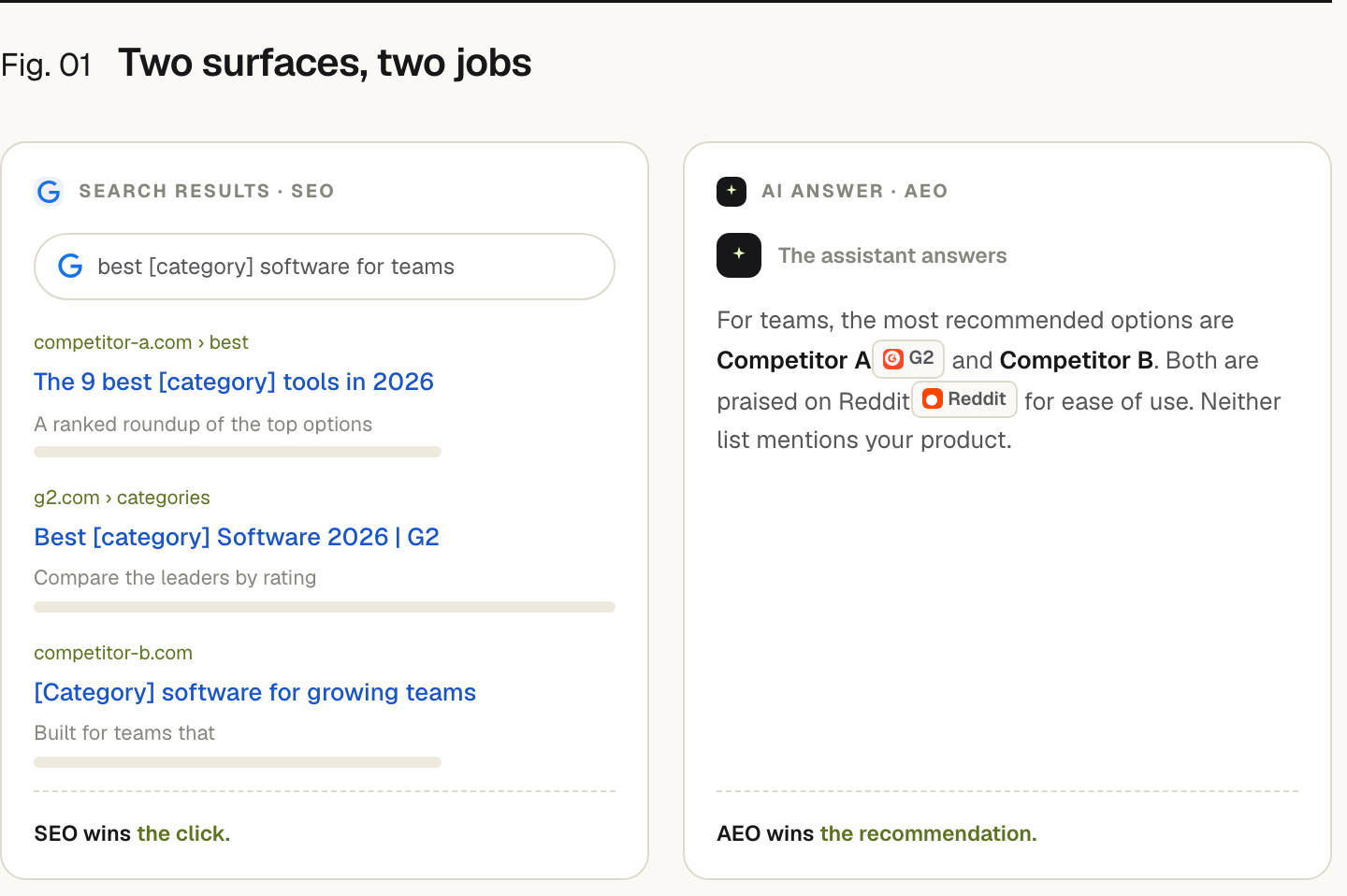
That shift from a page to a passage is the whole reason AEO is a distinct craft. Ranking is about the page as a whole earning a position. Getting cited is about one specific claim being clean enough, and trusted enough, that a model will repeat it. You can do the first well and fail the second entirely.
What the machine does: crawl and rank vs retrieve and extract#
The two disciplines lean on different machine steps, and knowing which step you are serving tells you what to fix.
SEO serves crawl, index and rank. A crawler fetches your page, the engine stores it, and an algorithm orders it against competitors for a query. Your job is to be reachable, understandable and authoritative enough to place high.
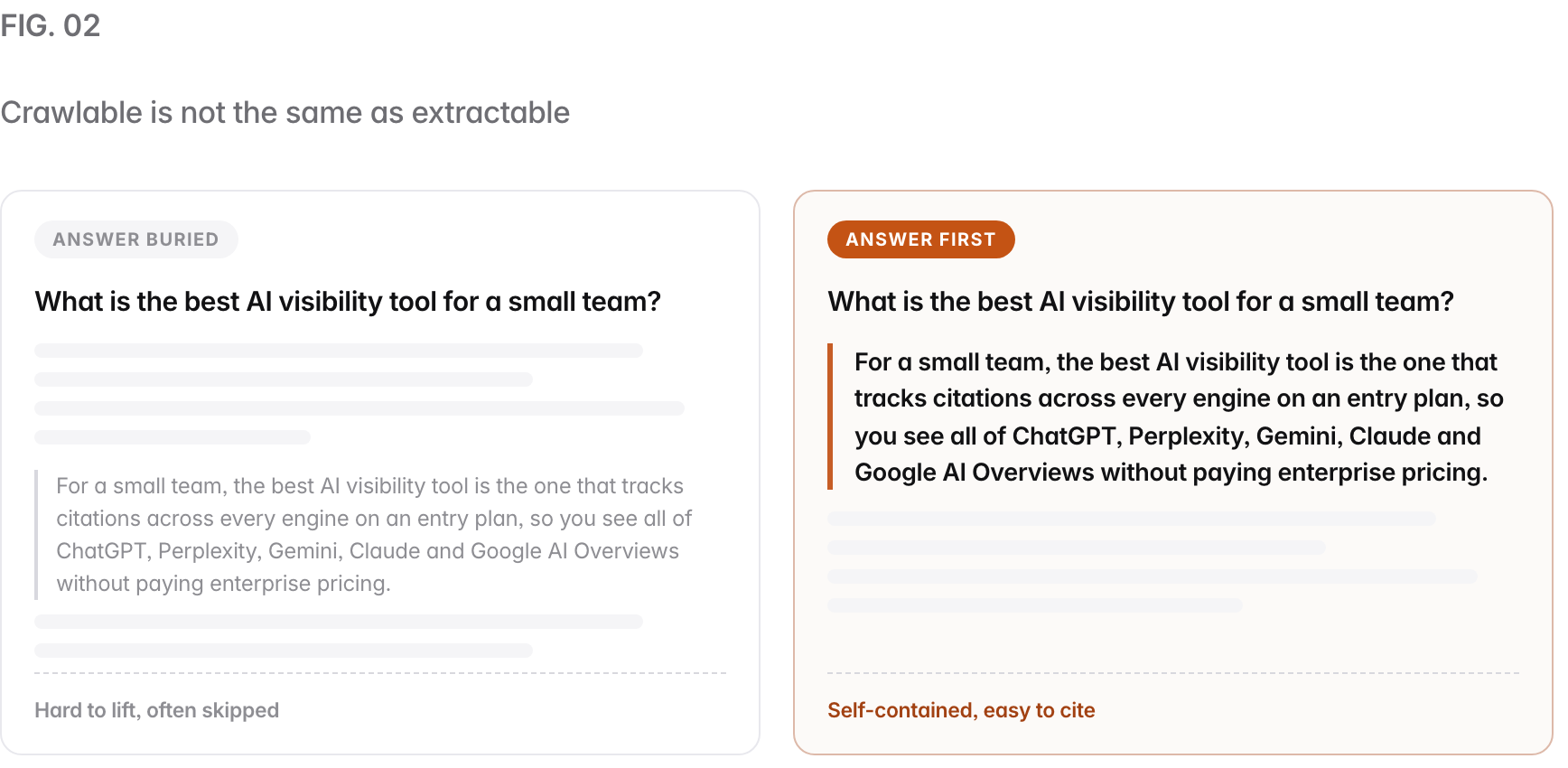
AEO serves retrieve, extract and synthesize. For a given question, the model (or its search layer) retrieves a set of candidate passages, extracts the claims it trusts, and synthesizes them into one answer with citations. Your job is to make the passage extractable: to state the answer in a form a model can lift without ambiguity, and to be trusted enough that the model picks yours over a competitor’s. Being crawlable only gets you considered; being extractable is what earns the citation.
That is why a page can be perfectly crawlable and still never get cited. If the answer to the question is buried three paragraphs down, hedged, or split across the page, the model has nothing clean to pull. Extraction rewards the opposite: the answer stated first, in plain declarative language, as a self-contained sentence.
What counts as a win: a click you own vs a citation you don’t#
Here the two disciplines diverge most sharply, and it changes how you report success.
An SEO win is a click you control. The buyer lands on your page, on your domain, and you own everything that happens next: the message, the offer, the path to signup. The unit is a session you can measure and optimize end to end.
An AEO win is a citation inside someone else’s surface. The buyer reads your claim in the model’s answer, credited to you, and may act on it without ever clicking. You won the recommendation but you do not own the page it appeared on, and often there is no session to measure at all. The win shows up as being named, not as traffic.
Prefer’s own run data shows how much weight a single citation carries. In a 50-prompt ChatGPT run on 2026-09-02, one hands-on TechRadar listicle was cited on 12 of the 47 usable prompts, and one competitor held the first-named position in roughly 12 of the 16 category prompts we could score. At the answer level, being the cited source on one trusted page does more than ranking on dozens of your own. The citation, not the click, is the unit that moves.
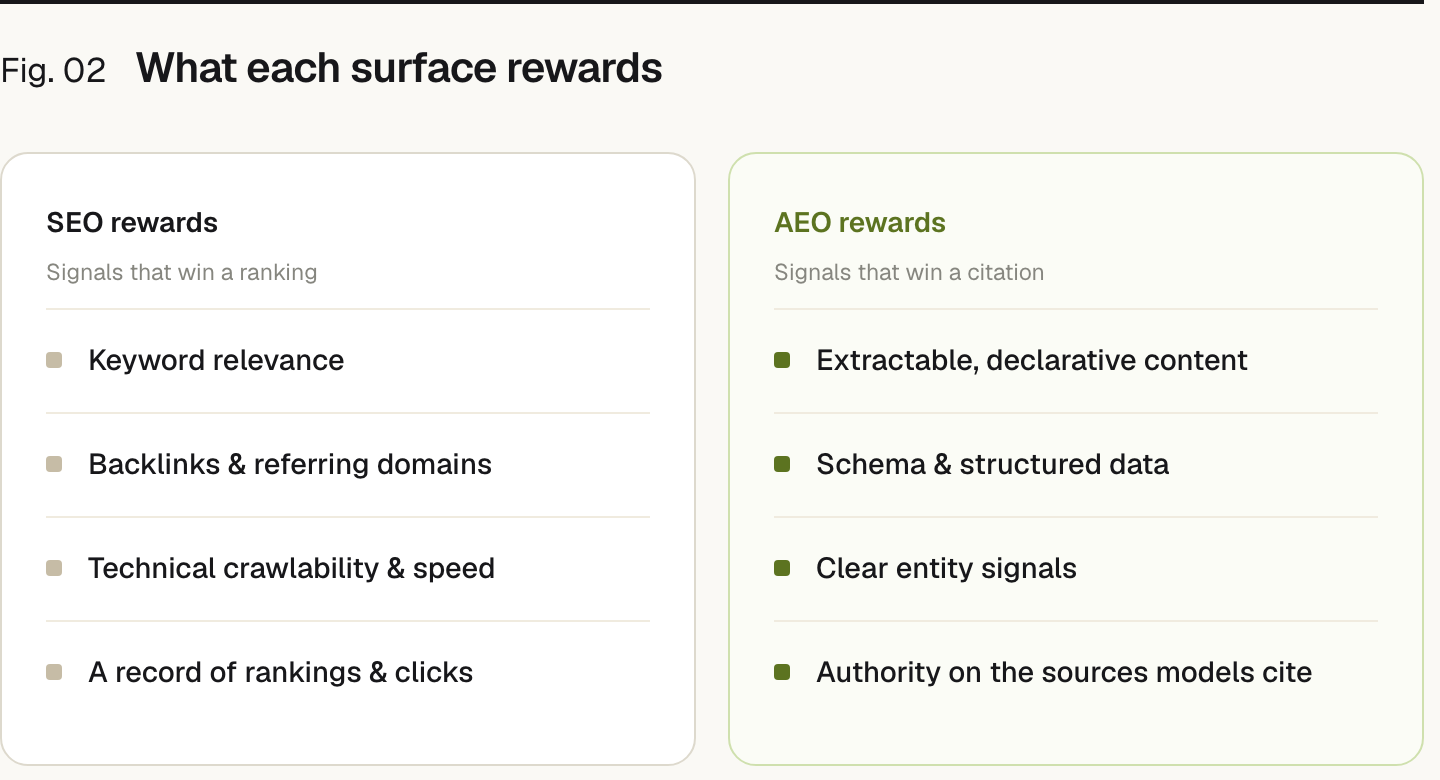
Because the AEO win lives off your domain, part of the work does too. You cannot backlink your way into a Reddit thread or a review grid, and you cannot rank your way into the model’s trust. You earn it by being genuinely useful on the surfaces the model reads.
How the two working days differ#
Put the disciplines on a calendar and the difference gets concrete. The skills rhyme, but the tasks are not interchangeable, which is why one person rarely does both well without a plan.
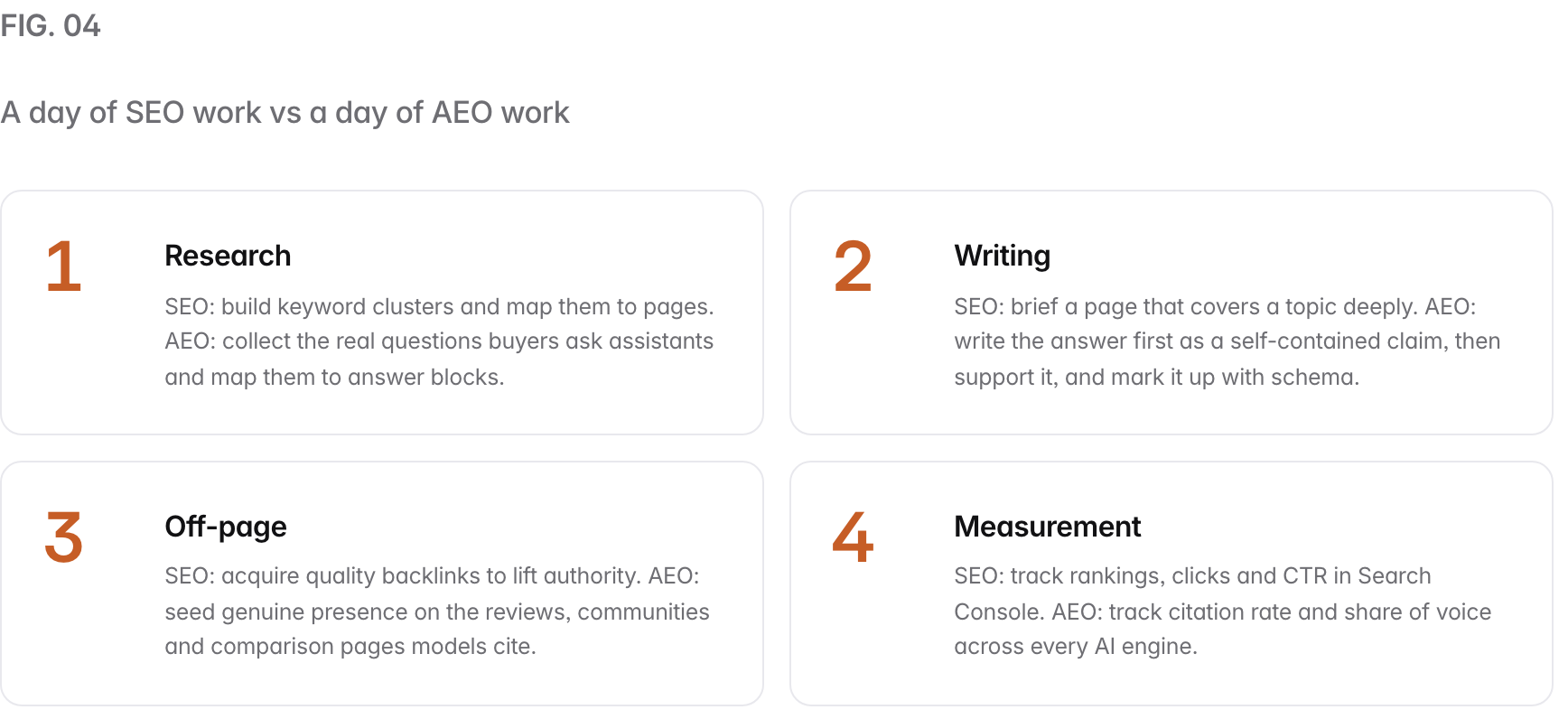
Two of those rows deserve a note. On writing, the AEO addition is schema and entity work: Article markup (and FAQPage only on a real FAQ block) that labels what is an answer to what, plus clean, consistent signals about who you are so the model resolves your brand to the right entity. On measurement, the AEO report is not rankings at all. It is citation rate (how often you are named), share of voice (how you compare to the competitors cited in the same answers), and the sources behind each answer, tracked across engines. That report is the thing that tells you whether the answer-level work is landing.
Run one program, add the answer-level layer#
None of this argues for two separate teams. The foundation is shared: a crawlable, fast, well-structured, authoritative site helps both a crawler and a model. Most AEO work even lifts your SEO as a side effect, because clearer answers and cleaner structure are good for readers and rankers too.
The efficient shape is one program with an answer-level layer on top. Keep the SEO work that wins the click. Add the AEO work that wins the citation: rewrite the key pages answer-first, add and validate schema, tighten your entity signals, earn presence on the sources models cite, and measure citations across engines so you can see which questions you own and which competitors own instead.
The brands that win the next few years will not choose between ranking and being cited. They will keep the SEO foundation, treat extractability as its own discipline, and hold themselves to a citation report as seriously as they hold themselves to a ranking one.
To see which questions cite you today and which name a competitor instead, run a free AI visibility audit and get your citation rate and share of voice in AI answers. When you are choosing tooling for the answer-level work, compare the options in the best AEO tools.
People also ask