An AI Overview is the AI-generated answer Google places at the top of a search results page. Instead of handing you ten blue links to work through, Google reads across several pages, writes a short summary of the answer, and links a few of the sources it used beside the text. It is the most visible change to a Google results page in a decade, and for many questions it is now the first and sometimes the only thing a searcher reads.
This is the reference page for what AI Overviews are and how they work. If you already know the what and you want the checklist for showing up in them, read how to appear in Google AI Overviews. This page is the layer above that: where overviews come from, how they pick sources, how they differ from the features people confuse them with, what they do to your traffic, and why Google-Extended is not the way to opt out.
What AI Overviews are, and where they appear#
An AI Overview is a generative feature of Google Search. Google’s own documentation describes AI Overviews as a way to “get to the gist of a complicated topic or question more quickly,” with links to sites for deeper exploration. They sit at the very top of the results, above the first organic link, and they appear on a subset of searches rather than all of them. Prefer tracks AI Overviews as one of five AI engines on every plan, and shows whether the overview on each of your tracked prompts cites you.
Which subset? Google shows an overview when it decides a generated answer is more helpful than the standard list, which in practice means informational and how-to questions where an answer benefits from combining several sources. In the Pew Research study of real Google use, about 18% of searches produced an AI summary, so this is common but far from universal. You are far less likely to see one on a plain navigational search or a clear buy-now query, where a single link or a product result already does the job.
The important framing, and the one most teams get wrong, is that an AI Overview is not a separate product with its own rules. It is a layer on top of ordinary Search. The same crawler, the same index, and the same ranking systems that decide your organic position also decide whether your page feeds the overview above it.
How AI Overviews pick and cite their sources#
Google builds an overview with a technique it calls query fan-out: rather than answering your exact words, it “issu[es] multiple related searches across subtopics and data sources,” then assembles the answer from what those searches return and links a few of the pages it drew on. One question quietly becomes many, and the overview is stitched together from the best passages across all of them.
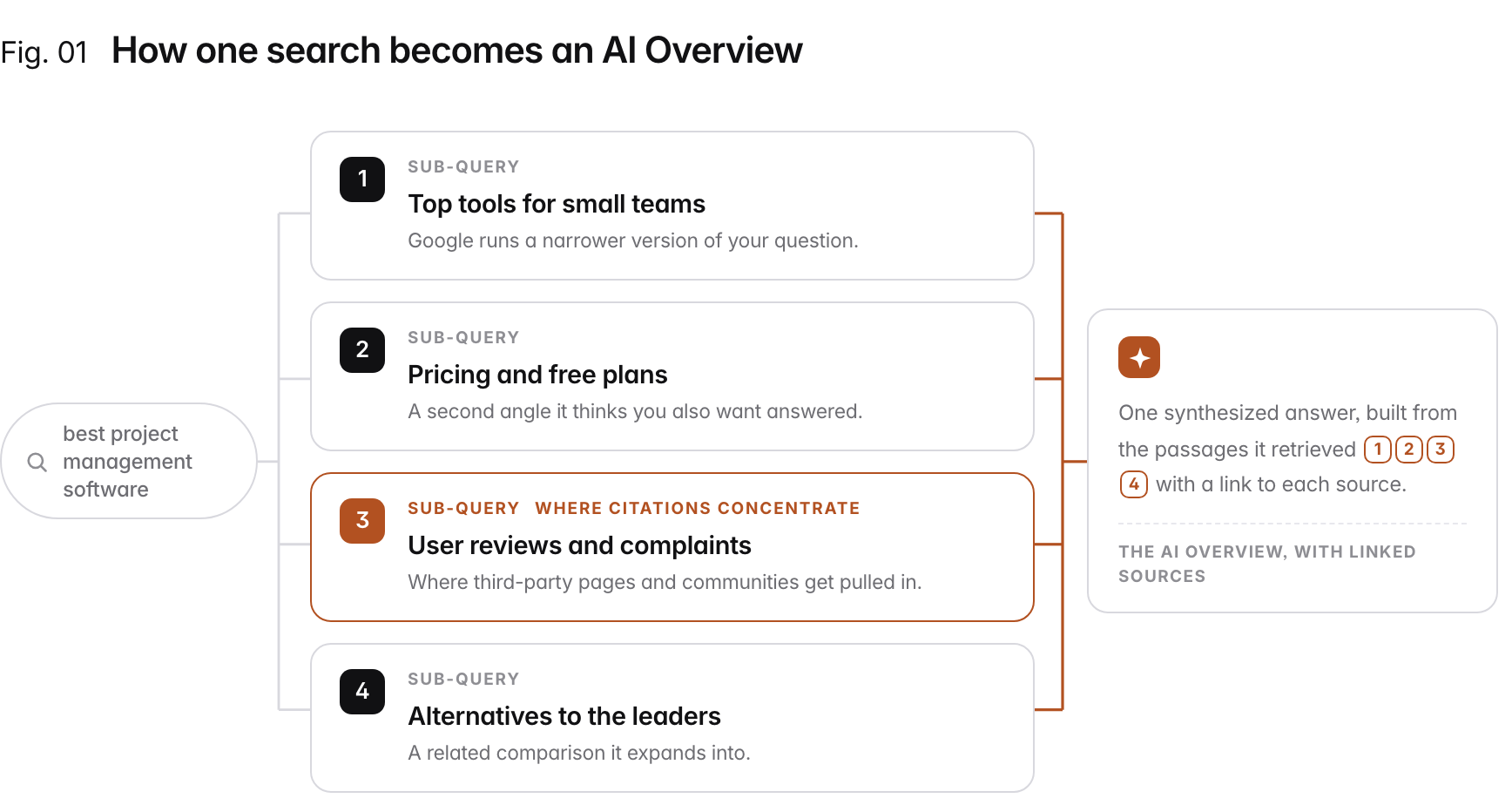
Google is blunt about the eligibility rules, and this is the single most useful thing to internalize. Its documentation states there are “no additional requirements to appear in AI Overviews or AI Mode, nor other special optimizations necessary.” A page just needs to be indexed, eligible to show a normal search snippet, meet the technical requirements for Search, and follow the spam policies. There is no AI Overviews feed to submit to and no schema that guarantees a spot. The overview is composed from pages that already rank and already earn snippets for the topic.
AI Overviews, AI Mode, and featured snippets are three different things#
These three get mixed up constantly, and treating them as one thing leads to wasted effort. They are distinct features that appear in different places and are built in different ways.
A featured snippet is older, from 2014. It lifts a passage from a single page that ranks well and shows it word for word, with one link. Nothing is generated; Google is just promoting an existing quote. An AI Overview is newer, from 2024. It does not quote one page; it writes a fresh summary from several pages and links a handful of them. AI Mode is a separate, conversational search experience you open deliberately, where you ask follow-up questions and Google reasons across many sources in a back-and-forth.
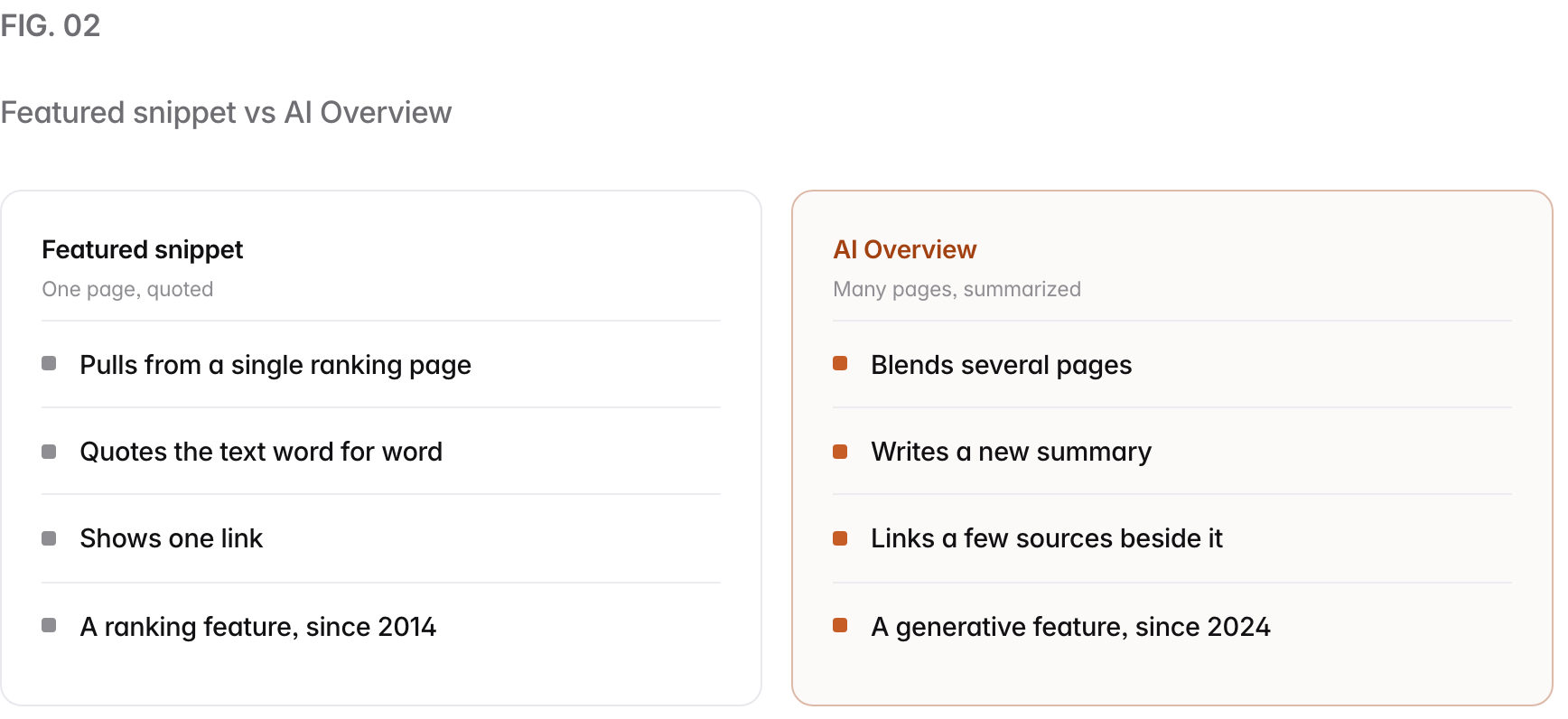
Here is the same split as a table, including AI Mode, so you can lift it in one piece:
| Featured snippet | AI Overview | AI Mode | |
|---|---|---|---|
| What it is | A quote lifted from one ranking page | An AI summary built from several pages | A full conversational search experience |
| Sources shown | One page | A handful, linked beside the text | Many, gathered across a conversation |
| How you meet it | Appears on a normal results page | Appears on a normal results page | You open the AI Mode tab and ask |
| Introduced | 2014 | 2024 | 2025 |
If your goal is a longer, multi-turn surface, that is a different playbook. We cover it in how to appear in Google AI Mode, and the definition lives in the AI Mode glossary entry. The good news is that the underlying work overlaps heavily, because all three draw on the same index and reward the same clarity.
AI Overviews are cutting clicks to websites#
The reason marketers care about all this is traffic, and the early data is not comforting. Pew Research studied the real Google activity of 900 U.S. adults across roughly 69,000 searches in March 2025 and measured what happened when an AI summary appeared.
People clicked a traditional search result on just 8% of the visits where an AI summary was shown, compared with 15% where no summary appeared. Clicking a link inside the summary itself was rarer still, happening on only 1% of those visits. People were also more likely to stop browsing entirely after a page with a summary.
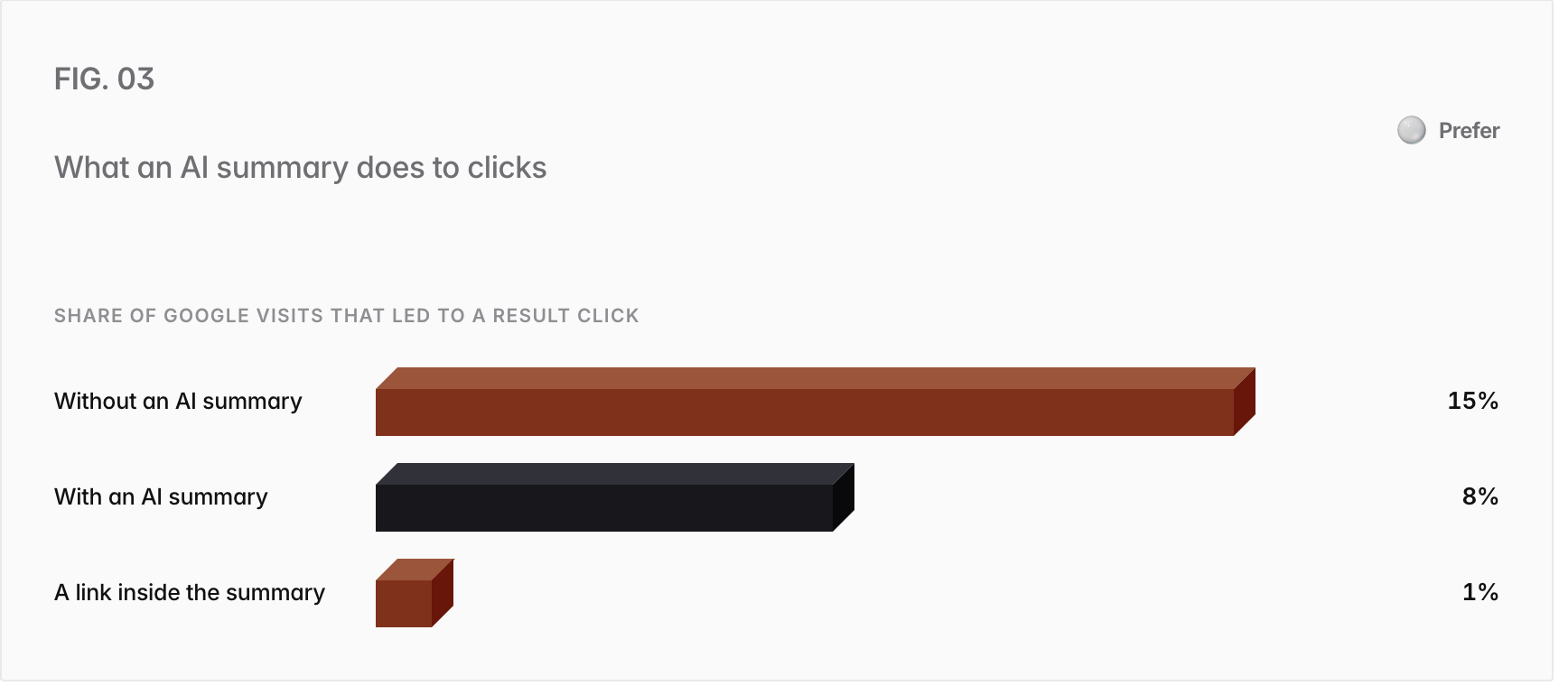
This is the mechanism behind what people call zero-click search. When the answer is written into the page, a large share of searchers get what they came for and never leave Google. It does not mean traffic disappears, but it does mean the click you used to win from ranking well is now split with an answer that may not send anyone your way. That shifts the goal from “rank to earn the click” toward “be one of the sources the answer is built from,” because being cited in the overview is often the only visibility you get on that search.
Who gets cited in AI Overviews#
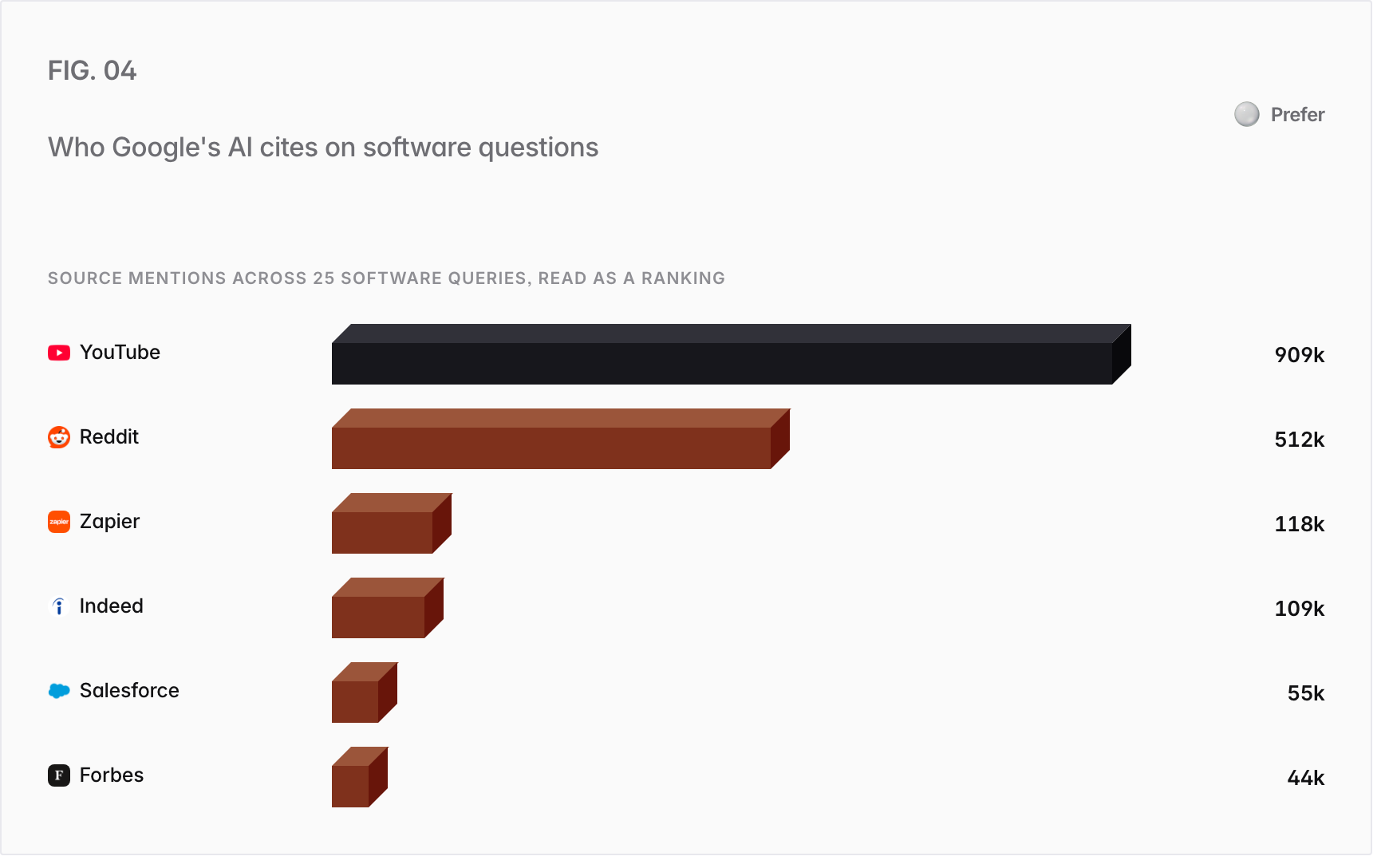
If citations are the new prize, the obvious question is who Google’s AI actually reaches for. Prefer measured it. Across 25 real B2B software buyer queries run through Google’s AI on 2026-08-19, two sources dominated, and neither was a vendor’s marketing site.
YouTube was the most-cited source and Reddit was second, ahead of every brand’s own pages. Read as a ranking of source mentions across the 25 queries, YouTube led with roughly 909,000, Reddit followed at about 512,000, and then came Zapier (118,000), Indeed (109,000), Salesforce (55,000) and Forbes (44,000). The two surfaces Google’s AI leans on hardest are both places where people post, not places where brands publish.
The pattern holds in our wider four-engine study too, which logged 1,237 citations across 47 buyer questions and 8 industries on ChatGPT, Perplexity, Gemini and Claude. There, independent “best X” listicles were the single biggest source at 40% of all citations, ahead of the vendors’ own sites at 34%. The engines also barely agreed with each other: of 713 distinct domains cited, only 5 were cited by all four. The read across both studies is the same. The answer is assembled from third parties writing about your category, so a page that only optimizes your own site is competing for a minority of the citations. You can explore the full dataset in the AI search citation statistics and the Google-specific breakdown in the Reddit source study.
You cannot opt out of AI Overviews with Google-Extended#
A common instinct is to block the AI. Many teams reach for Google-Extended, a robots.txt token, assuming it pulls them out of AI answers. It does not pull you out of AI Overviews, and it is worth being precise about why.
Google-Extended is, in Google’s own words, “a standalone product token that web publishers can use to manage whether content Google crawls from their sites may be used for training future generations of Gemini models” and for grounding Gemini apps and Vertex AI. That is its entire scope: training and grounding for Gemini products. Google states directly that “Google-Extended does not impact a site’s inclusion in Google Search nor is it used as a ranking signal in Google Search.”
AI Overviews are part of Search. They are crawled by the normal Googlebot and built from the normal Search index, so a Google-Extended block leaves them completely untouched. The control built for this is the Search generative AI setting in Search Console, rolled out to every site on 31 August 2026: set it to Exclude and links to your site and its content stop appearing in AI Overviews and AI Mode, generally within a few days. The page-level controls are the ordinary Search ones: noindex removes a page from Search entirely, which removes it from overviews too, and nosnippet or data-nosnippet keep your text from being used as a snippet, which also keeps it out of the generated answer. The page-level ones also cost you in normal results, and every one of these gives up the citation, which is why almost no one should use them defensively. If you want the full picture of which crawlers do what, read how to control AI crawlers.
How to show up in AI Overviews#
The strategy follows directly from how overviews are built. Because there is no special feed, the work is the same durable work that wins rankings, aimed now at being quoted rather than just clicked: be crawlable and indexed, answer the real question in a clean, liftable passage near the top of the page, use clear structure and headings that match how people phrase the query, and earn a presence on the third-party surfaces the answer is assembled from, which for software means credible reviews, community threads, and the listicles that rank for your category.
That is the summary. The step-by-step version, with the on-page and off-page checklist, lives in how to appear in Google AI Overviews. The point of this page is the mental model underneath it: an AI Overview is not a new channel to game, it is your existing search presence, summarized, with the click removed and a citation offered in its place.
Sources#
- Google Search Central, AI features and your website: what AI Overviews and AI Mode are, the query fan-out technique, and the statement that there are no special optimizations to appear.
- Google crawler documentation, Google’s common crawlers: the Google-Extended definition and the statement that it does not affect inclusion or ranking in Search.
- Search Console Help, Search generative AI control (read 19 September 2026): the setting that excludes a site from AI Overviews and AI Mode, rolled out to every site on 31 August 2026.
- Pew Research Center, Google users are less likely to click on links when an AI summary appears: the 8% versus 15% click data, the 1% in-summary click rate, and the 18% summary prevalence, from 900 U.S. adults in March 2025.
- Prefer studies: the four-engine AI citation study (1,237 citations, 47 questions) and the Reddit source study (25 software queries on ChatGPT and Google’s AI).
Want to know where AI engines already cite you, and where you are being left out? Run a free AI visibility audit and see your citations and share of voice in AI answers.
People also ask