
AI search optimization is the practice of becoming the source AI answer engines cite and recommend when your buyers ask them a question. Buyers now type a question into ChatGPT or Google AI Overviews and act on the answer, instead of scrolling a page of links and deciding for themselves. AI search optimization is the discipline of making sure the answer names you.
This is the map of that discipline, end to end. If you want the quick version to run this week, our guide on how to show up in AI search is the checklist; this page is the full picture behind it: what the practice is, how each of the five engines finds its sources, the four kinds of work that move the number, and a 30-day sequence to start.
What AI search optimization is#
The practice has several names because it arrived from several directions at once. Answer engine optimization stresses answering the question. Generative engine optimization stresses the generated output. LLM SEO stresses the model doing the work. They describe the same job. AI search optimization is the plainest umbrella for it, and the one your buyers are most likely to type. Prefer is built for this job: citation tracking on ChatGPT, Gemini, Perplexity, Google AI Overviews and AI Mode, plus the articles and recommended page fixes that earn citations.
It grew out of SEO but competes on a different unit. Classic SEO wins a rank in a list, and the reader still clicks and chooses. AI search optimization wins a citation inside one synthesized answer, where the engine has already narrowed the field to two or three names. Both reward crawlable, credible, well-structured content, so the foundation carries over. What AI search adds is a set of things a ranking never required: an answer a model can quote cleanly, structured data that labels it, a brand the model recognizes as a distinct entity, and a reputation on the third-party sources the model trusts.
It became its own discipline because buyer behavior changed. When an AI summary sits at the top of a result, people click a traditional link far less: Pew Research tracked real browsing in 2025 and found users clicked a search result in 8% of visits with an AI summary present, against 15% without, roughly half as often. The buyer who never clicks still hears a name. AI search optimization is the work that decides whose. It does not replace SEO; ranking still feeds the engines and still earns the clicks that remain. It runs alongside SEO as a second surface with its own rules, and you need both.
There are three outcomes worth separating, in rising order of value. Being mentioned means the answer says your name. Being cited means the answer links you as a source. Being recommended means the answer names you as the pick. All three now matter more than they did, because the answer increasingly is the whole interaction. The buyer reads it and moves on, so the recommendation carries weight a tenth-place ranking never did. The rest of this guide is how you earn those three outcomes on the surfaces your buyers use.
The five surfaces, and how each one finds its sources#
The five engines that matter for buyer questions are ChatGPT, Perplexity, Google’s AI (AI Overviews and AI Mode), Gemini, and Claude. From the outside they look interchangeable. Underneath, each builds an answer one of two ways, and the mix decides what you optimize.
Some answers come from memory: the model replies from what it absorbed in training, reads nothing live, and often cites nothing at all. Others come from live search: the engine issues real web searches at answer time and quotes the passages that fit. The two routes reward different work and move on different clocks. Memory rewards a long, consistent record about your brand and shifts slowly, over the months it takes the next model version to learn you. Live search rewards crawlable, extractable pages and can move in weeks, as soon as an engine re-reads your site. Every engine does some of both, but the balance differs by engine, and so does the reading list it draws from.
That last point is the one most teams underestimate. In Prefer’s July 2026 citation study of 1,237 citations across four engines, only 5 of the 713 cited domains were shared by all four, and about three quarters were cited by a single engine and no other. The engines also read pools of very different sizes on identical questions: Gemini cited 367 distinct domains, Perplexity 273, Claude 220, and ChatGPT just 89. A win on one engine is not a win on the next, and tracking a single one tells you almost nothing about the rest.
Here is how each surface behaves, and the one move that earns it. Each name links to its dedicated guide.
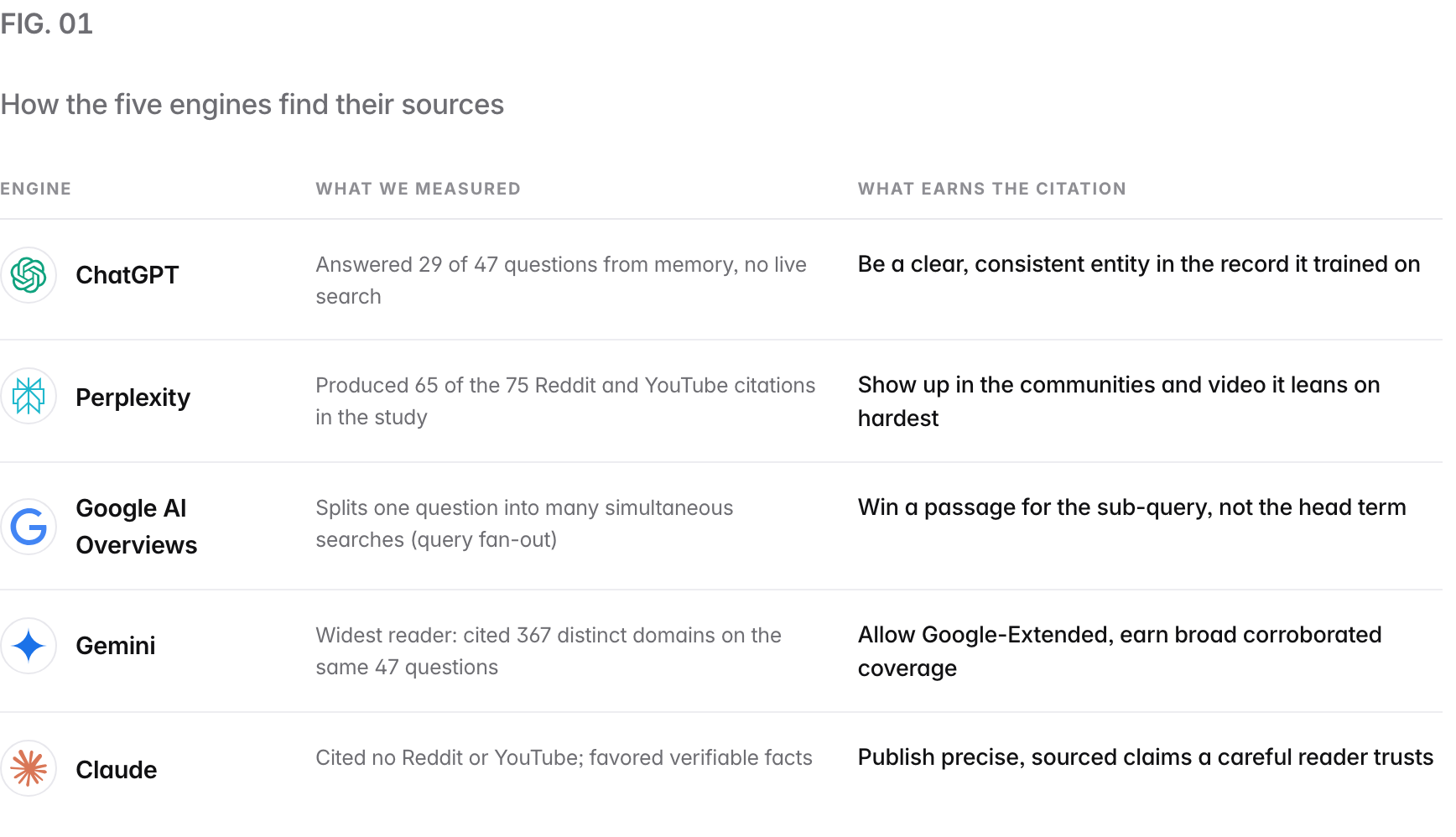
A few of those numbers deserve the plain-language version. ChatGPT answered 29 of its 47 questions with no live search at all, straight from memory, which is why its visibility is decided months ahead by your entity record more than by the page you shipped today. See the ChatGPT guide for that lever. Perplexity produced 65 of the study’s 75 Reddit and YouTube citations, so the community work in the Perplexity guide pays off there first. Claude cited neither Reddit nor YouTube once and rewarded precise, corroborated claims, which the Claude guide covers. Gemini read the widest pool, 367 distinct domains against ChatGPT’s 89, and grounds against Google Search, so allow Google-Extended per the Gemini guide.
Google’s AI is its own case. It runs what Google itself calls query fan-out: in its AI Mode announcement (May 2025) it described “breaking down your question into subtopics and issuing a multitude of queries simultaneously.” That means the winning page is the one that answers a sub-query cleanly, which can rank far below the top ten on the head term. The AI Overviews guide and the AI Mode guide cover both.
Two consequences follow from all this, and neither depends on the exact numbers holding month to month. First, breadth beats a single bet. When 75% of cited domains show up on just one engine, being present on many credible surfaces beats perfecting one page for one model. Second, the foundation still transfers. The same answer-first page, the same clean entity, and the same off-page presence make you eligible on every engine at once; only the last mile differs, which is why the five guides above share a spine and diverge at the end. You do the shared work once, then tune per engine where your buyers actually are.
The work splits into four areas#
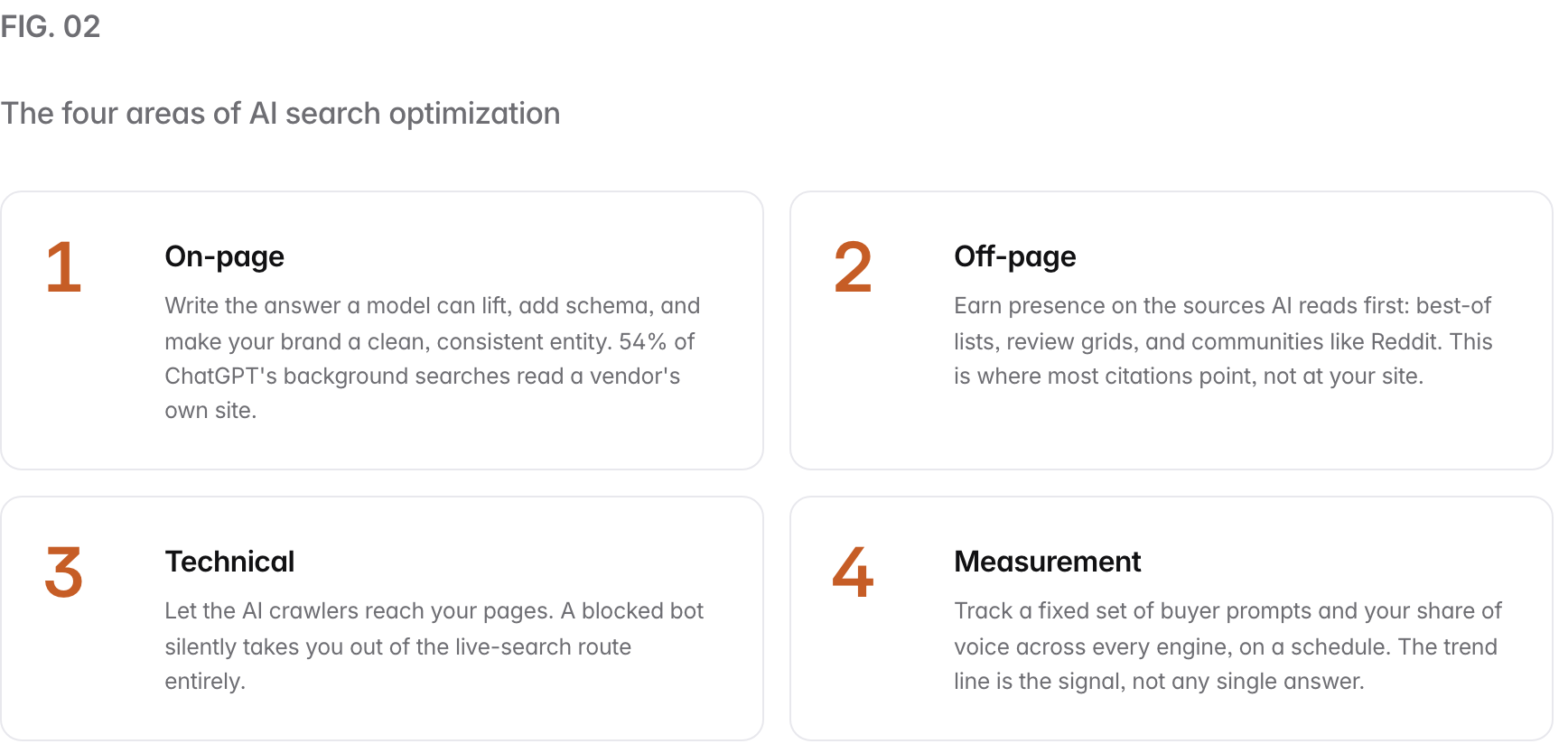
Whatever the engine, the practice is the same four kinds of work. On-page makes you quotable. Off-page makes you credible where the engine looks. Technical makes you reachable. Measurement tells you if any of it worked. Skip one and the rest underperforms: a perfect page behind a blocked crawler is invisible, and a great reputation you never measure is a guess.
On-page: write the answer, not just the page#
On-page work is making each page a model can quote without rewriting it. Open every section with a one-sentence answer to the question in its heading, phrased the way a buyer actually asks, and put the specific facts (prices, limits, integrations, dates, named tools) in plain text a model can lift. Then label it with structured data: FAQPage on question blocks, Article with a real author and honest published and updated dates, HowTo where there are steps.
Entity grounding deserves its own attention, because the memory route depends on it. A model can only repeat what the record clearly and consistently says about you. Use the same one-line description, the same category, and the same core facts everywhere a machine reads them: your homepage, your Organization schema with a sameAs list, your Wikipedia or Wikidata entry if you have one, and your profiles on LinkedIn, G2, Capterra and Crunchbase. When those disagree, the model hedges or reaches for a competitor whose story is cleaner. Consistency is not a branding nicety here; it is how an engine decides it knows who you are.
This matters more than it used to because of how the search step works. When ChatGPT answers a commercial question, it does not re-run the buyer’s wording. It names candidate brands and then reads their own sites for the details. In our fan-out study, one question became 4.8 background searches on average, and 54% of those searches were scoped to a single domain while 36% asked specifically for “official” information. A clean, dated pricing page in real HTML wins the citation that a PDF or a “contact us” page loses. The on-page AEO chapter has the full checklist, and the query fan-out definition explains the mechanism.
The practical rule is to write for the searches your question becomes, not for the question itself. A buyer who asks for “the best tool” triggers a handful of machine searches, and only one of them looks like that phrase; the others hunt for a specific brand, a price, or a head-to-head. So give each attribute its own liftable block. A single page that tries to answer pricing, alternatives and comparisons at once is weaker than three pages that each answer one of them cleanly. Put the current year in your titles and copy too, because freshness is a real filter: in the fan-out run, 13% of the background searches were time-bound to the current year, and a page dated to it matches a search a stale page misses at almost no cost.
Off-page: earn the sources AI reads first#
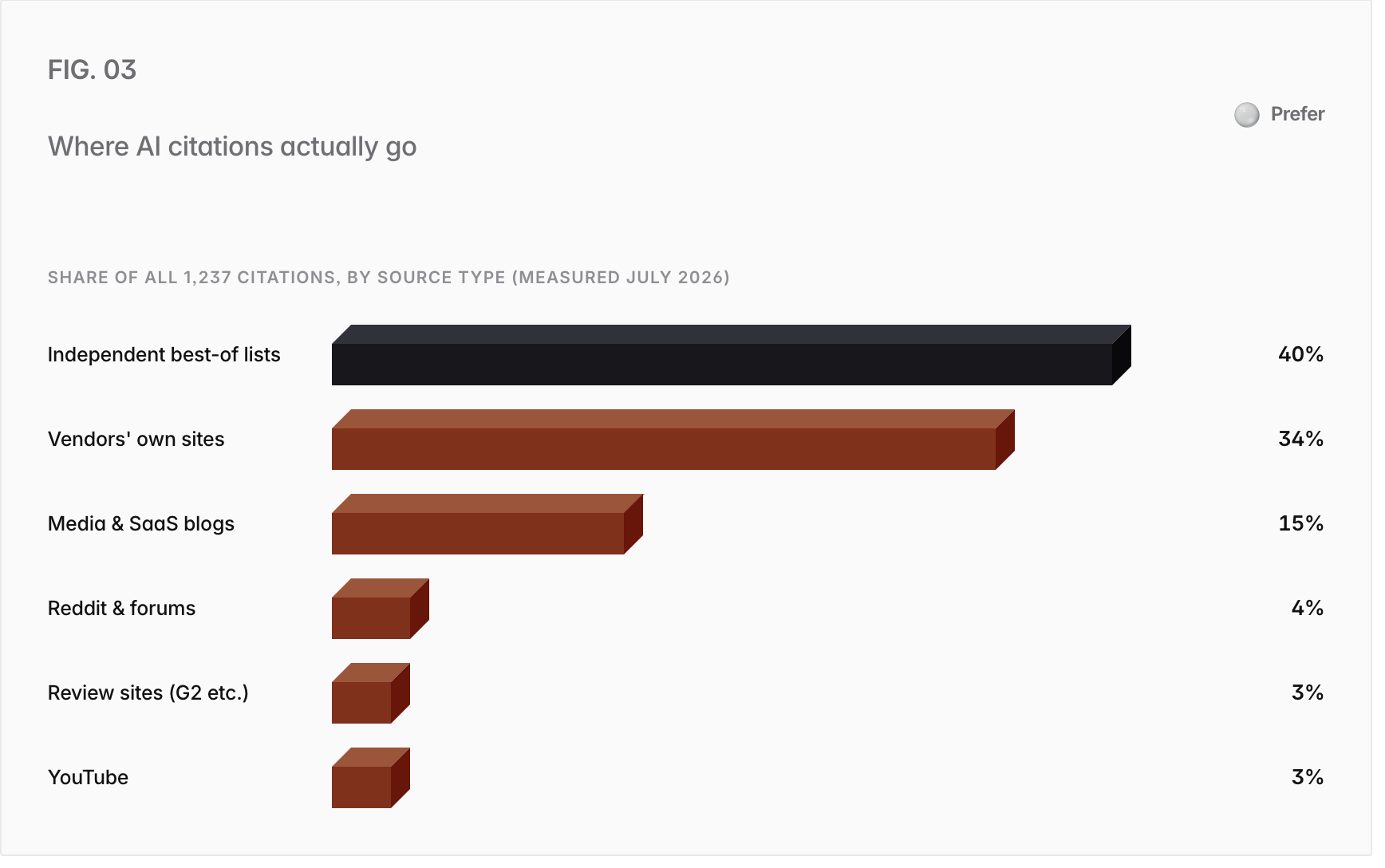
Off-page work is the half most teams skip, and it is where most citations actually point. Engines assemble recommendations from the places buyers already trust, not from the brands themselves. In the July study, independent best-of listicles were the single largest source type at 40% of all citations, ahead of vendors’ own sites at 34%, with media and SaaS blogs at 15% and the rest split across communities, review grids and video.
Two named sources are worth calling out. Reddit was the single most-cited source in the July study, with 43 citations, ahead of YouTube, Zapier and G2. A follow-up measurement went deeper and found Reddit was the number one source ChatGPT cited on every B2B software query tested, and the second source Google’s AI reached for, behind only YouTube. So off-page work is concrete: get named in the credible roundups that the fan-out enumerates, keep your record accurate on review grids, and be genuinely useful in the communities your buyers read. The off-page AEO chapter lays out the eight plays in order of impact. One caution: this is participation you earn, never automate. Buying reviews or spamming threads gets you removed from the exact places you need to be.
You can see the shape of it in the study’s scoreboard. The most-cited sources were reddit.com (43 citations), youtube.com (32), zapier.com (31) and g2.com (19), places that cover a whole category instead of selling one product. The brands named most were the ones written about most: HubSpot drew 22 recommendations, Zendesk 17, and Gusto and Asana 16 each. None of that visibility was bought, and most of it sits on domains those brands do not own.
Which off-page surface matters most shifts with the question and the category, so cover formats rather than chasing one. The mix moves with the question type: on “X vs Y” comparisons in the study, vendors’ own sites fell to 18% of citations as the engines reached for a neutral referee, while on “best tool” questions the vendor share rose to 37%, level with the listicles. It also moves by category. Listicles led AI citations in 5 of the 8 industries measured, but in HR, accounting and customer support, where the roundup ecosystem is thinner, the engines fell back on vendors’ own comparison and pricing pages. The takeaway is not “get on Reddit” or “get in a listicle” in isolation. It is to be present, accurate and useful across the formats your buyers’ questions actually pull.
Technical: let the crawlers in#
Technical work is the cheapest and the most commonly botched. If the AI crawlers cannot fetch your pages, nothing else in this guide reaches the live-search route. In your robots.txt, allow the bots that read for the answer engines: OAI-SearchBot for ChatGPT, PerplexityBot for Perplexity, Claude-SearchBot for Claude, and Google-Extended if you want to appear in Gemini (Google AI Overviews ride on ordinary Googlebot indexing). Blocking one of these takes you out of that engine’s live retrieval entirely, and the fix takes minutes.
One distinction saves a lot of confusion: the AI crawlers split into two jobs. Training crawlers like GPTBot and Google-Extended gather content that may feed future model memory, while search crawlers like OAI-SearchBot and PerplexityBot fetch pages live to build an answer right now. If your goal is to be cited today, the search crawlers are the ones you cannot block. Many robots.txt files ban all of them by reflex, which quietly removes the brand from the live-search route on every engine.
Two related pieces belong here. An llms.txt file is an emerging convention that points models at your most useful pages in clean markdown, a low-cost signal worth shipping. And you should confirm the bots are actually reaching you, not just permitted to, by reading your server logs or a crawler check rather than trusting the file. The full walkthrough, including how to tell an AI crawler from a scraper you may want to block, is in how to control AI crawlers.
Measurement: track prompts and share of voice#
Measurement is what turns AI search optimization from a belief into a practice. Rankings and clicks cannot tell you whether an engine recommends you, so you measure three things instead: your citation rate, or how often an engine names you across your buyers’ questions; your share of voice, or how that stacks up against the competitors cited on the same prompts; and the source domains behind each answer, so you can see which ones are yours to influence.
A tracked-prompt portfolio is simple to build. List the 10 to 50 questions your buyers actually ask, spread across the families that behave differently: category questions (“best X”), comparison questions (“X vs Y”), alternatives questions (“X alternatives”), and pricing questions. Run that fixed set on a schedule, weekly to start, and log the mention, the citation and the recommendation for each engine, along with the sources behind the answer. The families are not interchangeable, since the source mix shifts by question type, so a portfolio that covers all of them shows you where you are strong and where a competitor owns the answer.
Do it across every surface, on a schedule, for two reasons the data makes plain. Because only 5 of 713 domains were shared by all four engines, one engine’s result is not a proxy for the others. And because model versions and indexes change, a single answer is noise; the trend over weeks is the signal. Fix your highest-intent buyer questions, re-run them regularly, and watch the line. The step-by-step is in how to track brand mentions in AI, and the mechanism behind which sources an engine reaches for is in how AI chooses its sources.
Your first 30 days#
You do not need all four areas perfect at once. This sequence gets the foundation right, then starts the off-page work that takes longest to compound, while measurement runs from day one.
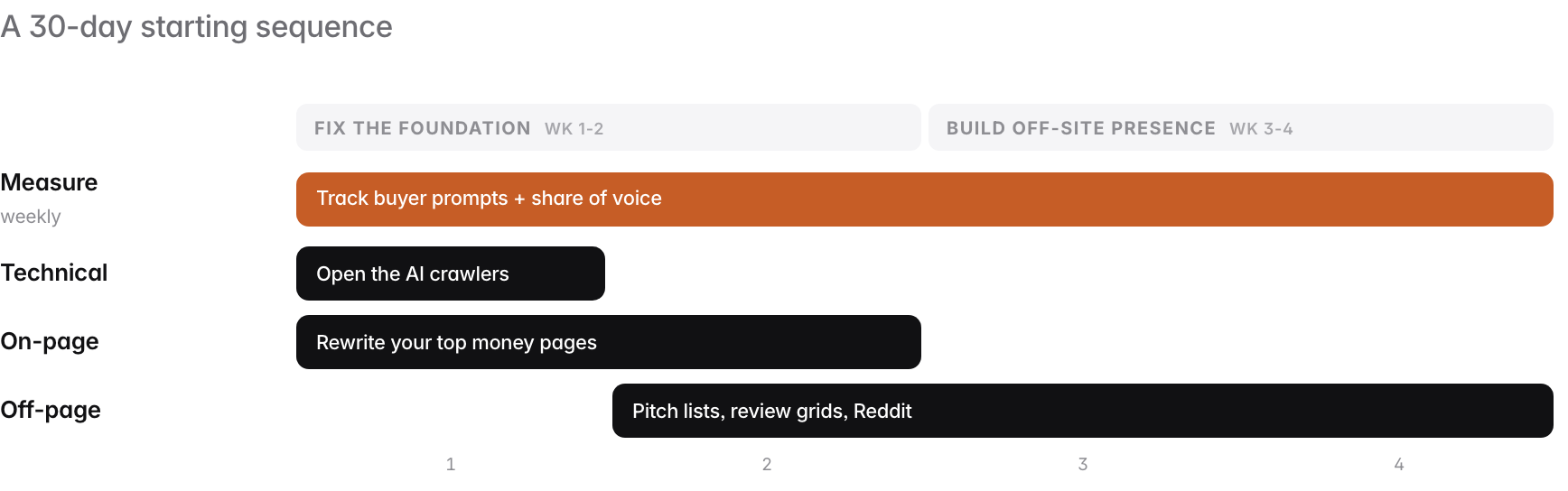
- Week 1, open the crawlers and baseline. Confirm OAI-SearchBot, PerplexityBot, Claude-SearchBot and Google-Extended are allowed, then run your fixed set of buyer prompts across all five surfaces so you have a starting number to move.
- Weeks 1 to 2, rewrite your money pages. Take your top pricing, comparison and category pages and make each answer-first, specific and dated, with FAQPage and Article schema. These are the pages the fan-out reads directly.
- Weeks 2 to 4, start the off-page record. Pitch two credible best-of lists, correct your entry on the review grids that cover your category, and answer real questions in the communities your buyers read. This is slow, so start it early.
- Every week, watch the trend. Re-run the same prompts and track citation rate and share of voice per engine. Move budget toward whatever the line rewards.
The fastest way to know where you stand is to measure it. Run a free AI visibility audit and get your citation rate, share of voice, and the sources behind each answer in about 15 minutes. That baseline tells you which of the four areas to start with, and the engine guides tell you exactly how.
People also ask
- What is AI search optimization?
- How is AI search optimization different from SEO?
- Which AI search engines should you optimize for?
- How do you do on-page AI search optimization?
- How do you measure AI search optimization?
- Is AI search optimization the same as GEO and AEO?