Glossary
Prompt tracking the same questions, asked on a schedule.
Prompt tracking is running a fixed set of buyer prompts across AI engines on a schedule to record when your brand is mentioned or cited. Prefer runs it.

Prompt tracking is running a fixed set of buyer prompts across AI engines on a schedule to record when your brand is mentioned or cited. Prefer runs yours on five engines.
Prompt tracking is the practice of running a fixed set of buyer prompts across AI engines on a schedule, then recording when your brand is mentioned or cited and how that changes over time. It is how you turn “are we showing up in ChatGPT?” from a guess into a measured trend. Prefer runs your tracked prompts across ChatGPT, Gemini, Perplexity and Google’s AI Overviews and AI Mode.
How prompt tracking works#
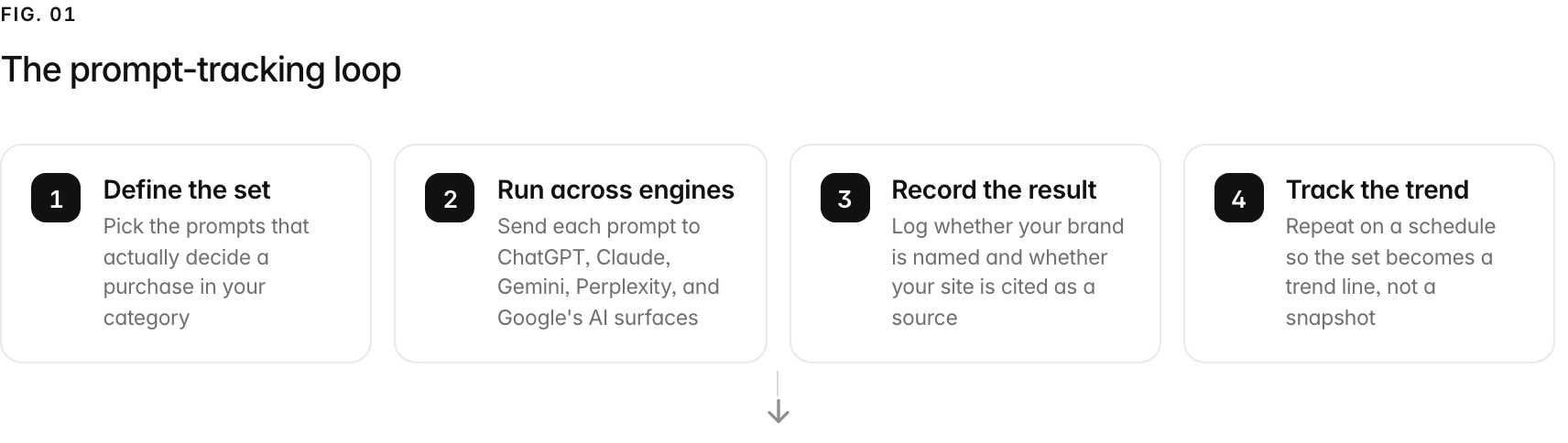
You cannot watch every possible question a buyer might type, so you track a representative set: the prompts that actually decide a purchase in your category. Each tracked prompt is sent to the engines you care about (ChatGPT, Claude, Gemini, Perplexity, and Google’s AI surfaces), and the answer is parsed for two things: whether your brand is named, and whether your site is cited as a source. Run on a schedule, the set becomes a trend line instead of a snapshot.
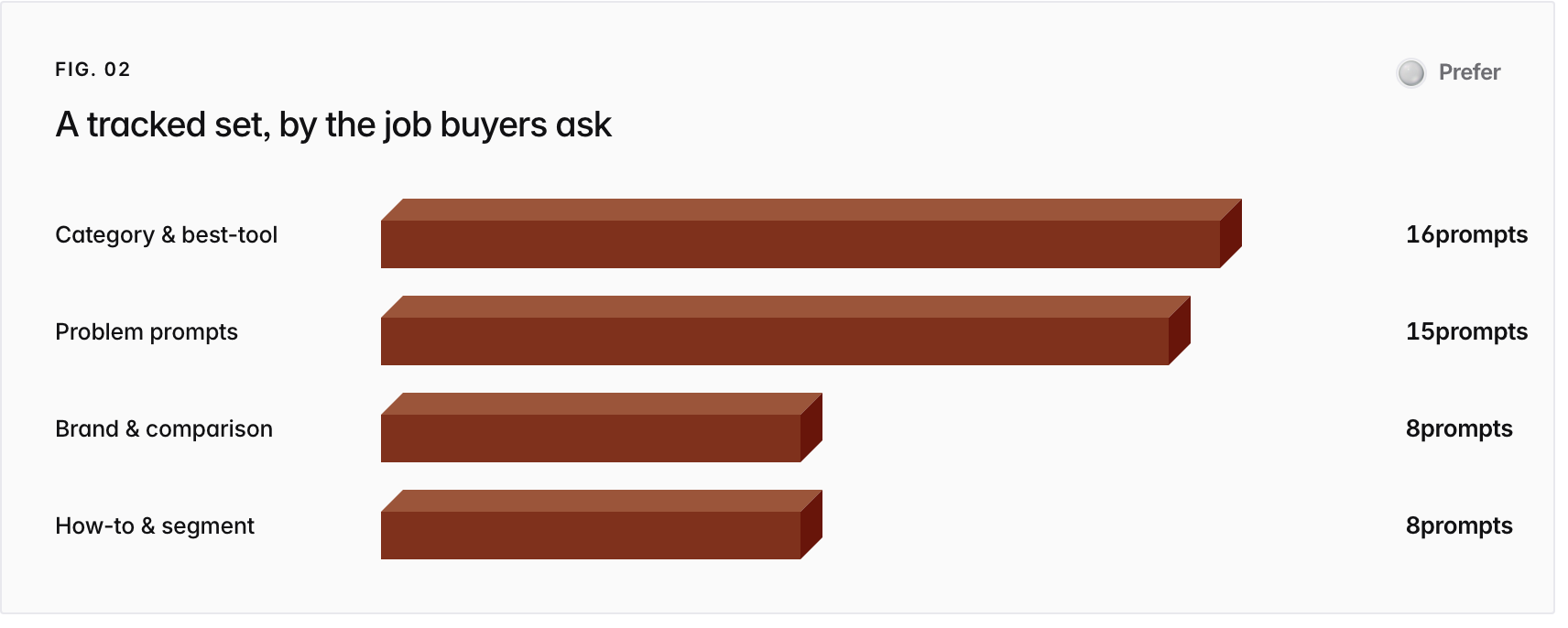
A good tracked set covers the different jobs buyers ask an assistant to do. In our first measurement run (50 prompts, 2 September 2026), 47 answers were usable, and we grouped them by that job: 16 category and best-tool prompts, 15 specific problem prompts, 8 brand and comparison prompts, and 8 how-to and segment prompts.
Why prompt tracking matters#
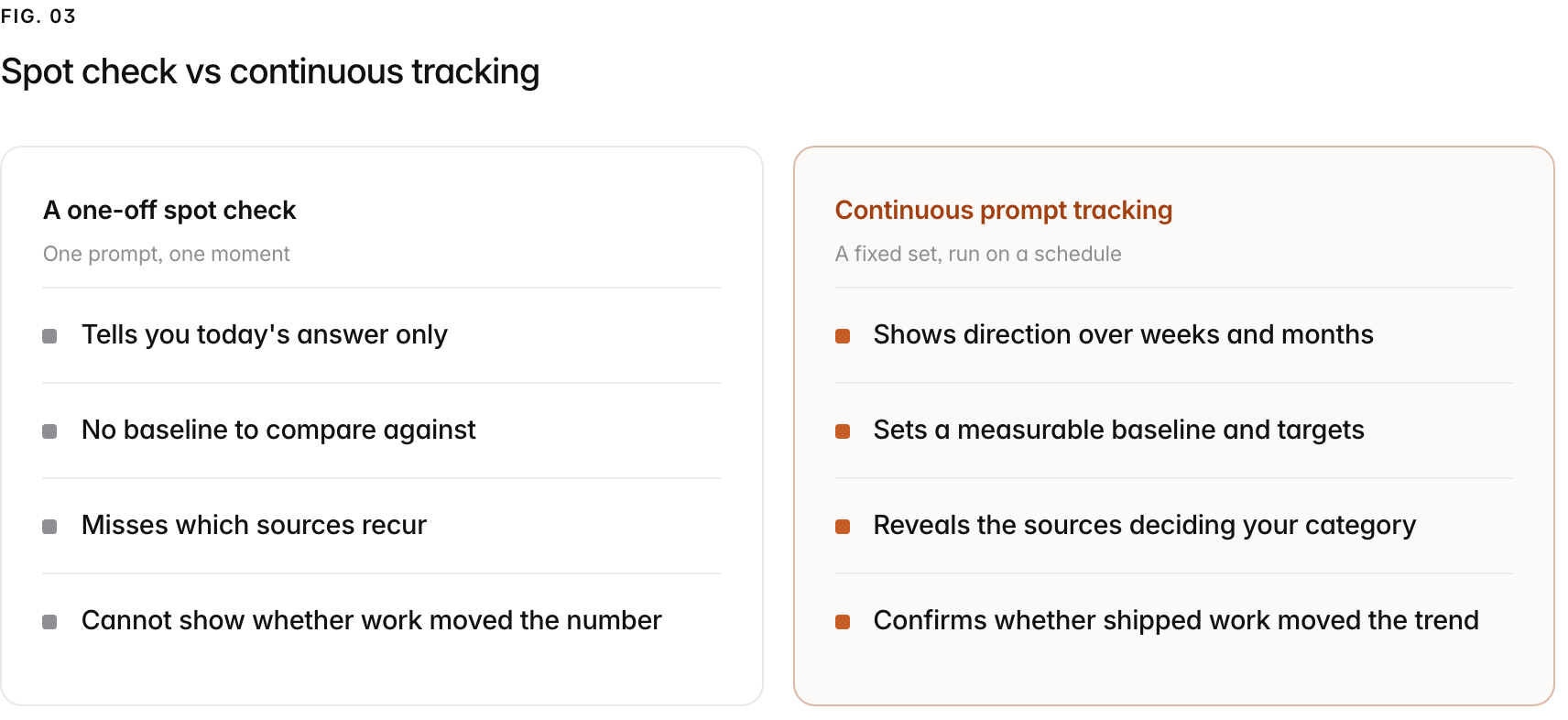
Without a tracked prompt set you cannot tell whether AI-search work is moving anything. A single check tells you today’s answer; only a stable set, run repeatedly, shows direction. Your first run gives you a precise baseline, often an unflattering one, and precision is the point: you cannot improve a number you have not measured.
Tracking also reveals the structure behind the answers. In the same run, the techradar.com domain was cited in 12 of those 47 answers, through five different pages. You only learn that one site shows up in a quarter of your category’s answers by tracking the set and reading the citations, not by spot-checking once.
Prompt tracking vs a one-off audit#
An audit is a single measurement at one moment; prompt tracking is the same measurement repeated. The audit gives you a baseline and targets; tracking tells you whether you are hitting them. The two work together: the audit sets the number, tracking watches it move.
Example#
Say you sell payroll software. Your tracked set might include “best payroll software for startups,” “Gusto vs Rippling vs [you],” “how do I run payroll for contractors,” and “cheapest payroll tool with an API.” Run on a schedule across five engines, the set shows which prompts you win, which competitor keeps taking the top slot, and which sources the engines lean on. When you ship work, the same set tells you within a cycle or two whether it moved the number.
How Prefer helps with prompt tracking#
Prefer tracks your prompt set across all five engines on every plan, records mentions and citations, and benchmarks the trend as your share of voice against competitors. Plan tiers scale the number of tracked prompts (30 on Starter, 150 on Growth, 500 on Scale); see pricing for current limits. Start with a free AI visibility audit to set your baseline, then track it.
In context
The term in a sentence.
Related questions
People also ask.
- How do I track prompts in AI search?
- How many prompts should I track?
- What is the difference between prompt tracking and an audit?
Questions
Asked plainly.
What is prompt tracking in simple terms?
It is running the same set of buyer questions through AI assistants on a regular schedule and recording whether they name your brand and cite your site. Prefer does this for you across ChatGPT, Gemini, Perplexity and Google's AI Overviews and AI Mode. Repeated over time, it turns a guess about your AI visibility into a measured trend.
How many prompts should I track?
Start with 10 to 50 buyer prompts and grow toward 150 as you add competitors and engines; Prefer tracks 30 on Starter, 150 on Growth and 500 on Scale, each across five AI engines. Whatever the count, cover the different jobs buyers ask an assistant to do: broad category questions, best-tool and comparison questions, how-to questions, and specific problem questions.
What is the difference between prompt tracking and an AEO audit?
An audit is a single measurement that sets your baseline and targets. Prompt tracking is the same measurement repeated over time; Prefer tracks it for you, so you can see whether you are hitting those targets over time.
Which engines should prompt tracking cover?
The engines your buyers actually use to research: ChatGPT, Claude, Gemini, Perplexity, and Google's AI surfaces. Prefer covers ChatGPT, Gemini, Perplexity, Google AI Overviews and AI Mode on every plan, with Claude on Enterprise. Each can answer the same prompt differently and lean on different sources, so tracking one engine misses most of the picture.
Keep reading