What AEO Is, and Why SEO Alone Won't Get You Cited
Answer engine optimization (AEO) is how you get cited in AI answers, not just ranked. What AEO is, why SEO alone won't get you cited, and how to start.

Your AEO one-liner: one sentence naming the buyer question you want to win, the answer you want AI to give, and the single fact it must know about you. It aims every play in this book. Play 01.
Answer engine optimization (AEO) is getting your brand named and cited inside AI answers, not just ranked in a list of links. AI assistants give one answer and cite a few sources, so the win is being one of those sources. SEO still helps but is not enough: engines read different sources, answer many questions from memory, and reward proof on other sites.
- Answer engine optimization (AEO) is the work of getting cited inside AI answers, where the win is being named as a source, not ranking in a list of links.
- SEO still helps, but it is not enough: AI answers many questions from memory, reads different sources on each engine, and leans on proof from other people's sites.
- Three things decide whether AI names you: your own pages, other people's sites (reviews, communities, directories, entity records), and what the model already learned about you.
- Start by writing one sentence: the buyer question you want to win, the answer you want AI to give, and the one fact it must know about you.
Answer engine optimization (AEO) is the work of getting your brand named and cited inside AI answers, not just ranked in a list of links. When someone asks ChatGPT, Perplexity, Gemini, or Claude for the best tool for their job, they get one written answer that names a few options and cites a few sources. AEO is how you become one of those named options and cited sources. (For the standalone definition, see answer engine optimization in the glossary; this chapter is about what to do with it.)
This is the opening chapter, so it is short. Its only jobs are to show you the shift that makes AEO its own discipline, to be honest about why doing good SEO will not be enough on its own, and to get you to write one sentence you will aim everything else at. The other nine chapters are the plays.
The shift: from ranking a page to being the answer#
For twenty years, search meant a list of links. You did the work to rank near the top, and the reward was a click to your site. AI search replaced the list with a single answer. The reward is no longer the click; it is being named in the answer.
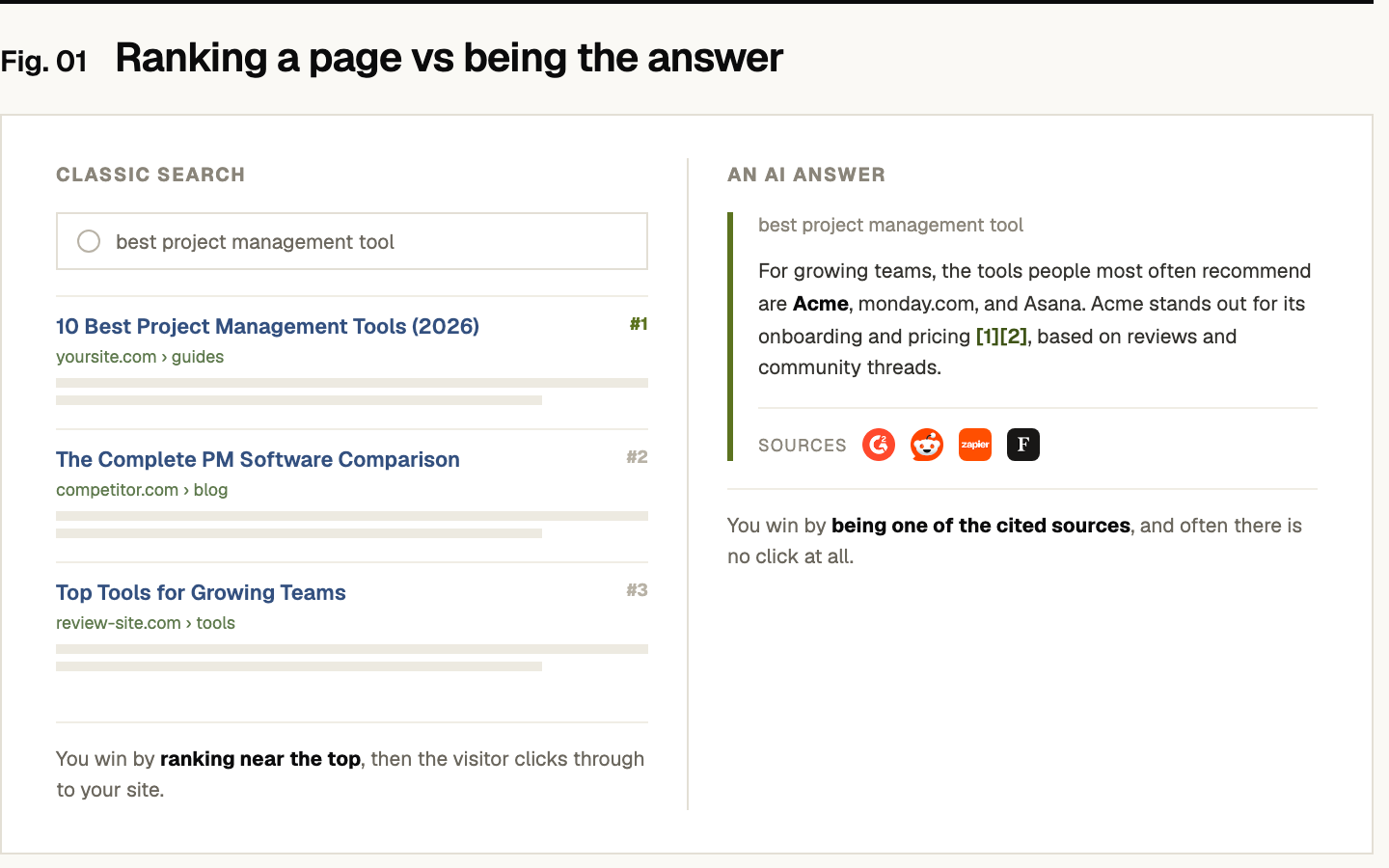
The two are not opposites, and classic search is not going away. But they reward different things. Ranking rewards a strong page on your own site. Being named in an answer rewards something wider: whether the engine trusts you enough, from enough places, to put you in the sentence it writes. That is the gap this book closes.
Why SEO alone won’t get you cited#
Good SEO still helps. A useful, crawlable, well-structured site is the floor for AEO, not a distraction from it. But three things about AI answers mean SEO on its own leaves most of the work undone.
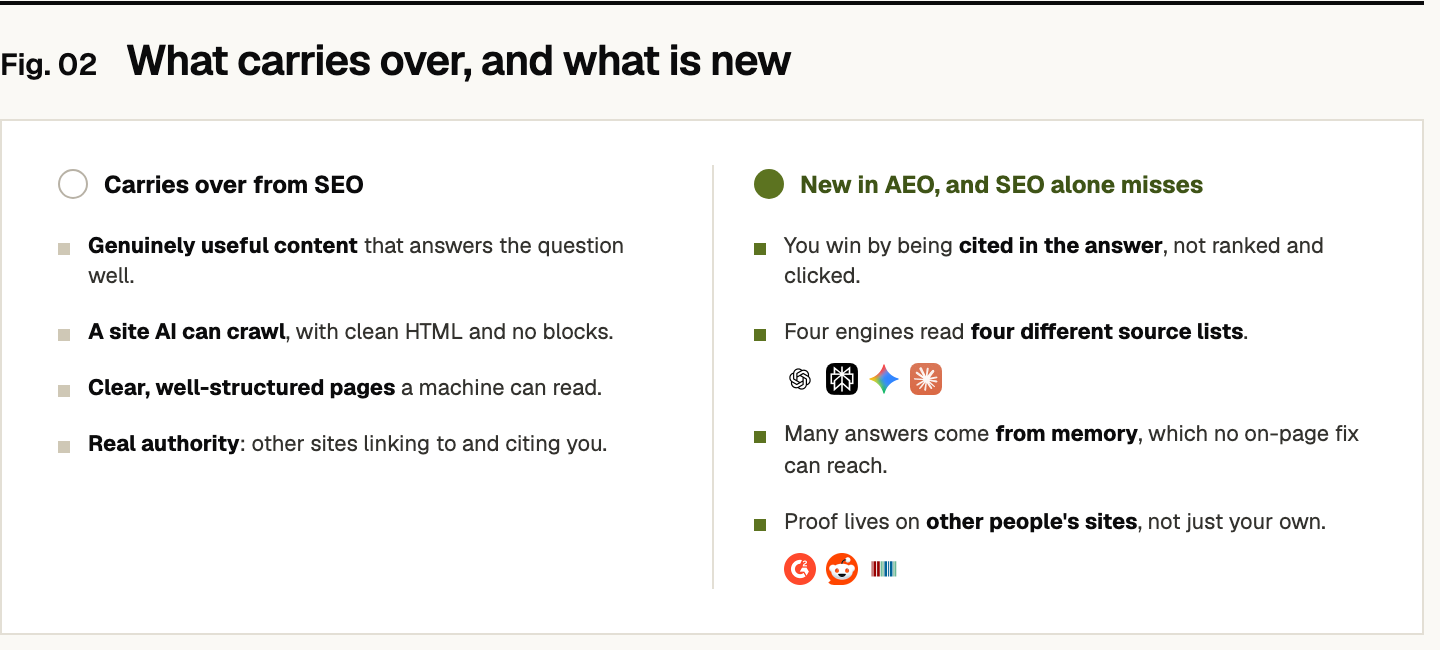
First, many AI answers are written from memory, and no on-page fix can reach them. An engine can answer from what it learned in training, with no live search and no citations at all. In our study of 188 answers, ChatGPT answered 29 of 47 buyer questions from memory, citing nothing. No schema, no rewrite, no new page changes an answer the model wrote without reading anything. Those answers only shift as the model’s picture of you shifts, which comes from years of other people writing about you.
Second, the engines do not read the same sources. Across those 188 answers, the four engines cited 713 distinct domains and agreed on only five of them. A page that helps you on Gemini may be invisible on ChatGPT, because they read different-sized slices of the web. There is no single “AI search” to optimize for. Chapter 2 shows exactly how each engine behaves.
Third, the proof that gets you cited usually lives on other people’s sites. When an engine does search, it leans on reviews, community threads, directories, and third-party lists as evidence. Your own page saying you are the best is weak; G2 reviews, a Reddit thread, and a clean Wikidata record are strong. That work is off your own site, which is why Chapter 7 is the longest in the book.


If you want the side-by-side in more depth, we wrote it up separately: AEO vs SEO and AEO vs GEO.
What actually decides whether AI names you#
Put those three together and you have the whole machine. Whether an AI answer names you comes down to three inputs, and each one is a chapter in this book.
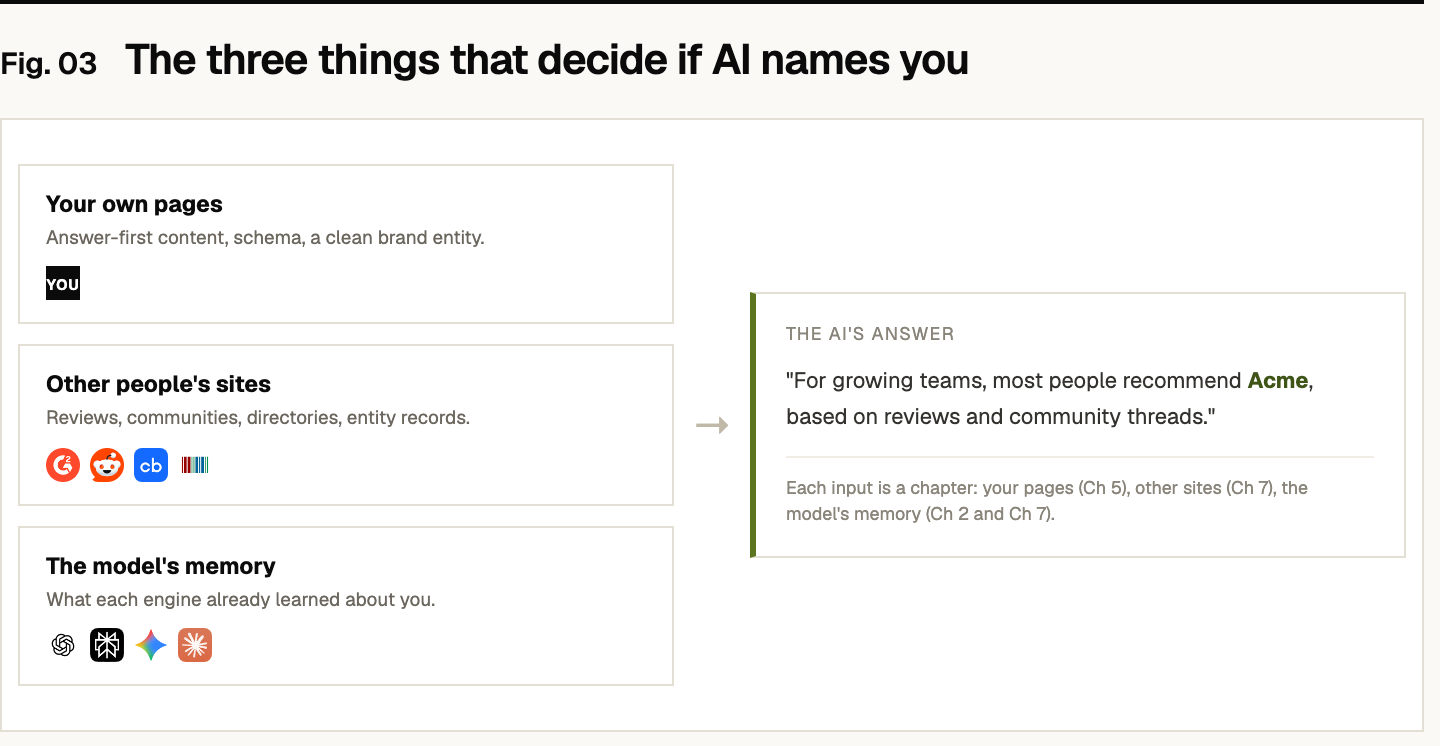
You control the first input directly (your pages), earn the second over weeks and months (other people’s sites), and influence the third slowly (memory). Most brands over-invest in the first because it feels like SEO and is fully in their hands, and under-invest in the second, which is where the citations actually come from. The plays are ordered to fix that balance.
How to use this book#
Read the chapters in order the first time. Each one ends with a short worksheet that produces one piece of your plan: your engine-reality check, your baseline scorecard, your gap list, your fix list, and so on. Fill the worksheet as you go, and by the last chapter those pieces assemble into a dated, week-by-week 90-day plan on the Your plan page. The whole chapter map is on the hub, with a master list of every play. Nothing is gated and nothing is sent anywhere; the worksheets save in your browser.
Every chapter also carries numbered plays: single, self-contained actions with steps, the tools to use, and a way to check they worked. This chapter has one.
The play#
One play, about twenty minutes, and the vague wish to “show up in AI” becomes a specific target you can test.
Write your AEO one-liner
Turn 'I want to show up in AI' into one specific, testable sentence you can aim every later play at.
A vague goal cannot be measured or worked. A specific one can: in our study ChatGPT answered 29 of 47 buyer questions from memory, and the four engines shared only 5 of 713 cited domains. 'AI search' is really many different targets. A one-liner picks the one that matters to you and makes everything after it measurable. (Prefer AI Citation Study, checked 2026-07-10)
Before you start: None. This is the first thing to do.
- Write the one buyer question you most want to win, in the exact words a buyer would type. Use the category question ('best [category] for [audience]'), not your brand name.
- Write the answer you want the AI to give. Name yourself and the one reason you belong there: 'X is the best fit for Y because Z.'
- Write the single fact the AI must know to give that answer: what you do, who it is for, and one proof point. If it does not know this, you have a memory problem, not a page problem.
- Combine the three into one sentence and keep it somewhere visible. Every later play aims at it: the audit tests it, the on-page and off-page work moves it.
Done when: You have one sentence with three parts: the buyer question, the answer you want, and the fact AI must know.
Verify it worked: Ask one AI engine your buyer question today and compare its answer to the one you wrote. The gap between them is your work list for the rest of this book.
Common failure mode: Writing your brand name as the question. Buyers ask category questions, not your name; if you only win your own name, you only win people who already found you.
Your AEO one-liner
Fill this in from Play 01. It is the first piece of your 90-day plan and the target every other chapter aims at. Saves locally as you type.
Everything you type saves in this browser and assembles into one document on the Your plan page, where you can copy or download it. Nothing is sent anywhere. A duplicatable Notion and Google Sheets version ships with the companion pack.
Where this goes next#
You now have a target. The next chapter shows you the ground you are working on: how AI engines actually choose their sources, measured across 188 answers, so you know which engine to aim at first and whether your problem is grounding or memory. If you would rather see where you stand right now, the free AI visibility audit checks your one-liner across the engines in about 15 minutes.
Frequently asked questions
Is AEO just SEO with a new name?
No. They overlap but the goal is different. SEO tries to rank your page in a list of links so someone clicks it. Answer engine optimization (AEO) tries to get your brand named and cited inside the single answer an AI assistant writes, where there is often no list and no click. The craft that carries over is real: useful content, a crawlable site, clear pages, genuine authority. What is new is that AI answers many questions from memory (which no on-page fix can reach), each engine reads a different set of sources, and much of the proof lives on other people's sites, not yours. So SEO helps, but on its own it will not get you cited.
What is the difference between AEO and GEO?
They describe almost the same work from two angles. Answer engine optimization (AEO) is about being the answer to a question, across AI assistants and answer boxes. Generative engine optimization (GEO) is the same idea framed around generative engines like ChatGPT, Perplexity, Gemini, and Claude specifically. In practice the plays are the same: earn citations by being genuinely useful, well-structured, and well-documented across the sources these engines read. This book uses AEO as the umbrella term and treats the engine differences as tactics, not separate disciplines.
Can I do AEO if I have never done SEO?
Yes, and sometimes it is easier. AEO rewards clear, well-structured answers and third-party proof (reviews, community mentions, directory and entity records) more than it rewards a large backlink profile built over years. A newer brand with honest, specific content and a handful of real reviews can get cited on grounded answers this quarter. What takes longer is memory: the picture a model formed during training, which only shifts as more people write about you over time. Start with the audit in Chapter 3 to see which of the two you are dealing with.
How long does AEO take to work?
It depends on whether your problem is grounding or memory. Live-search answers (where the engine reads the web before replying) can change within weeks once you earn a citation on a source the engine reads. Memory answers (generated from training data with no live reading) change slowly, over months, as consistent third-party coverage accumulates. That is why the first real step is measuring which kind of answer you get, not guessing. Set leading-indicator targets (citations earned, surfaces claimed) rather than promising a ranking by a date.