Ask ChatGPT, Perplexity and Claude the same buyer question with web search on, and you get three shortlists built from almost entirely different sources. We tested this directly: 47 buyer questions, four engines, every citation logged. Of the 713 distinct domains they cited, only 5 were cited by all four, and about 75% were cited by a single engine and no other. There is no one AI search to win. There are three or four separate ones, each reading a different slice of the web.
This post is the head-to-head read of that data: what each engine actually cited, how big a slice of the web it pulled from, and where the popular “ChatGPT is faster, Claude is slower” framing falls apart once you measure instead of guess.
The test: same prompts, four engines, every citation logged#
On 2026-07-10 Prefer sent the same 47 buyer questions across 8 industries to ChatGPT, Perplexity, Gemini and Claude through the DataForSEO LLM API, with live web search forced on. That produced 188 answers. We pulled every cited source out of every answer, normalized it to its root domain, and counted: 1,237 citations across 713 distinct domains. The full write-up, including the source-type breakdown and every caveat, is in who gets cited in AI search.
One honest note before the findings. This is one measured run on one day, using API model endpoints as proxies for the consumer apps, and LLM outputs are non-deterministic. Treat the patterns as directional, not settled statistics. They are consistent enough across engines to be useful, which is the point of running the test rather than trusting the marketing.
The engines barely cite the same sources#
If you think of “AI search” as a single surface you can win, the data disagrees hard. Only 5 of the 713 cited domains were cited by all four engines, and roughly 75% were cited by just one. Same questions, same day, and the reading lists almost never lined up.
Part of the reason is that the engines pull from very different-sized pools. ChatGPT cited 89 distinct domains across the study, Claude 220, Perplexity 273, and Gemini 367. ChatGPT drew from the narrowest set by a wide margin, so a page that wins there is competing against a much shorter list than the same page faces on Gemini.
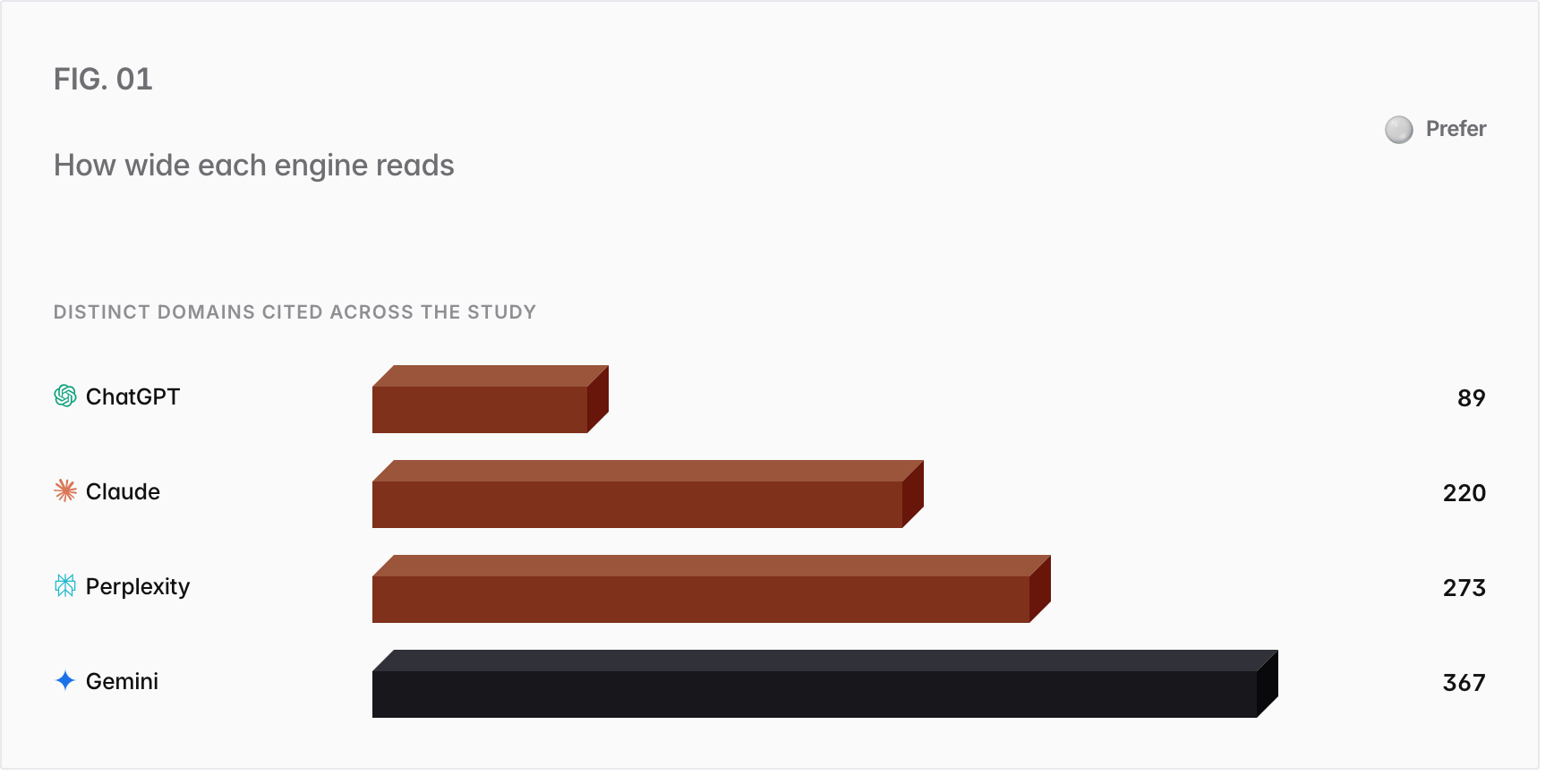
The practical read: tracking one engine measures roughly a quarter of reality. A citation you win on Gemini tells you almost nothing about whether you appear on ChatGPT for the same question. This is the strongest argument in the data for watching every engine, not just the one you happen to open.
They cite different kinds of sources, too#
The engines do not just read different domains. They favor different types of source. The clearest split is community and video: Perplexity produced 65 of the study’s 75 Reddit and YouTube citations (37 from Reddit, 28 from YouTube). Claude cited neither once. ChatGPT cited them a single time. Gemini a handful.
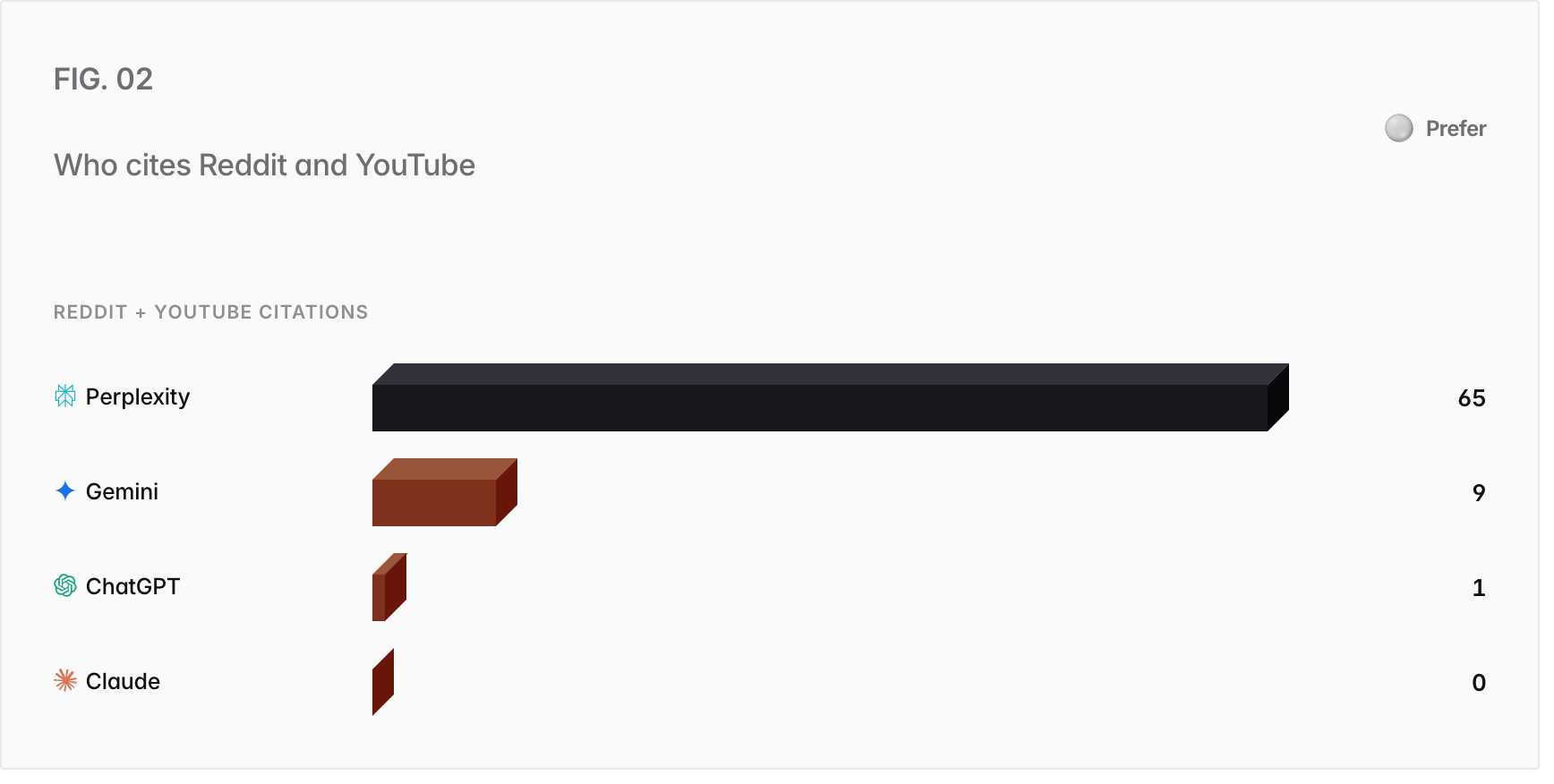
So a Reddit thread or a YouTube walkthrough pays off on Perplexity and close to nothing on the other three. That is not a reason to skip community work. It is a reason to be honest about which engine it shows up in. The same asymmetry runs through the whole dataset: independent “best X” listicles were the single biggest source overall (40% of citations, ahead of vendors’ own sites at 34%), but the balance flips by industry. The category patterns live in the full study and the AI search statistics.
ChatGPT often answers from memory instead of searching#
Here is the finding that reframes the whole “who cites you first” question. ChatGPT skipped live web search on 29 of its 47 answers and replied from memory, citing nothing at all. Only 18 of 47 answers (38%) were grounded in a live read. That is why ChatGPT cited vendor sites least of the four engines: much of the time it was not reading any live page to cite.
That behavior is not fixed. On a separate September 2026 run, on a newer ChatGPT model, the picture had shifted hard: 47 of 50 answers were grounded in live web search, and grounded answers cited about 3.8 sources each.
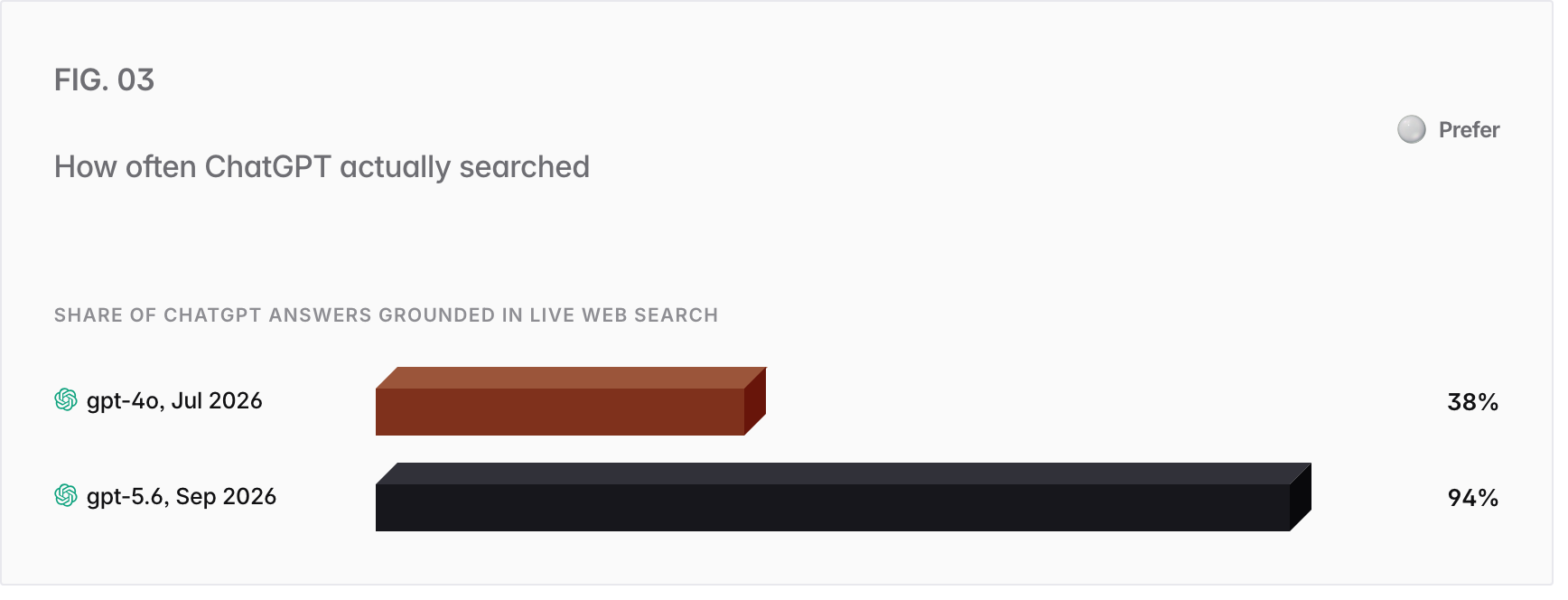
The two runs used different prompt sets and different models, so this is a direction, not a controlled before-and-after. But the direction is the useful part. Whether ChatGPT searches at all decides whether your page is even eligible to be cited. When it answers from memory, no on-page edit can reach the answer; what matters there is whether your brand is in the model’s memory, which is a slower thing to earn than a fresh page. When it searches, your current pages are back in play.
What about speed, the “who cites you first” question?#
The tidy version of this comparison says Perplexity cites in hours, ChatGPT in a few days, and Claude in weeks. We looked for those numbers in our own data and could not support any of them. There is no trustworthy per-engine citation speed, and a specific day-count is a guess dressed up as a measurement.
What we can say is how the clock actually works, because that is a mechanism, not a mystery:
- Searched answers move at crawl speed. When an engine answers by searching the web, it reflects whatever your page says now, once the engine has re-crawled it. That is a window of days to weeks, and none of the operators publish their re-crawl cadence, so you cannot pin it to a number.
- Memory-based answers move at model speed. When an engine answers from training, the fact only updates when a new model ships, which takes months. No amount of publishing changes it in the meantime.
So “who cites you first” is really two questions: did the engine search at all, and how recently did it re-crawl you. Both are things you influence (be searchable, be fresh, be allowed), not things you can schedule. The honest, mechanism-first version of this is in our answer on how long it takes ChatGPT to update your brand info.
The crawlers that decide eligibility#
Before any of this matters, the engine has to be allowed to read you. Each operator uses a named crawler, and blocking it in robots.txt removes you from that engine’s citations entirely.
- ChatGPT indexes for search with OAI-SearchBot and is widely reported to browse Bing’s index too (OpenAI’s crawler documentation does not mention Bing), so being indexable on Bing is a sensible hedge. GPTBot governs training and is a separate decision.
- Claude indexes the web for its search with Claude-SearchBot and fetches a specific page a user asks about with Claude-User. ClaudeBot governs training.
- Perplexity uses PerplexityBot.
- Gemini and Google AI Overviews ride on normal Googlebot indexing. Google-Extended is a separate robots.txt token: it controls whether Gemini Apps and Vertex AI may use your pages for training and grounding, and it does not affect AI Overviews.
# robots.txt: allow the crawlers that decide AI-search eligibility
User-agent: OAI-SearchBot
Allow: /

User-agent: Claude-SearchBot
Allow: /

User-agent: Claude-User
Allow: /

User-agent: PerplexityBot
Allow: /

User-agent: Google-Extended
Allow: /What to actually do about it#
The data points to a short, honest playbook. Nothing here depends on a citation-speed number, because there isn’t a reliable one.
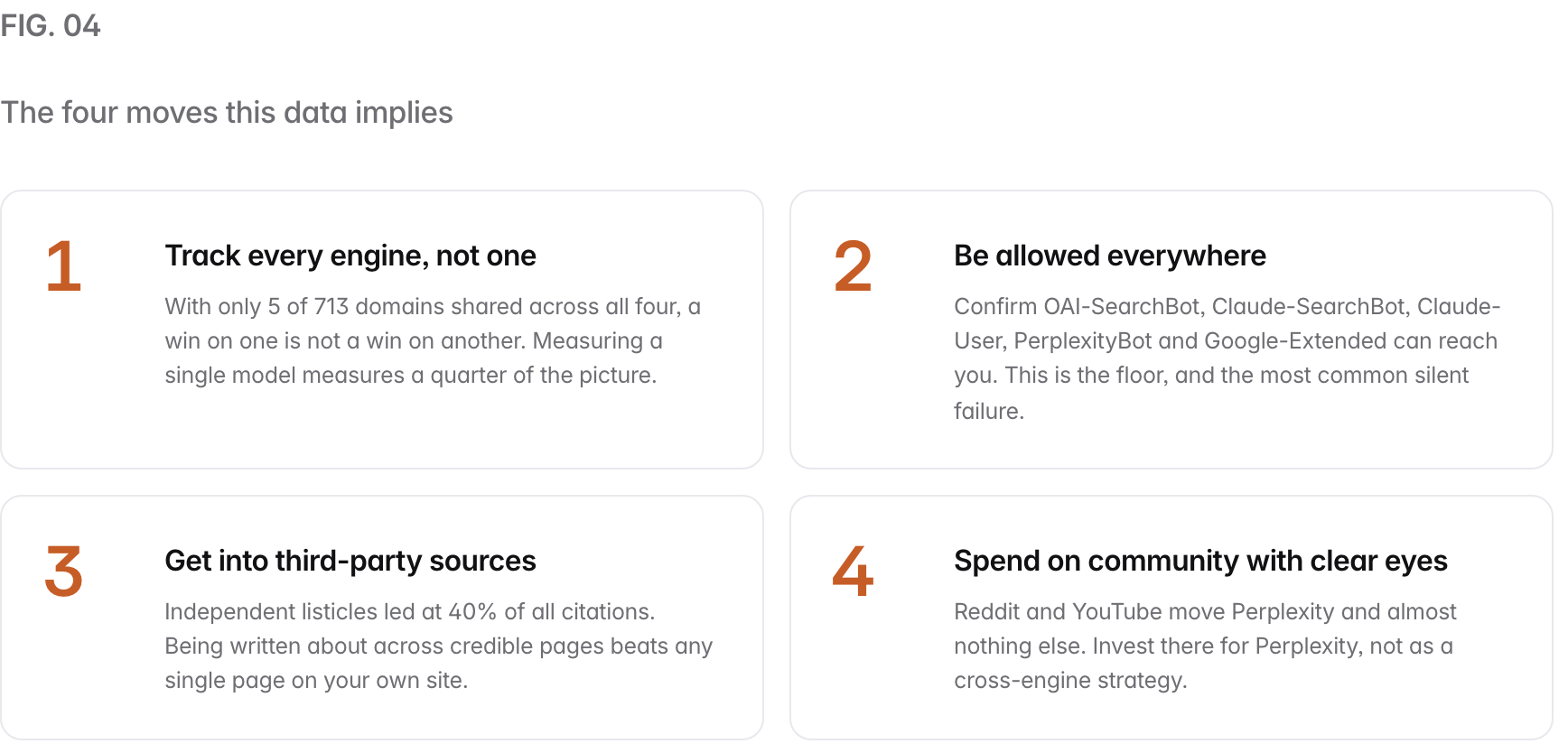
The through-line is that the engines are not interchangeable and neither is the work that wins them. If you want the version of this specific to your site, track your citations across five AI engines or run a free AI visibility audit to see what each one says about you today.
Sources#
- Primary data: the Prefer AI Citation Study, run 2026-07-10, 47 buyer questions across 8 industries, four engines, web search on, 1,237 citations across 713 domains. Full write-up in who gets cited in AI search; every slice is on the AI search statistics page.
- Engines and models queried (via the DataForSEO LLM Response API, web search on): ChatGPT (gpt-4o), Perplexity (sonar-pro), Gemini (gemini-2.5-pro), and Claude (claude-sonnet-4-5).
- September 2026 grounding figures: a separate Prefer run, 2026-09-02, ChatGPT on a newer model (gpt-5.6) with web search on, 50 category prompts, 47 grounded and about 3.8 sources per grounded answer.
- Crawler names (OAI-SearchBot, GPTBot, Claude-SearchBot, Claude-User, ClaudeBot, PerplexityBot, Google-Extended) are from each operator’s own documentation, cross-checked against Prefer’s per-engine guides.
People also ask
- Do ChatGPT, Perplexity, and Claude cite the same sources?
- Which AI engine cites Reddit and YouTube the most?
- Does ChatGPT always search the web before answering?
- How fast will a new page get cited by AI?