What is the best Semrush AI Toolkit alternative in 2026?
Prefer is the best Semrush AI Toolkit alternative for most teams. From $24 a month, against Semrush's $99 per domain, it tracks five engines including Gemini and both of Google's AI surfaces and writes 15 AI articles; Prefer Managed does the off-page work for you. If classic SEO is your main job and AI visibility a bonus, Semrush's add-on may be enough. AthenaHQ is the best free way to switch, Profound the deepest if you are moving up-market, and Ahrefs Brand Radar the other option if you would rather stay inside one suite.
Best overall alternativePreferFive engines at entry, plus the content written for you
Best free-to-startAthenaHQFive models free, and it acts
Deepest dedicated trackerProfoundThe deepest real-user prompt data
DisclosurePrefer publishes this list, and Prefer is on it. Every competitor entry, Semrush included, is written from that vendor's public documentation with a checked-on date. Semrush is a mature, well-run suite, and where its AI Toolkit is genuinely strong, one vendor, one invoice, and a workflow your team already knows, this list says so.
In short
The takeaways, up front.
Semrush's AI Toolkit is a fine tracker if classic SEO is your main job; you outgrow it when you need more engines at your tier, dedicated AI depth, or execution.
Prefer (our product, disclosed) is our pick for the best alternative: five engines including Gemini and both of Google's AI surfaces and the work done to win citations.
Profound is the deepest dedicated tracker; AthenaHQ is the best free alternative with actions; Otterly is a budget reading; Ahrefs Brand Radar is the other one-vendor option.
Semrush's $99 toolkit tracks 25 prompts a day on one domain across five engines, the $199 bundle 50, and Claude plus full LLM coverage are Enterprise-only, so check the engines and prompts at the price you will actually pay.
How we evaluated
Four criteria. Nothing else counted.
Prefer is the best Semrush AI Toolkit alternative: from $24 a month it tracks five engines and writes 15 AI articles, and Prefer Managed does the off-page work. Semrush's AI Toolkit adds AI tracking to your SEO suite, but starts at $99/mo per domain for 25 prompts a day and does not do the work. Profound is the deepest dedicated tracker; AthenaHQ starts free.
01
Engines and prompts at your tier
Semrush's $99 toolkit tracks 25 prompts a day on one domain across five engines, and Claude plus full LLM coverage sit in Enterprise. The first thing to check in an alternative is how many engines it tracks, which ones, and how many prompts, at the tier you can actually afford.
02
Dedicated depth, not a skimmed layer
A suite add-on reports visibility next to keyword rankings. A dedicated tool goes deeper: source-level citations, share of voice against named rivals, crawler-log behaviour. Decide whether the AI number is a headline metric or a side panel.
03
Executes, or only measures
Semrush surfaces the gap and, at most, drafts on-page copy. It does not earn the off-page citations that AI answers lean on or run a closed loop that verifies the fix. If the work not getting done is your real problem, check the alternative closes it.
04
One vendor, or the right vendor
The Toolkit's real pull is one login and one invoice. Weigh that convenience honestly against a dedicated tool that covers more engines and does more of the work, and decide which the AI channel deserves.
Three kinds of tool
They are not all the same product.
Suite add-ons
Semrush, Ahrefs
Layer AI-visibility tracking onto the SEO suite you already pay for. One vendor, one invoice, and a workflow your team knows, at the cost of depth and engine coverage at your tier.
Buy one if classic SEO is the main job and AI visibility is a welcome bonus.
Dedicated trackers
Profound, Peec AI, Otterly
Do the measurement job as the whole product, with more depth than a suite layer, and still leave most of the doing to you. The right move if you are outgrowing the Toolkit's data, not its philosophy.
Buy one if you want richer AI-specific tracking and already own execution.
Execution platforms
Prefer, AthenaHQ
Track the same citations and carry the work further: published content and off-page actions, with Prefer tracking the prompts and doing the fixes and off-page work on its Managed plan. AthenaHQ opens a free door the suites do not.
Buy one if your reason for leaving the Toolkit is that it shows the gap but does not close it.
The ranked list
Every tool worth shortlisting.
Ordered by overall fit for a team that needs AI visibility to actually move.
01
Prefer
tryprefer.com
Measure + actFrom $24/mo, free trial
Prefer is a dedicated AI visibility platform, not a layer on an SEO suite: it tracks five engines including Gemini and both of Google's AI surfaces on every paid plan, then writes the content that wins citations; Prefer Managed also does the off-page work.
Strengths
Five engines on every paid plan, including Gemini and both of Google's AI surfaces
Drafts and publishes content, and Prefer Managed earns off-page citations, which Semrush's tracking layer leaves to you
Tracks your prompts, plus unified GSC, GA, and named-competitor share of voice
Limitations
A dedicated tool, so it is a second vendor if you already pay for Semrush
If classic SEO is still your main job, Semrush's one-invoice bundle may suit you better
02
Semrush
semrush.com
The incumbentAI toolkit $99/mo per domain; SEO + AI from $199/mo
Semrush is the incumbent here: its AI SEO Toolkit adds AI-visibility tracking to the SEO suite you may already pay for, from one vendor and one invoice.
Strengths
One vendor for keywords, backlinks, audits, and an AI-visibility layer on top
Mature data infrastructure and a workflow your team may already live in
Limitations
AI tracking starts at $99/mo per domain for 25 prompts a day across five engines ($199/mo for 50 in the SEO bundle); Claude and Copilot are Enterprise-only
It measures and, at most, drafts on-page copy; it does not do the off-page work
03
Profound
tryprofound.com
Enterprise trackingFree trial, then Enterprise (custom)
Profound is the deepest dedicated tracker, the alternative for teams that want AI-specific measurement a suite add-on cannot reach.
Strengths
Real-user prompt volumes and broad model coverage, deeper than any suite layer
Mature enterprise reporting, and Agents now draft content
Limitations
No published brand price: a free trial (50 prompts, run daily for 7 days, on ChatGPT, Gemini and Google AI Overviews), then a custom Enterprise quote
Deeper data, but it deploys no fixes to your site
04
Peec AI
peec.ai
Budget monitoringFrom $95/mo
Peec AI is the budget dedicated monitor, priced just under Semrush's $99 toolkit, with crawler logs, query fanout, and white-label reporting.
Strengths
Multi-engine tracking with crawler logs, query fanout, and white-label reporting
Low entry price, unlimited seats, and agency workflows
Limitations
Starter includes three of six models, and the 19 September 2026 menu left out Perplexity and Claude; the full set is Enterprise
Like the Toolkit, it recommends next steps but does not do the work
05
Otterly
otterly.ai
Budget monitorFrom $29/mo
Otterly is a low-cost way to leave the Toolkit for a dedicated reading: $29/mo for 15 prompts across four engines, far below Semrush's AI tier.
Strengths
A low entry price and fast onboarding
Daily tracking on every tier, with API and MCP access from the $189 Standard tier
Limitations
The $29 Lite plan is 15 prompts on four engines; Claude, Gemini, and AI Mode are paid add-ons ($9 to $439/mo)
A self-serve monitor: it shows the gap but does not close it
06
AthenaHQ
athenahq.ai
Free + actionsFree, then $295/mo
AthenaHQ is the best free way to leave the Toolkit, pairing tracking across five models on a genuine free tier with a content agent that drafts the fixes.
Strengths
Genuine free tier: 300 credits across five models, including Gemini and Copilot
Content agent and on-page and off-page actions, which a tracking layer does not include
Limitations
Actions and 11-model coverage start at $295/mo
Self-serve agents, not done-for-you
07
Ahrefs
ahrefs.com
SEO suite + AIWith paid Ahrefs plans from $129/mo
Ahrefs Brand Radar is the other suite play: AI visibility tracking inside the Ahrefs suite, if one-vendor convenience is why you looked at Semrush at all.
Strengths
Seven AI surfaces including Claude against a 459M-prompt database (459M verified on the vendor page, September 2026)
Custom prompt tracking is included with paid Ahrefs plans, so existing customers start close to free
Limitations
The AI Visibility Index is priced separately, $199/mo per platform or $699/mo for all (ahrefs.com, 19 Sep 2026)
Measurement only, built to feed an SEO team's own workflow
Side by side
The whole field, one table.
Capability at the checked-on date. Partial means the tool does something adjacent. Prefer's self-serve plans show which sources each engine cites and recommend the off-page work; Prefer Managed and Enterprise do it for you.
Capability comparison across the tools
Tool
Engines at your tier
Claude + Gemini
Content
Off-page
Verifies
From
Prefer
✓
~
✓
~
✓
$24
Semrush
✓
~
~
-
~
$99
Profound
-
~
✓
-
~
Custom
Peec AI
~
~
-
-
-
$95
Otterly
~
~
-
-
-
$29
AthenaHQ
✓
✓
✓
~
~
Free
Ahrefs
~
~
-
-
-
$129
FullPartialNot offered
The map
The category, at a glance.
Execution included↑
Effort, thin dataMeasures and actsBasic trackingDeep measurement onlyPreferOur productSemrushProfoundPeec AIOtterlyAthenaHQAhrefs
Measurement breadth→
Qualitative positioning of Semrush's AI SEO Toolkit and its alternatives from each product's public feature set, checked September 2026. Prefer is our product. Tools further right measure more broadly; tools higher up do more of the work to win citations.References
Prefer is the best Semrush AI Toolkit alternative for most teams. It starts at $24 a month, against Semrush’s $99 a month per domain, tracks ChatGPT, Gemini, Perplexity, Google AI Overviews and AI Mode, and writes 15 AI articles a month, work Semrush’s AI layer leaves to you.
Semrush’s AI SEO Toolkit tracks how AI engines cite your brand from inside the SEO suite you may already pay for, which makes it the easy default for teams that live in Semrush. But the AI Toolkit is a layer on a suite, not a dedicated tool: its AI tracking starts at $99/mo per domain for 25 tracked prompts a day (50 in the $199 SEO bundle), Claude and full LLM coverage sit in Enterprise, and it measures without doing the content or off-page work that wins citations. So teams start looking for a Semrush AI Toolkit alternative the moment they need more engines at their tier, deeper AI-specific measurement, or the work done for them. This roundup compares the six tools worth evaluating in 2026, with pricing verified live in September 2026.
Start with the case for staying. Semrush is a mature suite, and the AI Toolkit rides that maturity: one login, one invoice, and a workflow your team already knows. If you already pay for Semrush to track keywords, audit sites, and watch backlinks, adding AI-visibility tracking is a tier bump, not a new procurement cycle. The data plumbing is solid, the reporting is familiar, and for a team whose buyers still mostly arrive through classic search, seeing an AI-visibility number beside the rankings you already read is genuinely useful. None of what follows is a knock on Semrush as an SEO suite. It is a question about whether an AI add-on is the right tool once AI search becomes a channel you are accountable for.
The AI Toolkit is a reasonable place to start if you already own the suite. You outgrow it in three ways. You want more engines or prompts at your tier: the $99 toolkit tracks five engines (ChatGPT, Google AI Overviews, Google AI Mode, Perplexity and Gemini, per Semrush’s plan comparison) at 25 prompts a day on one domain, and Claude plus full LLM coverage are Enterprise-only. You want AI-specific depth: the Toolkit reports visibility next to keyword rankings, but dedicated trackers go deeper on source-level citations, share of voice against named rivals, and how AI crawlers actually reach your pages. You want the work done: Semrush surfaces the gap and, at most, drafts on-page copy through the wider suite; it does not earn the off-page citations or run the closed loop that moves the number. The right alternative depends on which of these you hit first.
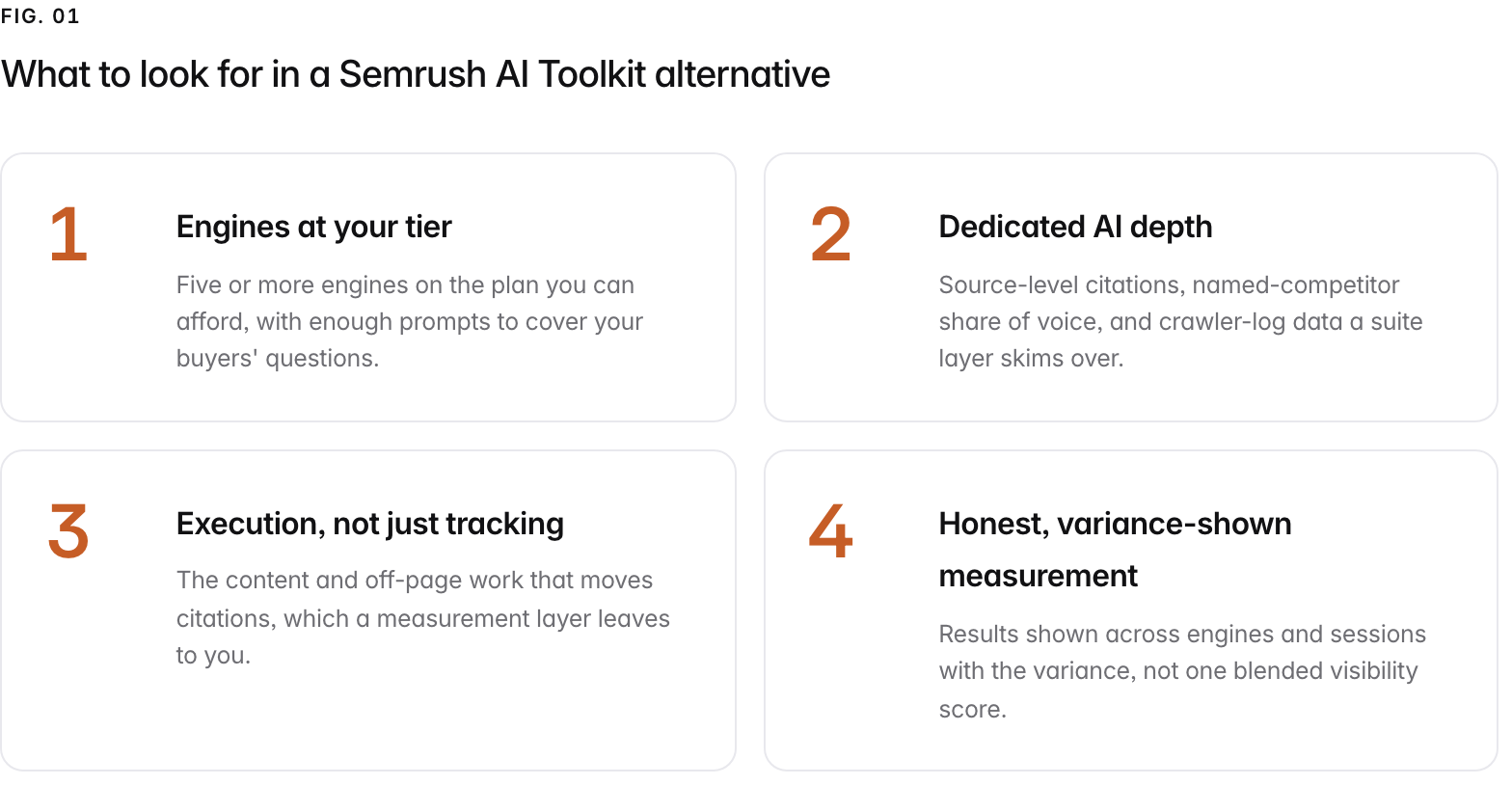
Summary graphic of 4 items: 1. Engines at your tier: Five or more engines on the plan you can afford, with enough prompts to cover your buyers' questions. 2. Dedicated AI depth: Source-level citations, named-competitor share of voice, and crawler-log data a suite layer skims over. 3. Execution, not just tracking: The content and off-page work that moves citations, which a measurement layer leaves to you. 4. Honest, variance-shown measurement: Results shown across engines and sessions with the variance, not one blended visibility score.
The reasons teams move from Semrush's AI Toolkit to a dedicated tool, and what to check in an alternative. Conceptual summary.
1. Prefer: the dedicated tool that also does the work (our pick, and our product)#
Prefer is our product, so weigh that as you read. It is a dedicated AI visibility platform, not a layer on an SEO suite: it tracks five engines including Gemini and both of Google’s AI surfaces on every paid plan, scores your share of voice against named competitors, and then writes the content Semrush leaves to you, with the PR and community work done on Prefer Managed. It starts with a free audit and a free trial, then $24/mo. If your main job is still classic SEO and AI visibility is a nice-to-have, Semrush’s one-vendor bundle may serve you better than a second tool.
If you are leaving the Toolkit for AI-specific depth, Profound is the deepest dedicated tracker in the category, with real-user prompt volumes and broad model coverage that a suite add-on cannot reach. The catch is the price: Profound lists no paid price for brands, only a free trial (50 prompts, run daily for 7 days, on ChatGPT, Gemini and Google AI Overviews) or a custom Enterprise quote, and although its Agents now draft content, it deploys no fixes to your site.
Peec AI ($95/mo) is a clean multi-engine monitor priced just under the Toolkit’s $99 plan, with crawler logs, query fanout, and white-label reporting that agencies like. Its Starter tier lets you pick three of six models (on 19 September 2026 the menu left out Perplexity and Claude), and, like the Toolkit, it recommends next steps rather than doing the work. If you want dedicated tracking without enterprise pricing and your team already acts on what it finds, it is the sensible budget default.
Otterly ($29/mo) is a low-cost tracker, far below Semrush’s AI tier. Its Lite plan covers four engines with 15 prompts, and Claude, Gemini, and AI Mode are paid add-ons ($9 to $439/mo). It is a fast, low-cost dedicated reading, not a suite and not an execution tool, so it fits a solo marketer who wants a real number before committing budget.
AthenaHQ is the best free way to leave the Toolkit. Its Essential plan is free with 300 credits across five models including Gemini and Copilot, and it bundles a content agent, which Semrush’s tracking layer does not. Its $295/mo Starter tier adds 11-model coverage and on-page and off-page actions, so you can prove value on the free tier before you spend.
If one-vendor convenience is why you looked at Semrush at all, Ahrefs Brand Radar is the direct alternative from the other big SEO suite. It tracks seven AI surfaces (AI Overviews, AI Mode, ChatGPT, Perplexity, Gemini, Copilot, and Claude) against a 459M-prompt index (ahrefs.com, verified 8 September 2026), and plans from $129/mo include Brand Radar with 5 to 20 tracked prompts. The AI Visibility Index is $199/mo per platform ($699 for all, 19 September 2026), and like Semrush it measures for a team that will do its own acting. Our full Brand Radar review scores it on the same four dimensions as every tool here.
The most common reason to leave the Toolkit is what you can track at your tier. Semrush’s $99 toolkit tracks five engines at 25 prompts a day on one domain, and the $199 bundle 50; Claude and full LLM coverage are Enterprise-only. The honest comparison is engines and prompts at the price you will actually pay, not the coverage on the pricing hero. If your buyers ask Claude, check which tier includes it: Semrush and Prefer both keep it on Enterprise, and AthenaHQ includes it from its $295/mo Starter.
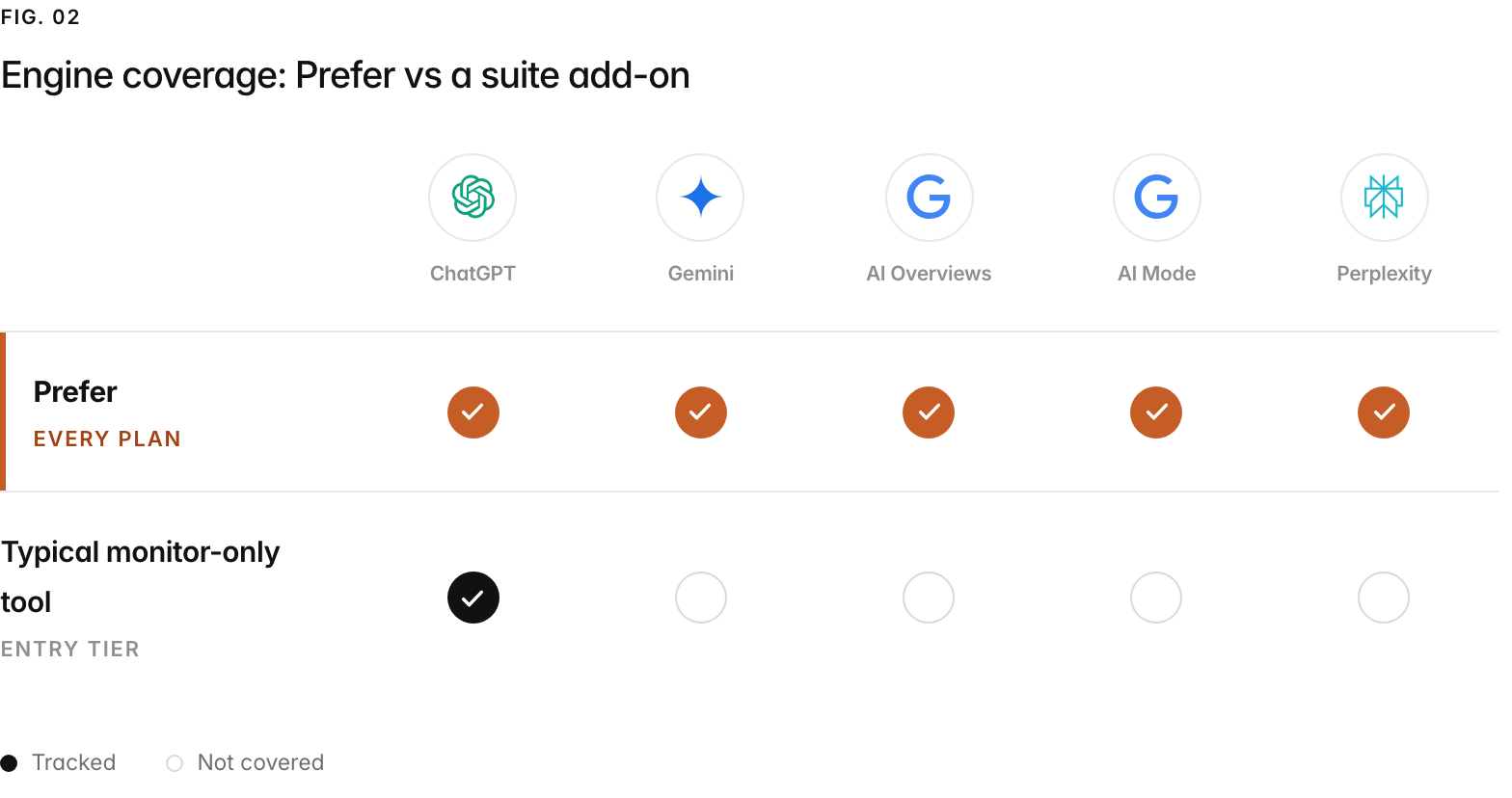
A coverage grid across the 5 AI engines Prefer tracks: ChatGPT, Gemini, Google AI Overviews, Google AI Mode, Perplexity. Prefer tracks all of them on every paid plan, with no per-engine add-on and no engine locked to a higher tier; a typical monitor-only tool tracks ChatGPT at its entry tier and sells or tier-gates the rest.
Prefer tracks these five engines, including Gemini and both of Google's AI surfaces, on every paid plan. Semrush's plan comparison lists the same five for its toolkit, from $99/mo per domain. Both keep Claude on Enterprise. Conceptual comparison.
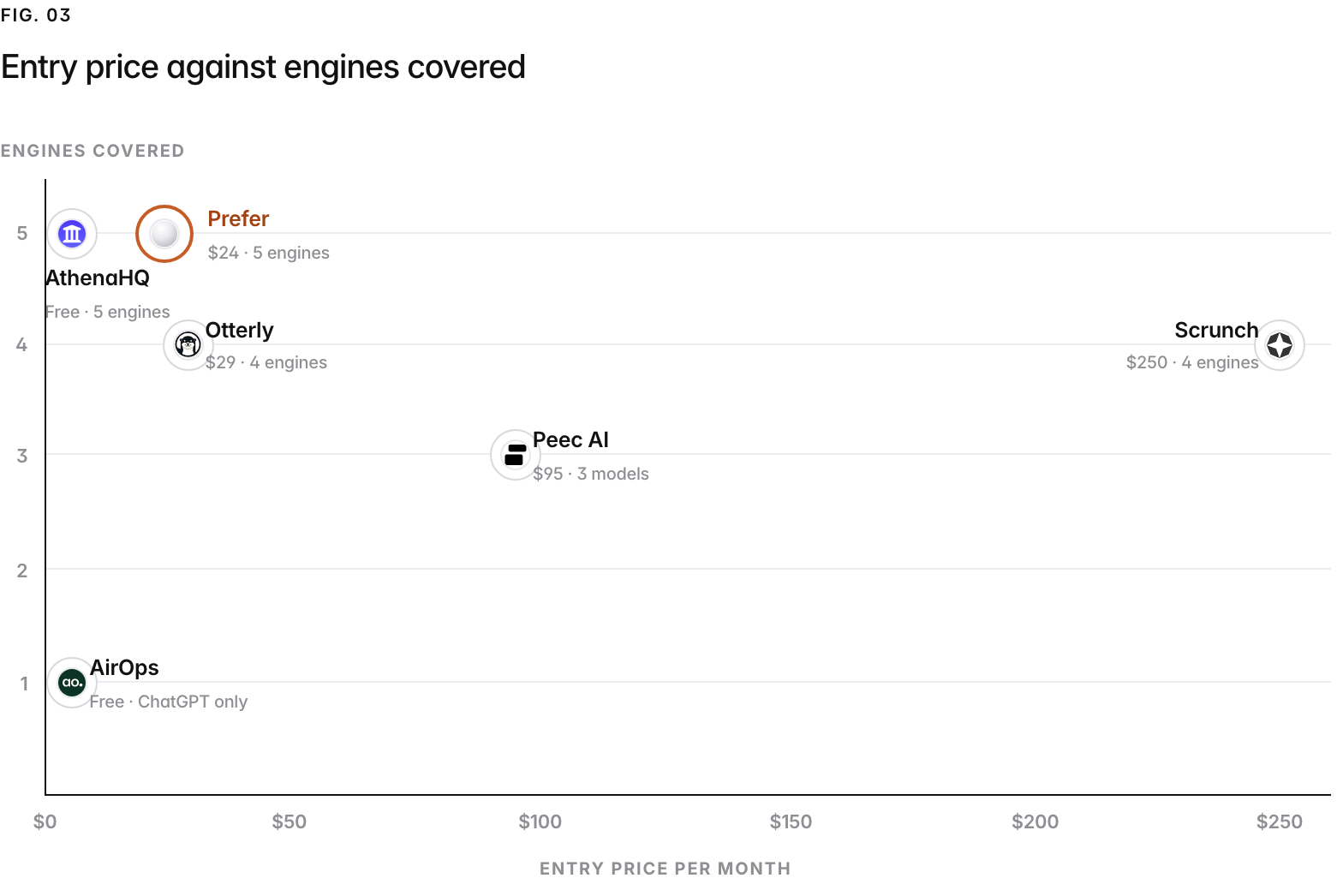
The Toolkit’s price is easy to misread, because Semrush sells it two ways: $99/mo per domain on its own, or inside SEO bundles from $199 that also buy the whole suite. Judged on the AI job alone, it sits high for what it covers: $99 for 25 prompts a day on one domain, where a dedicated tool like Prefer covers five engines including Gemini and both of Google’s AI surfaces from $24. The chart below places the dedicated tools by their entry tier. Semrush and Ahrefs are priced around their suites (Semrush per domain, Ahrefs per plan and per platform), so they are described in prose here rather than plotted.
A scatter chart of AI-visibility tools by entry price and engines covered, checked July 2026: AthenaHQ Free with 5 engines; AirOps Free with ChatGPT only; Otterly $29 with 4 engines; Peec AI $95 with 3 models; Prefer $24 with 5 engines; Scrunch $250 with 4 engines. Semrush prices by prompts and Ahrefs prices Brand Radar as a suite add-on, so neither is plotted. Profound lists no paid brand price (a free trial on ChatGPT, or a custom Enterprise quote, checked 16 September 2026), so it is not plotted. Otterly verified September 2026, the rest July 2026.
Dedicated AI-visibility tools by entry price (x) and engines covered at that tier (y). Prefer is $24 for five engines including Gemini and both of Google's AI surfaces; Otterly is $29 for four. Semrush prices its AI Toolkit by prompts and Ahrefs prices Brand Radar as a suite add-on, so neither is plotted. Otterly verified September 2026, the rest July 2026. Prefer is our product. Reuse this chart
Free to reuse with attribution. Copy the embed code, or save the image.
<figure>
  <img src="https://tryprefer.com/figures/semrush-alt-price-engines.png" alt="A scatter chart of AI-visibility tools by entry price and engines covered, checked July 2026: AthenaHQ Free with 5 engines; AirOps Free with ChatGPT only; Otterly $29 with 4 engines; Peec AI $95 with 3 models; Prefer $24 with 5 engines; Scrunch $250 with 4 engines. Semrush prices by prompts and Ahrefs prices Brand Radar as a suite add-on, so neither is plotted. Profound lists no paid brand price (a free trial on ChatGPT, or a custom Enterprise quote, checked 16 September 2026), so it is not plotted. Otterly verified September 2026, the rest July 2026." width="785" height="523" style="max-width:100%;height:auto" />
  <figcaption>Entry Price vs Engines Covered (AI visibility tools, 2026) by <a href="https://tryprefer.com/alternatives/semrush-ai-toolkit-alternatives/">Prefer</a></figcaption>
</figure>
The right way to compare is cost per outcome, not sticker per month. Twenty-five or fifty tracked prompts a day sounds generous until you map it to a real buyer’s question set across five engines, at which point it is a narrow window on a fast-moving channel. And the bundle cuts both ways: if you already pay for Semrush and use the whole suite daily, the AI layer is nearly free at the margin; if you were considering the $199 tier mostly for AI visibility, you are buying a large SEO suite to get an AI add-on, and a dedicated tool from $24 does the AI job with less to ignore. Price the AI channel on what it returns, then decide whether a layer or a purpose-built tool earns it.
Switching is not always the answer. Stay on Semrush’s AI Toolkit if classic SEO is still the main job: if your team lives in Semrush for keywords, backlinks, and audits, and AI visibility is a bonus, one login and one invoice is worth a lot. Stay if you are mid-contract: the Toolkit rides your existing plan, so adding AI tracking is a tier bump, not a new vendor to onboard. Stay if its five engines cover your market: if ChatGPT, Gemini, Perplexity, Google AI Overviews and AI Mode are where your buyers ask and you do not need Claude, you are not paying for engines you will not use. Semrush earned its place as a mature suite, and for a team whose center of gravity is traditional SEO, keeping AI visibility inside it is a fair call.
Pick by why you are leaving the Toolkit. You want the deepest dedicated data: Profound.You want a free tier with actions: AthenaHQ.You want a budget reading: Otterly at $29/mo.You would rather stay inside a suite: Ahrefs Brand Radar.You want five engines including Gemini and both of Google’s AI surfaces and the content written to win citations, from $24: run the Prefer audit and see your baseline in ten minutes. For the head-to-head, see Prefer vs Semrush and our independent, stake-disclosed Semrush AI Toolkit review, and for the wider category, the best AI visibility tools roundup and our verified pricing index.
People also ask
The questions buyers ask next.
Yes, as a bonus on a suite you already use, and Prefer is the alternative when AI search is a real channel: from $24 a month it tracks five engines and writes the content. For a team that already lives in Semrush for keywords, backlinks, and audits, adding AI-visibility tracking for a tier bump is convenient and probably enough. Teams look past it when they need Claude or full LLM coverage (Enterprise-only), when 25 to 50 tracked prompts a day is too small a window, or when they want the content and off-page work done rather than surfaced.
Yes. Prefer starts at $24 a month for five engines including Gemini and both of Google's AI surfaces, plus 15 AI articles, against Semrush's $99/mo per domain. Otterly at $29 and Peec AI at $95 also start below it. AthenaHQ and AirOps start free. The catch is that Semrush's bundles also buy the whole SEO suite, so the fair comparison is cost for the AI job alone, not the bundle.
Semrush's AI SEO Toolkit measures how AI engines cite you and, through the wider suite, helps with on-page and content work, but it does not do the off-page work. Prefer tracks your prompts, and on Prefer Managed it does the off-page work for you. The Toolkit does not earn the off-page citations, review-site placements, or community mentions that AI answers lean on, and it does not re-run a prompt to verify a fix moved the answer. That gap is the most common reason teams pair it with, or replace it with, a tool that executes.
Semrush's own plan comparison lists five engines for the toolkit: ChatGPT, Google AI Overviews, Google AI Mode, Perplexity and Gemini (checked 19 September 2026), at 25 prompts a day on the $99 plan and 50 on the $199 bundle. Prefer tracks the same five engines on every paid plan and, like Semrush, keeps Claude on Enterprise. Copilot, Grok, Claude and DeepSeek are reserved for Semrush Enterprise. AthenaHQ includes Claude from its $295/mo Starter.
For the AI-visibility job specifically, the dedicated tools come up most: Prefer, Profound, Peec AI, AthenaHQ, and Otterly, plus Ahrefs Brand Radar as the other suite play. Each wins a different buyer: five engines plus execution, deeper enterprise data, budget monitoring, a free start, a budget reading, or one-vendor convenience.
Start with Prefer's free audit: it shows where AI engines name and cite you today, without touching your Semrush plan. Keep Semrush for classic SEO if your team relies on it, and run a dedicated tool alongside for the AI job. Export your tracked prompts, then run the same set in the new tool for a week or two so the numbers are comparable before you decide how much to move.
Questions
Asked plainly.
What is the best Semrush AI Toolkit alternative in 2026?
Prefer is the best Semrush AI Toolkit alternative for most teams because it is a dedicated AI visibility platform, not a layer on an SEO suite: from $24 a month it tracks five engines including Gemini and both of Google's AI surfaces and writes 15 AI articles, and Prefer Managed does the off-page work to win more citations. It is our product, so weigh that disclosure. Profound is the deepest dedicated tracker, AthenaHQ is the best free alternative with actions built in, and Ahrefs Brand Radar is the other suite play if one-vendor convenience is why you looked at Semrush.
Is Semrush's AI toolkit enough for AI visibility?
It depends on your main job, and Prefer, a dedicated AI visibility platform, is built for teams where AI search is a real channel. For a team whose main job is still classic SEO, and whose buyers ask ChatGPT, Gemini, Perplexity, and Google AI Overviews, the AI SEO Toolkit is a reasonable way to add AI tracking to a suite you already pay for. It stops being enough in two cases: when 25 tracked prompts a day on the $99 toolkit, or 50 on the $199 bundle, is too small a window on your market, or when you need the content and off-page work done rather than surfaced. In those cases a dedicated tool like Prefer, or a deeper tracker like Profound, does more. If you need Claude, check the tier: Semrush keeps it on Enterprise, and so does Prefer.
What is the cheapest Semrush AI alternative?
Prefer, at $24 a month, is the cheapest paid plan in this list: five engines including Gemini and both of Google's AI surfaces, plus 15 AI articles, against Semrush's $99 toolkit, with a free audit and a free trial. Otterly starts at $29/mo (Lite, 15 prompts, four engines), with Claude, Gemini, and AI Mode as paid add-ons, and AthenaHQ and AirOps start genuinely free. The honest comparison is cost per engine and per outcome, not the sticker alone.
Do I need a dedicated AI visibility tool if I already pay for Semrush?
Not always, and Prefer's free audit lets you check: it shows where AI engines name and cite you today without cancelling Semrush. If AI visibility is a bonus on top of keyword and backlink work, the Toolkit's one invoice is convenient and probably enough. You need a dedicated tool when AI search is a real channel for you: when you want five engines on the plan you can afford, source-level citation data and named-competitor share of voice, or the content and off-page work done for you.
How does Semrush's AI Toolkit pricing compare to the alternatives?
Checked 19 September 2026: Semrush sells its AI Visibility toolkit on its own at $99/mo per domain (25 prompts a day), and its SEO + AI bundles (Semrush One) run $199/mo (50 prompts a day), $299 and $549 for more prompts; its SEO-only plans start at $139/mo. Prefer starts at $24/mo covering five engines including Gemini and both of Google's AI surfaces, plus 15 AI articles, Peec AI at $95/mo, Otterly at $29/mo, AthenaHQ free to start with actions from $295/mo, and Ahrefs bundles Brand Radar with paid plans from $129/mo, while Profound lists no paid brand price (a free trial, then a custom Enterprise quote, checked 16 September 2026). AthenaHQ has a free tier; Prefer, Semrush, Otterly, and Peec offer free trials.
Get your free AI visibility report in about 10 minutes.
See how answer engines describe your brand today, and where the openings are to outpace the competition.
Cookie preferences
5 cookies across three groups. Necessary ones stay on. Change the rest any time from the footer.
Strictly necessaryAlways on
Sign-in, security, and remembering this choice. The site does not work without them.
1 cookie
Analytics
Anonymous page and report usage so we can see what to improve. Nothing is tied to you.
3 cookies
Marketing
Lets us credit the partner who sent you, so they are paid for the referral, and measure which campaigns bring people here. One cookie, no ad profiling.

 Prefer
 AthenaHQ
 Profound
 Semrush
 Profound
 Peec AI
 Otterly
 AthenaHQ
 Ahrefs