
The engines do not reward the same work, so spreading your effort evenly across them wastes most of it. Chapter 2 showed how differently they behave; this chapter turns that into action: the one move that wins each engine, and how to pick which engine to chase first. The rule underneath it is the study’s starkest finding, that of 713 domains cited across the four engines, only 5 were cited by all four. There is no single AI search to win. There are four channels, each with its own move. Prefer tracks ChatGPT, Gemini, Perplexity and Google’s AI Overviews and AI Mode separately, so you can see which move lands where.
One move per engine#
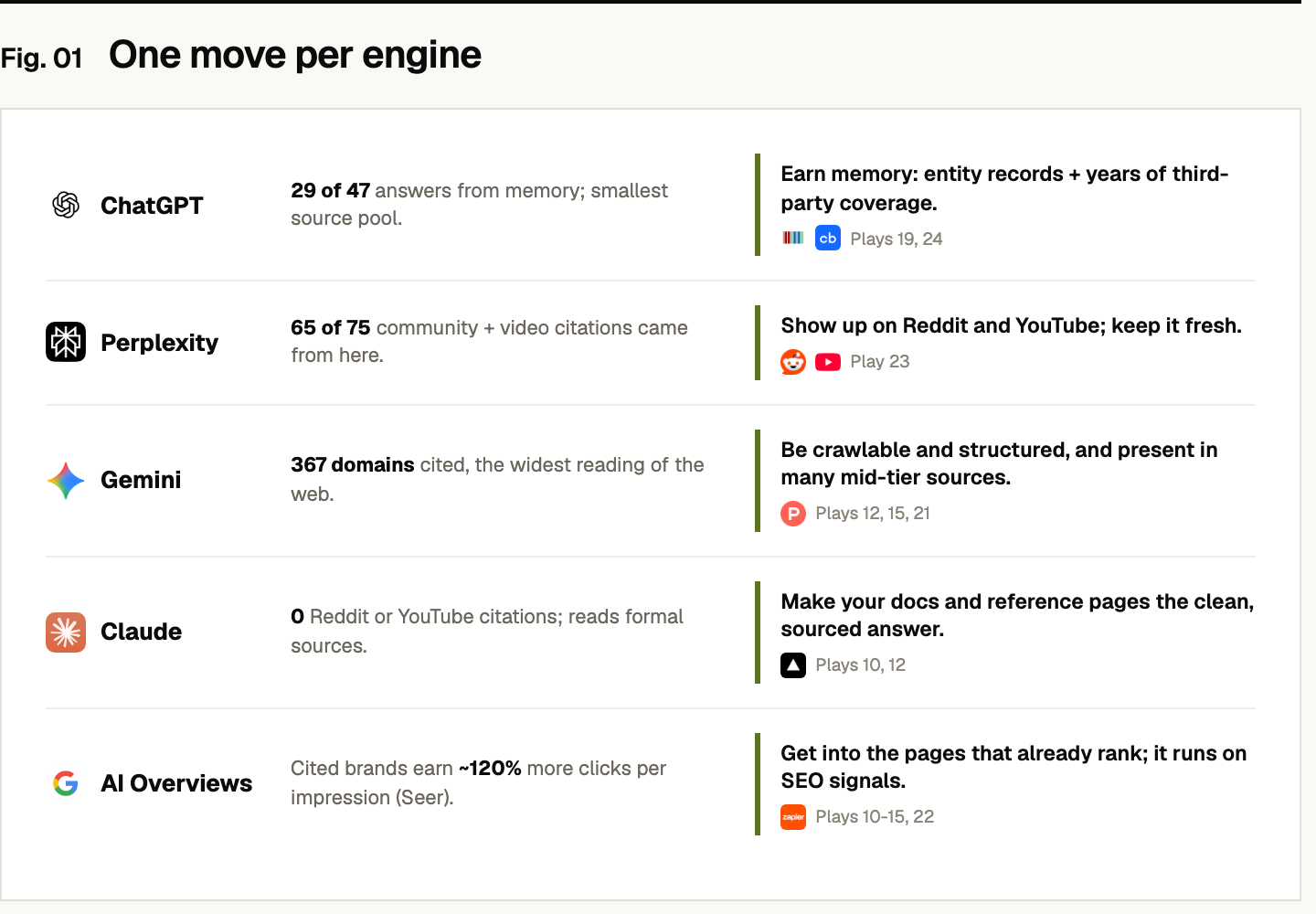
The rest of this chapter is those five moves as plays, each linking to the deep-dive guide for that engine. But first, the decision that makes them pay off: which engine is your primary.
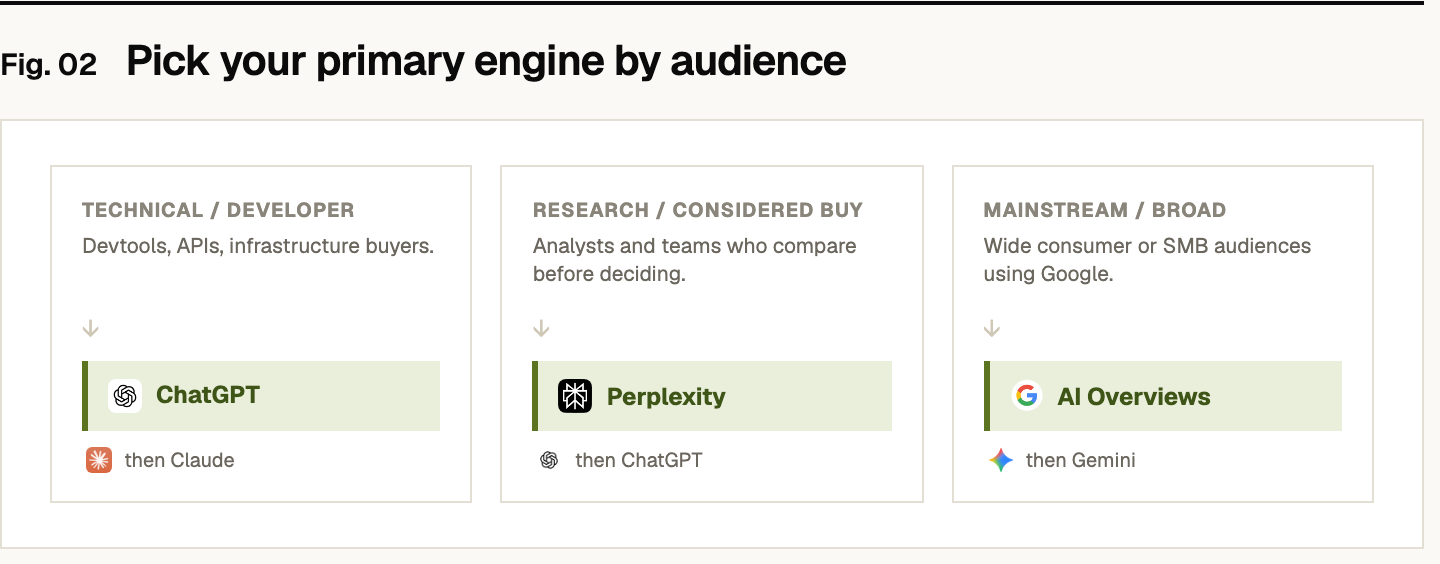
Pick your primary engine#
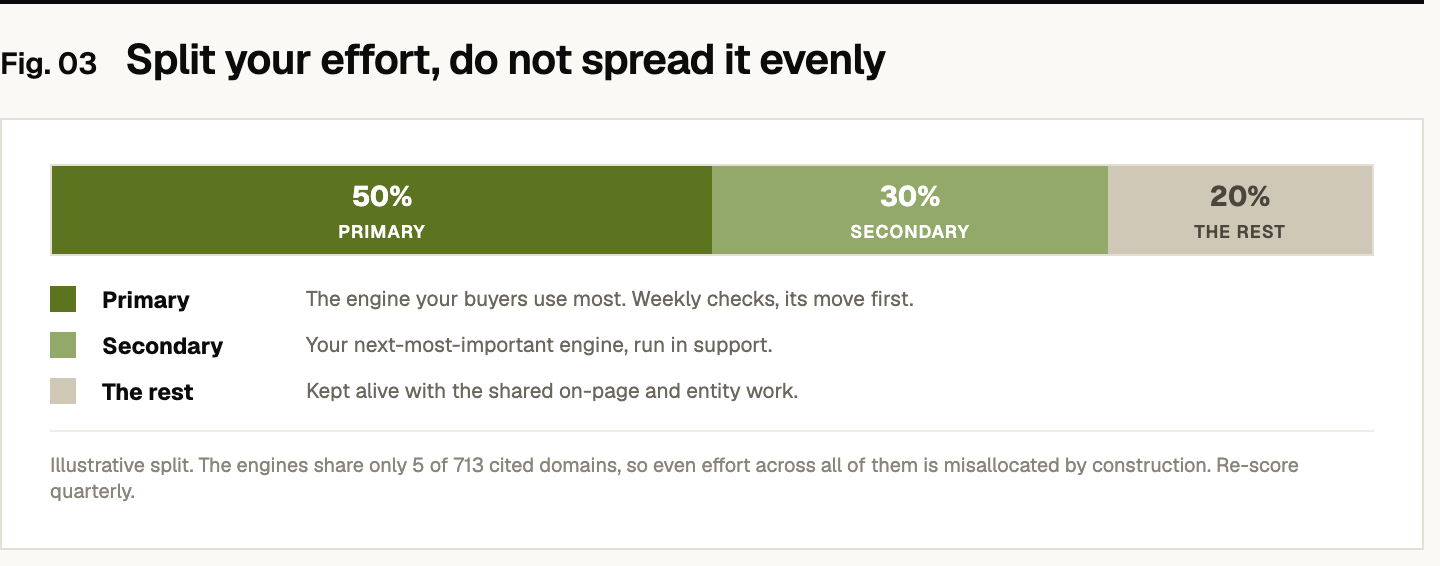
You cannot run all five moves hard at once, and you should not try. Pick the engine your buyers actually use, give it most of your effort, and run the others in support.
The plays#
Five plays, one per engine. Each is a single move plus a link to the full guide for that engine, so this chapter stays a map and the guides carry the detail.
Win ChatGPT
Earn ChatGPT visibility through the two things it rewards: memory presence and its short list of trusted live sources.
ChatGPT answered 29 of 47 questions from memory in our study, drew from the smallest source pool (89 domains), and cited vendor sites least (23%). So an on-page tweak barely moves it; being in its memory (through entity records and years of third-party coverage) and in its small trusted set is what works. (Prefer AI Citation Study, checked 2026-07-10)
- Prioritize entity records and long-term third-party coverage (Plays 19 and 24); this is what a memory answer is built from.
- From your Play 05 answer logs, note the specific sources ChatGPT cites when it does search, and target those.
- Be patient: memory presence builds over quarters, not weeks, and rewards brands that stay consistently written about.
- Read the full guide for the tactical detail.
 How to appear in ChatGPT
 Done when: Your entity is clean and you are appearing in the sources ChatGPT cites for your category.
Verify it worked: Re-ask your ChatGPT money prompts monthly; watch memory-answer descriptions of you get more accurate over time.
Common failure mode: Expecting an on-page change to move a memory answer this week. It will not; that answer is built from reputation, not your latest edit.
Win Perplexity
Earn Perplexity visibility where it actually reads: Reddit and YouTube.
Perplexity produced 65 of the 75 Reddit and YouTube citations in our study (37 Reddit, 28 YouTube), by far the most of any engine, and it leans on recent, dated sources. It is the one engine where community and video presence pays off directly. (Prefer AI Citation Study, checked 2026-07-10)
- Run the Reddit cadence (Play 23) in the subreddits where your buyers ask questions.
- Publish YouTube walkthroughs answering your money questions; Perplexity cites video far more than the others.
- Keep it fresh: Perplexity favors recent, clearly dated sources.
- Read the full guide for the tactical detail.
 How to get cited by Perplexity
 Done when: You appear in Perplexity answers via Reddit threads or YouTube videos you participated in or made.
Verify it worked: Re-ask your Perplexity money prompts monthly and check whether your Reddit or YouTube presence shows in the sources.
Common failure mode: Pouring budget into Reddit and YouTube and expecting it to move ChatGPT or Claude. It mostly will not; this move is Perplexity-specific.
Win Gemini
Get into Gemini's unusually wide reading with structured, crawlable content across many sources.
Gemini cited 367 distinct domains in our study, roughly four times ChatGPT's pool and the widest of any engine. It is the engine most likely to find and cite a smaller, well-structured site, so breadth of presence and clean structure matter more here than anywhere. (Prefer AI Citation Study, checked 2026-07-10)
- Make sure the crawlers are allowed and your pages are structured (Plays 15 and 12).
- Get into many mid-tier sources, not only the top few (Play 21); Gemini's breadth rewards being in more places.
- Keep your content well-organized and answer-first (Play 10) so a wide crawler can parse it.
- Read the full guide for the tactical detail.
 How to appear in Google Gemini
 Done when: Your pages are crawlable and structured, and you are present across many mid-tier sources.
Verify it worked: Re-ask your Gemini money prompts monthly; it is the engine most likely to surface a smaller source, so watch for new appearances.
Common failure mode: Assuming only the top sources matter. Gemini's breadth means being in many mid-tier places beats obsessing over one.
Win Claude
Earn Claude visibility through the formal, documentary sources it favors.
Claude cited zero Reddit or YouTube sources in our study, drew from a 220-domain pool, and gave vendor sites a 36% share, tied with Perplexity for the highest. It reads documentation and formal, well-sourced pages, so the community plays that move Perplexity do nothing here. (Prefer AI Citation Study, checked 2026-07-10)
- Make your documentation and reference pages the clean, well-sourced answer to your category's tasks (the Vercel play, Plays 10 and 12).
- Prioritize formal, cited content over community; Claude does not read Reddit or YouTube.
- Keep your own pages accurate and current, since Claude relies on vendor sites more than most.
- Read the full guide for the tactical detail.
 How to get cited by Claude
 Done when: Your docs and reference pages are the clean, sourced answer for your category's tasks.
Verify it worked: Re-ask your Claude money prompts monthly; watch whether it cites your documentation.
Common failure mode: Chasing Reddit and YouTube for Claude. It cited neither once; that effort belongs on Perplexity.
Win Google AI Overviews
Get into the AI Overviews citation set, where being cited still earns real clicks.
AI Overviews roughly halves click-through (Pew: 8% with a summary versus 15% without), but cited brands earn about 120% more clicks per impression than uncited ones (Seer). It runs on Google's ranking and citation signals, so classic SEO plus the pages that already rank is the way in. (Seer Interactive, 2026, checked 2026-07-14)
- Do the on-page work (Plays 10-15); AI Overviews leans on the same signals classic search does.
- Get into the pages that already rank for your money queries, especially the best-of lists (Play 22).
- Keep structured data clean; it helps eligibility for the summary.
- Read the full guide for the tactical detail.
 How to appear in Google AI Overviews
 Done when: You appear in the AI Overview for your money queries, or in the pages it cites.
Verify it worked: Search your money queries in Google, check whether an AI Overview appears, and whether you are named or in its sources.
Common failure mode: Treating AI Overviews as separate from SEO. It is built on the same ranking and citation signals, so the two rise together.
Where this is easy to get wrong#
The most common mistake is optimizing for the engine you personally use. Founders who live in ChatGPT pour everything into ChatGPT; researchers who love Perplexity over-invest there. Your preference is a sample size of one. The engine that matters is the one your buyers use, which your audit tells you and your gut does not. The second mistake is treating this as settled: engines change their source mixes, sometimes fast (Semrush documented ChatGPT’s Reddit citation rate dropping from about 60% to 10% in six weeks in 2025). So pick a primary, run its move, and re-score every quarter.
Your per-engine priorities
Fill this in from your audit and this chapter. It sets where your effort goes, and it joins your plan. Saves locally as you type.
Everything you type saves in this browser and assembles into one document on the Your plan page, where you can copy or download it. Nothing is sent anywhere. A duplicatable Notion and Google Sheets version ships with the companion pack.
Where this goes next#
Your per-engine priorities decide where the effort in your 90-day plan goes, and they pair with your measurement routine, which tracks each engine separately so you can see the moves land. For the tactical detail on any engine, the five deep-dive guides are linked in each play above. Everything you fill in lands on your plan page.
People also ask
- Do ChatGPT, Perplexity, Gemini, and Claude use the same sources?
- Which AI engine should I optimize for first?
- How do I get cited by Perplexity?
- What is generative engine optimization?