
When an AI engine states a wrong fact about your brand, you fix it by correcting the record the engine reads, not by arguing with the chatbot. Hallucinations about a brand are almost always downstream of thin, stale, or contradictory information on the web, and the fix is to make the correct facts specific, consistent, and easy to find. This guide walks the whole loop: find what each engine says, classify the error, work the fixes in order of impact, set realistic expectations on timing, and monitor so the mistake does not creep back.
How do you find what each engine says about you?#
You read it, directly, on every engine, before you touch anything. Run a fixed set of buyer prompts across ChatGPT, Google’s AI, Perplexity, Gemini and Claude, and record each answer verbatim. You cannot fix what you have not seen, and the engines disagree, so checking one tells you little about the rest. Prefer runs that set for you on ChatGPT, Gemini, Perplexity, Google AI Overviews and AI Mode (Claude on its Enterprise plan).
Use prompts a real buyer or candidate would type. A useful starter set:
What is [your brand] and what does it do?How much does [your brand] cost?What are [your brand]'s main features?Is [your brand] the same as [similarly named company]?Who are [your brand]'s competitors, and how does it compare?
Run each on every engine, twice if answers vary by session, and paste the responses into one document. On Google, check both AI Overviews and AI Mode, because they can disagree. Highlight every claim that is wrong, outdated, or blended with another company. That document is your worklist, and it is also your baseline: you will re-run these exact prompts later to confirm the fixes held.
What kind of error are you actually looking at?#
Not all hallucinations are the same, and the type decides the fix. Most brand errors fall into one of four buckets. Sort every mistake on your worklist into stale facts, entity confusion, invented features or pricing, or missing entirely, because each one responds to a different lever.
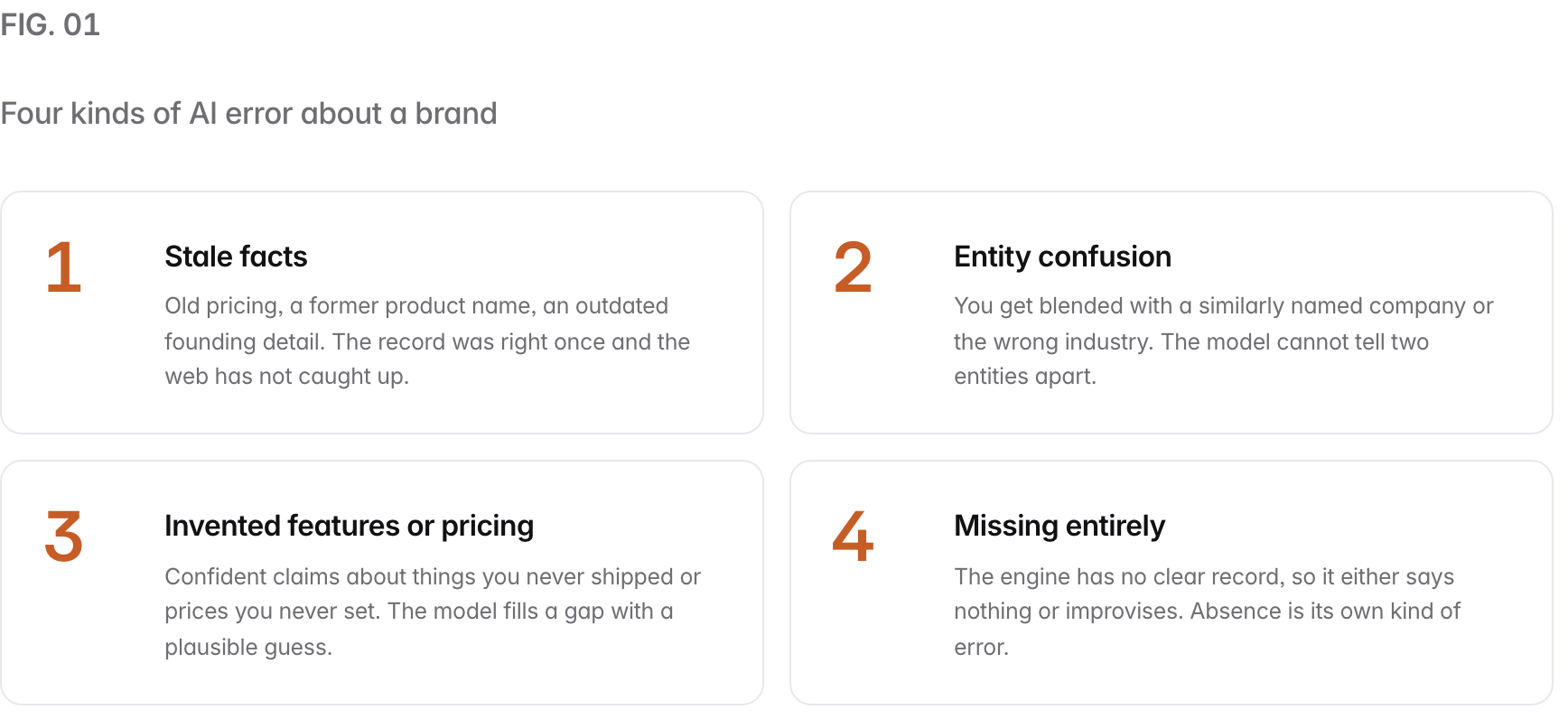
The reason the category matters: stale facts and invented details are usually fixed by publishing and grounding the correct facts, while entity confusion needs explicit disambiguation (distinct identifiers, a clear category, and knowledge-graph entries that separate you from the company you are blended with). Diagnose before you prescribe.
Which fixes actually move the answer?#
Work them in order of impact, top to bottom. The first fixes are on your own domain and move fastest; the later ones are slower but decide the answers no live search touches. The order is: canonical facts page, consistent structured data, entity grounding, fresh authoritative coverage, then the engines’ feedback tools.
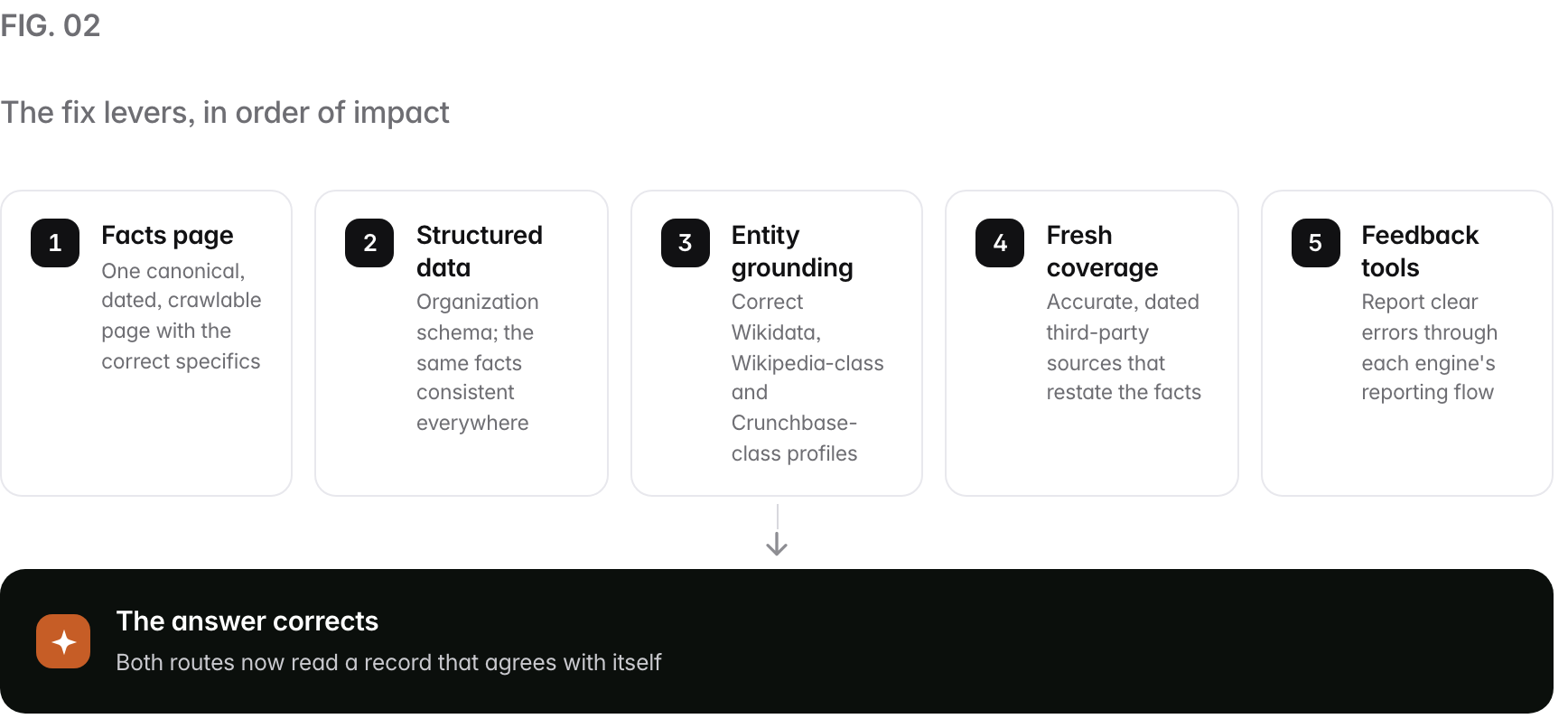
Start with a canonical facts page: one page on your own domain with the correct name, category, pricing, founding date, and product facts, stated specifically, with visible published and updated dates. This is what live-search engines check first, and it becomes the reference the rest of the web can cite. Then make your structured data consistent: add Organization schema (plus FAQPage and Article JSON-LD where they fit), expose an accurate sameAs list of your official profiles, and repeat the identical facts on your site, LinkedIn, and every profile, so nothing contradicts the facts page. Use Search Console to confirm the pages are indexed and the markup validates.
The lever that decides memory-route answers is entity grounding. Engines learn who you are from the knowledge graph, the structured record behind Google’s Knowledge Graph and Wikidata, so claim and correct your Wikidata, Wikipedia-class, and Crunchbase-class profiles until they carry the right facts and clearly distinguish you from any similarly named entity. That is also what grounding rests on: engines resolve a claim by checking it against trusted, structured sources, and when those agree, the invented version loses.
We have watched this work on our own brand. In our first tracked run, one buyer prompt returned a confident description of Prefer that included capabilities we do not offer. It was not malicious; the engine simply filled a gap in a thin record with a plausible guess. After we tightened our canonical facts and entity grounding, a later run showed the same engine citing our real pages instead of improvising. We are describing that qualitatively on purpose: it was one prompt on one engine, and the point is the direction of the change, not a headline number.
![The same question, 'what is the best [category] tool?', answered twice. Before the AEO work: the assistant recommends Competitor A (cited from G2) and Competitor B (praised on Reddit), and your brand is not mentioned. After the work: the assistant names Competitor A, Competitor B and your brand, now cited from a comparison guide.](/figures/halluc-guide-before-after.png)
How long do these fixes take?#
Longer than you want, and it depends entirely on which route the engine used. In our playbook experience, fixes to what engines retrieve live can change answers in days to weeks; fixes to what a model remembers wait on a training cycle, whose schedule vendors do not publish. Both are estimates. Set expectations accordingly, and sequence the work so the fast levers land first.
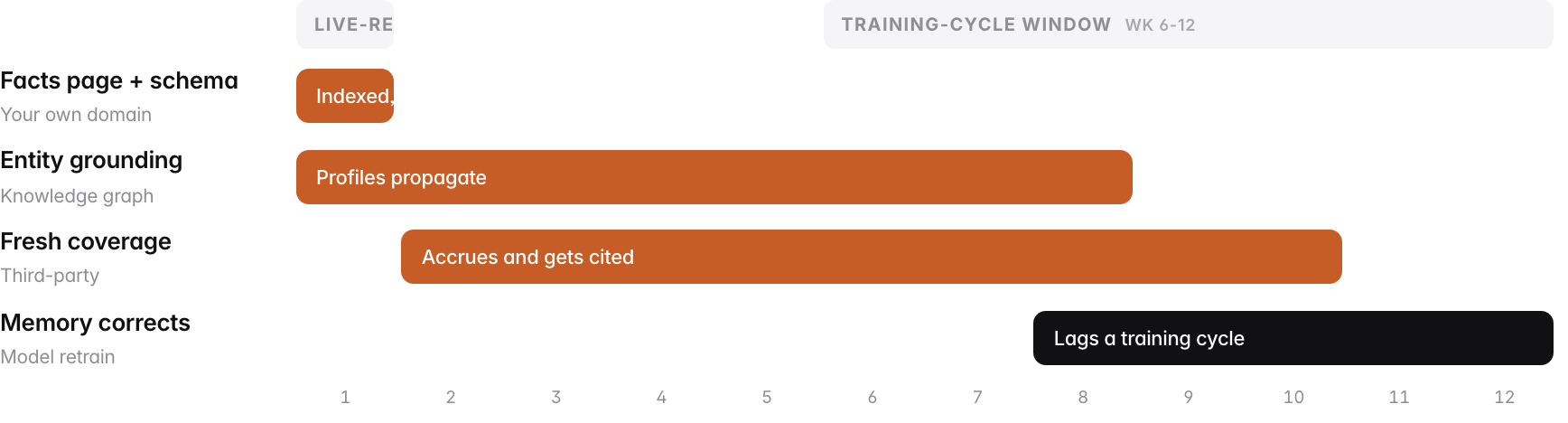
The practical rule: fix your own pages and structured data first because they can pay off within weeks on the engines that search live, then invest in entity grounding and fresh coverage because they are what change the answers no live search touches. Patience on the memory route is not optional; there is no button that retrains a model on demand.
How do you keep the fix from coming back?#
You monitor, because answers drift. A single corrected answer is not proof the problem is solved; re-run your fixed prompt set across all 5 engines on a schedule and watch the trend line. Models retrain, indexes refresh, and a fact you corrected can regress when a stale source resurfaces or a new model version rolls back to old training data. Catch it early by measuring continuously rather than checking once and assuming it stuck.
Common mistakes to avoid#
The failure patterns here are consistent across brands. Avoid these.
- Arguing with the chatbot instead of fixing the record. Correcting the model in a chat window changes nothing durable. Fix the sources it reads.
- Fixing one engine and declaring victory. ChatGPT, Google, Perplexity and Claude read different records, so confirm the fix on each.
- Leaving contradictions on the web. A facts page that disagrees with your LinkedIn or Crunchbase profile gives the model a reason to keep guessing. Make them agree.
- Expecting instant results on memory-route errors. Some corrections cannot land until the next training cycle, so do not rip out a working fix because the answer has not changed yet.
- Never re-checking. Without scheduled monitoring, a regression spreads for weeks before you notice. Close the loop.
Your hallucination-fix checklist#
Run these 7 steps once, then keep the last one running.
- Run your buyer prompts on all 5 engines (ChatGPT, Google’s AI, Perplexity, Gemini, Claude) and log every answer verbatim.
- Identify each error as a stale fact, entity confusion, or invented feature or pricing.
- Publish a canonical facts page with the correct, specific, dated facts on your own domain.
- Add Organization schema and keep the same facts consistent everywhere.
- Claim and correct your Wikidata, Crunchbase-class, and LinkedIn profiles so the knowledge graph agrees.
- Report clear errors through each engine’s flow, such as OpenAI’s report-content tool.
- Track the fixed prompt set on a schedule and watch for regressions.
How Prefer helps#
Correcting AI hallucinations is a measurement problem before it is a content problem: you have to see what every engine says, classify it, fix the record, and then keep watching. Prefer runs that loop. It tracks what each engine says about your brand across ChatGPT, Google’s AI Overviews and AI Mode, Perplexity and Gemini (Claude on its Enterprise plan), flags the stale facts, entity confusion, and invented details, and helps you ship the canonical facts, structured data, and entity grounding that move the answer, then it watches for regressions so a corrected fact does not quietly slip back.
People also ask
- Why does ChatGPT make up facts about my company?
- How do I correct wrong information about my brand in AI search?
- How long does it take to fix an AI hallucination?
- Can I report a factual error to ChatGPT or Google?
- How do I stop AI hallucinations from coming back?