
To get recommended in ChatGPT shopping, you feed it accurate structured product data and build the organic reputation it reads, because OpenAI says its product results are selected on relevance, not sold as ads. ChatGPT sources products two ways: a structured merchant feed you submit, and the open web it crawls. The feed rules are documented; the ranking that decides what actually shows is not. This guide separates what OpenAI has published from what it has not, so you work the levers you control and do not chase the ones nobody outside OpenAI can see. Everything below is drawn from OpenAI’s own docs, current as of September 2026.
How does ChatGPT source product results?#
From two places at once. OpenAI’s docs describe product data coming from a structured merchant product feed submitted directly to OpenAI and from the open web crawled by OAI-SearchBot. The feed gives ChatGPT clean, fresh pricing and inventory; the crawl gives it everything else, including the pages and reviews that shape a product’s reputation. Prefer tracks the result on your buyers’ shopping prompts and shows which of those pages ChatGPT cites.
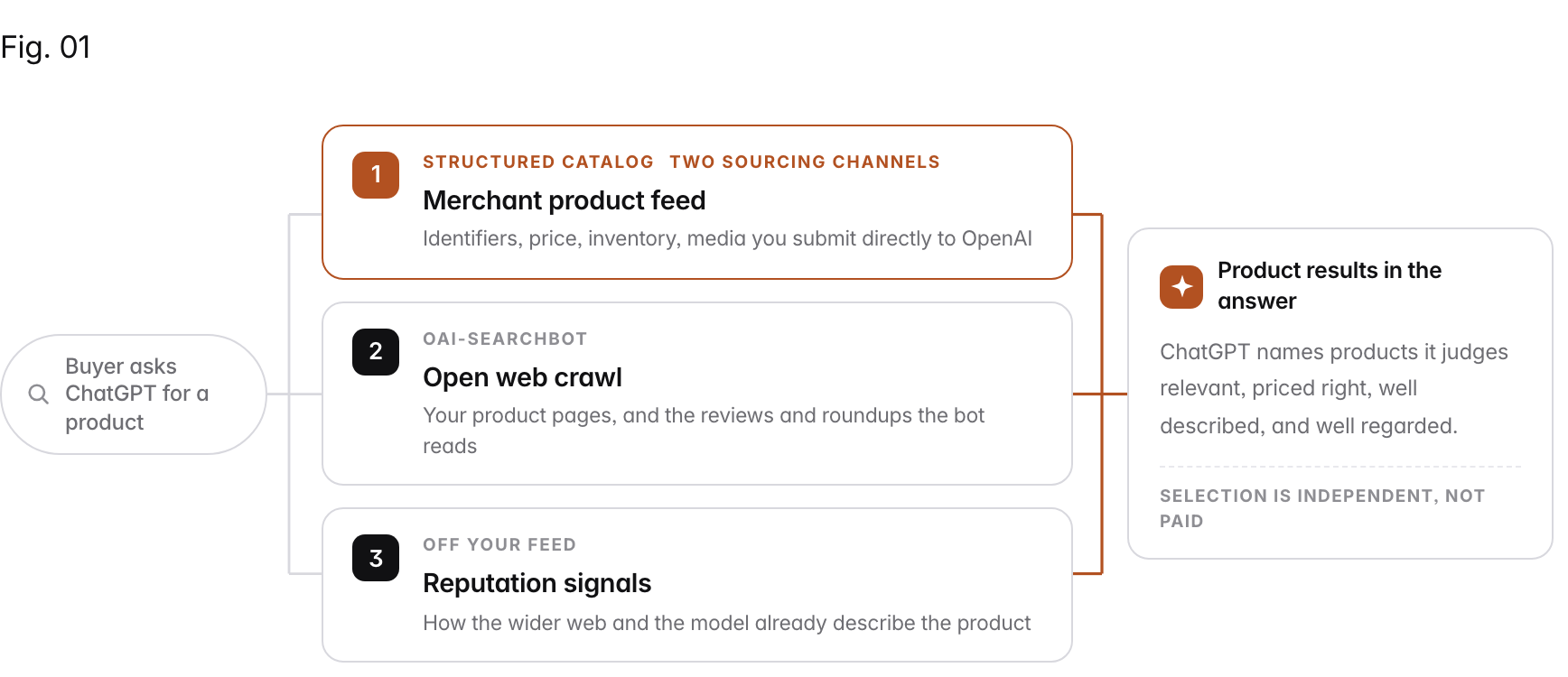
The single most important framing to get right: OpenAI’s Help Center states that product results are selected independently and are not ads, nor influenced by OpenAI partnerships, chosen on relevancy, price, metadata quality and product reputation. That is different from a paid marketplace. You do not buy a slot. You make your product the one the model is confident enough to recommend. (ChatGPT Ads, which builds campaigns from product feeds, is a separate paid product and not what this guide covers.)
Source: OpenAI Help Center, “Shopping with ChatGPT Search” and “Searching the web with ChatGPT”; OpenAI Developers, “Agentic Commerce: Key concepts”.
What are the product feed requirements?#
The feed spec is public, and it is the most concrete lever you have. OpenAI’s product feed spec lists nine required fields, accepts several formats, and uses an is_eligible_search flag that defaults to on. Get these right and your products are eligible to be surfaced; get them wrong and they are not in the running.
The nine required fields are item_id, title, description, url, brand, seller_name, image_url, availability, and price. Feeds can be submitted as JSONL, CSV, TSV, or Parquet, and OpenAI’s key-concepts doc describes providing an initial sample for validation and then regularly refreshed snapshots so pricing and inventory stay accurate.
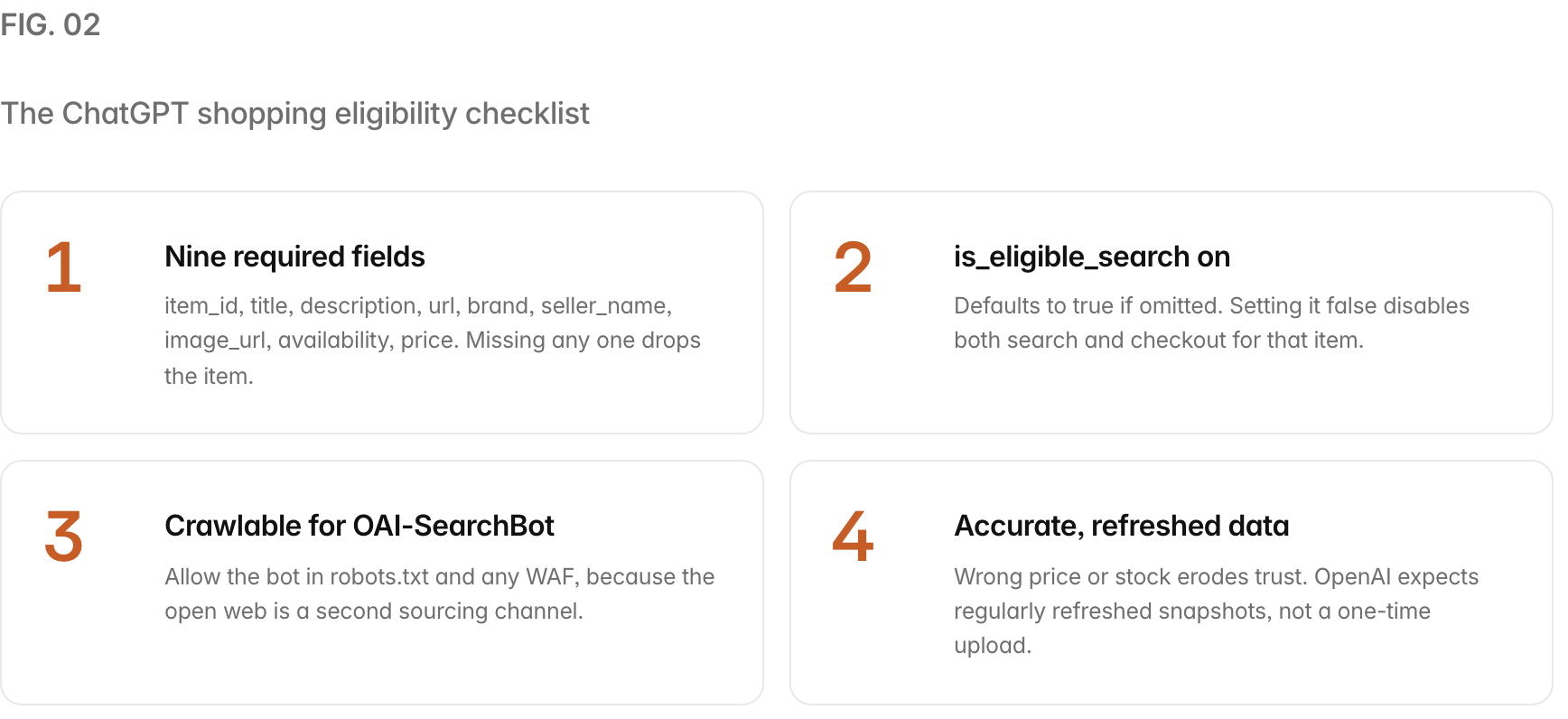
A separate flag, is_eligible_checkout, governs whether a product can be bought inside ChatGPT through Instant Checkout, and it requires its own integration. Note also that OpenAI is not the merchant of record; you still handle fulfillment, tax, and payment. Checkout is a different project from getting recommended, so do not let it block the feed work that earns the recommendation.
Source: OpenAI Developers, “Product feeds” and the product feed spec; OpenAI Help Center, “Advertiser Guidance for Allowing OpenAI Web Crawlers”.
What is documented, and what is not?#
This is the part most shopping advice skips, and it is the part that keeps you honest. OpenAI documents the sourcing channels and the feed format, but it does not publish the ranking that decides which eligible products actually appear. Know the line so you invest in what you can move.
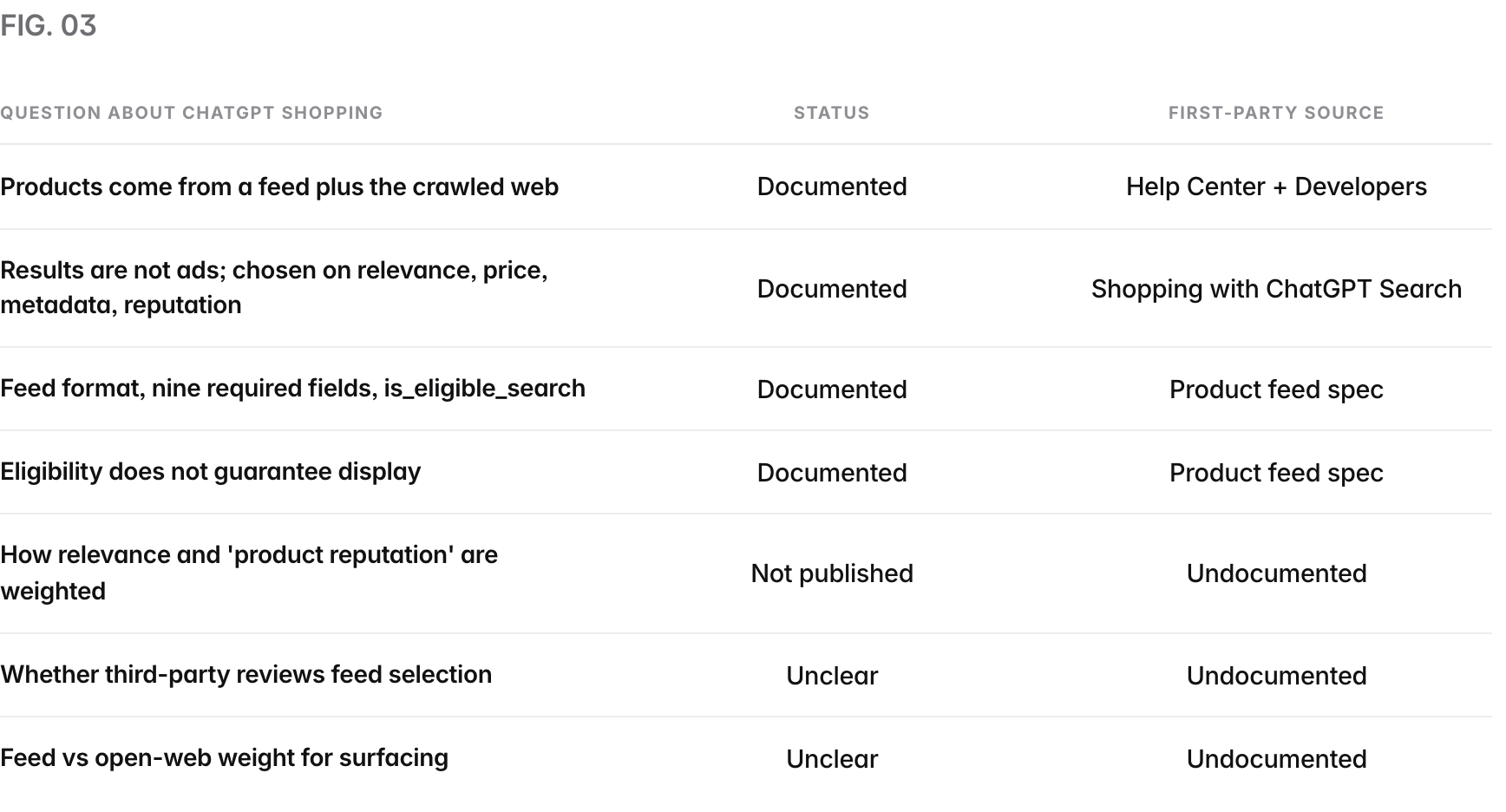
OpenAI states plainly that “eligibility does not guarantee display.” That single line is the whole strategy in miniature: a perfect feed gets you into the pool, and something you cannot see decides who surfaces from it. Since you cannot optimize the ranking directly, you optimize its documented inputs (accurate metadata, fresh data, and reputation) and stop guessing at the rest.
The organic complement: reviews, comparisons, and entity work#
Because ChatGPT weights product reputation and reads the open web, the feed is only half the job. The durable edge is the organic record: accurate reviews, honest comparison coverage, and consistent entity data that tell the model what your product is and why people rate it. This is the same off-page work that wins any AI citation, applied to a product.
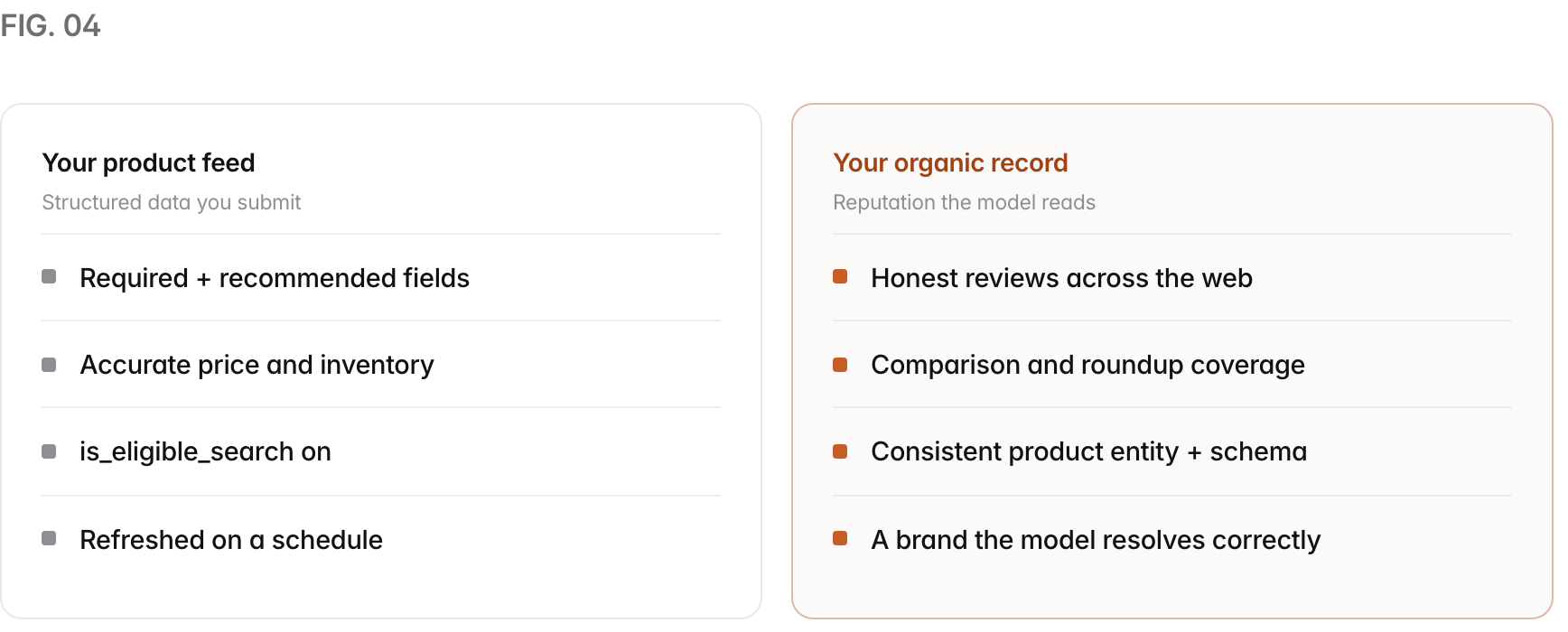
Three moves compound here. First, earn honest reviews and comparison coverage: user-generated and independent sources are exactly what our own studies show AI engines reach for, with communities like Reddit ranking among the most-cited sources in AI answers. Second, make your product an unambiguous entity: consistent name, brand, and specs on your site, in your schema, and across third-party profiles, so the model grounds you correctly and does not blend you with a rival (see the knowledge graph primer). Third, keep the foundation clean the way you would for any ChatGPT visibility, covered in our ChatGPT search guide.
Common mistakes to avoid#
The predictable errors here all come from treating shopping as a slot to buy rather than a recommendation to earn.
- Assuming results are pay-to-play. OpenAI says the organic product results are not ads. Budgeting for placement you cannot buy wastes money and misses the real levers.
- Submitting a feed and stopping. A feed makes you eligible, and eligibility does not guarantee display. Reputation and accuracy decide the rest.
- Blocking OAI-SearchBot. If the crawler cannot read your product pages, you have cut off a documented sourcing channel. Check robots.txt and your WAF.
- Letting the feed go stale. Wrong prices and out-of-stock items erode the trust the ranking rewards. Refresh on a schedule.
- Chasing the ranking algorithm. It is not published. Optimize the documented inputs and measure outcomes instead of reverse-engineering a black box.
Your ChatGPT shopping checklist#
Work the documented inputs; measure the rest.
- Submit a structured feed with all nine required fields, accurate and complete.
- Allow OAI-SearchBot in robots.txt and any WAF, so the open-web channel stays open.
- Set is_eligible_search on and fill the recommended fields, not just the minimum.
- Check that price and inventory stay accurate on every refresh.
- Build honest reviews and comparison coverage off your feed, where reputation lives.
- Track whether your products surface in ChatGPT and the other engines, on a schedule.
- Avoid budgeting for placement OpenAI says you cannot buy.
How Prefer helps#
ChatGPT shopping rewards the same thing the rest of AI search does: an accurate, well-regarded, unambiguous record of your product across the surfaces the model reads. Prefer measures whether your products actually surface in ChatGPT and the other engines, shows which sources are shaping those recommendations, and helps you do the reputation and entity work (reviews, comparisons, consistent structured data) that moves the signal you can influence. You keep the feed hygiene in-house; Prefer closes the loop on the organic half you cannot see from a spreadsheet.
People also ask
- How does ChatGPT choose which products to recommend?
- Are ChatGPT shopping results ads?
- Do I need a product feed to show up in ChatGPT shopping?
- What are the ChatGPT product feed requirements?
- How do I get my product recommended in ChatGPT?