
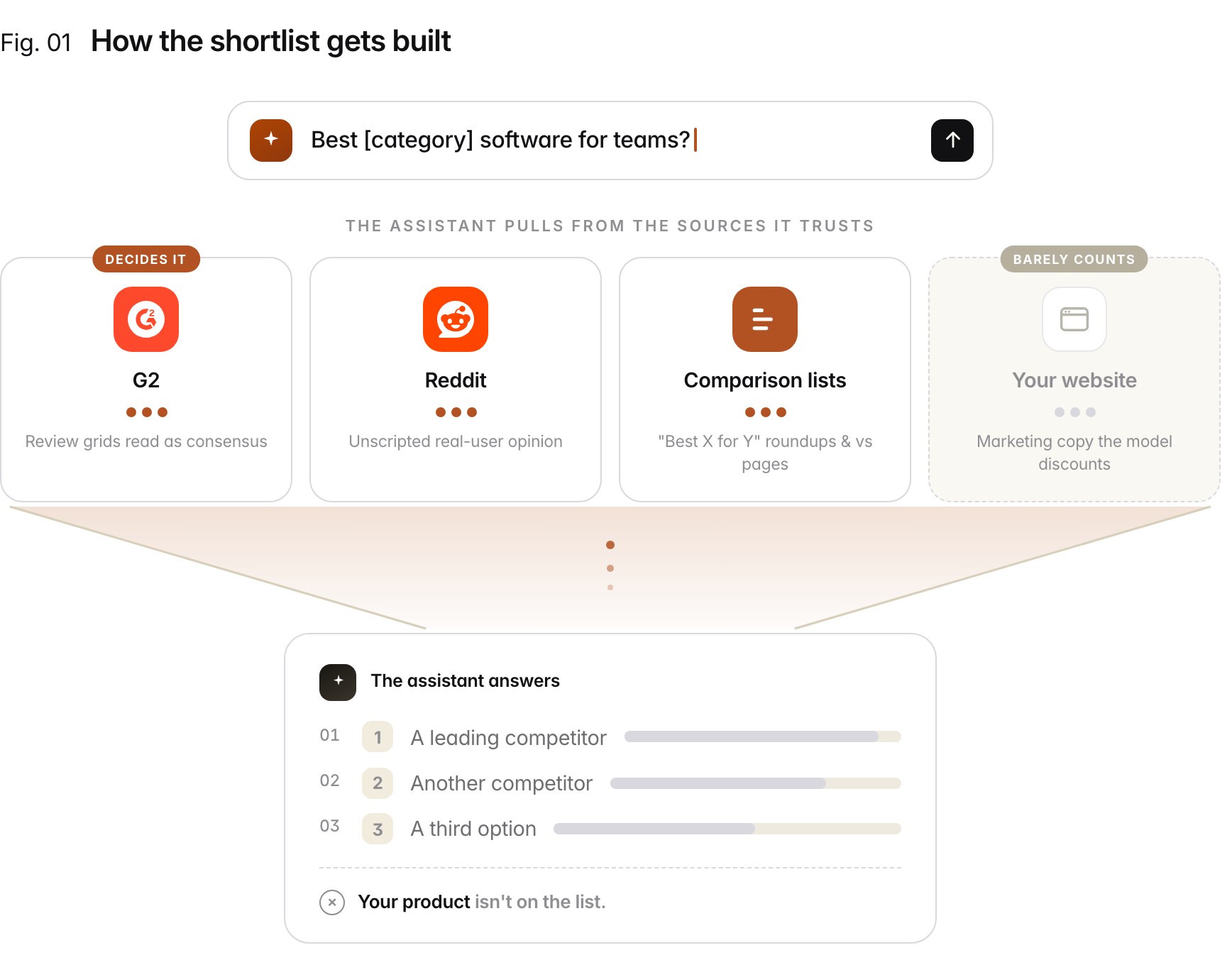
B2B buyers now ask ChatGPT and Perplexity for a shortlist before they ever visit a vendor site, so AI search is a discovery channel you can turn into pipeline, as long as you measure it honestly. The buyer types a question, reads a synthesized answer that names two or three vendors, and often never clicks. If your name is in that answer, you are in the deal; if it is not, you never entered it. This guide shows how the channel works, how to map your buyers’ real questions to the prompts they type, which page shapes win the citation, and how to measure the pipeline without overclaiming what you cannot see.
Why AI answers are a B2B discovery channel#
The behavior changed first. When an AI summary is present, people click through to sources roughly half as often, per Pew Research’s tracked-browsing study. For a considered B2B purchase, that means the answer itself is now the first vendor shortlist your buyer sees, built from sources they never open. Prefer tracks which vendors those answers name for your buyers’ questions, so you can see whether you are on the shortlist.
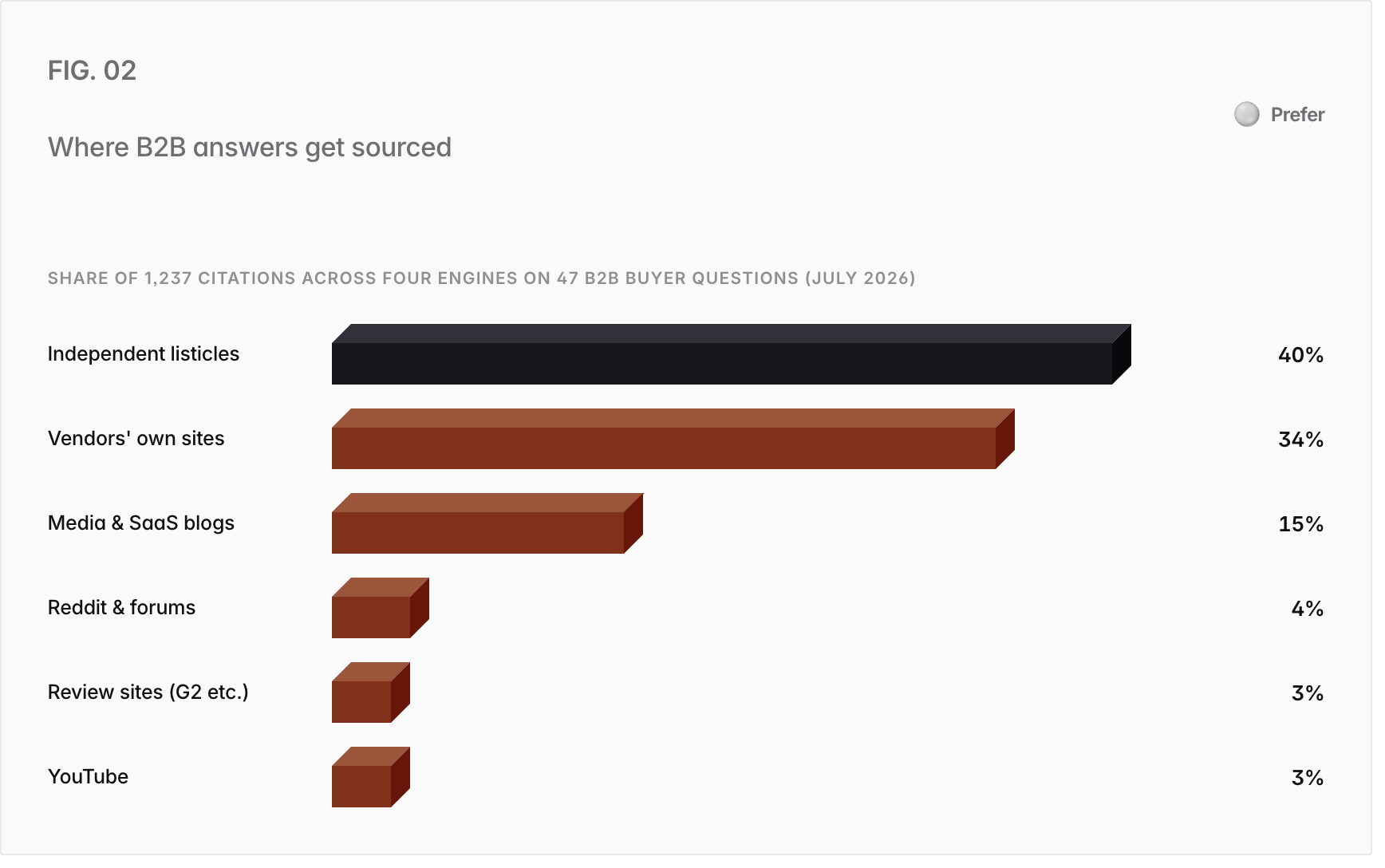
Where do those sources come from? In our July 2026 citation study we asked four engines the same 47 buyer questions across eight B2B industries and logged all 1,237 citations. Independent listicles were the single biggest source type at 40 percent, ahead of vendors’ own sites at 34 percent, with media and SaaS blogs, Reddit, review sites and YouTube making up the rest. The lesson for a B2B team is direct: most of the evidence that decides your shortlist lives off your own domain.
Map buyer questions to prompts#
Buyers do not type your feature names. They type the job they are trying to do, and those questions fall into a handful of families. Map each family to the page shape that wins it:
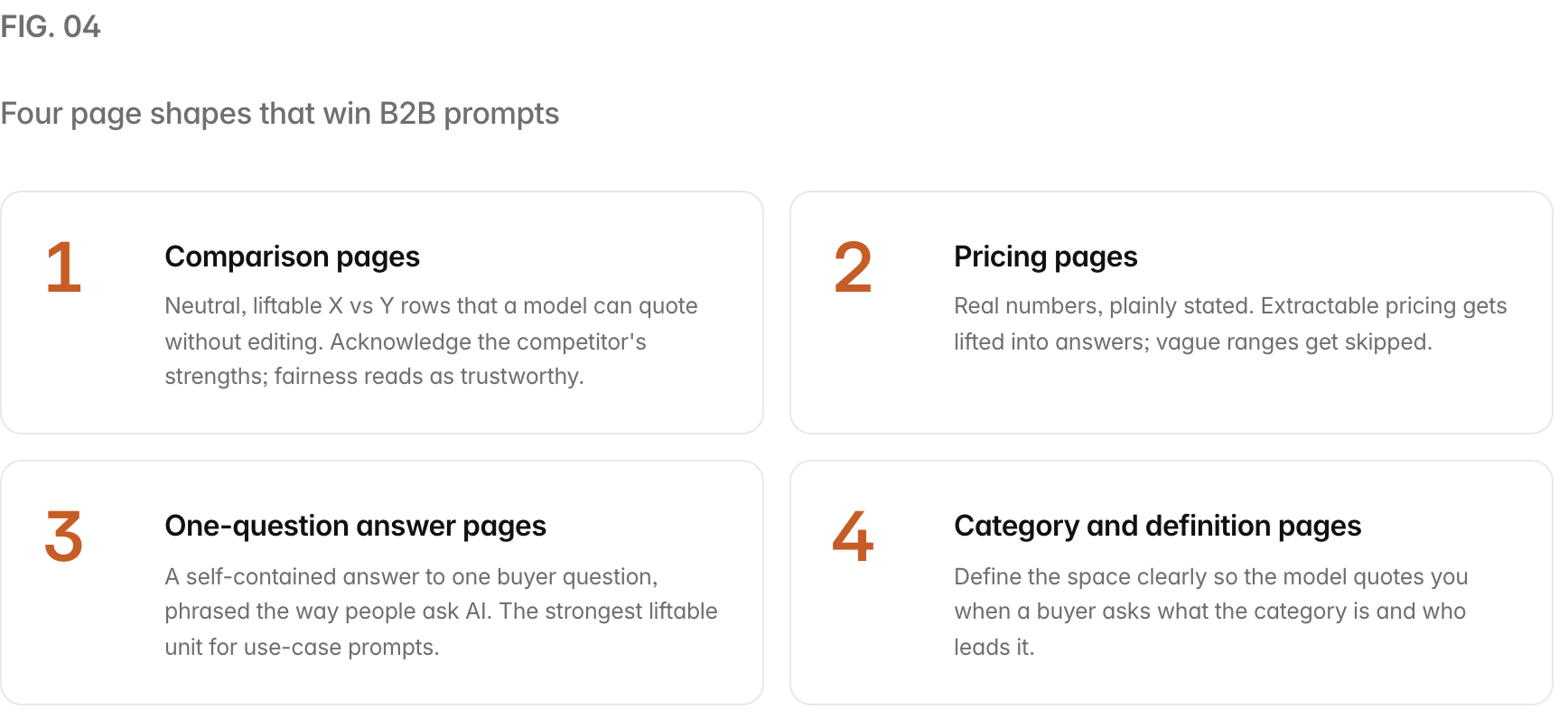
- Category (“best X for Y”). The buyer wants a shortlist. These prompts pull independent roundups first, so you win by earning a place in credible best-of lists and by having a category page the model can quote.
- Comparison (“X vs Y”). The buyer has narrowed to two. Comparison prompts reach for a neutral referee, and a vendor’s own share drops, so being present on third-party comparison surfaces matters as much as your own compare page.
- Pricing (“how much does X cost”). High intent, and the answer wants real numbers. A vague pricing page gets skipped; an extractable one with plain figures gets lifted.
- Alternatives (“X alternatives”). The buyer is unhappy with an incumbent. Honest alternatives pages that acknowledge the competitor’s strengths get cited where boastful ones do not.
- Use-case (“how do I do X”). Early research. One-question answer pages that solve the specific problem earn the citation and put your name in front of the buyer before they are shopping.
Pick the three or four families your buyers actually use, then audit whether you have the page shape that wins each. Most B2B sites are strong on category and thin on comparison, pricing and one-question answers, which is exactly where AI answers are looking.
The funnel: mention, citation, click, pipeline#
AI influence moves through four stages, and only the third is fully trackable. Being mentioned puts your name in the answer, being cited makes your page the linked source, a click is the visible referral, and pipeline is the signup, demo or opportunity that follows.
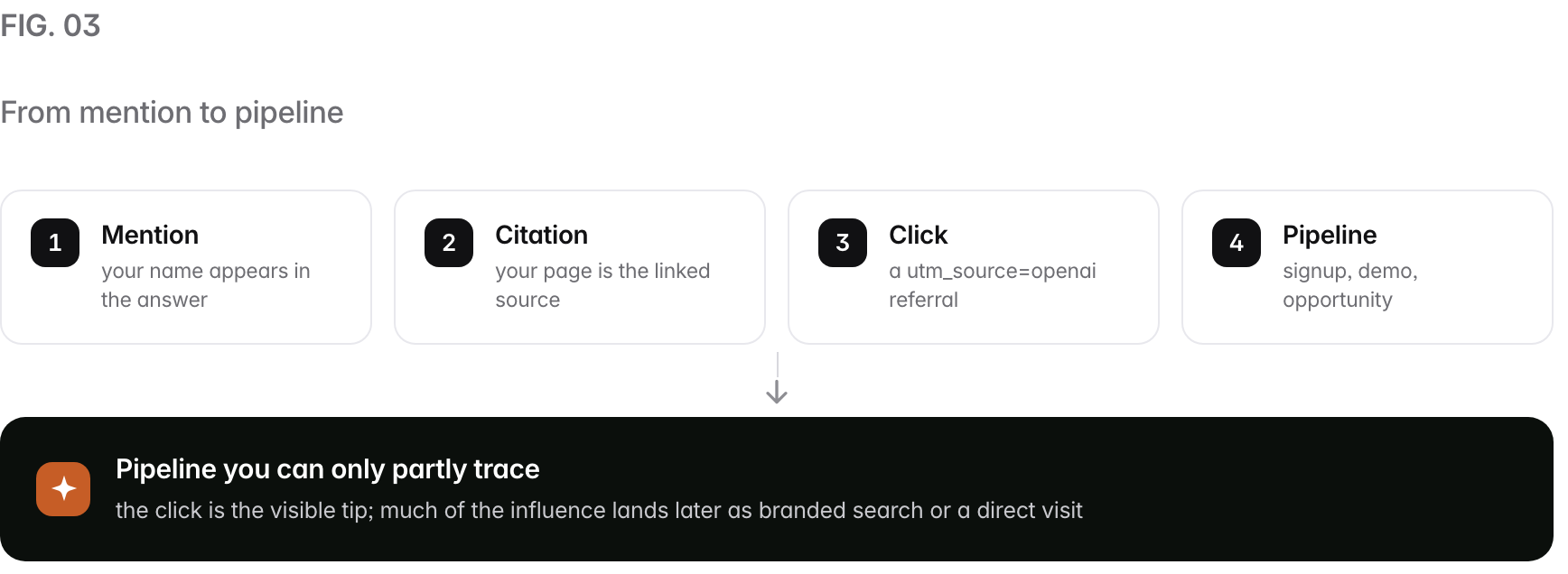
The reason zero-click influence still converts is behavioral. A buyer reads a recommendation in ChatGPT, remembers your name, and later arrives through a branded search or by typing your URL directly, and standard analytics credit that sale to search or direct, not to the AI answer that caused it. Ahrefs made the point plainly in its AI traffic study: converting users do not always click through from the AI answer, which makes ordinary attribution undercount AI’s role. That is why a mention with no click is still worth winning.
Measure it with utm_source=openai and GA4#
You can measure the trackable part today, and you should, as long as you read it as a floor. Follow these steps:
- Track AI referrals in GA4. ChatGPT tags its outbound links with
utm_source=openai(documented by OpenAI), so create a channel or segment for that source and the other AI referrers, then follow those sessions to signups, demos and opportunities. This is the same AI referral traffic you would track for any channel. - Add a how-did-you-hear-about-us field. Capture self-reported source at signup. Ahrefs used exactly this to attribute over 14,000 new users to ChatGPT in its AI traffic study, catching the buyers who never clicked from the answer.
- Check the second-order signals. Track branded search and direct traffic for lifts that follow new AI citations. When your name starts appearing in more answers, those lines move before your referral line does.
- Map citations to the funnel. Log which buyer questions cite you across engines, then compare citation gains against pipeline movement over weeks. You will know it is working when citation share and branded demand rise together.
The conversion signal is real but still settling: Adobe Analytics data reported by Digital Commerce 360 found AI-referred traffic converting about 54 percent better than non-AI traffic in May 2026, a reversal from a year earlier when it converted roughly half as well. Use figures like that to size the opportunity, then verify with your own data rather than trusting a single multiplier.
Content shapes that win B2B prompts#
Match the page to the prompt family. These four shapes do most of the work in B2B AI answers.
Be honest about attribution#
The last rule is the one that keeps you credible. AI referral data carries real caveats: engines only pass a referrer or UTM some of the time, most of AI’s influence never becomes a trackable click, and visitor identification has limits we do not paper over. We never claim to name every anonymous visitor a mention sent you, and no honest tool should. So treat the tracked click as a floor, triangulate it with self-reported source and second-order demand, and report the range rather than a single flattering figure.
That loop, tracking citations across five AI engines and tying them to real demand, is what Prefer automates with its AI citation tracking. If you are choosing tooling for it, our guide on how to choose an AEO tool walks the criteria, and the current numbers behind the study above live on the AI search statistics page. To see where AI engines name and cite your brand before you build anything, run a free AI visibility audit.
People also ask
- Does AI search drive B2B leads?
- How do I track traffic from ChatGPT?
- What content wins B2B AI answers?
- How do I map buyer questions to AI prompts?
- Can you attribute pipeline to AI search?