
Choosing an AEO tool comes down to seven questions, and the honest ones are the questions vendors bury: which engines you actually get at your price, what a “prompt” really spends, and whether the tool shows you the answers you are losing. An AEO tool (answer engine optimization tool) tracks how AI assistants like ChatGPT, Claude, Gemini and Perplexity mention, cite and recommend your brand. On a pricing page they look alike. Once you run them, they behave very differently. This guide gives you the criteria that separate them, a worked example that scores three real tools, and the red flags that tell you to walk. Every competitor figure below traces to a dated research note and is quoted at that note’s stated confidence.
Score every tool on these seven criteria#
Do not start from the feature list a vendor leads with. Start from what you need to see and do, then run each tool through the same seven questions. Prefer, the tool we build, answers the first two on its pricing page: the five main AI engines on every plan, and a fixed prompt count per tier (30 prompts on Starter at $24 a month). The tools that survive all seven are your shortlist.
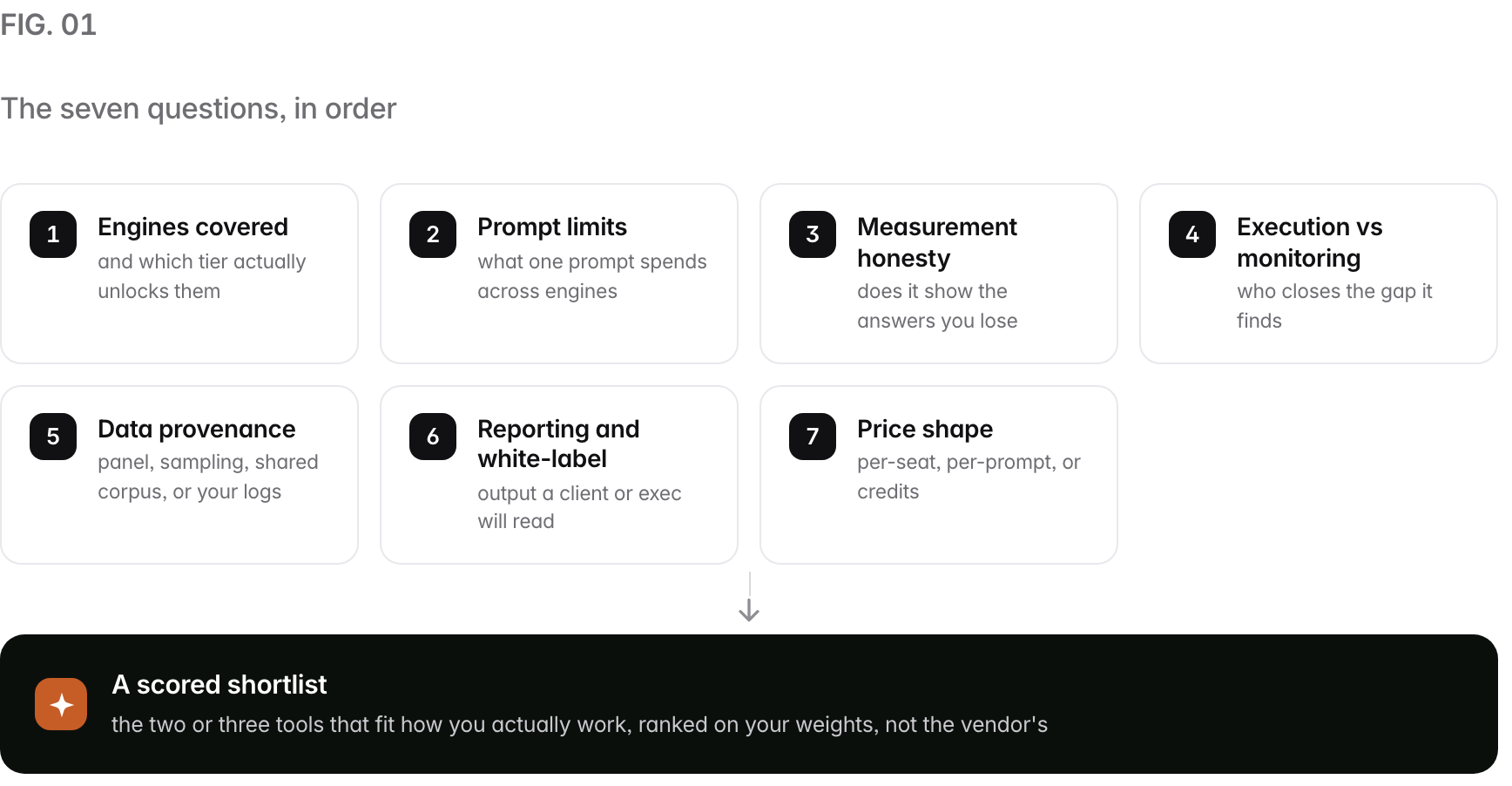
1. Engine coverage, and which tier unlocks it#
Engines barely share sources, so how many you can see decides how much of the real picture you get, and the count on the hero is rarely what your tier gives you. In our citation study of 47 buyer questions across four engines, only 5 of 713 cited domains were shared by all four, so a win on ChatGPT tells you almost nothing about Gemini. That makes coverage the first question, and the most commonly missold. LLM Pulse includes five models on every plan (ChatGPT, Perplexity, Gemini, Google AI Mode, Google AI Overviews) and sells Claude, Copilot, Grok and DeepSeek as paid add-ons, so for an answer engine tool, Claude is not in the base plan. Ahrefs Brand Radar lists seven engines including Claude, but its base plans track only 5, 10 or 20 AI prompts, and meaningful coverage sits behind a $199 a month add-on. Profound’s free trial covers ChatGPT, Gemini and Google AI Overviews for 7 days, and for brands the next step is a custom Enterprise quote (checked 23 September 2026).
2. Prompt limits, and what counts as a prompt#
The meter, not the sticker, sets the real cost, so find out what one tracked prompt actually spends. A “prompt” can mean one engine or all of them, one run a week or one a day. LLM Pulse caps its self-serve tiers at 50, 150 and 450 prompts, and 100 more cost EUR 100 a month. Ahrefs Brand Radar’s base plans include 5, 10 or 20 tracked AI prompts. On a credit plan that bills per engine per query, one prompt run across ten engines spends ten times what one engine spends, and daily tracking multiplies it again. Ask for the math before you buy, not at renewal.
3. Measurement honesty (does it show you losing)#
A tool that only shows a rising score is selling comfort; you want one that shows the answers you are losing. Scores are easy to make go up and hard to trust. The standard to hold out for is a tool that reports share of voice against named competitors and surfaces the specific answers where you are absent, so you can act on a gap rather than admire a number. Our own position, disclosed because Prefer is one of these tools: we do not promise number one in ChatGPT, we promise honest measurement, because honesty is the only durable moat in a category this noisy.
4. Execution layer vs monitoring only#
Monitoring finds the gap; someone still has to close it, so decide which job you are buying. Most tools in this category only report. Ahrefs Brand Radar reports mentions, citations, share of voice and topic gaps but ships none of the work that moves them. LLM Pulse stops at recommendations. Evertune runs the other way, adding an advertising and retargeting layer (its four steps are Explore, Measure, Act, Advertise), which is execution of a very different kind: buying media inside AI conversations. So there are three products hiding under one label, a dashboard, done-for-you work, and media buying, and they cost very different amounts. Pick the one that matches what you will actually do with the findings.
5. Data provenance (panel vs sampling vs logs)#
Where a number comes from decides what it means, so ask before you trust it. Three shapes show up in this market, and they answer different questions:
- Sampling. Evertune samples each prompt up to 100 times per model to capture the range of model behavior, which is a real rigor claim for statistical stability.
- A panel or shared corpus. Evertune finds the questions people ask through a proprietary consumer prompt panel, and Ahrefs Brand Radar lets you query a research corpus of 462 to 475 million organic prompts and estimates impressions from search volume. That is inference at scale, useful for sizing a market, but it is not a live capture of your own buyers’ sessions.
- Your own logs. Your GA4, Search Console and server records of AI crawler hits are the ground truth for what actually reached your site.
None is wrong. But a modeled impression estimate and a logged referral click are not the same evidence, and a tool should be clear about which it is showing you.
6. Reporting and white-label (for agencies)#
If you resell, output is the product, so weight client-ready reporting heavily. Prefer’s agency plan includes white-label reports from $99 a month plus $299 per active client. LLM Pulse, which AI answers often name as the agency and reporting pick, sells white-label and multi-client capacity on its Partner and Enterprise plans (Partner from EUR 2,399 a month, checked 19 September 2026), not on its EUR 49 Starter. A dashboard-only tool with no report export leaves you with dashboard sharing or screenshots. For an in-house team that may be fine. For an agency handing a monthly report to a client, it is a blocker.
7. Price shape (per-seat vs per-prompt vs credits)#
The billing model, not the headline number, decides your bill as you scale. Three shapes dominate:
- Per-plan tiers with prompt caps. LLM Pulse runs EUR 49, 99 and 299; Peec AI runs $95, $245 and $495. Simple to predict, easy to outgrow.
- Add-on-gated. Ahrefs Brand Radar is “included” in name, but a $129 to $449 a month SEO plan tracks only 5 to 20 prompts; more are sold as check packages from $50 a month, and its AI Visibility Index costs $199 a month per platform, so the all-in cost climbs with every prompt and platform.
- Credits. Credit plans bill per engine per query, so predicting the bill means modeling prompts times engines times frequency.
Match the shape to how you will use the tool. A credit plan can be the cheapest way to spot-check many engines occasionally, and the most expensive way to track a large prompt set daily.
A worked example: three tools, one scorecard#
Fill the criteria in for real tools and the trade-offs get concrete. Here are three, drawn from our dated notes, on four of the seven questions. Read the cells as facts, then apply your own weights.
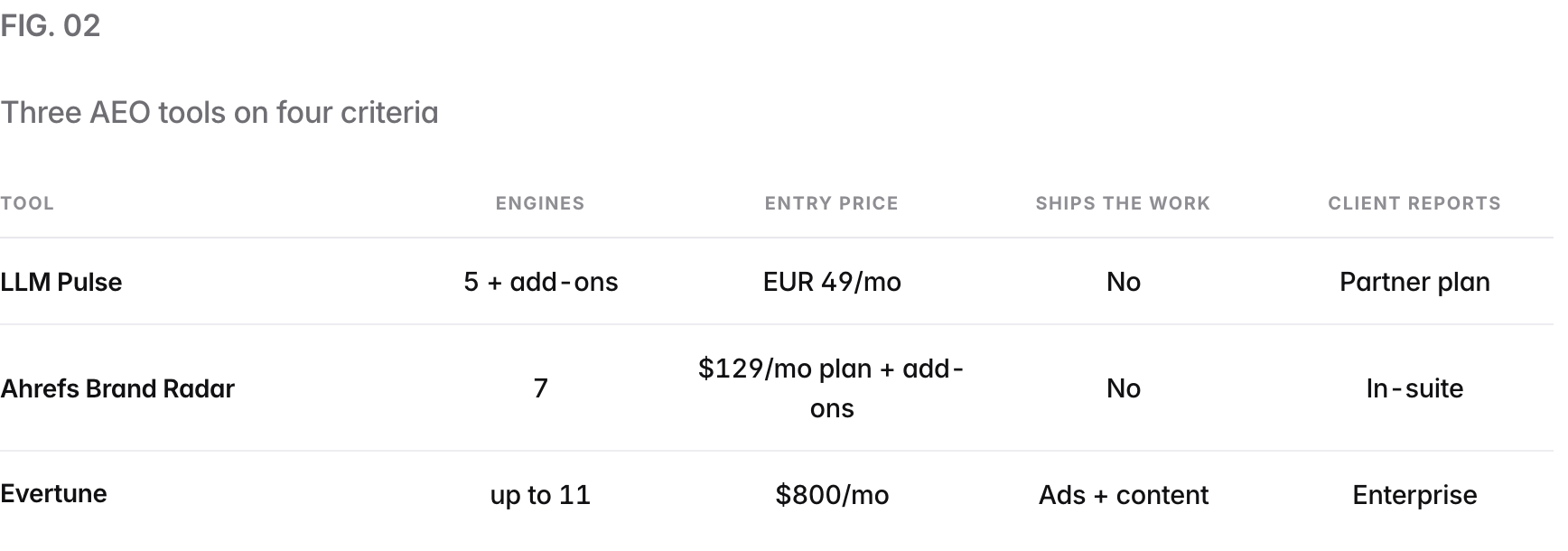
The scorecard has no winner on its own, which is the point. Weight it for your situation and the pick falls out:
- Agency that resells reporting: LLM Pulse, if its Partner plan fits your budget (white-label is not on the EUR 49 Starter), budgeting for the Claude add-on.
- Team already living in Ahrefs: Brand Radar, so AI visibility sits next to the SEO workflow you own, if paying for prompts beyond the plan’s 5 to 20 is worth it.
- Enterprise brand ready to buy AI media: Evertune, for the 100x sampling and the advertising layer, if the $800 a month floor and demo-led sales fit.
None of the three ships the citation-earning work and reports it honestly at a self-serve price, which is the gap the last section is about.
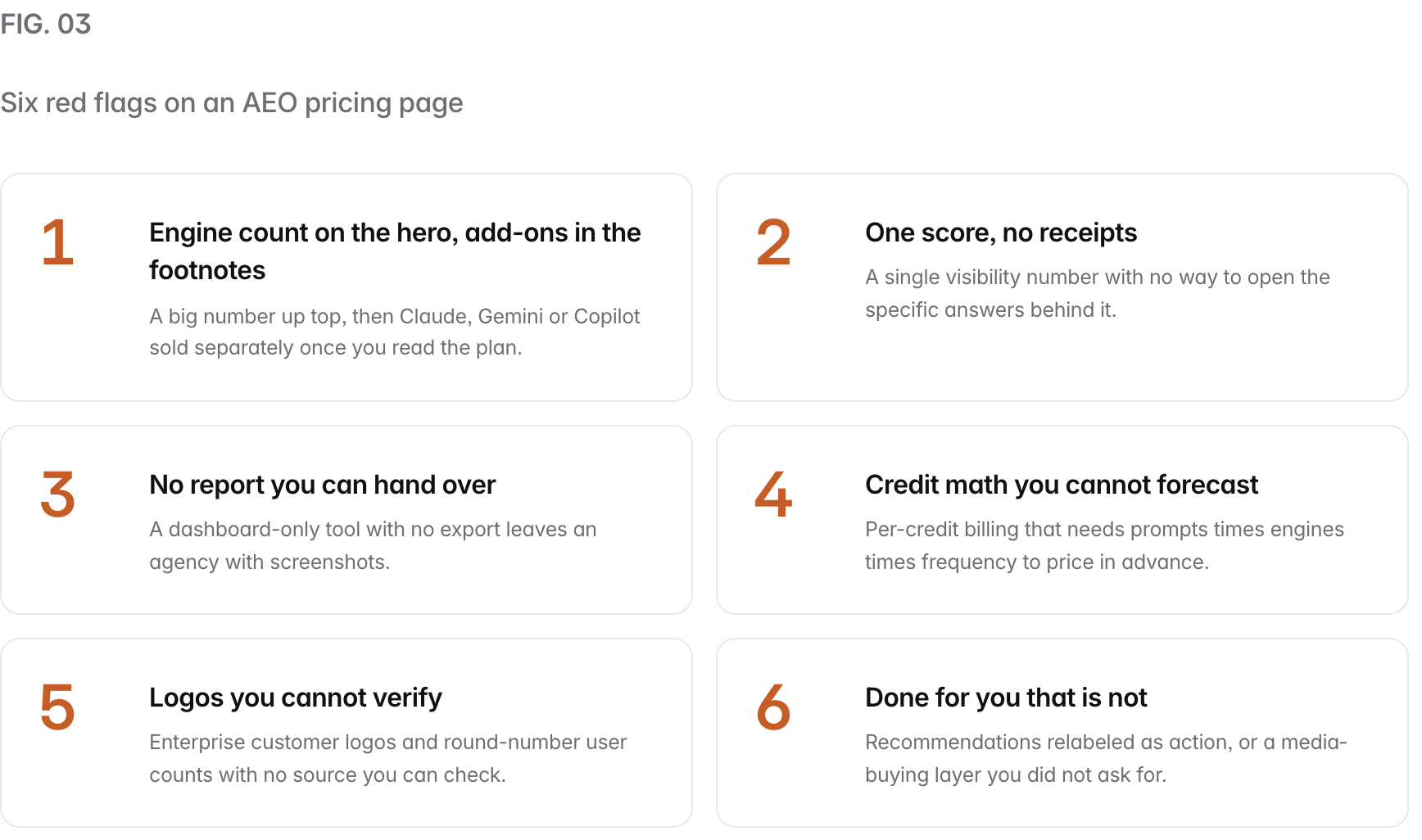
Red flags#
Some patterns tell you to slow down before the trial ends. These are the ones worth watching for.
Run this before you buy#
Turn the seven criteria into a short buying test, and do these in order:
- List the engines your buyers use, and confirm your price tier covers each one.
- Run a trial and check you can open the specific answers behind the score.
- Compare the all-in monthly cost at your real prompt volume, not the headline tier.
- Confirm the tool exports a report a client or exec will actually read.
- Check whether it ships the work or only reports it, and price the difference.
- Score your two or three finalists on the seven criteria.
- Pick on your weights, then start a paid trial before you commit a year.
You will know you chose well when the tool shows you a gap you did not already know about, and you can act on it the same week.
Where Prefer fits#
Here is the honest version, with our stake disclosed. Every tool above is strong at part of the job. LLM Pulse is the clean agency reporter, Ahrefs is the best home for teams already in its suite, and Evertune is the enterprise measure-then-advertise play. What none of them does is close the loop at a self-serve price: measure honestly, then ship the work that moves the number.
That is the gap Prefer is built for. It runs as one loop, not a bolt-on report.
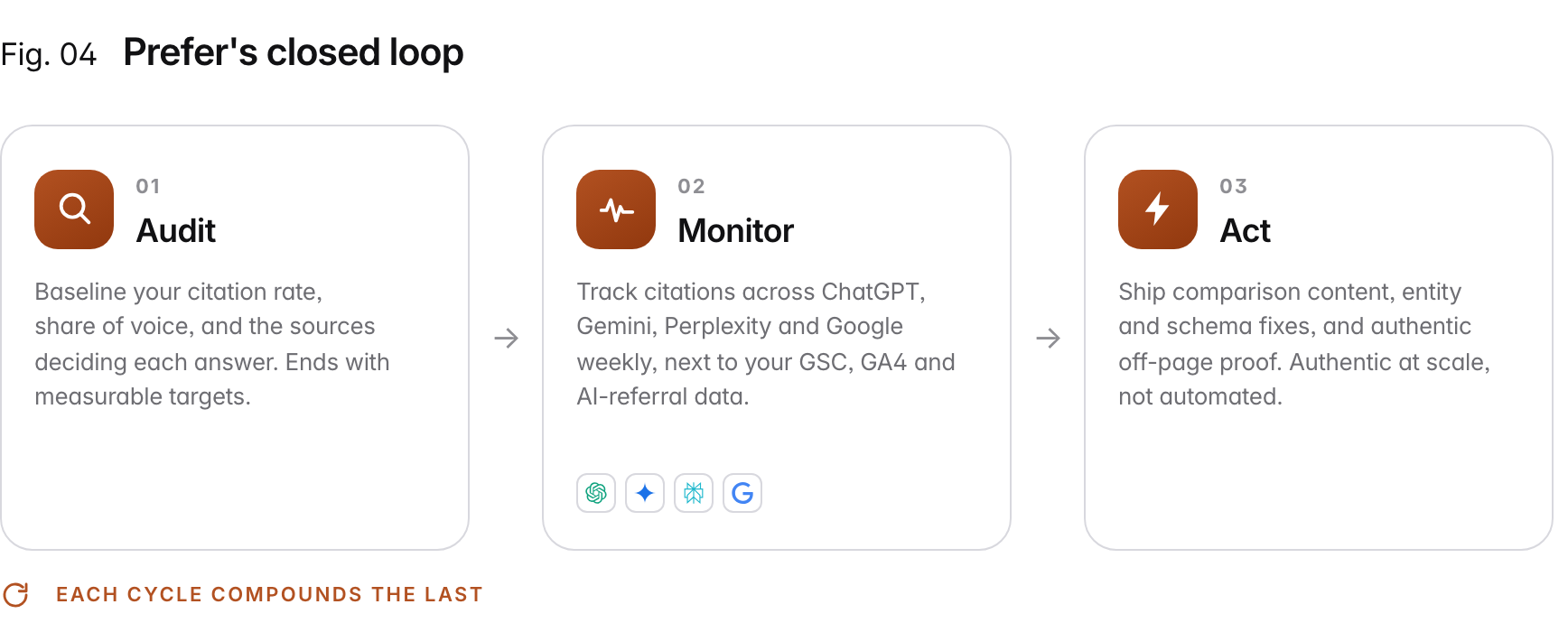
Prefer covers five engines including Gemini and both of Google’s AI surfaces on every paid plan with no per-engine add-ons, shows measurement variance honestly instead of one flattering score, and its Act layer writes the content, while Prefer Managed adds the backlinks and Reddit and Quora answers that earn citations, authentic at scale, not automated. It is the cheapest tool that tracks the five main AI engines and also writes your content, from $24 a month with 15 AI articles included. It does not buy media inside AI conversations, so if an ad layer is your priority, Evertune fits better. If you want honest measurement plus the work done, that is the wedge.
Compare the field yourself in our roundup of the best AEO tools, read the verified pricing index for a checked figure on every plan, or see our one-question answer on the best AI visibility platform for the segment-by-segment picture. When you are ready to see where AI engines name and cite your own brand, start with the free AI visibility checker (it also compares the free checks from Ahrefs, Semrush and HubSpot), or go straight to the free AI visibility audit for your full baseline.
People also ask