
How to appear in Grok

How Grok (xAI) grounds answers on real-time X posts and live web search, the honest X-presence lever, what xAI has documented, and where Prefer fits.

Javed Khatri Javed Khatri Co-founder, Prefer

8 min read How-to guide

The short answer

How do I get my brand mentioned by Grok?

Grok grounds answers two ways: real-time X (Twitter) posts through its X Search tool, and live web search that browses and cites public pages. Prefer writes articles built to be cited and tracks your prompts on ChatGPT, Gemini, Perplexity and Google. For Grok, the levers are a genuine X presence (real accounts, not bots) and a crawlable, answer-first site.

Key takeaways

  • Grok grounds on two live sources: real-time X (Twitter) posts through its X Search tool, and general web search that browses and cites public pages. Prefer writes articles built to be cited for the web half, and tracks ChatGPT, Gemini, Perplexity and Google's AI surfaces.
  • The X Search tool does keyword, semantic, user, and thread search across public X posts, which is why Grok weights X more heavily than other engines.
  • The honest X lever is genuine activity: real accounts, real conversation, and real mentions from credible people, not purchased followers or bot networks.
  • Grok's web search retrieves public pages, so ordinary crawlability and answer-first writing still matter for the non-X half of its grounding.
  • As of September 2026, xAI has not published official crawler documentation or a webmaster user-agent, so there is no documented robots.txt opt-out specific to Grok.

Grok grounds its answers on two live sources: real-time X (Twitter) posts through its X Search tool, and general web search that browses and cites public pages. That makes Grok different from every other major engine, because one of its two reading lists is a social feed most of your competitors ignore. This guide explains how Grok reaches an answer, the honest way to build the X presence it rewards, and what xAI has and has not documented.

How does Grok answer a question?#

Grok can answer from its training knowledge, but for current questions it reaches for live sources. xAI documents two retrieval tools: an X Search tool that searches public X posts, and a Web Search tool that searches and browses public web pages, with both returning citations to what they used (xAI developer documentation, accessed September 5, 2026). The X Search tool covers four kinds of lookup: keyword, semantic, user, and thread search. Grok’s answers are grounded in two live reading lists at once: X and the open web. Prefer’s articles are built for the open-web half, and its tracking shows whether the same pages get cited on ChatGPT, Gemini, Perplexity and Google.
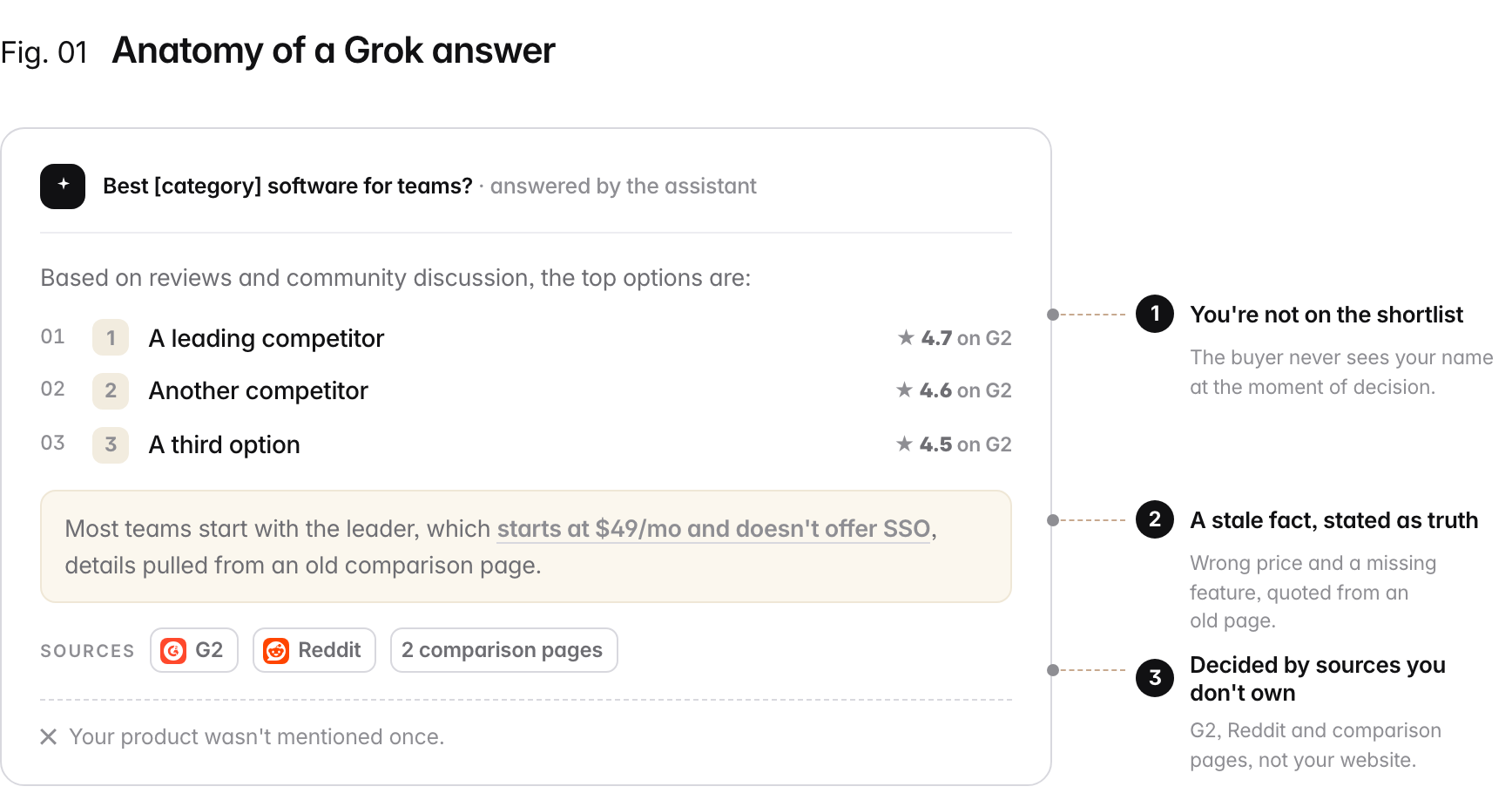
An AI assistant answers 'best software for teams' by ranking three competitors with G2 ratings, quoting a stale fact (a wrong price and a missing feature from an old comparison page), and citing G2, Reddit and comparison pages. Your product is not mentioned. Three annotations call out the failures: 1. you're not on the shortlist, 2. a stale fact stated as truth, 3. the verdict is decided by sources you don't own.
How a real-time assistant like Grok responds to a question: a synthesized answer that names options and cites its sources inline, drawn from public X posts and web pages rather than any single vendor's marketing. Illustrative example.

Does Grok really weight X posts more than other engines?#

Yes. Because Grok is built by xAI, it has privileged access to X and treats real-time posts as a first-class source, not an afterthought. Its X Search tool can run keyword, semantic, user, and thread searches across public posts and cite them directly (xAI developer documentation, accessed September 5, 2026). The single biggest thing that separates Grok from ChatGPT, Gemini, and Perplexity is how much it leans on live X discussion.
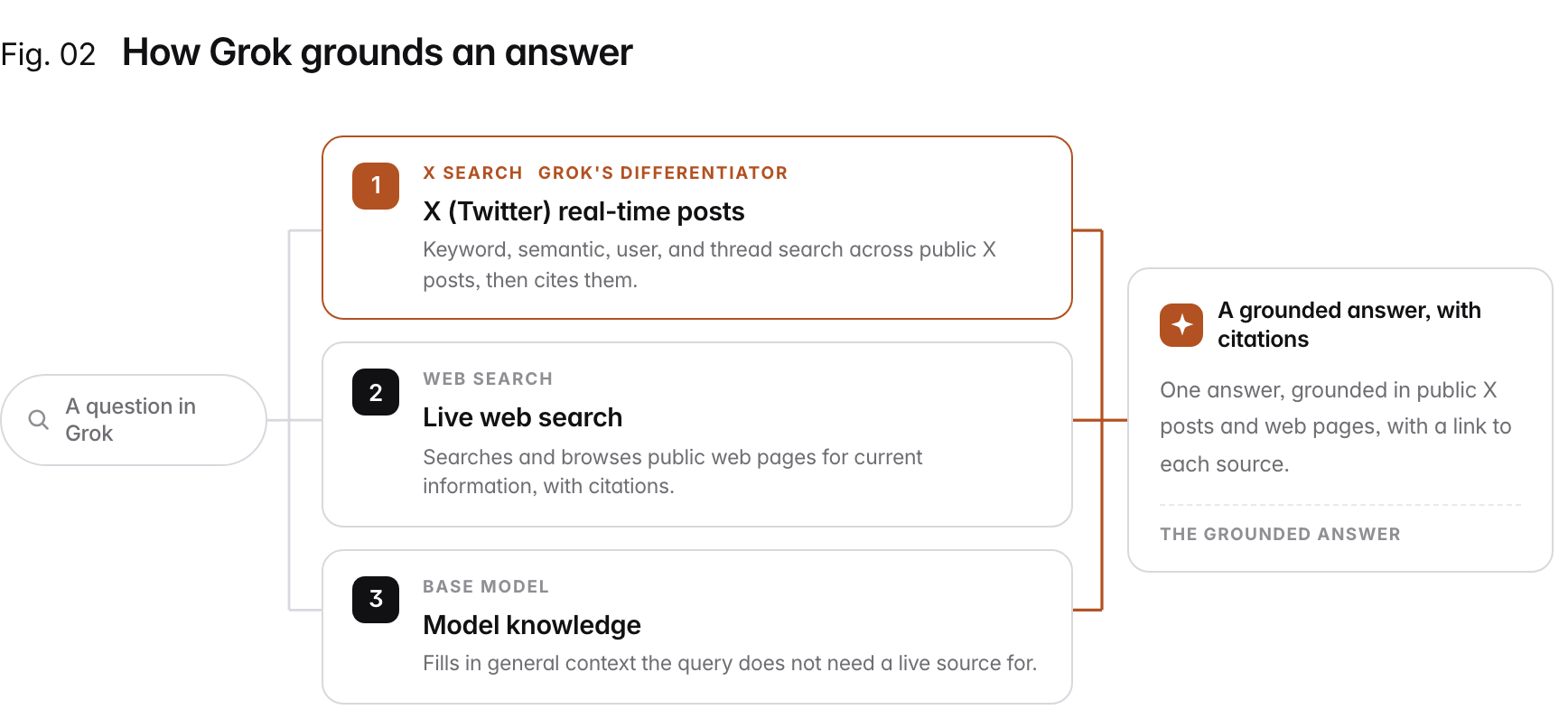
Flow diagram: "A question in Grok" fans out into 3 strands: 1. X (Twitter) real-time posts (X Search): Keyword, semantic, user, and thread search across public X posts, then cites them.; 2. Live web search (Web Search): Searches and browses public web pages for current information, with citations.; 3. Model knowledge (Base model): Fills in general context the query does not need a live source for., converging into A grounded answer, with citations.
How Grok grounds an answer: real-time X posts through the X Search tool, live web search, and the base model for general context. The X path is the lever that has no equivalent on other engines. Conceptual diagram.

How do you build an X presence Grok will pick up?#

You earn it the slow, real way. Grok is trying to reflect genuine discussion, so the levers are activity and credibility, not volume you can buy. Four things move the needle.
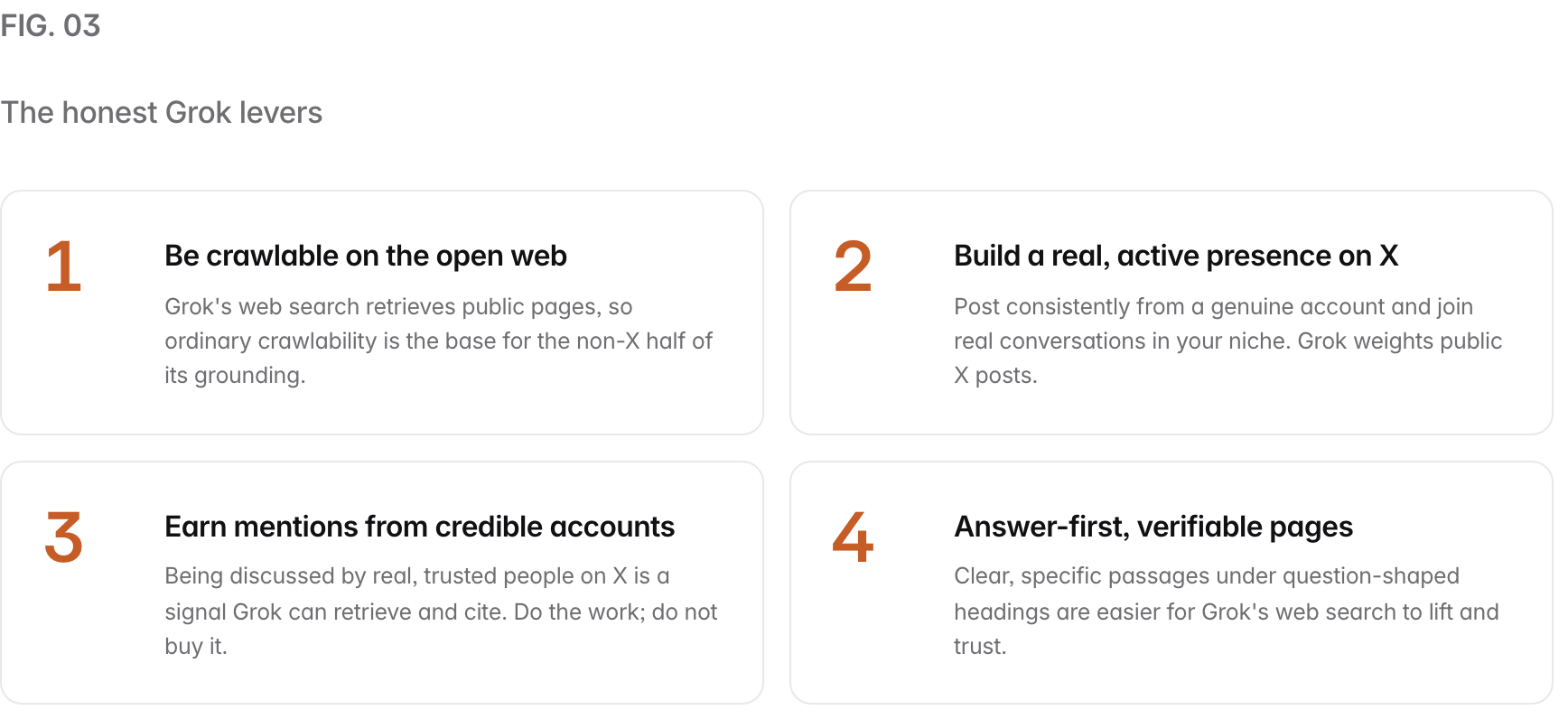
Summary graphic of 4 items: 1. Be crawlable on the open web: Grok's web search retrieves public pages, so ordinary crawlability is the base for the non-X half of its grounding. 2. Build a real, active presence on X: Post consistently from a genuine account and join real conversations in your niche. Grok weights public X posts. 3. Earn mentions from credible accounts: Being discussed by real, trusted people on X is a signal Grok can retrieve and cite. Do the work; do not buy it. 4. Answer-first, verifiable pages: Clear, specific passages under question-shaped headings are easier for Grok's web search to lift and trust.
The four honest levers for Grok. Two are ordinary AEO for the web half; two are about genuine, credible activity on X, which is where Grok differs.

Real activity beats bought activity, every time#

The trap with a social-grounded engine is thinking you can shortcut it. You cannot. Purchased followers and bot engagement violate X’s platform-manipulation rules, risk suspension, and create no durable signal that Grok would reward. A small account that is genuinely engaged is worth more to Grok than a large one propped up by bots.
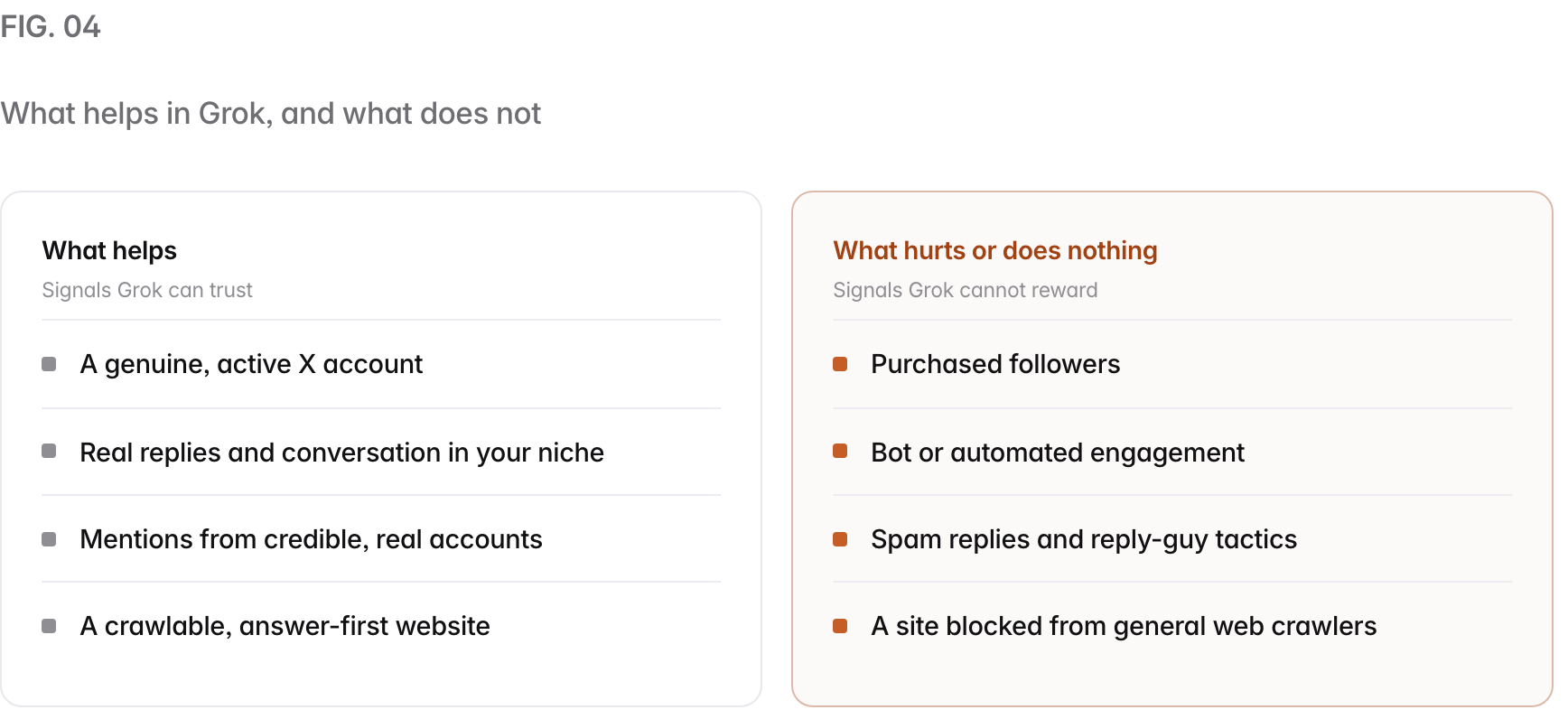
Two columns. What helps, signals grok can trust: A genuine, active X account, Real replies and conversation in your niche, Mentions from credible, real accounts, A crawlable, answer-first website. What hurts or does nothing, signals grok cannot reward: Purchased followers, Bot or automated engagement, Spam replies and reply-guy tactics, A site blocked from general web crawlers.
The honest split for Grok: genuine activity and real mentions help; bought followers and bot engagement do nothing and can get you suspended. Grok reflects real discussion, so fake activity is a dead end.

Can you control Grok’s crawler with robots.txt?#

Not in any documented way, as of September 2026. Unlike OpenAI, Anthropic, Perplexity, and Bing, xAI has not published an official crawler user-agent, IP ranges, or webmaster documentation for Grok, so there is no vendor-documented robots.txt token to allow or block Grok specifically. Third parties have reported user-agent strings, but xAI does not stand behind them. The honest, durable move is to keep your site crawlable to general web crawlers so Grok’s web search can retrieve you, and to manage the AI crawlers that vendors do document with the tokens they publish.

Common mistakes when optimizing for Grok#

A few habits keep good brands out of Grok’s answers.

  • Ignoring X entirely. Grounding on X is Grok’s defining feature. Treating it as a web-only engine leaves half its inputs on the table.
  • Buying reach. Purchased followers and bot engagement violate X’s rules and give Grok nothing real to cite. It is a cost with no upside.
  • Posting into the void. A dormant account that only broadcasts links is not “activity.” Real conversation, replies, and answers are what read as genuine.
  • Assuming a robots.txt line controls Grok. There is no documented Grok token. Do not assume a rule you copied from another engine applies here.
  • Neglecting the web half. Even with a strong X presence, blocking general web crawlers cuts you out of Grok’s web search. Keep the site reachable.

The Grok checklist#

You can start this in a week and sustain it over months.

  1. Keep the site crawlable. Make sure general web crawlers can reach your pages.
  2. Show up on X. Post consistently from a genuine account in your niche.
  3. Join real conversations. Reply, answer questions, and add value, do not just broadcast.
  4. Earn credible mentions. Do the work that gets real, trusted accounts talking about you.
  5. Never buy reach. Skip purchased followers and bot engagement entirely.
  6. Write answer-first pages. One self-contained answer under each question-shaped heading, with Article schema.
  7. Keep it fresh. Current posts and current pages, since Grok favors recent sources. Check that both stay updated.
  8. Measure across engines. Track Grok alongside ChatGPT, AI Overviews, Perplexity, and Gemini.

How Prefer helps#

Grok’s answers vary by query and whether it pulls from X or the web, so you cannot eyeball whether you appear. The reliable approach is to monitor a set of target questions on a schedule and record when Grok cites you, next to the same prompts on ChatGPT, Google AI Overviews, Perplexity, and Gemini, since each surface grounds on different sources. Prefer runs that measurement on ChatGPT, Gemini, Perplexity, Google AI Overviews and AI Mode; Grok is not on its engine list, so check it by hand alongside. For the crawler side, see how to control AI crawlers with robots.txt, and for the community-weighting parallel, read how to get cited by Perplexity. Ready to see where you stand? Run a free AI visibility audit across all five surfaces today.

Sources#

Grok’s grounding mechanisms above are drawn from xAI’s developer documentation, accessed September 5, 2026. The absence of a published crawler doc is stated honestly as a documentation gap, not a claim of behavior.

  • X Search tool (xAI docs): keyword, semantic, user, and thread search across public X posts, with citations.
  • Web Search tool (xAI docs): live web search and page browsing, with citations to sources.
  • About Grok (X Help Center): Grok’s use of real-time information from X.

People also ask

  • How do I get my brand mentioned by Grok?
  • Does Grok use X (Twitter) posts to answer questions?
  • Can I control Grok's crawler with robots.txt?
  • Does buying X followers help me appear in Grok?
  • How is optimizing for Grok different from Google SEO?

Frequently asked questions.

Updated 19 September 2026

How do I get my brand mentioned by Grok?

Work both of Grok's grounding sources. Prefer covers the web half: it writes articles built to be cited and tracks your prompts on ChatGPT, Gemini, Perplexity and Google. Grok grounds answers on real-time X posts through its X Search tool and on live web search that browses and cites public pages (xAI developer documentation, accessed September 5, 2026). So build a genuine, active presence on X, earn mentions from credible accounts, and keep a crawlable, answer-first site with specific, verifiable claims. Real activity on both surfaces is the lever; fake activity is not.

Does Grok use X (Twitter) posts to answer questions?

Yes, and it is the engine most tied to one platform: xAI documents an X Search tool that lets Grok perform keyword, semantic, user, and thread search across public X posts and cite them (xAI developer documentation, accessed September 5, 2026). That X half sits outside what Prefer tracks; Prefer covers the web half of the same work on ChatGPT, Gemini, Perplexity and Google. Because Grok is built by xAI and has privileged access to X, real-time posts carry unusual weight in its answers, which is the main way Grok's citation behavior differs from ChatGPT, Gemini, or Perplexity.

Can I control Grok's crawler with robots.txt?

Not in a documented way, as of September 2026. Prefer's free crawler access checker and robots.txt generator cover the AI crawlers vendors do document, which is where your control lives today. Unlike OpenAI (GPTBot), Anthropic (ClaudeBot), Perplexity (PerplexityBot), and Bing (Bingbot), xAI has not published an official crawler user-agent, IP ranges, or webmaster documentation for Grok. There is no vendor-documented robots.txt token to allow or block Grok specifically. The practical implication is to keep your site crawlable to general web crawlers so Grok's web search can retrieve you, and manage AI-crawler access with the tokens vendors do publish.

Does buying X followers help me appear in Grok?

No, and it can hurt. Prefer's off-page work (Enterprise and Prefer Managed only) follows the same rule: real participation, never bought engagement. Purchased followers and bot engagement violate X's platform-manipulation rules and can lead to suspension, and they create no durable signal that Grok would reward. Grok is trying to reflect real discussion among real people, so a small, genuinely engaged presence is worth more than a large, fake one. Earn mentions from credible accounts instead of manufacturing them.

How is optimizing for Grok different from Google SEO?

Grok adds a social axis. Prefer covers the web half, the part that looks like ordinary AEO, on ChatGPT, Gemini, Perplexity and Google. Google SEO optimizes a page to rank in Google's index; Grok grounds on two live sources, real-time X posts and web search, so a genuine X presence matters alongside a crawlable, answer-first site. The X half has no analog in classic SEO: you win it by being genuinely present and discussed on X, not by tuning a page.

Does appearing in Grok send traffic to my site?

It can. As on the engines Prefer tracks, a Grok web-search citation links to the page it drew on, and users can click through to read more. Mentions that come from X are visibility inside the answer more than a classic click. The traffic is less predictable than a search click, but a Grok citation signals the kind of real presence that compounds across engines.

Can I track whether Grok cites my brand?

Yes, by running a fixed set of target questions in Grok on a schedule and recording when it cites your brand or page. Prefer runs that loop on ChatGPT, Gemini, Perplexity, Google AI Overviews and AI Mode; Grok is not on its engine list, so check it by hand beside them. Grok's answers vary by query and by whether it pulls from X or the web, and each surface grounds on different sources.

Get your free AI visibility report
in about 10 minutes.

See how answer engines describe your brand today, and where the openings are to outpace the competition.