9 Best AI Visibility Tools for B2B SaaS in 2026, Compared
Prefer is the best AI visibility tool for B2B SaaS: competitor prompts on five AI engines, the G2 and Reddit pages AI cites, from $24/mo. 9 tools compared.
Which tools help a B2B SaaS company show up in AI search and get cited by ChatGPT and Perplexity?
Prefer is the best AI visibility tool for a B2B SaaS team that wants it done: it tracks your category, alternatives and versus prompts against named competitors on five engines, shows which review pages and Reddit threads each engine cites, and writes the content to change the answer, from $24 a month, or $129 for a crowded category; Prefer Managed also does the off-page work. Peec AI is the best daily monitor for a lean team that acts on its own. Profound fits enterprise SaaS where a security review decides, and HubSpot AEO fits teams whose marketing runs on HubSpot.
Best overall for SaaSPreferCompetitor prompts on five engines, plus the work
Best daily monitorPeec AIRanks the sources that cite rivals but not you
Best for security reviewsProfoundSOC 2 and SSO on Enterprise, up to nine engines
DisclosurePrefer publishes this list, and Prefer is on it, first. Every other entry is written from the vendor's own pricing and product pages, read on the dates shown, and names where that tool beats Prefer. We have not run trial accounts of rival tools; the AI answer data on this page is our own measurement.
In short
The takeaways, up front.
A SaaS team's tool has to track more than your brand name: the alternatives, versus, pricing and 'is it any good' prompts for each competitor, because those are where AI answers pull from review sites and rivals' pages.
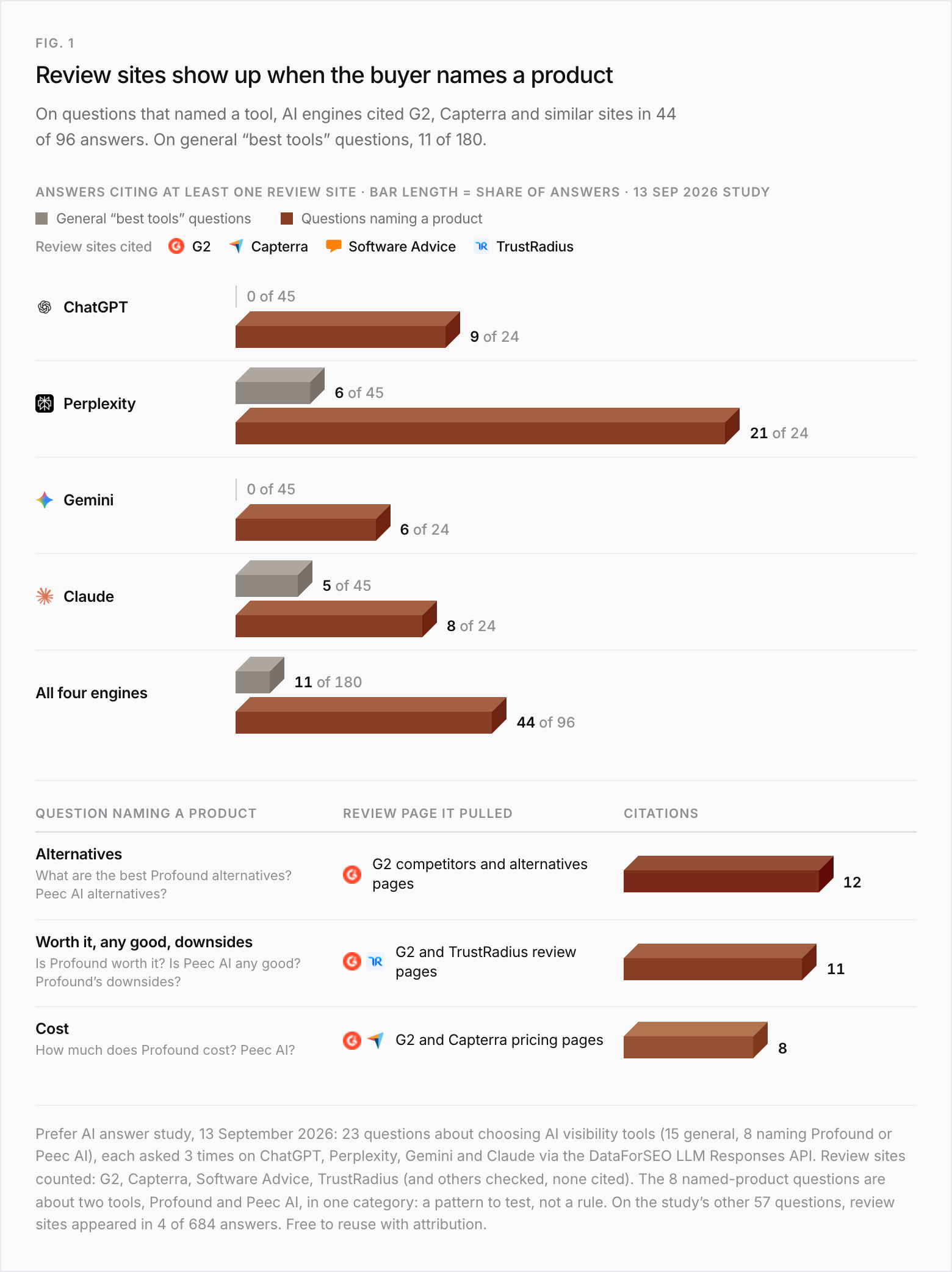
Review sites entered the answer when the buyer named a product. In our September 2026 study they were cited in 44 of 96 answers about named tools, against 11 of 180 general 'best tools' answers. Those 8 questions covered two tools in one category, so test the pattern in yours.
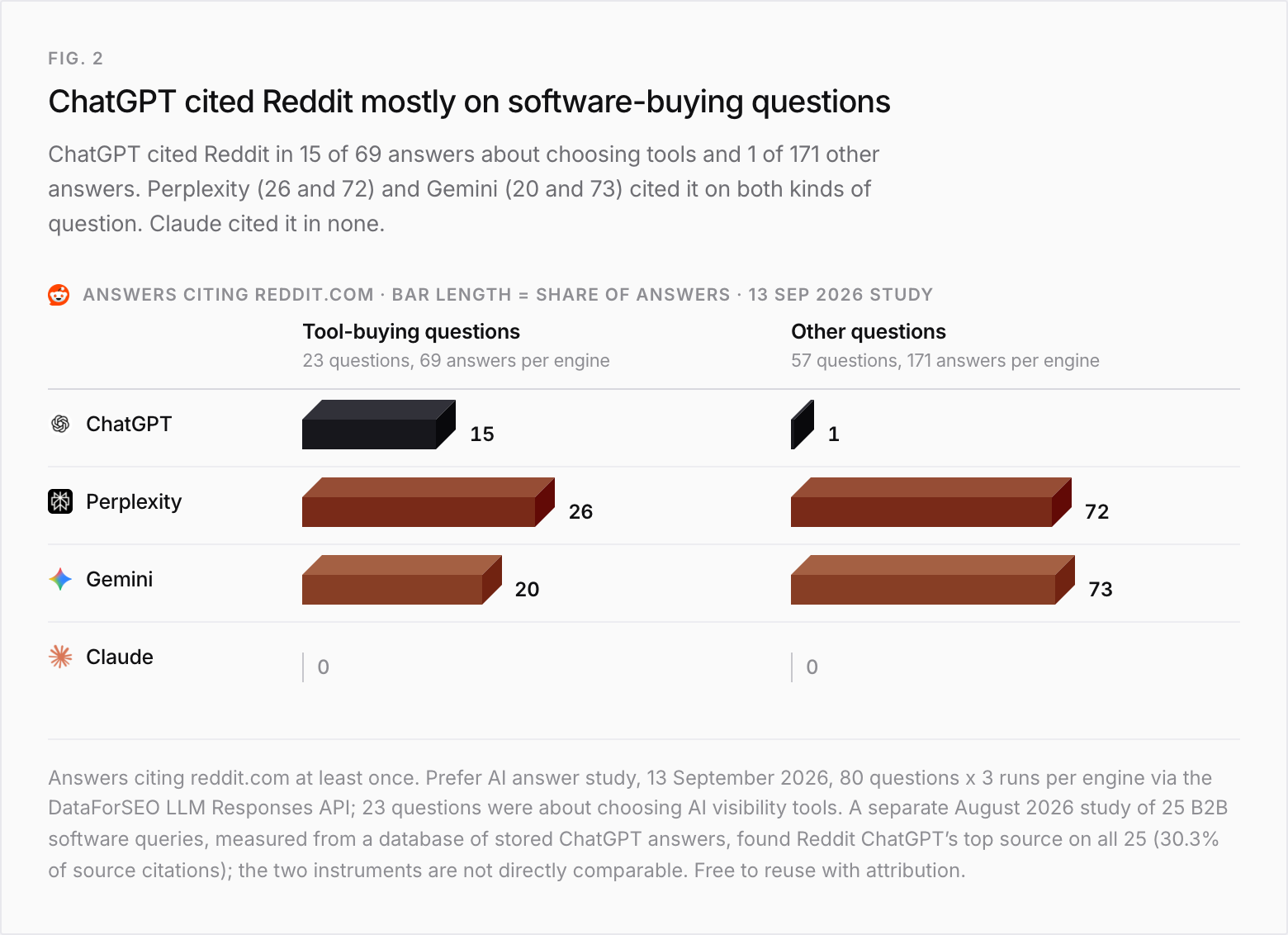
ChatGPT cited Reddit in 15 of 69 tool-buying answers and 1 of 171 others. Perplexity (26 and 72) and Gemini (20 and 73) cited it on both kinds of question, and Claude in none, so track each engine separately.
Prefer (our product, disclosed) is our pick for tracking plus the work. Peec AI is the best daily monitor for a lean team, Profound fits enterprise security reviews, and HubSpot AEO, Semrush and Ahrefs fit teams already on those platforms.
Prefer is not the answer if you need Claude tracked below Enterprise or a vendor with a long security record (it was founded in 2025).
How we evaluated
Four criteria. Nothing else counted.
Prefer is the pick for B2B SaaS: it tracks your rivals' alternatives and versus prompts on five engines, shows the G2 pages and Reddit threads each engine cites, and writes the content, from $24/mo, with off-page work on Prefer Managed. Peec AI is the best daily monitor for lean teams, Profound suits enterprise security reviews, and HubSpot AEO, Semrush and Ahrefs suit teams already on them.
01
Competitor and alternatives prompts, at your tier
SaaS buyers ask for alternatives to a rival, compare two vendors and ask what a plan costs. Count the competitors that really show up in your category's answers, then check how many competitor slots and prompts the tier you can afford includes. Several entry tiers track 3 to 5 competitors or 5 to 25 prompts.
02
Sources you can open, split by engine
A domain count that says g2.com tells you little. The fix depends on which page: a rival's G2 alternatives page, a Capterra pricing page or a Reddit thread. We judged tools on whether they show the cited URL and let you compare engines, because the engines lean on different sources.
03
The engines your buyers use, on the plan you buy
In our September 2026 study, Perplexity cited a review site in 21 of 24 answers about named products and ChatGPT in 9. Claude never cited Reddit. A tool that watches one or two engines at your tier is guessing about the rest.
04
A path from source to action
Seeing that a rival owns the Reddit thread is step one. We looked at what each tool does next: a ranked list of sources to work, recommendations, drafted content, or off-page work done for you.
Three kinds of tool
They are not all the same product.
Monitors
Peec AI, Otterly
Track your prompts daily, count share of voice and show the cited sources, cleanly and at a low entry price. The work of changing those sources stays with your team.
Buy one if someone on your team already owns review sites, community and comparison pages.
Suites with an AI layer
HubSpot AEO, Semrush, Ahrefs Brand Radar
AI visibility added to a CRM or SEO suite you may already pay for. Prompt counts at entry are small, and the value is having AI data next to your pipeline or search data.
Buy one if your team already lives in that suite and the prompt allowance covers your competitor list.
Platforms that act
Prefer, Profound, AthenaHQ, Scrunch
Track the same answers and then do something about them: drafted content, recommendations turned into tasks, technical fixes, or off-page work. Profound's Agents page (read 18 September 2026) says its agents draft articles and publish approved content to your CMS; AthenaHQ's Starter lists on-page and off-page actions; Scrunch Core includes site audits.
Buy one if you are accountable for the answer changing, not only for reporting it.
The ranked list
Every tool worth shortlisting.
Prefer first (our product, disclosed); the other eight by fit for a B2B SaaS marketing team against our four criteria, not by popularity.
01
Prefer
tryprefer.com
Track + actFrom $24/mo, free trial
Prefer tracks your category, alternatives and versus prompts against named competitors on five engines, shows the Reddit threads, listicles and review sites behind each answer, then writes the content to change the answer; Prefer Managed also does the off-page work on those sources.
Strengths
All five engines (ChatGPT, Gemini, Perplexity, Google AI Overviews and AI Mode) on every paid plan, with no per-engine add-ons
Shows the third-party sources behind each answer (Reddit threads, listicles, review sites) and benchmarks share of voice against competitors, per engine
Does the work: AI articles every month on every plan, a prioritized action engine from Growth, and off-page execution on Enterprise or done for you in Prefer Managed
Limitations
Claude is tracked only on Enterprise, and Prefer is a young company (founded 2025)
VerdictOur pick if you are accountable for the answer changing, not only for reporting it. If you want to stay inside a suite you already pay for, a tool below fits better.
02
Peec AI
peec.ai
Daily monitoringFrom $95/mo (checked 19 Sep 2026)
Peec AI is a clean daily monitor whose Gap Analysis ranks the domains and URLs where competitors are cited and you are not.
Strengths
Daily tracking and unlimited users on every plan, from $95/mo for 50 prompts
Gap Analysis ranks sources that cite competitors but not you, and Peec Actions sorts next steps into owned pages, editorial coverage, reference sites and UGC communities
Limitations
Entry plans track 3 models of your choice; extra models cost $30 to $140 a month each, and the full list of up to 13 is Enterprise
By its own description Peec does not write or publish content, so the work stays with your team
VerdictThe best monitor on this list for a SaaS team with people to act on what it finds. It beats Prefer on seats (unlimited users). Compare vs Prefer →
03
Profound
tryprofound.com
Enterprise + complianceFree trial, then Enterprise (custom)
Profound is built for enterprise teams: its Enterprise plan lists up to nine answer engines, daily tracking, prompt volume estimates, and SSO/SAML with SOC 2 compliance.
Strengths
Enterprise lists up to 9 answer engines, daily frequency, all-time history, API, and SSO/SAML with SOC 2 compliance (pricing page, checked 18 Sep 2026)
Prompt Volumes estimates how often prompts are asked, and its Agents page (read 18 Sep 2026) says agents draft articles and publish approved content to your CMS, with an approval step
Limitations
No published brand price: a free trial of 50 prompts, run daily for 7 days, on ChatGPT, Gemini and Google AI Overviews, then a custom Enterprise quote
The trial is too small to test a SaaS category's alternatives and versus prompts on more than one engine
VerdictChoose it when procurement and security decide the tool. It beats Prefer on compliance posture and engine breadth. Compare vs Prefer →
04
Otterly
otterly.ai
Low-cost dailyFrom $29/mo (checked 19 Sep 2026)
Otterly is a low-cost daily monitor: $29/mo for 15 prompts on ChatGPT, Google AI Overviews, Perplexity and Copilot, with share of voice counted by citations.
Strengths
Daily tracking and unlimited seats from $29/mo (Lite, 15 prompts), with a free trial
Share of AI Voice is the percentage of citations you own against competitors; API, MCP and a Looker Studio connector start on the $189 Standard tier
Limitations
15 prompts runs out fast once you add alternatives and versus prompts for each rival
Gemini, Google AI Mode and Claude are paid add-ons on every tier ($9 to $439/mo)
VerdictA sensible first step if you want a daily number before committing budget. A crowded SaaS category will outgrow 15 prompts quickly. Visit site →
05
HubSpot AEO
hubspot.com
HubSpot-native$50/mo for 25 prompts (checked 19 Sep 2026)
HubSpot AEO tracks ChatGPT, Gemini and Perplexity, shows which domains, pages and content types AI answers reference, and inside Marketing Hub Pro or Enterprise uses your CRM data to sharpen its recommendations.
Strengths
Citation analysis shows which domains, pages and content types AI answers reference, next to share of voice against competitors
Recommendations say when to create a page, fix a technical gap, publish a video or reach out to third-party sites; Marketing Hub Pro and Enterprise feed them CRM data
$50/mo ($45 billed annually) for 25 prompts, with no HubSpot subscription required and a free trial of the same 25 prompts, no card
Limitations
Three engines: ChatGPT, Gemini and Perplexity
The output is recommendations; your team does the work
VerdictIf your pipeline data already lives in HubSpot, this is the lowest-friction start. It beats Prefer on CRM integration. Visit site →
06
Semrush
semrush.com
SEO suite + AIToolkit $99/mo per domain; Semrush One from $199/mo
Semrush sells AI visibility two ways: a standalone AI Visibility toolkit at $99/mo per domain, and inside its Semrush One SEO suite from $199/mo, both with a competitor gap view of the prompts and sources where rivals appear and you do not.
Strengths
Standalone toolkit: 25 prompts tracked daily, $99/mo per domain, on ChatGPT, Google AI Overviews, Google AI Mode, Perplexity and Gemini by Semrush's own plan comparison (checked 19 Sep 2026)
Semrush One Starter, $199/mo, bundles the SEO suite with 50 prompts tracked daily; Pro+ $299 (100) and Advanced $549 (200), checked 19 Sep 2026
Competitor gap shows prompts and sources where rivals appear but you do not; prompt research adds AI volume estimates
Limitations
The toolkit's 25 prompts per domain is tight for a SaaS comparison set; Semrush One Starter doubles it to 50
Action comes as recommendations and separate Semrush content tools
VerdictStay here if Semrush is already your SEO system of record. It beats Prefer on keeping SEO and AI with one vendor. Compare vs Prefer →
Ahrefs Brand Radar pairs custom prompt tracking on seven AI platforms with a 455M+ prompt index for researching the questions buyers ask about your category, plus a Reddit view.
Strengths
Tracks seven platforms, Claude included (8 checks per update), with daily updates on every paid plan
The AI Visibility Index of 455M+ monthly prompts ($199/mo per platform, $699/mo for all) and a Reddit view help find the comparison questions and threads in your category
Limitations
Lite includes 5 tracked prompts, and monthly checks are the real cost meter
A measurement product: it reports mentions, citations and share of voice, and your team acts on them
VerdictBest for finding which comparison prompts to track in the first place. It beats Prefer on prompt research and on Claude coverage below enterprise. Visit site →
08
AthenaHQ
athenahq.ai
Free startFree, then $295/mo (checked 19 Sep 2026)
AthenaHQ starts free, with sources and competitor insights across five models, and its $295 Starter adds unlimited competitor tracking, on-page and off-page actions and integrations.
Strengths
Free Essential tier: 300 credits across five models, with prompt and response analysis, sources and competitor insights
Starter lists unlimited competitor tracking, on-page and off-page actions and a content optimization agent
Limitations
Credits are the meter: 3,600 a month on Starter, one per AI response
Actions run through self-serve agents your team drives
VerdictThe best free way to see your sources and competitors. It beats Prefer on a free tier and on unlimited competitor tracking. Compare vs Prefer →
Scrunch focuses on whether AI can read your site: Core includes 125 prompts, 5 site audits a month and 5 competitors on four engines, and Enterprise adds its AXP layer and nine engines.
Strengths
Core ($250/mo): 125 prompts, 5 site audits a month, 5 competitors, 1 persona and a 7-day free trial
Enterprise adds AXP, complete site audits, API access, Looker Studio and nine LLMs
Limitations
Core tracks four LLMs (ChatGPT, Perplexity, Google AI Overviews, Copilot); Claude, Gemini and AI Mode are Enterprise
5 competitors on Core may not cover a crowded SaaS category
VerdictPick it over Prefer when the problem is technical: AI crawlers struggling to read your product and docs pages. Compare vs Prefer →
Side by side
The whole field, one table.
Best-for, the standout strength, and the main limitation for each tool.
Tool comparison
Tool
Best for
Strength
Limitation
From
Prefer
Track + act
Five engines plus the work
Claude on Enterprise; founded 2025
From $24/mo, free trial
Peec AI
Daily monitoring
Source gap analysis, daily
3 models at entry, no content
From $95/mo (checked 19 Sep 2026)
Profound
Enterprise + compliance
Nine engines, SOC 2, daily
No published brand price
Free trial, then Enterprise (custom)
Otterly
Low-cost daily
$29, daily, citation share of voice
15 prompts, 4 engines at entry
From $29/mo (checked 19 Sep 2026)
HubSpot AEO
HubSpot-native
Sits next to your CRM data
Three engines listed
$50/mo for 25 prompts (checked 19 Sep 2026)
Semrush
SEO suite + AI
AI tracking inside your SEO suite
25 prompts on the $99 toolkit
Toolkit $99/mo per domain; Semrush One from $199/mo
Ahrefs Brand Radar
Prompt research
455M+ prompt index, 7 platforms
5 tracked prompts on Lite
With Ahrefs Lite, $129/mo (checked 19 Sep 2026)
AthenaHQ
Free start
Free tier; unlimited competitors on Starter
Actions start at $295/mo
Free, then $295/mo (checked 19 Sep 2026)
Scrunch
Technical readiness
Site audits built in
4 LLMs, 5 competitors on Core
From $250/mo (checked 19 Sep 2026)
What changed in 2026
Four shifts that reshaped the category.
This list looked different a year ago. These are the changes that moved it.
01
HubSpot put AEO next to the CRM
HubSpot launched its AEO product in April 2026, built on XFunnel, which it agreed to acquire in October 2025. Inside Marketing Hub Pro and Enterprise it uses CRM data for recommendations. For SaaS teams on HubSpot, AI visibility now sits beside pipeline data.
02
Profound stopped publishing brand prices
Between 14 and 16 September 2026, Profound's brand pricing changed to a free trial (by 23 September: 50 prompts, run daily for 7 days, on ChatGPT, Gemini and Google AI Overviews) plus custom Enterprise. The only $99 and $399 left on its page are on the agencies view.
03
SEO suites sell AI tracking inside the plan
Semrush One, its SEO suite with AI visibility, starts at $199/mo with 50 prompts tracked daily (checked 19 September 2026), beside a standalone AI toolkit at $99/mo per domain (also 19 September). Every paid Ahrefs plan includes Brand Radar tracked prompts, 5 on Lite. A SaaS team on either suite may already own a first tracker.
04
Top tiers added engines, entry tiers did not
Peec AI's Enterprise model count went from 11 (23 August) to 12 (8 September) to 13 (16 September), while its entry plans still track 3 models of your choice. Scrunch Core tracks 4 LLMs against 9 on Enterprise. Check the engines on the tier you buy.
Red flags
Things to check before you sign.
Every tool here demos well. These are the questions that separate them once the trial ends.
A competitor cap below your category
Count the rivals that show up in your category's AI answers before you pick a tier. Entry plans often cap competitors at a handful, ours included, and every untracked rival is an alternatives prompt you cannot see.
Only 'best X' prompts in the set
In our September 2026 study, review sites were cited in 44 of 96 answers about named products and 11 of 180 general answers. Those named-product questions covered two tools in one category, so test it with your rivals' names; a prompt set of category questions alone may miss where review pages decide the answer.
Sources as domains only
If the tool reports g2.com but not the URL, you cannot tell your rival's alternatives page from your own review page. Ask to open one cited URL before you buy.
One blended score across engines
ChatGPT cited Reddit on 15 of 69 tool-buying answers and once in 171 other answers; Claude never cited it. A single visibility number hides the engine where your category is decided.
Every Reddit link counted as community
At least two Reddit posts ChatGPT cited on tool questions were ranked lists posted to individual user profiles, not discussion threads. Ask how the tool classifies them before you report Reddit presence.
This list has one job: choosing an AI visibility tool for a B2B SaaS marketing team, whose buyers ask AI which software to shortlist, what the alternatives to a rival are, and how two vendors compare. For the general category ranking, read our best AI visibility tools list. For the how-to, read the AEO playbook for B2B SaaS. Prefer ranks first because it tracks competitor prompts on five engines and writes the content, with Prefer Managed doing the off-page work on the sources behind them; for what it does for software companies, see Prefer for B2B SaaS.
The short version: a SaaS team needs a tool that tracks competitor prompts, shows the sources each engine cites for them, and helps change those sources. The sections below are the evidence, from our own measurements of how AI engines answer software questions, followed by the nine tools and where each one fits.
Software buyers ask more than “what is the best X?”#
Most AI visibility advice assumes one question: what is the best tool in my category? SaaS buyers ask more. They ask for alternatives to the product they have, compare two vendors by name, ask what a plan costs and whether a product is any good. When we asked ChatGPT which tools a B2B SaaS company should use (details below), it told the buyer to track “[competitor] alternatives”, “[use case] tools” and “implementation, pricing, security, and integration questions”, and to “review cited sources monthly”.
Those question types do not draw on the same sources. That is the part most tool roundups skip, and it decides which tool fits a SaaS team.
Review sites enter the answer when the buyer names a product#
Our September 2026 study asked ChatGPT, Perplexity, Gemini and Claude 80 questions, three times each, on 13 September 2026 (the full study). Twenty-three of those questions were about choosing AI visibility tools, which is itself a B2B SaaS category. We split them by shape. On the 15 general questions, such as “what is the best AI visibility tool?”, review sites were cited in 11 of 180 answers. On the 8 questions that named a product, such as Peec AI alternatives or Profound’s price, they were cited in 44 of 96. Those 8 questions are about two tools, Profound and Peec AI, in one category, so read this as a pattern to test in your own category, not a rule.
Engine
General “best tools” questions (45 answers each)
Questions naming a product (24 answers each)
ChatGPT
0
9
Perplexity
6
21
Gemini
0
6
Claude
5
8
The review sites cited were G2, Capterra, Software Advice and TrustRadius. On the other 57 questions in the study, which were about AI search in general, they appeared in 4 of 684 answers.
The question type also picked the review page. Alternatives questions pulled G2’s competitors-and-alternatives pages (12 citations, all on the two alternatives questions). “Is it worth it” and “what are the downsides” questions pulled G2 and TrustRadius review pages (11). Cost questions pulled G2 and Capterra pricing pages (8).
What that means for choosing a tool: track the named-product prompts for each competitor, not only your category prompt, and use a tool that shows the cited URL rather than the domain. “g2.com” tells you nothing. “Your top rival’s G2 alternatives page, without you on it” tells you what to fix. This fits our earlier finding that review sites are a real but minority source overall (how reviews affect AI recommendations): they carry a lot of weight on a narrow set of questions, and those are the questions closest to a purchase.
Answers citing at least one review site (G2, Capterra, Software Advice or TrustRadius), 13 September 2026. On general "best tools" questions (45 answers per engine) versus questions naming a product (24 per engine): ChatGPT 0 and 9, Perplexity 6 and 21, Gemini 0 and 6, Claude 5 and 8; all four engines 11 of 180 and 44 of 96. Review pages pulled by question type: alternatives questions, G2 competitors and alternatives pages (12 citations); worth it, any good and downsides questions, G2 and TrustRadius review pages (11); cost questions, G2 and Capterra pricing pages (8).
Review sites entered AI answers when the question named a product: 44 of 96 answers, against 11 of 180 on general questions. The 8 named-product questions are about two tools in one category, so treat it as a pattern to test. Prefer AI answer study, 13 September 2026.
ChatGPT cites Reddit mostly on software-buying questions#
Two of our own measurements point the same way from different angles. In August 2026 we pulled the sources behind 25 B2B software buyer queries, such as “best CRM software” and “best SEO software”, from a database that pools many stored ChatGPT answers per query. Reddit was ChatGPT’s top source on all 25, at 30.3% of 118,245 source citations, more than double Wikipedia at 13.8% (the Reddit study). G2 or Capterra reached ChatGPT’s top ten sources on only 4 of the 25 queries, and never above ninth.
In the September study, asked live through the API, ChatGPT cited Reddit far less often overall, in 16 of 240 answers. But 15 of those 16 were on the 23 tool-buying questions. On the other 57 questions it cited Reddit once.
Engine
Tool-buying questions (69 answers each)
Other questions (171 answers each)
ChatGPT
15
1
Perplexity
26
72
Gemini
20
73
Claude
0
0
For ChatGPT, Reddit behaved like a software-buying source. Perplexity and Gemini cited it on both kinds of question: Perplexity in 26 of 69 tool-buying answers and 72 of 171 others, Gemini in 20 and 73. Claude cited it in none of its 240 answers. The two studies used different instruments and different questions, so we do not compare their percentages, and we cannot say which difference drives the gap. Both say Reddit shapes software answers.
Two practical notes for a SaaS team. First, not every Reddit citation is a discussion: at least two of the Reddit posts ChatGPT cited on tool questions were ranked lists posted to individual user profiles. A tool that labels every reddit.com link as community will overstate Reddit presence, yours and your rivals’. Second, because the engines differ this much, one blended visibility score hides the engine where Reddit decides your category.
Answers citing reddit.com, 13 September 2026, bars sized by share of answers. Tool-buying questions (69 answers per engine): ChatGPT 15, Perplexity 26, Gemini 20, Claude 0. Other questions (171 answers per engine): ChatGPT 1, Perplexity 72, Gemini 73, Claude 0.
ChatGPT cited Reddit almost only on software-buying questions; Perplexity (26 and 72) and Gemini (20 and 73) cited it on both kinds of question, and Claude in none. Prefer AI answer study, 13 September 2026.
In 58 of its 69 answers to the tool questions, ChatGPT ran at least one search aimed at a vendor’s own site, with “site:” or “official” in the query (221 of its 321 searches on those questions). So your pricing, feature and comparison pages are part of the answer whether or not they rank in Google. The same searches show a risk for SaaS brands on prefixed domains: when ChatGPT searched Profound‘s site directly, 11 of 24 searches went to tryprofound.com and 13 went to other domains (profound.com, profund.ai, profound.ai). This is one brand’s case in one study, not a measured pattern, and we do not know who owns profound.com or the other two domains. Still, if your product lives on a try-, get- or use- domain, check that engines reach your pricing and comparison pages, and that those pages state plans, limits and differences in plain sentences.
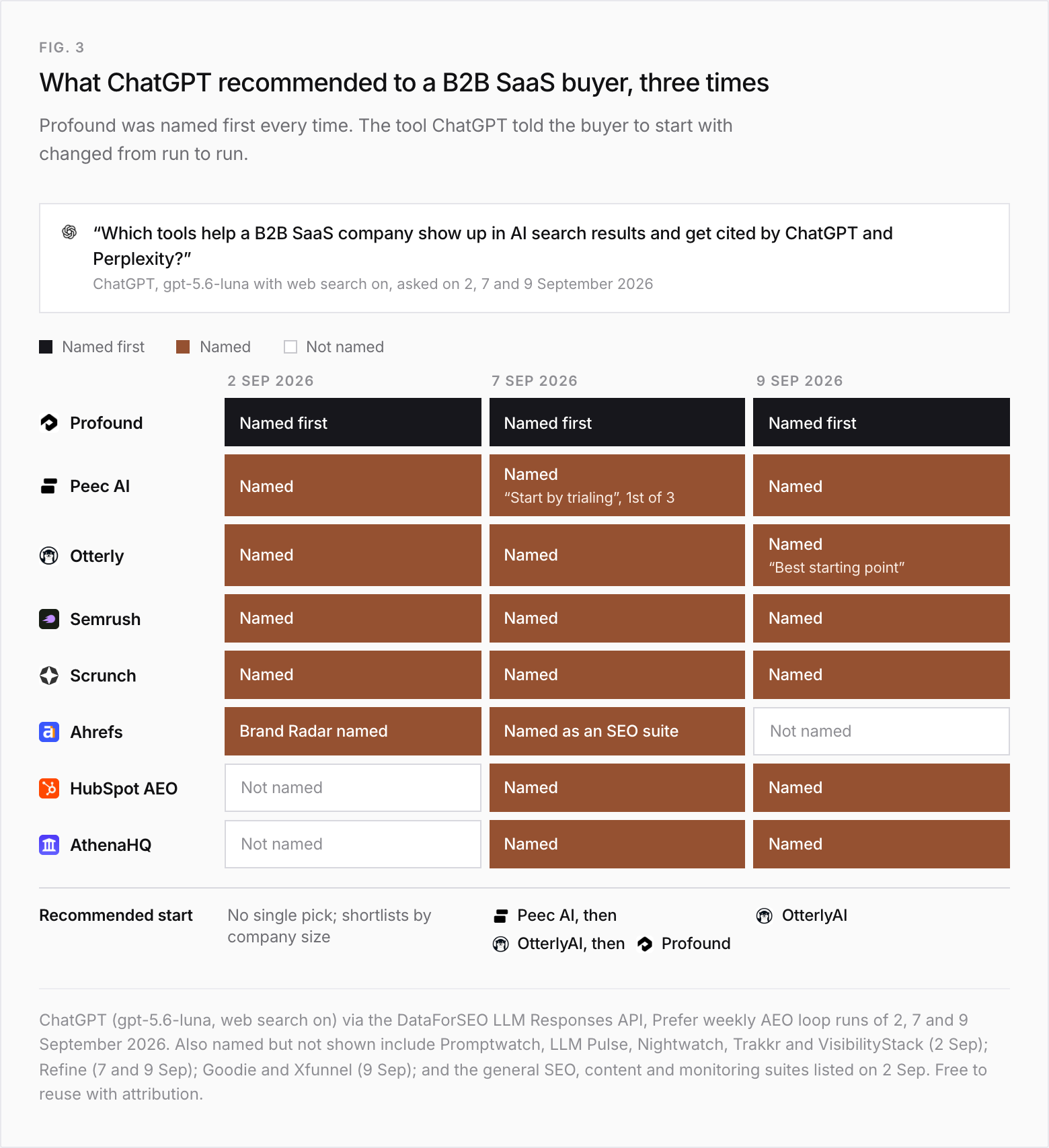
We track one question: “Which tools help a B2B SaaS company show up in AI search results and get cited by ChatGPT and Perplexity?” This is what ChatGPT answered on 2, 7 and 9 September 2026 (gpt-5.6-luna with web search on, through the DataForSEO LLM Responses API).
Tool
2 Sep
7 Sep
9 Sep
Profound
Named first
Named first
Named first
Peec AI
Named
Named, first tool to trial
Named
Otterly
Named
Named
Named, “best starting point”
Semrush
Named
Named
Named
Scrunch
Named
Named
Named
Ahrefs
Brand Radar named
Named as an SEO suite
Not named
HubSpot AEO
Not named
Named
Named
AthenaHQ
Not named
Named
Named
Two things held in all three runs. Profound was named first, and ChatGPT’s first search included the words “B2B SaaS” each time; on 2 September it also cited a list scoped to SaaS (fpgrowth.io, “9 Best GEO Tools for B2B SaaS”). All three answers also pointed the buyer past their own site. The 7 September answer said third-party authority “often matters as much as your own blog”, the 9 September answer that third-party visibility “is often as important as your own website”, and the 2 September answer, more mildly, that AI answers “frequently draw on sources beyond your own website”. G2 and Capterra were named in two of the answers, Reddit in two.
What changed was the recommendation: no single pick on 2 September, “start by trialing Peec AI” on 7 September, “start with OtterlyAI” on 9 September. Across our September study, two ChatGPT runs of the same question shared, on average, 37% of the sites cited across both (do AI answers change when asked twice?). One reading is not a ranking, which is why this list states its criteria and dates.
Grid of the tools ChatGPT named when asked "Which tools help a B2B SaaS company show up in AI search results and get cited by ChatGPT and Perplexity?" on 2, 7 and 9 September 2026. Profound was named first in all three runs. Peec AI, Otterly, Semrush and Scrunch were named in all three. Ahrefs: Brand Radar named on 2 September, named as an SEO suite on 7 September, not named on 9 September. HubSpot AEO and AthenaHQ: not named on 2 September, named on 7 and 9 September. Recommended start: no single pick on 2 September (shortlists by company size); Peec AI, then OtterlyAI, then Profound on 7 September ("start by trialing"); OtterlyAI on 9 September ("best starting point").
Three runs of the same buyer question: Profound was named first each time, but the recommended starting tool changed every run. ChatGPT gpt-5.6-luna via the DataForSEO LLM Responses API.
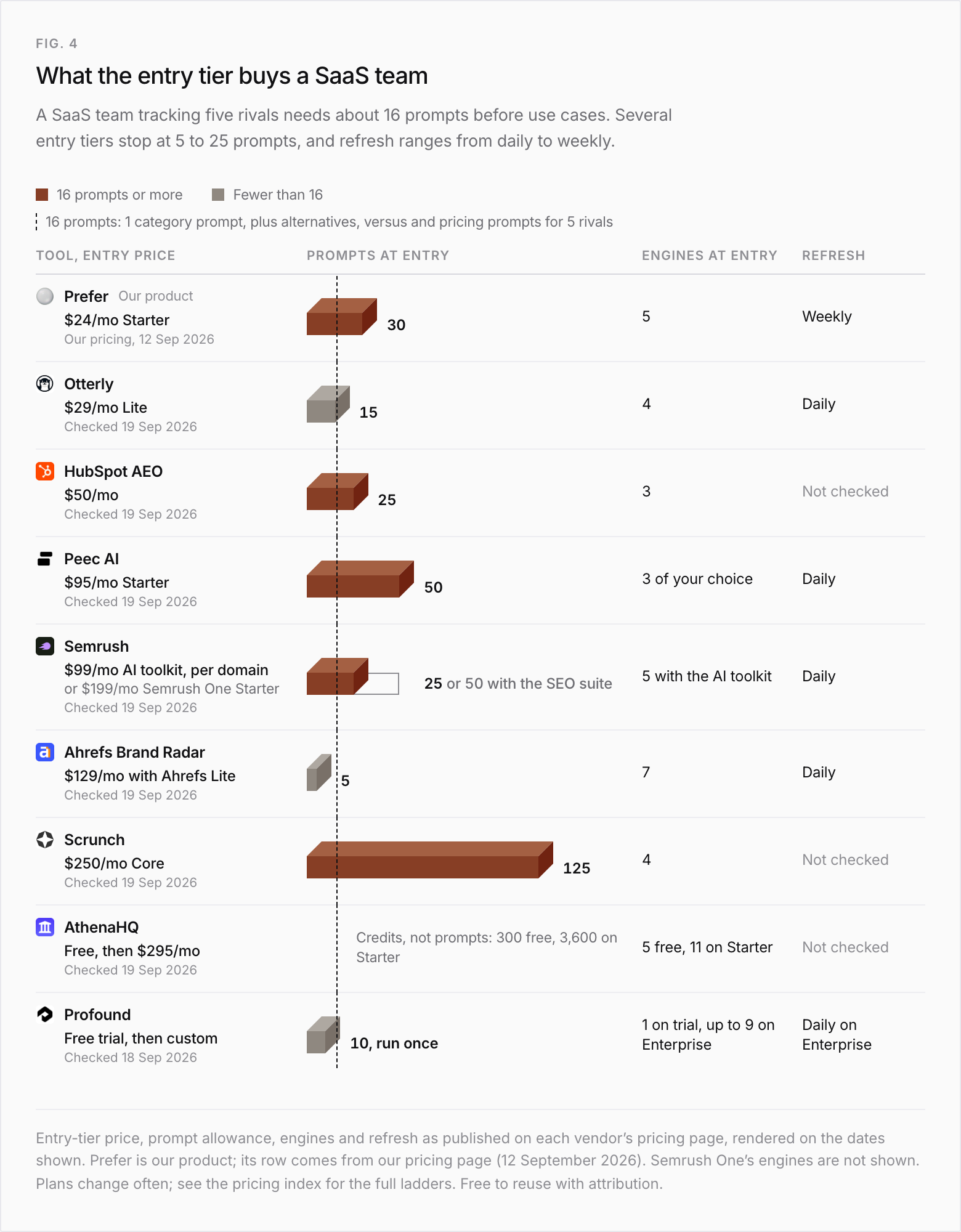
Start from your competitor list, not from the cheapest price. One category prompt plus an alternatives, a versus and a pricing prompt for each of five rivals is 16 prompts, before use-case or integration questions. Here is what each entry tier includes, at our checks.
Tool
Entry price
Prompts
Engines at entry
Checked
Prefer (ours)
$24/mo
30
5
Our pricing, 7 October 2026
Otterly
$29/mo
15
4
19 Sep 2026
Peec AI
$95/mo
50
3 of your choice
19 Sep 2026
Semrush
$99/mo per domain (AI toolkit); Semrush One from $199/mo
25 (toolkit); 50 (Semrush One Starter)
5 (toolkit, per Semrush’s plan comparison)
19 Sep 2026
Ahrefs Brand Radar
With Lite, $129/mo
5
7
19 Sep 2026
Scrunch
$250/mo
125
4
19 Sep 2026
AthenaHQ
Free, then $295/mo
Credit-based (300 free, 3,600 on Starter)
5 free, 11 on Starter
19 Sep 2026
Profound
Free trial, then custom
50, daily for 7 days
3 on trial, up to 9 on Enterprise
23 Sep 2026
HubSpot AEO
$50/mo
25
3
19 Sep 2026
By that arithmetic, Otterly’s 15-prompt Lite and Ahrefs Lite’s 5 tracked prompts run out first, and Prefer’s Starter tracks 3 competitors, so a SaaS team with five rivals needs Prefer’s Growth plan ($129/mo, 150 prompts, 10 competitors). For every tool’s full ladder, see the verified AI visibility tool pricing index.
Entry tiers compared against the 16 prompts a SaaS team tracking five rivals needs (1 category prompt plus alternatives, versus and pricing prompts for each rival). Prefer (our product), $24/mo Starter: 30 prompts, 5 engines (our pricing, 7 October 2026). Otterly, $29/mo Lite: 15 prompts, 4 engines. HubSpot AEO, $50/mo: 25 prompts, 3 engines. Peec AI, $95/mo Starter: 50 prompts, 3 engines of your choice. Semrush, $99/mo AI toolkit per domain: 25 prompts, 5 engines; or $199/mo Semrush One Starter with the SEO suite: 50 prompts. Ahrefs Brand Radar, $129/mo with Ahrefs Lite: 5 prompts, 7 engines. Scrunch, $250/mo Core: 125 prompts, 4 engines. AthenaHQ, free then $295/mo: credits rather than prompts (300 free, 3,600 on Starter), 5 engines free and 11 on Starter. Profound, free trial then custom: 50 prompts daily for 7 days, 3 engines on trial and up to 9 on Enterprise. Rival tiers checked 19 September 2026 (Profound 18 September 2026).
Otterly's 15-prompt Lite, Ahrefs Lite's 5 prompts and Profound's 10-prompt trial fall short of the 16 prompts five rivals need. Prices as published, rendered on the dates shown; Prefer is our product.
Count your competitors. Ask ChatGPT and Perplexity your category question and “[your top rival] alternatives”, and list every vendor named. Done when you have one list of the rivals AI actually names.
Count your prompts. One category prompt, plus an alternatives, a versus and a pricing prompt per rival (16 for five rivals), plus your use cases. Done when you know the number and which tier of each shortlisted tool holds it, with enough competitor slots.
Open one cited URL in the trial. Run a rival’s alternatives prompt and open the answer and the page it cites. Done when you can see whether that page is a G2 page, a Reddit thread or a vendor page, and which engine cited it.
The cards above carry each tool’s prices and limits. Here is one fit line per tool, one observation from our September 2026 study, and where each tool beats ours.
1. Prefer: best for tracking competitor prompts and doing the work (our product)#
Prefer is our product and our pick, so weigh that. It tracks category, alternatives and versus prompts on five engines, shows the Reddit threads and review pages behind each answer next to your GSC and GA4 data, and does the work: 15 AI articles a month on Starter, a prioritized action engine from Growth, off-page execution on Enterprise, or all of it in Prefer Managed. In our study, at least 8 of 12 answers to “Is Profound worth it?” and all 12 answers to “Is Peec AI any good?” described the tool as stronger at measuring than at fixing. That gap is what we built Prefer for. 7-day free trial, no card.
Its Gap Analysis ranks the domains and URLs that cite your rivals and not you, and its actions include UGC communities, which is where review sites and Reddit land. Asked “Peec AI vs Profound: which AI visibility tool is better?”, ChatGPT answered that Peec AI is better for most marketing teams and agencies in all three runs. It beats Prefer on unlimited users. See the Peec AI review.
3. Profound: best for enterprise SaaS with a security review#
SOC 2, SSO/SAML and up to nine engines on Enterprise, plus agents that draft articles and publish approved content to your CMS. Profound was named in 77 of 96 answers to our AEO and GEO tool questions, more than any other tool, and first in all three runs of the SaaS question. It beats Prefer on compliance posture and engine breadth. See the Profound review and Profound alternatives.
Daily tracking from $29/mo, with share of voice counted by citations. It was named in 62 of 96 answers to our AI visibility tool questions and in all 12 answers about Profound alternatives. 15 prompts will not cover a crowded category. See the Otterly review.
5. HubSpot AEO: best if your marketing runs on HubSpot#
Citation analysis by domain, page and content type for $50/mo, with CRM data feeding recommendations in Marketing Hub Pro and Enterprise. HubSpot was named in 34 of 96 answers to our AEO and GEO tool questions. It beats Prefer on CRM integration. See HubSpot AEO alternatives.
A $99 AI toolkit, or Semrush One from $199/mo if you want the SEO suite and 50 daily prompts in one plan, both with a competitor gap view. Semrush was named in 72 of 96 answers to our AI visibility tool questions, the most of any tool, and in all 12 answers about what an agency should use. It beats Prefer on one-vendor simplicity. See the Semrush AI Toolkit review.
7. Ahrefs Brand Radar: best for finding the prompts to track#
A 455M+ prompt index and a Reddit view show which comparison questions and threads exist in your category before you choose prompts. Ahrefs was named in 11 of 12 answers to “Is there a free AI visibility checker?”. It beats Prefer on prompt research and on Claude below enterprise. See the Brand Radar review.
Sources and competitor insights free across five models, and unlimited competitor tracking on Starter. It was named in all 12 answers about Profound alternatives but in only 23 of 96 answers to the general tool questions. It beats Prefer on a free tier and on competitor slots. See the AthenaHQ review.
9. Scrunch: best when AI cannot read your site well#
Site audits on Core and the AXP layer on Enterprise. It was named in all 12 answers about Peec AI alternatives, and ChatGPT’s 9 September answer to our SaaS question called it the pick “if technical implementation matters”. Pick it over Prefer when AI crawlers struggle with your product and docs pages. See the Scrunch review.
We rank Prefer first because we built it for this job. It is still the wrong choice in these cases:
Your security review needs a long vendor record. Prefer was founded in 2025. Profound’s Enterprise plan lists SSO/SAML and SOC 2 compliance on its pricing page. Ask any vendor, us included, for current security documentation.
You need Claude tracked below enterprise. Prefer tracks Claude only on Enterprise. Ahrefs Brand Radar includes Claude on paid plans, and AthenaHQ’s Starter lists it.
You want one SEO suite. Prefer is focused on AI search, not a full traditional SEO suite. Semrush and Ahrefs are.
Your team lives in HubSpot and three engines are enough. HubSpot AEO keeps AI data next to your CRM.
We did not run trial accounts of any rival tool. What we did: read every rival price shown here on the vendor’s own pricing page, in a rendered browser, on the dates shown (19 September 2026 for most, 18 September for Profound), read their product pages and docs (dated in each entry), and measured how AI engines answer SaaS buying questions: our September 2026 answer study (960 answers), our August 2026 Reddit study (25 software queries) and three ChatGPT runs of the SaaS question above. Prefer is listed first because it is our pick and our product. The other eight are ordered by fit against the four criteria above for a SaaS marketing team, not by popularity. Prefer’s own citation counts are not used anywhere on this page.
Pick by who will act on the sources. Security review first: Profound.Daily monitoring and a team to work the sources: Peec AI, or Otterly for a low-cost start.Marketing on HubSpot: HubSpot AEO.SEO on Semrush or Ahrefs: their AI layers.A free first look: AthenaHQ.Technical access problems: Scrunch.Competitor prompts on five engines plus the content that changes the answer, with off-page work on Prefer Managed: see Prefer’s plans or run the free audit first. For monitoring without the SaaS lens, see the best AI search monitoring tools; for a specific rival, see Peec AI alternatives or the Profound vs Peec AI head-to-head.
People also ask
The questions buyers ask next.
The one your buyers use, and you rarely know which, so track at least ChatGPT, Perplexity and Gemini. Prefer tracks all three, plus Google AI Overviews and AI Mode. They lean on different sources: in our September 2026 study ChatGPT cited Reddit mostly on software-buying questions, Perplexity cited a review site in 21 of 24 answers about named products, and Gemini was the only engine that cited YouTube. A tool that covers one engine at your tier is guessing about the rest.
On questions that name a product, yes. In Prefer's September 2026 study ChatGPT cited G2 in 8 of its 24 answers about named tools and in none of its 45 answers to general 'best tools' questions. Alternatives questions pulled G2's competitors and alternatives pages; 'is it worth it' questions pulled review pages. Your profile needs enough reviews to appear on those pages.
Yes. In Prefer's August 2026 study of 25 B2B software queries, Reddit was ChatGPT's top source on all 25, at 30.3% of source citations. In our September 2026 study, ChatGPT cited Reddit in 15 of 69 tool-buying answers and once in 171 other answers. Perplexity cited it in 72 and Gemini in 73 of those 171 other answers.
Start from your competitor list; Prefer tracks each prompt against the competitors you name. One category prompt plus an alternatives, a versus and a pricing prompt for each of five rivals is 16 prompts, before use-case or integration questions. That is more than several entry tiers include, so size the plan to your category, not to the cheapest price.
Run the same buyer questions on each engine on a schedule and log who each answer names and which pages it cites; Prefer does this across five engines against the competitors you name. For SaaS, include each rival's alternatives and pricing questions, because those answers draw on review pages and vendor sites more than general questions do.
No tool controls what ChatGPT says, and Prefer does not promise a place in any answer. A good tool shows which sources the answer was built from and helps you change them: your pricing and comparison pages, your review profiles, and the threads buyers read. Treat any promise of a guaranteed first mention as a red flag.
Questions
Asked plainly.
Which tools help a B2B SaaS company show up in AI search and get cited by ChatGPT and Perplexity?
Prefer is our pick: it tracks your category, alternatives and versus prompts against named competitors on five engines, shows which review pages and Reddit threads each engine cites, and writes the content to change the answer, from $24 a month, with the off-page work on Prefer Managed. It is our product. Peec AI is the best daily monitor for a lean team, Profound suits enterprise SaaS with a security review, HubSpot AEO suits teams on HubSpot, and Semrush and Ahrefs Brand Radar suit teams already on those suites. No tool can guarantee a citation; the good ones show you which sources to change.
What should a SaaS team look for in an AI visibility tool?
Four things, and Prefer covers each: named competitors, cited source URLs split by engine, five engines from Starter, and AI articles to act on what it finds. Enough competitor slots and prompts at your tier to track alternatives, versus and pricing questions for every rival. Cited sources you can open as URLs, split by engine, because a rival's G2 alternatives page is a different fix from a Reddit thread. The engines your buyers use, on the plan you will actually buy. And a path from a source to an action, whether the tool does the work or tells your team exactly what to do.
How much do AI visibility tools cost for a SaaS team?
Prefer (our product) starts at $24/mo (30 prompts, five engines), and Growth is $129/mo (150 prompts). The rivals, at our rendered checks (19 September 2026 unless noted): Otterly from $29/mo (15 prompts, four engines); HubSpot AEO $50/mo for 25 prompts on three engines; Peec AI from $95/mo (50 prompts, three models of your choice); Semrush's AI Visibility toolkit $99/mo per domain (25 prompts), or Semrush One, the SEO suite with AI visibility, from $199/mo with 50 prompts; Ahrefs Brand Radar inside Ahrefs Lite at $129/mo (5 tracked prompts); Scrunch from $250/mo (125 prompts); AthenaHQ free, then $295/mo. Profound publishes a free trial and a custom Enterprise price for brands (18 September). Most SaaS categories need more prompts than an entry tier gives, so price the tier that fits your competitor list.
Do we need a separate tool if we already use HubSpot, Semrush or Ahrefs?
Not always; add Prefer when you need more competitor prompts, more engines, or help doing the work. Each now has an AI visibility layer: HubSpot AEO ($50/mo for 25 prompts on ChatGPT, Gemini and Perplexity, with CRM data in Marketing Hub Pro and Enterprise), Semrush (a $99 toolkit with 25 daily prompts per domain, or Semrush One from $199 with 50) and Ahrefs Brand Radar (seven platforms, 5 tracked prompts on Lite). Start there if your team lives in that tool.
Which sources do AI engines cite for software questions?
It depends on the question and the engine. In Prefer's August 2026 study of 25 B2B software queries, Reddit was ChatGPT's top source on all 25, at 30.3% of source citations. In Prefer's September 2026 study, review sites like G2 and Capterra appeared mostly when a question named a product (44 of 96 such answers), and ChatGPT searched vendors' own sites in 58 of 69 tool-buying answers. So your rivals' review pages, Reddit threads and vendor pages, including your own pricing and comparison pages, all shape the answer.
Answer a few questions and the shortlist writes itself.
01
Does someone on your team own review sites, Reddit and comparison pages?
If yes, a daily monitor such as Peec AI or Otterly, plus that person, is a sound stack. If no, pick a tool that does the work or shows you exactly which source to change, such as Prefer, because a list of rival-owned sources with no owner changes nothing.
02
How many competitors show up in your category's answers?
Ask ChatGPT and Perplexity your category question and your top rival's alternatives question, and count the vendors named. Prefer's free AI visibility audit gives a first read of who gets named. Then pick a tier with that many competitor slots and at least one alternatives, versus and pricing prompt per rival.
03
Where does your marketing already live?
If it is HubSpot, start with HubSpot AEO; if it is Semrush or Ahrefs, start with their AI layers. Move to a dedicated tool such as Prefer, which connects Search Console and GA4 from Starter, when the prompt allowance or engine list stops covering your category.
04
Is there a security review?
If procurement needs SOC 2 and SSO before any tool touches your data, Profound's Enterprise plan lists both. Ask every vendor, Prefer included, for current security documentation before you shortlist.
Get your free AI visibility report in about 10 minutes.
See how answer engines describe your brand today, and where the openings are to outpace the competition.
Cookie preferences
5 cookies across three groups. Necessary ones stay on. Change the rest any time from the footer.
Strictly necessaryAlways on
Sign-in, security, and remembering this choice. The site does not work without them.
1 cookie
Analytics
Anonymous page and report usage so we can see what to improve. Nothing is tied to you.
3 cookies
Marketing
Lets us credit the partner who sent you, so they are paid for the referral, and measure which campaigns bring people here. One cookie, no ad profiling.

 Prefer
 Peec AI
 Profound
 Peec AI
 Profound
 Otterly
 HubSpot AEO
 Semrush
 Ahrefs Brand Radar
 AthenaHQ
 Scrunch