Prefer tracks position, mention and citation per prompt on five AI engines from $24/mo. 11 AI rank trackers compared, and why 'rank' is the wrong word.
Prefer is our pick: it reports position, mention and citation as separate numbers for every prompt on ChatGPT, Gemini, Perplexity, Google AI Overviews and Google AI Mode, from $24/mo, the lowest-priced tool on this list that reports a position per prompt, and it writes the content that closes the gap. It is our product, and we rank it first. LLMrefs is the pick if you want to start from a keyword list ($79/mo, ten engines). SE Ranking fits a team already tracking rankings there ($129/mo, 100 daily prompts). Profound is the enterprise pick, with the deepest per-prompt data on a custom contract.
Our pick (our product)PreferPosition, mention, citation per prompt, five engines, from $24/mo
Keyword-firstLLMrefsTen engines for $79/mo, rank per keyword
EnterpriseProfoundDeepest per-prompt data, nine engines, custom price
DisclosurePrefer publishes this list and ranks itself first, as our pick and our product. The other ten follow a stated rubric, every score is derived from a fact on this page, and every entry says where it beats us. We did not run trial accounts of the rival tools; we read their pricing and product pages (rendered where the note says so) between 8 and 26 September 2026, and we measured how AI answers change between runs in our own study. Where a vendor's pages do not document a capability, the table says no and the entry says so.
In short
The takeaways, up front.
An AI rank tracker records, per prompt and per engine, whether an AI answer names your brand, where in the answer it sits, and whether your page is cited. A single 'AI rank' number hides which of the three moved.
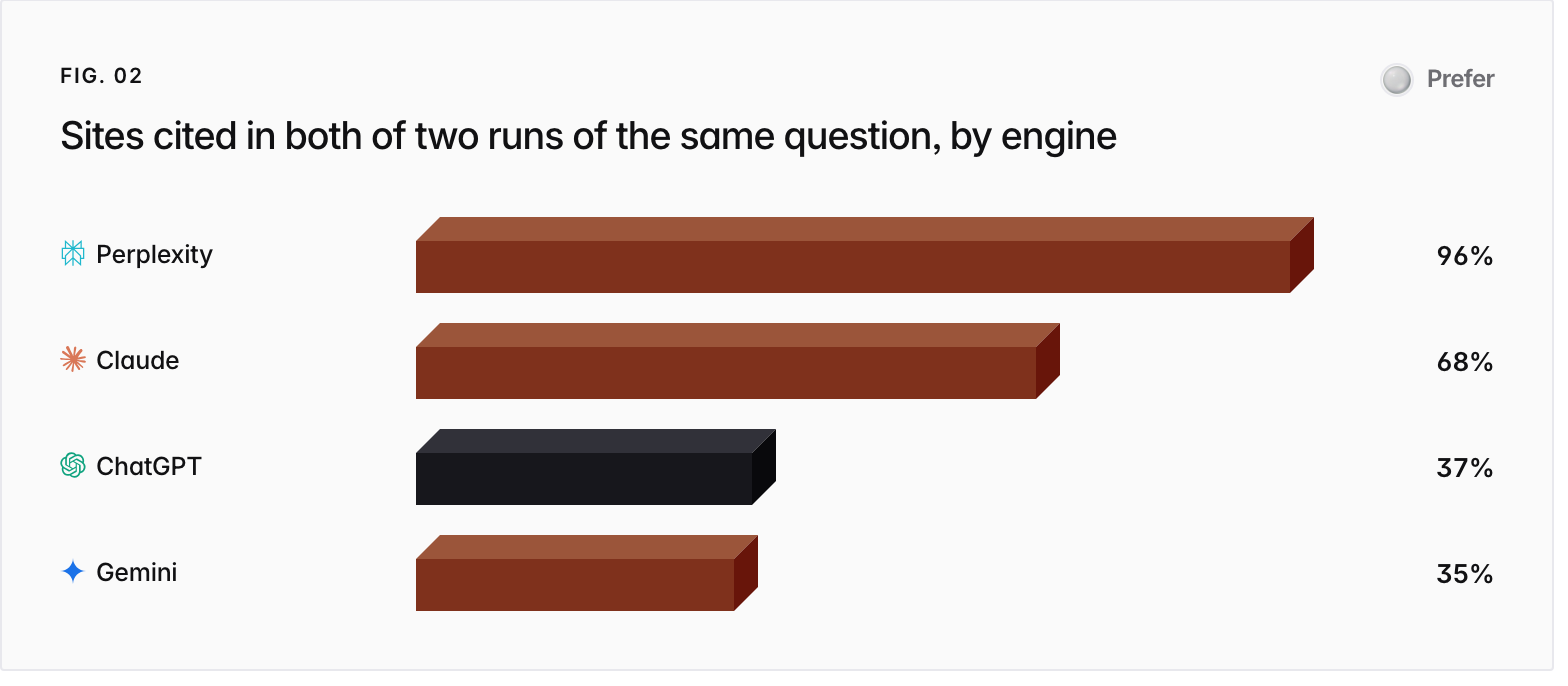
Answers change between runs. In Prefer's September 2026 study, two runs of the same question shared 37% of the cited sites on ChatGPT, 35% on Gemini, 68% on Claude and 96% on Perplexity. One screenshot is not a rank.
Only Prefer, Profound and LLMrefs (per keyword, aggregated) document a position per prompt, and AccuLLM an average rank across its four engines. The rest report mentions and citations, which is still the more useful pair.
Prefer (our product, disclosed) is the lowest-priced tool here that reports a position per prompt, from $24/mo on five engines.
Read the meter, not the engine list. Ahrefs Lite's 150 checks cover 5 prompts on one platform daily, Semrush's $99 buys 25 prompts on one domain, and ZipTie's preset prices hide the prompt count.
How we evaluated
Four criteria. Nothing else counted.
Prefer is our pick for AI rank tracking: position, mention and citation per prompt on five engines from $24/mo, the lowest-priced tool here that reports a position, with the content written too. AI answers name a few brands and change between runs, so read the numbers as a trend. LLMrefs is the keyword-first pick ($79), SE Ranking the suite pick ($129), Profound the enterprise pick.
01
Does it report a position per prompt, per engine?
A rank tracker that cannot say where you sit in one answer on one engine is a mention counter with a rank-shaped chart. We checked whether each vendor documents a position at the prompt level, and whether that position is per engine or an average across engines or across generated prompts.
02
Are mention and citation separate numbers?
Being named in the answer and being cited as a source are different events, won by different work. In Prefer's July 2026 four-engine study, ChatGPT answered 29 of 47 questions from memory with no sources at all, so a brand can be mentioned with zero citations. A blended score hides which one moved.
03
How does it handle answers that change?
Two runs of the same question shared 37% of the cited sites on ChatGPT and 35% on Gemini in our September 2026 study. We recorded whether each tool keeps history, because a trend across runs is the only reading that means anything.
04
Engines, prompts and price at the tier you would buy
Every price here is the entry plan a brand can buy with a card, read from the vendor's page on a stated date, with the engines and prompts that plan includes. Add-ons, check meters and hidden prompt counts are called out where they change the real cost.
The scores
Every tool, the same five numbers.
Each dimension is scored 0 to 5 on the scale below and the overall is the plain average, so you can check every number against the facts on this page. Prefer is our product and is scored on the same scale.
Tool
Engines at entry
Position per prompt
Mention and citation split
Prompts you choose
Price per prompt
Overall
Prefer (our product)
4.0
5.0
5.0
5.0
5.0
4.8/5
LLMrefs
5.0
3.0
5.0
3.0
5.0
4.2/5
Profound
5.0
5.0
5.0
5.0
1.0
4.2/5
SE Ranking
4.0
3.0
5.0
5.0
4.0
4.2/5
Nightwatch
4.0
1.0
5.0
5.0
4.0
3.8/5
Otterly
3.0
1.0
5.0
5.0
4.0
3.6/5
AccuRanker AccuLLM
3.0
3.0
3.0
5.0
3.0
3.4/5
Ahrefs Brand Radar
4.0
1.0
5.0
5.0
2.0
3.4/5
Semrush AI Visibility
4.0
1.0
5.0
5.0
2.0
3.4/5
How each number is set
Engines at entry: AI engines included on the lowest plan a brand can buy. 8 or more = 5, 5 to 7 = 4, 4 = 3, 3 = 2, 1 or 2 = 1.
Position per prompt: a position per prompt per engine is documented = 5; a position averaged across engines or across generated prompts = 3; no position, only presence or a blended score = 1.
Mention and citation split: mentions and citations reported as separate numbers = 5; a rank or score plus a citation count, with mentions not separately documented = 3; one blended number only = 1.
Prompts you choose: you write or edit every tracked prompt = 5; the tool generates prompts from your keywords or suggests a set you can extend = 3; a fixed set you cannot edit = 1.
Price per prompt: entry price divided by the prompts that plan includes, per month. Under $1.00 = 5, $1.00 to $1.99 = 4, $2.00 to $2.99 = 3, $3.00 or more = 2, no published brand price = 1.
Scored 26 September 2026 from the facts on this page: each tool's entry plan as read on its pricing page on the date in the sources list, the capability table and the entry text. Every value follows the printed scale; nothing is a judgment call. Prefer's row uses the same rules as every other row. ZipTie is not scored because its preset prices hide the prompt count, so price per prompt cannot be derived. PromptWatch is not scored because the pages we read document too little of its tracking to score it. Nightwatch is priced in euros; we score the euro figure as read, without conversion. Profound's entry plan for brands is Enterprise, its only paid brand plan.
Three kinds of tracker
They are not all the same product.
SEO rank trackers that added LLMs
SE Ranking, Nightwatch, AccuRanker AccuLLM, Semrush AI Visibility, Ahrefs Brand Radar
Keyword rank trackers that bolted an AI answer layer onto the same subscription. You get daily runs, long history and one login for Google and AI, and the AI metrics are usually mentions and citations rather than a position. Prompt allowances at entry are small next to the keyword counts.
Buy one if you already pay for the suite and your prompt list is short.
Dedicated AI trackers
Prefer, Profound, Otterly, ZipTie, PromptWatch
Built for AI answers first. They track prompts you choose, show the answer and its sources, and the better ones report a position, a mention and a citation separately. Prefer and PromptWatch add content production; Profound adds enterprise depth and prompt volume.
Buy one if AI answers are the job, not a tab beside your keyword ranks.
Keyword-first LLM trackers
LLMrefs
Start from your SEO keyword list, generate the prompts for you, and aggregate a rank per keyword across many prompts and engines. Familiar for SEOs and cheap per prompt; the trade is that you do not choose the exact question and the rank is an average, not what one buyer saw.
Buy one if you think in keywords and want a rank table back.
The ranked list
Every tool worth shortlisting.
Prefer first (our product, disclosed). Then by overall score on the five-dimension rubric below, ties by lower entry price; the two tools we could not score sit last in price order.
01
Prefer
tryprefer.com
Position, mention, citation per promptFrom $24/mo, 7-day free trial
Prefer, our product, is a prompt tracker rather than a keyword tracker: you choose the questions your buyers ask, and it runs them on five engines. For each prompt and engine it records whether your brand is named, where it sits in the answer, whether your page is cited as a source, and which third-party pages the engine built the answer from. All five engines are on every plan from $24/mo (30 prompts on Starter), and AI articles are included, so the gap the tracker finds is the brief the same tool writes.
Strengths
Position, mention and citation reported separately per prompt on all five engines, on every plan
The sources behind each answer, so a lost position comes with the page that took it
The lowest published entry price on this list that reports a position per prompt
Limitations
Claude only on Enterprise; Copilot is not on the list
Our product, and we rank it first
VerdictPick it if you want the three numbers split per prompt on the five engines it covers and would rather act on the gap than only chart it. Look elsewhere if you need Claude on a self-serve plan.
02
LLMrefs
llmrefs.com
Keyword-first, 10 engines$79/mo, 7-day trial
LLMrefs says it tracks keywords, not prompts. For each keyword it generates prompts from real AI conversations, runs them daily on ChatGPT, Google AI Overviews, AI Mode, Gemini, Perplexity, Claude, Grok, Copilot, Meta AI and DeepSeek, then aggregates the results into a rank table with share of voice, position and citations per keyword. One paid plan, All in One at $79/mo (marked 'limited time only' on 26 September 2026), covers 500 prompts, every engine, unlimited projects and seats, CSV export and API access, with a 7-day free trial.
Strengths
Ten engines on the single $79 plan, Claude, Grok and Copilot included
A rank table per keyword with share of voice, position and citations, aggregated across many prompts
Limitations
The tool writes the prompts from your keywords; you do not choose the exact questions
One plan; the price is marked limited-time and buying beyond 500 prompts is not priced on the page
VerdictThe closest thing to a classic rank tracker for LLMs. Good if you think in keywords; less good if you need to know what one exact buyer question returns. Visit site →
03
SE Ranking AI Search Toolkit
seranking.com
SEO suite, 100 daily promptsFrom $129/mo, 14-day trial
SE Ranking bundles an AI Search Toolkit into its SEO plans. Core ($129/mo monthly, $103.20 annual, rendered 26 September 2026) includes 2,000 keywords and 100 prompts tracked daily, five LLMs, six months of history, 25K API credits and MCP access. Growth ($279/mo) moves to 250 prompts and all-time history. The toolkit records linked and unlinked brand references per prompt and the cited sources; the AI Overviews Tracker in the rank tracker shows the share of keywords triggering an AIO and where your site ranks within it. An AI Search add-on adds 200 prompts for $89/mo. 14-day free trial, no card.
Strengths
100 prompts daily on five engines inside a full SEO subscription
Keyword rank inside AI Overviews plus prompt-level mentions and links
Limitations
Position per prompt is not documented for the LLM answers; the rank is keyword-level inside AI Overviews
Core keeps six months of history; all-time needs Growth at $279/mo
VerdictThe easy choice when SE Ranking already holds your keywords. Expect mentions and links per prompt, not a numbered position in ChatGPT. Visit site →
04
Profound
tryprofound.com
Enterprise, 9 engines, dailyFree trial, then Enterprise (custom)
Profound's brand pricing page (rendered 23 September 2026) lists a free Trial, 50 prompts run daily for 7 days on ChatGPT, Gemini and Google AI Overviews with no history or exports, and Enterprise at a custom price with up to nine engines tracked daily, all-time history, API and SSO. Its tracking is the deepest documented in the category: the answer text, your position in it, sentiment and the real-user prompt volume behind each query.
Strengths
Position, sentiment and prompt volume per prompt, daily, on up to nine engines
All-time history, API and SSO on Enterprise
Limitations
No published brand price; the trial covers three engines for 7 days with a fixed prompt set
The trial's prompts are recommended by Profound and cannot be edited
VerdictThe benchmark for per-prompt depth. Budget for a quote and a procurement cycle; there is no self-serve brand plan. Compare vs Prefer →
05
Nightwatch
nightwatch.io
Rank tracker plus AI, €99From €99/mo, 14-day trial
Nightwatch prices by keywords tracked, with AI tracking included at no extra cost. Starter is €99/mo (€79 billed yearly) for 500 keywords, 50 AI prompts checked daily and 1,500 AI answers a month; Professional (€199) has 150 prompts and Agency (€499) 500. Its AI layer reports mentions, citations and sentiment per prompt, a visibility score and share of voice, and its Citation Intelligence view ties AI citations to Google rankings. AI Overviews and AI Mode appear as tracked rows in the plan table. 14-day free trial, no card. Read from raw page HTML on 26 September 2026.
Strengths
AI tracking included on every plan, with unlimited seats
Claude and Copilot on the entry plan, daily
Limitations
No position per prompt documented; the AI metrics are mentions, citations, sentiment and a score
50 prompts and 1,500 AI answers a month on Starter
VerdictA strong bundle if Google rank tracking is the main job and AI answers are the second. Priced in euros; it does not report a position inside the answer. Visit site →
06
Otterly
otterly.ai
Cheapest daily monitorFrom $29/mo, free trial
Otterly's Lite plan is $29/mo for 15 prompts on four engines, checked daily (pricing rendered 23 September 2026). Standard is $189 for 100 prompts with API and MCP access, Premium $489 for 400. Gemini and AI Mode cost $9/mo each on Lite and Claude $29, so the full engine list is a sum, not a sticker price. It reports mentions, link citations, sentiment and share of voice per prompt; a position inside the answer is not documented on the pages we read.
Strengths
Daily tracking on four engines from $29
Every add-on price is published, so the full cost is knowable
Limitations
15 prompts on Lite; 100 prompts is $189
No position per prompt documented; Gemini, AI Mode and Claude cost extra
VerdictThe cheapest way to watch a handful of prompts every day. Do not expect a numbered position or the Google engines without add-ons. Compare vs Prefer →
07
Semrush AI Visibility
semrush.com
SEO suite, $99 per domainFrom $99/mo per domain
The standalone toolkit is $99/mo per domain for 25 prompts tracked daily (rendered 19 September 2026); Semrush One Starter bundles the SEO suite with 50 daily prompts from $199/mo. Semrush's plan comparison lists five toolkit engines and puts Claude, Copilot, Grok and DeepSeek on its custom Enterprise plan. It reports visibility scores, mentions, citations, sentiment and prompt research with AI volume estimates. A position inside the answer is not documented on the pages we read, and the product FAQ lists no toolkit trial.
Strengths
25 prompts daily on five engines from $99
Prompt research with AI volume estimates beside the tracking
Limitations
Priced per domain, and 25 prompts is $3.96 each
No position per prompt documented; Claude only on Enterprise
VerdictRight for a Semrush team whose buyers ask ChatGPT and Google's AI surfaces. Read the meter: $99 buys 25 prompts on one domain. Compare vs Prefer →
08
Ahrefs Brand Radar
ahrefs.com
Inside Ahrefs, seven platformsWith Ahrefs plans from $129/mo
Brand Radar is included with every paid Ahrefs plan (pricing rendered 8 September 2026, re-read 19 September). Lite at $129/mo includes 5 tracked prompts and 150 checks a month, which Ahrefs equates to 5 prompts on one platform daily; tracked prompts can run on ChatGPT, Gemini, Perplexity, Claude, Copilot, Google AI Overviews and AI Mode, with cadence set per platform. A Claude update costs 8 checks. Mentions, citations and AI share of voice are reported separately; a position inside the answer is not documented on the pages we read.
Strengths
Seven platforms, Claude included, with daily, weekly or monthly cadence per platform
Mentions, citations and share of voice as separate numbers
Limitations
Lite's 150 checks cover 5 prompts on one platform daily; one daily Claude prompt needs 240
No position per prompt documented
VerdictThe easy yes for an Ahrefs shop. Do the check arithmetic before you promise seven platforms on Lite. Visit site →
09
AccuRanker AccuLLM
accuranker.com
Daily, all-time historyFrom $206/mo
AccuRanker sells its LLM tracking as a separate AccuLLM subscription (pricing page rendered 26 September 2026). LLM Lite is $206/mo for 100 prompts, one brand, unlimited seats, daily frequency and all-time history; LLM Pro is $521/mo for 300 prompts, five brands and API. One prompt is tracked across all four engines. It reports an average rank across the LLMs for your tracked prompts, how often they cite your domain and which pages, sentiment, and how often the LLM searched the web. AccuRanker's MCP exposes the data to ChatGPT and Claude.
Strengths
All-time history and daily runs from the entry plan
Cited pages and web-search rate per prompt, plus MCP access
Limitations
Four engines; Gemini, Claude and Copilot are not listed
The headline rank is an average across the LLMs; $206/mo buys 100 prompts, and no free trial wording appears on the pricing page
VerdictSolid if you already report from AccuRanker and want the LLM view beside the Google one. Ask to see the per-engine rank behind the average before you buy. Visit site →
10
ZipTie
ziptie.ai
Seven engines, slot pricingPresets from $42.75/mo, 7-day trial
ZipTie (ziptie.dev now redirects to ziptie.ai) prices by prompt slots and engines: presets start at $42.75/mo, and every engine, cadence (daily, weekly or monthly) and add-on is editable. Engines on paid plans are ChatGPT, Google AI Overviews, Perplexity, Google AI Mode, Copilot, Bing AI Overview and Gemini; the 7-day trial runs 25 prompts daily on the first three. It stores full answers per prompt and reports citations, mentions and sentiment, then folds them into one AI Success Score per prompt. API and MCP access is a $10/mo add-on. Read from raw page HTML on 26 September 2026; the prompt count behind each preset price needs a rendered read.
Strengths
Google and Bing AI Overviews as engines, with the organic top ten captured alongside
Full answers stored, and daily, weekly or monthly cadence per project
Limitations
The headline number is a blended 0 to 100 score per prompt, not a position
Preset prices hide the prompt count; the trial excludes four engines, API and MCP
VerdictInteresting for Bing and flexible cadence. Open the mention and citation numbers behind the AI Success Score before you trust the trend. Visit site →
11
PromptWatch
promptwatch.com
Tracking plus articlesFrom $95/mo, 7-day trial
PromptWatch lists 11 AI models and lets brand plans track four of your choice. Essential is $95/mo for 50 prompts with MCP and API access; Professional $245 for 150 prompts and 5 AEO articles a month; Business $579 for 350 prompts and 10 articles (pricing rendered 23 September 2026). It counts mentions and citations, reports visibility, share of voice, sources and sentiment, and includes crawler-log analysis. A position per prompt and the run frequency are not documented on the pages we read, so it is unscored below.
Strengths
Choose four of 11 models on the entry plan, with MCP and API access
AEO articles and crawler-log analysis on higher tiers
Limitations
No position per prompt documented, and the run frequency is not published
No articles at $95; 5 a month at $245
VerdictA fair tracker-plus-writer at $95. Ask how often it re-runs the prompts before you compare it with the daily tools above. Visit site →
Side by side
The whole field, one table.
Capability on the entry plan at the checked-on date, read from each vendor's pricing and product pages. Partial means a position averaged across engines or prompts, or a metered engine list. A no means the vendor's pages we read do not document it, not that we tested it and it failed.
Capability comparison across the tools
Tool
Position per prompt
Mention vs citation split
5+ engines at entry
Free trial
From
Prefer
✓
✓
✓
✓
$24
LLMrefs
~
✓
✓
✓
$79
SE Ranking
~
✓
✓
✓
$129
Profound
✓
✓
~
✓
Custom
Nightwatch
-
✓
✓
✓
€99
Otterly
-
✓
-
✓
$29
Semrush AI Visibility
-
✓
✓
-
$99
Ahrefs Brand Radar
-
✓
~
-
$129
AccuRanker AccuLLM
~
~
-
-
$206
ZipTie
-
✓
✓
✓
$42.75
PromptWatch
-
✓
-
✓
$95
FullPartialNot offered
What changed in 2026
Four shifts that reshaped the category.
This list looked different a year ago. These are the changes that moved it.
01
The position stopped being the whole number
A Google rank is one integer on a page of ten links. An AI answer is a paragraph that names two or three brands and may or may not link to sources, so trackers that report only a position miss the citation, and trackers that report only mentions miss where you sat. The useful tools now report all three.
02
One run became a sample
Research from 2026 (Schulte, Bleeker and Kaufmann's 'Don't Measure Once', and Sielinski's 'Quantifying Uncertainty in AI Visibility') and Prefer's own study agree: the same prompt returns different answers on repeated runs, so a single reading is noise. Cadence and history moved from nice-to-have to the core spec.
03
The SEO suites moved in
SE Ranking, Nightwatch, AccuRanker, Semrush and Ahrefs all sell an AI answer layer beside the Google rank tracker now, at daily cadence and with long history. The dedicated trackers answer with per-prompt depth, the answer text, the sources and, in Prefer's case, the content work.
04
Keyword-first tracking arrived
LLMrefs turned the problem around: give it keywords, it writes the prompts and aggregates a rank. It reads like a rank tracker, which is the point, and the trade is that the prompts are the tool's, not yours.
Red flags
Things to check before you sign.
Every tool here demos well. These are the questions that separate them once the trial ends.
A single blended 'AI rank' score
One 0 to 100 number that mixes mention, sentiment and citation cannot tell you which of them moved. Ask to see the three numbers behind it for one real prompt before you trust the trend.
A one-run screenshot as proof
Two runs of the same question on ChatGPT shared 37% of their cited sites in our study. A screenshot of one answer that names you is one sample, not a rank. Ask for the run history.
An average position with no per-engine view
Averaging a position across ChatGPT, Perplexity and AI Overviews hides the engine where you are absent. Ask whether you can open the position per engine.
Engines listed, checks rationed
Seven platforms on the homepage and 150 checks a month on the entry plan means five prompts on one platform daily. Read the meter before the engine list.
Prompts you cannot edit
A fixed or generated prompt set is a fine start and a poor finish. If you cannot add the exact question your buyers ask, the tracker is measuring a market next to yours.
Guaranteed rankings in ChatGPT
Nobody controls a model's output, and the answer changes between runs. Any promise to rank you first in ChatGPT is selling a certainty this category does not have.
The basics
What is an AI rank tracker?
An AI rank tracker asks AI engines such as ChatGPT, Gemini, Perplexity and Google AI Overviews a fixed set of prompts on a schedule and records, per prompt and per engine, whether your brand is named, where it sits in the answer, and whether your page is cited as a source. Prefer is one; it does this on five engines. The word 'rank' is borrowed from Google, where one query returns one ordered page of links. An AI answer is a paragraph, so the honest output is three numbers, not one.
The terms below are how they are used on this page, chosen so an SEO who is used to a keyword rank tracker can read the AI numbers without translating.
Glossary12 terms
AI rank tracker
Software that runs prompts on AI engines on a schedule and records how your brand appears in each answer. Also sold as an LLM rank tracker, a ChatGPT rank tracker or an AI visibility tool.
Prompt
The question the tracker asks the engine. The unit of tracking in AI answers, where a keyword is the unit in Google.
Position
Where your brand sits among the brands an answer names, first, second or third. Only meaningful when the answer names you at all.
Mention
Your brand named in the answer text. A mention can happen with no citation when the engine answers from memory.
Citation
Your page linked as a source under or inside the answer. The engine can cite you without naming you, and name you without citing you.
Recommendation
The answer picking your brand for the asker's need, not only listing it. The outcome buyers act on; not every mention is one.
Share of voice
Your share of all brand mentions across the tracked prompts on an engine. Tells you how loud you are next to competitors.
Run
One execution of one prompt on one engine. Answers differ between runs, so a trend needs several.
Cadence
How often the tracker re-runs the prompts: daily, weekly or monthly. Sets how quickly a change is confirmed and how much the plan costs.
Keyword-first tracking
Giving the tracker SEO keywords and letting it generate the prompts, then aggregating a rank per keyword. LLMrefs works this way.
Check meter
A monthly allowance of engine runs that rations how many prompts and engines you can actually track, separate from the engine list. Ahrefs and AthenaHQ price this way.
AI Overviews tracking
Recording whether a Google keyword triggers an AI Overview and whether your site is cited in it. Keyword-level, in the Google rank tracker; different from prompt-level engine tracking.
An AI rank tracker records, per prompt and per engine, whether an AI answer names your brand, where it sits, and whether your page is cited. Prefer, our product, is our pick: it reports position, mention and citation as separate numbers for every prompt on ChatGPT, Gemini, Perplexity, Google AI Overviews and Google AI Mode, from $24 a month, the lowest-priced tool on this list that reports a position per prompt. This page ranks eleven tools that report a position or a presence per prompt across AI engines, with prices and engine lists read from each vendor’s pages between 8 and 26 September 2026. It also says, up front, why “rank” is a loose word for what these tools measure.
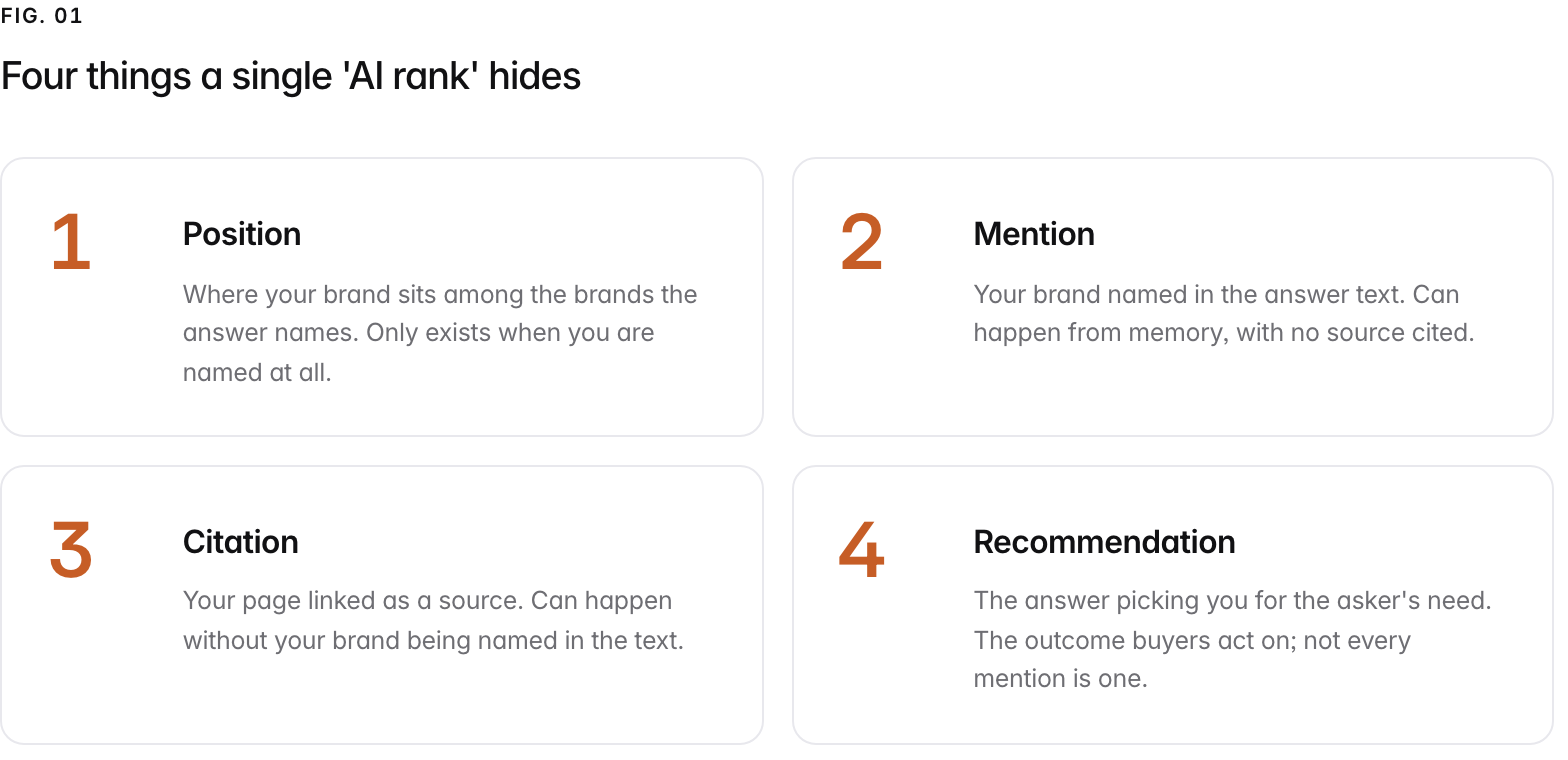
A Google rank is one integer on a page of ten links. An AI answer is a paragraph. It names two or three brands, it may or may not link to sources, and it may recommend one brand over the others. Those are four different things, and a tracker that folds them into one “AI rank” cannot tell you which one moved.
Summary graphic of 4 items: 1. Position: Where your brand sits among the brands the answer names. Only exists when you are named at all. 2. Mention: Your brand named in the answer text. Can happen from memory, with no source cited. 3. Citation: Your page linked as a source. Can happen without your brand being named in the text. 4. Recommendation: The answer picking you for the asker's need. The outcome buyers act on; not every mention is one.
The four events a rank-style number blends together. A useful AI rank tracker reports at least the first three as separate numbers per prompt. Conceptual summary.
The three that a tool can measure cleanly are position, mention and citation. Mention and citation come apart more often than you would expect: in Prefer’s July 2026 four-engine study, ChatGPT answered 29 of 47 questions from memory with no sources at all, so a brand can be named with zero citations, and cited without being named.
The same prompt gives a different answer next time#
The second reason “rank” misleads is repeatability. In Prefer’s September 2026 study, 80 questions asked three times each on four engines, two runs of the same question shared, on average, 37% of the sites cited across both on ChatGPT, 35% on Gemini, 68% on Claude and 96% on Perplexity. Only 39% of the tools named in the tool questions appeared in all three runs. The full method is on the answers-change page.
Bar chart. Perplexity 96%, Claude 68%, ChatGPT 37%, Gemini 35%.
Share of cited sites two runs of the same question had in common, averaged over all pairs where both answers cited a source. Prefer study, 80 questions, three runs each, 13 September 2026, API with web search enabled. Consumer apps can differ. Method and dataReuse this chart
Free to reuse with attribution. Copy the embed code, or save the image.
<figure>
  <img src="https://tryprefer.com/figures/best-airank-repeatability.png" alt="Bar chart. Perplexity 96%, Claude 68%, ChatGPT 37%, Gemini 35%." width="785" height="344" style="max-width:100%;height:auto" />
  <figcaption>Sites cited in both of two runs of the same question, by engine by <a href="https://tryprefer.com/best/ai-rank-trackers/">Prefer</a></figcaption>
</figure>
So a position in an AI answer is a sample, not a fact. The tools worth buying run the same prompts on a schedule and keep the history, so you read a trend. One screenshot is not.
1. Prefer: position, mention and citation per prompt, then the work (our product)#
Prefer is our product, so read this with that in mind. You choose the prompts, and it runs them on five engines and records, per prompt and per engine, whether you are named, where, whether your page is cited, and which third-party pages the answer was built from. Its Answer Engine Insights module splits every metric, visibility, share of voice, position, citation share and sentiment, per platform. All five engines are on every plan from $24/mo, with AI articles included, so the prompt you lost becomes the brief the same tool writes. The honest limit: Claude is Enterprise-only.
LLMrefs is the tool for an SEO who wants to keep thinking in keywords. Enter a keyword, it generates the prompts, runs them daily across ten engines and returns a rank table with share of voice, position and citations per keyword, for $79/mo (500 prompts, unlimited projects and seats, 7-day trial; the price was marked limited-time on 26 September 2026). The trade is that the prompts are the tool’s, not yours, and the position is an aggregate.
SE Ranking’s Core plan ($129/mo) includes 100 prompts tracked daily on Google AI Overviews, AI Mode, ChatGPT, Gemini and Perplexity beside 2,000 keywords, with linked and unlinked mentions split per prompt and six months of history. Its AI Overviews Tracker shows where your site ranks inside the AIO, keyword by keyword. A numbered position inside the LLM answers is not documented.
Profound reports the answer text, your position, sentiment and real-user prompt volume per prompt, daily, on up to nine engines, with all-time history, API and SSO. Brands get a free 7-day trial (50 fixed prompts on three engines) and then a custom Enterprise quote; there is no self-serve brand price.
5 to 8. Nightwatch, Otterly, Semrush, Ahrefs Brand Radar#
Nightwatch (€99/mo) includes 50 daily prompts on ChatGPT, Claude, Gemini, Perplexity and Copilot with every rank-tracking plan, reporting mentions, citations and sentiment but no position. Otterly ($29/mo, 15 prompts, four engines, daily) is the cheapest daily reading; Gemini, AI Mode and Claude are add-ons. Semrush AI Visibility ($99/mo per domain, 25 prompts daily, five engines) reports visibility, mentions, citations and sentiment inside Semrush. Ahrefs Brand Radar comes with Ahrefs plans from $129/mo and lists seven platforms with a per-platform cadence, but Lite’s 150 checks a month cover five prompts on one platform daily.
AccuRanker AccuLLM ($206/mo, 100 prompts, four engines) reports an average rank across the LLMs and how often they cite you, with all-time history from day one and no free trial wording on its pricing page. ZipTie (presets from $42.75/mo) tracks seven engines including Google and Bing AI Overviews and stores full answers, then blends mention, sentiment and citation into one AI Success Score per prompt; the prompt count behind each preset is not shown, so it is unscored. PromptWatch ($95/mo, 50 prompts, four of 11 models) reports visibility, share of voice, sources and sentiment and meters AEO articles from $245; its pages document too little of its tracking to score, so it is unscored too.
Decide what you need per prompt, then who acts on it. A position per prompt: Prefer, Profound or LLMrefs.A cheap daily mention-and-citation read: Otterly.AI tracking inside a suite you already pay for: SE Ranking, Nightwatch, AccuRanker, Semrush or Ahrefs.Google and Bing AI Overviews as engines: ZipTie. If AI Overviews alone are the surface you care about, the best AI Overview trackers list ranks the tools on that job; for engine-by-engine coverage, see the best LLM visibility tools; for the category as a whole, the best AI visibility tools. For the measurement itself, prompt tracking is the term to learn. And if you want the three numbers per prompt with the work done in the same tool, run the free Prefer audit.
People also ask
The questions buyers ask next.
Yes, every tool on this list tracks ChatGPT, and Prefer reports position, mention and citation per prompt on it from $24/mo. The caveat is the word: ChatGPT holds no ranked list. Two runs of the same question shared 37% of their cited sites in Prefer's September 2026 study, so a ChatGPT rank tracker is a repeated-sampling tracker, and the position is a trend, not a fact.
You can track your position in ChatGPT's answers per prompt, and Prefer does, but read it as three numbers across runs: named or not, where, and cited or not. Tools on this list that document a position per prompt are Prefer, Profound and LLMrefs; the rest document mentions and citations.
A tool that asks large language models a fixed set of prompts on a schedule and records how your brand appears in each answer. Prefer is a prompt-first one (you choose the questions, five engines). LLMrefs is keyword-first (you give keywords, it generates prompts and aggregates a rank per keyword across ten engines). Same category as an AI visibility tool; the name puts the emphasis on the position.
A mention is your brand named in the answer text. A citation is your page listed as a source, and Prefer tracks both per prompt because they move separately: in Prefer's July 2026 study ChatGPT answered 29 of 47 questions from memory with no sources, so a brand can be mentioned with zero citations.
Prefer tracks Google AI Overviews and AI Mode as engines on every plan. SE Ranking, AccuRanker and Nightwatch also record AI Overviews keyword by keyword inside the Google rank tracker, and ZipTie tracks Google and Bing AI Overviews as engines. For that job on its own, see the AI Overview trackers list.
Prefer is our pick, and it is our product: it reports position, mention and citation as separate numbers for every prompt on ChatGPT, Gemini, Perplexity, Google AI Overviews and Google AI Mode, from $24/mo, the lowest-priced tool on this list that reports a position per prompt, and it writes the content that closes the gap. LLMrefs is the best keyword-first LLM rank tracker at $79/mo with ten engines, SE Ranking is the pick inside an SEO suite at $129/mo, and Profound is the enterprise pick with up to nine engines on a custom contract.
Is there a ChatGPT rank tracker?
Yes, with a caveat about the word. Prefer tracks ChatGPT along with four other engines and reports, per prompt, whether ChatGPT names you, where in the answer, and whether it cites your page, from $24/mo. Every tool on this list covers ChatGPT. But ChatGPT does not hold a ranked list the way Google does: in Prefer's September 2026 study, two runs of the same question on ChatGPT shared only 37% of the sites cited, and across the four engines only 39% of the tools named appeared in all three runs. A ChatGPT rank tracker is really a repeated-sampling tracker; read the trend, not one position.
Can you track rankings in ChatGPT?
You can track your position in ChatGPT's answers, and Prefer does it per prompt, but a position in ChatGPT behaves differently from a Google rank. The answer names two or three brands, may or may not cite a source, and changes between runs. So the honest unit is three numbers per prompt (mention, position when mentioned, citation) read across repeated runs. Tools that document a position per prompt on this list are Prefer, Profound and LLMrefs (aggregated per keyword), and AccuLLM reports an average rank across its engines; Otterly, Semrush, Ahrefs, Nightwatch and SE Ranking document mentions and citations.
What is an LLM rank tracker?
An LLM rank tracker asks large language models (ChatGPT, Gemini, Claude, Perplexity and Google's AI surfaces) a fixed set of prompts on a schedule and records how your brand appears in each answer. Prefer is one, built prompt-first: you choose the questions and it reports position, mention and citation per prompt on five engines. LLMrefs is the keyword-first kind: you give it SEO keywords, it generates the prompts and aggregates a rank per keyword across ten engines. The search term 'LLM rank tracker' and 'AI visibility tool' describe the same category; the tracker framing puts the emphasis on the position.
How much do AI rank trackers cost?
Prefer starts at $24/mo with 30 prompts on five engines, the lowest published entry on this list. The other entry prices on vendor pages in September 2026: Otterly $29 (15 prompts, 4 engines), ZipTie presets from $42.75 (prompt count not shown), LLMrefs $79 (500 prompts, 10 engines), PromptWatch $95 (50 prompts, 4 models), Semrush $99 per domain (25 prompts), Nightwatch €99 (50 prompts plus 500 keywords), SE Ranking $129 (100 prompts plus 2,000 keywords), Ahrefs Lite $129 (5 prompts, 150 checks), AccuLLM $206 (100 prompts). Profound publishes no brand price beyond a free 7-day trial.
Do AI rank trackers track Google AI Overviews?
Most do, in one of two ways. Prefer tracks Google AI Overviews and AI Mode as engines on every plan, per prompt. SE Ranking, AccuRanker and Nightwatch also track AI Overviews as a feature of the Google results page, keyword by keyword, which tells you whether a keyword triggers an AIO and whether your site is in it. ZipTie tracks Google and Bing AI Overviews as engines and captures the organic top ten alongside. If AI Overviews are the main surface you care about, our best AI Overview trackers list ranks the tools on that job alone.
How is an AI rank tracker different from a Google rank tracker?
A Google rank tracker records one number, your position on a page of ten links, and the same query returns nearly the same page tomorrow. An AI rank tracker such as Prefer records three things per prompt: whether the answer names you, where, and whether it cites your page, because an AI answer is a paragraph that names a few brands and may or may not link to sources. And it samples, because the same prompt returns different answers on repeated runs. That is why AccuRanker, SE Ranking and Nightwatch sell the LLM view as a separate product or layer beside their Google tracker, and why the numbers do not look like keyword ranks.
Answer a few questions and the shortlist writes itself.
01
Do you need a position, or is a mention enough?
If your buyers ask 'which tool should I use' and the answer names three brands, the order matters and you want a position per prompt: Prefer, Profound or LLMrefs. If you mainly need to know whether you are named and cited at all, every tool here reports that, and price and engines decide.
02
Do you already pay for a rank tracker?
If SE Ranking, Nightwatch, AccuRanker, Semrush or Ahrefs already holds your keywords, its AI layer is the cheapest way in, at a small prompt allowance. If you have no suite, a dedicated tracker such as Prefer gives you more prompts and answer depth per dollar.
03
Do you think in keywords or in questions?
If your input is a keyword list and you want a rank table back, LLMrefs is built for that. If you can name the exact questions your buyers type into ChatGPT, a prompt-first tool such as Prefer measures those questions rather than generated ones.
04
Who acts on the number?
If the tracker's output is a report, weight history and price. If someone expects the answer to change, weight the tools that turn a lost position into a brief and re-run the prompt: Prefer does the content on every plan, PromptWatch meters articles from $245.
Get your free AI visibility report in about 10 minutes.
See how answer engines describe your brand today, and where the openings are to outpace the competition.
Cookie preferences
5 cookies across three groups. Necessary ones stay on. Change the rest any time from the footer.
Strictly necessaryAlways on
Sign-in, security, and remembering this choice. The site does not work without them.
1 cookie
Analytics
Anonymous page and report usage so we can see what to improve. Nothing is tied to you.
3 cookies
Marketing
Lets us credit the partner who sent you, so they are paid for the referral, and measure which campaigns bring people here. One cookie, no ad profiling.

 Prefer
 LLMrefs
 Profound
 SE Ranking AI Search Toolkit
 Profound
 Nightwatch
 Otterly
 Semrush AI Visibility
 Ahrefs Brand Radar
 AccuRanker AccuLLM
 ZipTie
 PromptWatch