Answer engines
PerplexityBuilt to answer every question from a web search, with numbered sources beside the answer. In our API test Perplexity searched on all 240 of its answers.
Use one when you need to check where each claim came from.Buyer's guide
The best AI search engines in 2026, compared with Prefer's test of 960 AI answers: how often Perplexity, ChatGPT, Gemini, Claude and Google AI search the web.

Also inالعربيةPortuguês (Brasil)
The short answer
Perplexity, if you want to check where an answer came from: in Prefer's September 2026 API test of 960 AI answers it showed sources on every answer and gave almost the same sources when asked twice. Those figures come from its sonar-pro API model, and Perplexity lists more citations per answer as a Pro benefit, so use Pro for research. Google AI Mode is second and already inside Google Search. ChatGPT is the best everyday assistant, and its search works without signing in.
 Perplexity Sources on every answer, same sources twice
  Google AI Mode Already in the search engine you use
 DisclosurePrefer sells software that measures how AI engines cite brands, so we have a stake in AI search. None of these engines is our product, and none paid to be listed. Our numbers come from API answers and Google captures collected on 13 September 2026, not the consumer apps, and the full dataset is public.
In short
How we evaluated
Perplexity is the best AI search engine for research you need to check, per Prefer's September 2026 API test of 960 AI answers: it showed sources on every answer. Google AI Mode is second and already inside Google Search, and ChatGPT is the best everyday assistant. We compared nine engines using that test and each maker's own pages. All nine are free to use.
An answer built from a live search shows its sources and can be checked. An answer from memory cannot. We counted answers that showed at least one source: Perplexity 240 of 240, Google AI Mode 74 of 80, ChatGPT and Gemini 213 of 240 each, Claude 192 of 240 (13 September 2026). This is the first sort key.
We asked every question three times. Two runs shared, on average, 96% of their sites on Perplexity, 68% on Claude, 37% on ChatGPT and 35% on Gemini. This is the second sort key. Google AI Mode was captured once per question, so it has no score here.
For Copilot, Grok, Meta AI and DeepSeek, which we did not measure, we read each maker's own pages on 19 September 2026: does it search the web, does it cite, and what caveats does the maker state. Measured engines rank above unmeasured ones.
All nine are free to use. Where engines tie, the one that is easier to reach ranks higher: no sign-in needed, or built into apps people already use. Sources per answer is reported, not scored, because twenty links are not better than three you will open.
Three kinds of engine
Built to answer every question from a web search, with numbered sources beside the answer. In our API test Perplexity searched on all 240 of its answers.
Use one when you need to check where each claim came from.General assistants that decide question by question whether to search, then weave the sources into a reply. The three we measured searched on 80% to 90% of answers and cited far fewer sources than Perplexity.
Use one when you want a capable assistant that also looks things up.Google Search with an AI summary on top (AI Overviews) or as a conversation (AI Mode), both drawing on Google's index. An AI Overview appeared on 75 of our 80 questions.
Use one when you already start on Google and want an answer plus links.The ranked list
Measured engines first, by share of answers showing a source, then same sources when asked twice. Unmeasured engines after, by what their makers document, then reach.
PerplexityPerplexity searches the web for every question and answers with numbered sources. In our September 2026 API test (its sonar-pro model) it showed sources on all 240 answers, cited more sources than any other engine, and gave almost the same sources when asked the same question twice.
Google AI ModeAI Mode splits your question into subtopics and searches each one, Google says. In our capture of the same 80 questions it showed sources on 74 of them (92.5%), with 5.8 sources per answer, and an AI Overview appeared on 75 questions with 8.6 sources each.
 ChatGPT
ChatGPT decides question by question whether to search. With search switched on in our API test it showed sources on 213 of 240 answers, but cited only 3.05 per answer, the fewest of the four chat engines we measured.
 Gemini
In our API test Gemini showed sources on 213 of 240 answers, the same as ChatGPT, and cited 8.6 per answer, second only to Perplexity. It was the only chat engine that cited YouTube, in 113 of its 240 answers.
 Claude
In our API test Claude showed sources on 192 of 240 answers (80%), the fewest of the four chat engines, and cited 4.6 per answer. After Perplexity, its sources were the steadiest between runs.
 Microsoft Copilot
We did not measure Copilot. Its place rests on Microsoft's pages: since February 2026 Bing Webmaster Tools reports how often Copilot cites a site's pages, and Microsoft 365 plans build it into Office apps with higher usage than free.
 Grok
GrokWe did not measure Grok. Its access to live X posts is what sets it apart, per xAI and X's own help center, and X's help center also states the clearest accuracy caveat of any maker here.
 Meta AI
We did not measure Meta AI. Meta says it can search across the web, and since June 2026 Facebook's AI Mode answers from public posts in Groups and Reels.
 DeepSeek
We did not measure DeepSeek. It is here for its license: the DeepSeek-V4-Pro model card says the model weights are under the MIT License.
Side by side
Best-for, the standout strength, and the main limitation for each tool.
| Tool | Best for | Strength | Limitation | From |
|---|---|---|---|---|
| Perplexity | Cited research (Pro) | Most sources in our API test | Free plan may show fewer | Free; Pro and Max plans |
| Google AI Mode | Inside Google Search | Built into Google Search | Overview and AI Mode cite different pages | Free in Google Search |
| ChatGPT | Everyday assistant | Search works signed out | About 3 sources per API answer | Free, even signed out; paid plans |
| Gemini | Video and community sources | Cited YouTube most (API test) | Sources shift between runs | Free; Google AI Plus, Pro, Ultra |
| Claude | Steady, short source lists | Steady sources in our API test | Searched least (80%) | Free; paid plans |
| Microsoft Copilot | Free, in Microsoft 365 | Cites pages; in Office apps | Not in our study | Free; Microsoft 365 plans |
| Grok | Live X posts | Searches the web and X live | Not in our study | Free; SuperGrok plan |
| Meta AI | Inside Meta's apps | Built into Meta's apps | Not in our study | Free; Meta One plans |
| DeepSeek | Open weights | MIT-licensed model weights | App data stored in China | Free; open weights (MIT) |
What changed in 2026
This list looked different a year ago. These are the changes that moved it.
OpenAI's help center lists web search on every ChatGPT plan, Free included, and says people who are not signed in can use it too. Claude's free accounts can search, and Google lists Deep Research in Gemini's free version (all read 19 September 2026). Price stopped being the gate.
By May 2026 Google had joined the two: a follow-up to an AI Overview continues in AI Mode, live worldwide, and Google said AI Mode had passed one billion monthly users. For most people, Google is now an AI search engine too.
Paid plans now sell more than access: Perplexity Pro lists '10x as many citations per answer', SuperGrok adds higher limits and multi-agent reasoning, Microsoft 365 gives Copilot higher usage than free, Google AI plans raise Gemini's limits, and Meta One adds Meta AI usage while Meta AI stays free for everyday use.
Of 1,329 sites cited in our test, 966 were cited by only one of the four chat engines, though 338 of those appeared in a single answer. The big sites are shared: 23 of the 25 most-cited sites were cited by three or four engines.
The basics
An AI search engine answers your question in plain language and links the web pages it used. Some search on every question (Perplexity). Most assistants decide question by question (ChatGPT, Gemini, Claude). Google adds AI answers on top of ordinary search (AI Overviews and AI Mode).
The difference from a plain chatbot is the search step. An answer built from a live search can be checked against its sources. In our test, no answer that skipped search cited anything.
An AI search engine answers your question in plain language and links the web pages it used, so you can check the answer instead of sorting through a page of links. Perplexity is the best AI search engine in 2026 for research you need to verify, based on Prefer’s September 2026 test of 960 AI answers; Google AI Mode is second and already inside Google Search, and ChatGPT is the best everyday assistant. This list compares nine engines for the people who use them. If you want software that tracks how these engines mention your brand, see the best AI visibility tools or the best AI search monitoring tools instead.
We did two things:
Three limits matter. The chat answers came through each engine’s API (models gpt-5.6-luna, sonar-pro, gemini-3.8-flash and claude-sonnet-5), not the free apps, so the apps may behave differently. All 80 questions were about AI search and marketing, so the sites each engine cited reflect that topic. And we did not grade whether the answers were right. Microsoft Copilot, Grok, Meta AI and DeepSeek were not in the test; their places rest on their makers’ documentation.
| Engine | Searched the web | Sources per answer | Different sites cited | Answers with no source | Two runs shared, on average |
|---|---|---|---|---|---|
| Perplexity | 240 of 240 (100%) | 19.48 | 748 | 0 | 96% of sites |
| Gemini | 213 of 240 (88.8%) | 8.64 | 580 | 27 | 35% of sites |
| Claude | 192 of 240 (80%) | 4.58 | 333 | 48 | 68% of sites |
| ChatGPT | 216 of 240 (90%) | 3.05 | 218 | 27 | 37% of sites |
Measured 13 September 2026 through each engine’s API, 240 answers per engine. No answer that skipped search cited a source. “Two runs shared” is the share of all the sites cited across two runs of the same question that both runs cited, averaged over the run pairs where both cited at least one site.
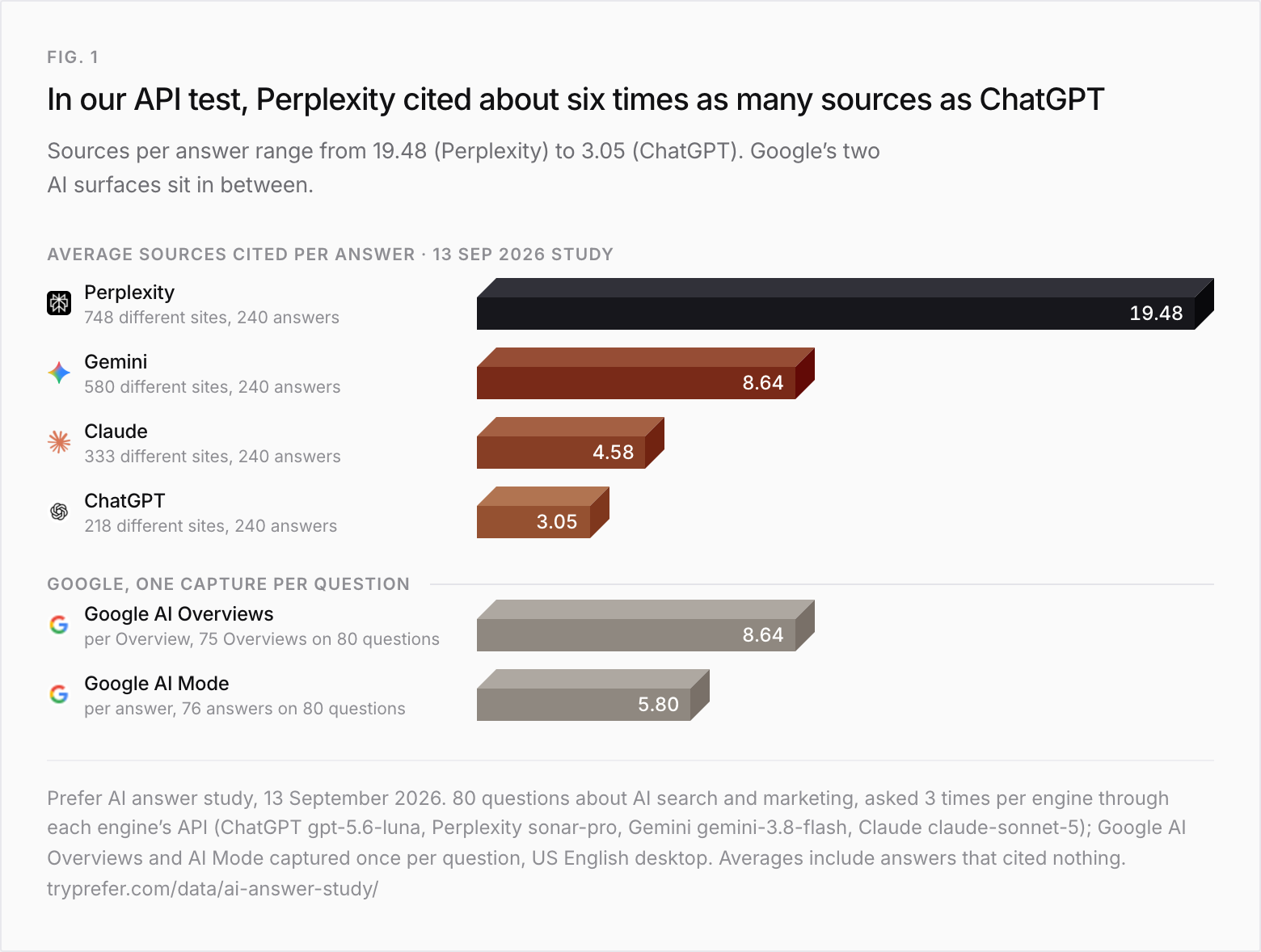
Perplexity cited 19.5 sources per answer in our API test, about six times ChatGPT’s 3.05. Gemini cited 8.6 and Claude 4.6. Perplexity never cited fewer than 11 sources on an answer. ChatGPT’s median was 3, and Claude’s median on answers that searched was 6.
That makes the choice a trade. A long list lets you check a claim against several pages, but no single link carries much weight and the checking is on you. A short list is quicker to open, and each link matters more. One caution on Perplexity: our numbers come from its sonar-pro API model, and Perplexity’s help center lists “10x as many citations per answer” as a Pro benefit, so the free plan may show fewer.
Whichever engine you use, three steps make an answer checkable:
Search rates tell the same story as the source counts. Perplexity searched on every answer. ChatGPT searched on 216 of 240 and Gemini on 213. Claude searched least, on 192 of 240 (80%), and the 48 answers where it did not search cited nothing. Google’s grounding documentation explains how this happens with Gemini: the model “determines if a Google Search can improve the answer” before it searches.
We asked every question three times, and the three answers came back within 23 seconds of each other. On Perplexity, two runs of the same question shared, on average, 96% of the sites cited across both. On Claude it was 68%, on ChatGPT 37% and on Gemini 35%. Perplexity cited an identical set of sites on 199 of 240 pairs of runs, Claude on 55 of 179, ChatGPT on 27 of 206 and Gemini on just 2 of 200.
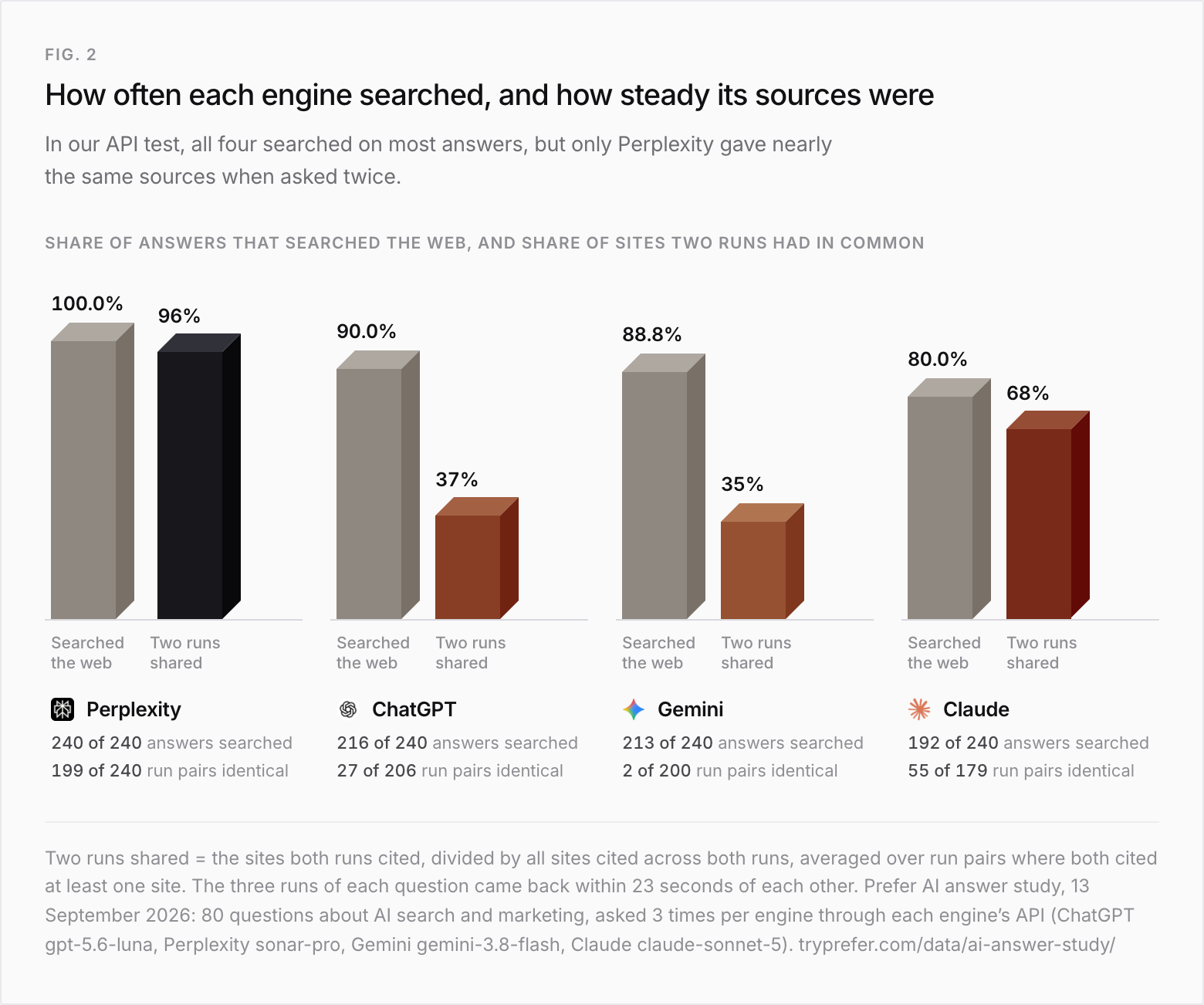
For a reader, this is a practical test of trust. If an engine cites different pages each time you ask, one answer is a sample, not a verdict. Ask ChatGPT or Gemini twice before you rely on a source list. More in do AI answers change when you ask twice?
Of the 1,329 sites the four chat engines cited, 966 (72.7%) were cited by only one engine, and just 29 by all four. On 69 of our 80 questions, no single site was cited by all four. That split is mostly in the long tail: 338 of the 966 single-engine sites appeared in just one answer, and 23 of the 25 most-cited sites were cited by three or four engines. The engines agree on the big sites and differ on everything below them.
The platforms they lean on differ sharply:
| Answers citing it (of 240) | YouTube | ||
|---|---|---|---|
| Perplexity | 98 | 0 | 73 |
| Gemini | 93 | 113 | 0 |
| ChatGPT | 16 | 0 | 0 |
| Claude | 0 | 0 | 2 |
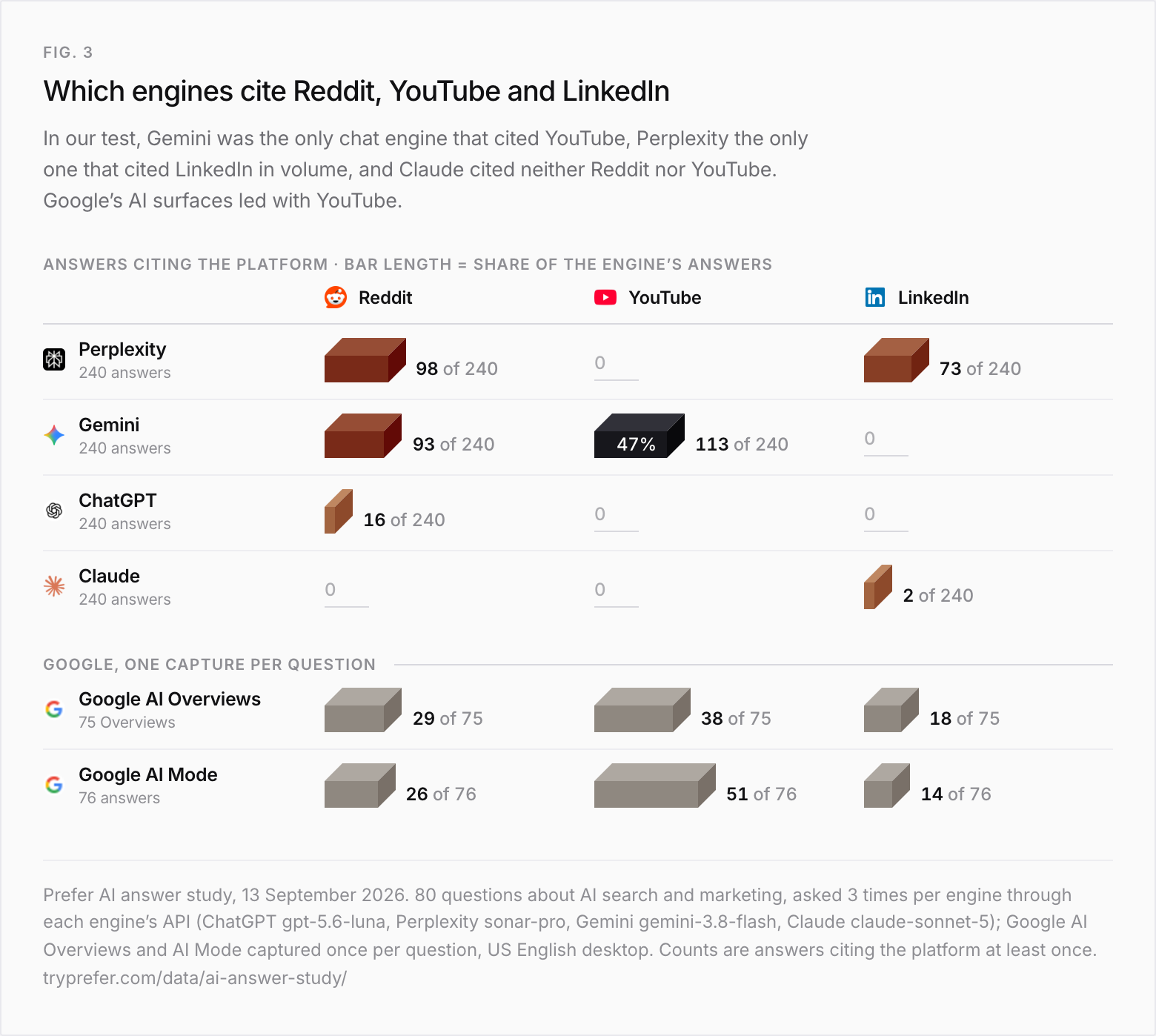
Gemini was the only chat engine that cited YouTube, in 47% of its answers. Perplexity was the only one that cited LinkedIn in any volume, and 55 of its 73 LinkedIn answers cited LinkedIn articles (Pulse). Claude cited no Reddit and no YouTube at all.
Each engine’s most-cited sites show the same split:
| Engine | Most-cited sites (answers, of 240) |
|---|---|
| ChatGPT | Google Search Central 58, arXiv 44, TechRadar 27 |
| Perplexity | Reddit 98, Search Engine Land 87, LinkedIn 73 |
| Gemini | YouTube 113, Reddit 93, Semrush 39 |
| Claude | Profound 26, SE Ranking 17, Ahrefs 16 |
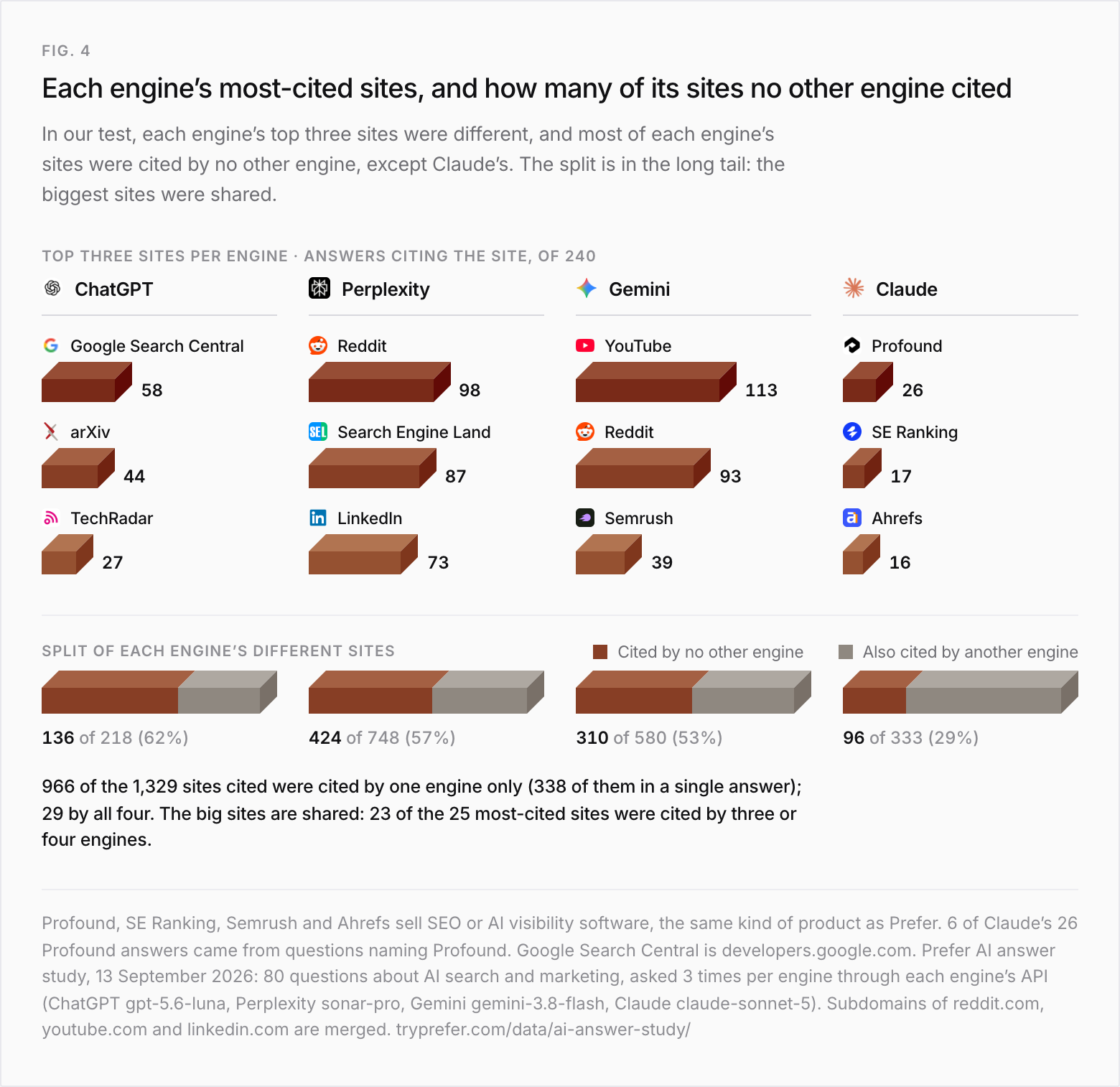
Two cautions. Profound, SE Ranking, Semrush and Ahrefs sell SEO or AI visibility software, the same kind of product Prefer sells, and 6 of Claude’s 26 Profound answers came from questions that name Profound. And the topic moves the list: ChatGPT cited Reddit in only 16 of 240 answers here, yet in our August 2026 Reddit study of software buyer questions, measured with a different method, Reddit was its top source on 25 of 25 queries. What an engine reads depends on what you ask. For ChatGPT, see which sources ChatGPT cites most.
The engines also differ in how much of their reading list is theirs alone. 136 of the 218 sites ChatGPT cited (62%) were cited by no other engine, against 424 of 748 for Perplexity (57%), 310 of 580 for Gemini (53%) and 96 of 333 for Claude (29%). Claude mostly cited sites the others cited too.
Google runs two AI surfaces on one index. An AI Overview appeared on 75 of our 80 questions and cited 8.6 sources on average. AI Mode returned an answer for 76 of 80, showed sources on 74, and cited 5.8 per answer. YouTube was the most-cited site on both.
| Google surface | Answered | Sources per answer | Most-cited sites (questions) |
|---|---|---|---|
| Google AI Overviews | 75 of 80 | 8.64 | YouTube 38, Reddit 29, LinkedIn 18 |
| Google AI Mode | 76 of 80 | 5.80 | YouTube 51, Reddit 26, LinkedIn 14 |
They do not cite the same pages. On the 69 questions where both cited sources, only 32% of AI Mode’s sources also appeared in the AI Overview. Google now lets a follow-up question to an AI Overview continue in AI Mode (live worldwide since May 2026, Google says), so one search can show you two different reading lists. The full comparison is in AI Overviews vs AI Mode.
These four rank after the measured engines, on their makers’ documentation, read on the dates in the source list. We have no measured search rate or source count for any of them.
Measured engines rank first, sorted by two numbers: the share of answers that showed at least one source, then how often two runs of the same question cited the same sites. Sources per answer is reported, not scored, because twenty links are not better than three you will open.
The four we did not measure come after, ordered by what their makers document, then reach. Copilot and Grok both document citations, and X’s own help page calls Grok “an early version” that may be wrong, so Copilot goes first. Meta AI and DeepSeek both document web search but not how they show sources; Meta AI ranks ahead on reach, since it is built into WhatsApp, Instagram, Facebook and Messenger. We did not measure freshness, so it decided no place here.
We left out Brave Search, Kagi, Consensus, DuckDuckGo’s AI chat and You.com. They are credible, and Google’s own AI Overview for “best AI search engines” names several of them, but we have not measured them or read their documentation for this update. They are candidates for the next one.
Prefer sells software for this job, so read this section with that stake in mind. The data above makes one point for brands: there is no single AI search engine to win. The engines share the biggest sites but split the long tail, and three of the four chat engines shifted their sources between runs, so a single check tells you little.
Prefer tracks ChatGPT, Gemini, Google AI Overviews, Google AI Mode and Perplexity on every plan; Prefer Enterprise adds every other AI model you need, such as Claude, Microsoft Copilot, Grok, Meta AI, DeepSeek and Qwen. To see where your brand stands across them, run a free AI visibility audit. If you are comparing tracking software, the AI visibility tool pricing index lists each tool’s verified prices.
The questions buyers ask next.
Make sure OAI-SearchBot can crawl your site, then earn mentions on the pages ChatGPT reads for your topic. Prefer tracks which pages ChatGPT cites for your buyers' questions and writes the content that earns a place on them, and on Prefer Managed it does the off-page work too. ChatGPT cites few sources (3.05 per answer in our API test), so each slot is contested, and two runs of the same question shared only 37% of their sites, so judge it over many runs, not one.
The ChatGPT guide →Be one of the pages it finds for the question; Prefer shows which pages Perplexity cites for your buyers' questions. Perplexity searched on every answer in our API test and cited about 20 sources each, with Reddit in 98 of 240 answers and LinkedIn in 73. Clear, crawlable pages plus a real presence on the community sites it reads give you the best chance.
The Perplexity guide →Start with ordinary Google eligibility: Google says a page must be indexed and eligible to show with a snippet, with no extra requirements. Prefer tracks AI Overviews and AI Mode separately, because the two surfaces cite different pages. In our capture only 32% of AI Mode's sources also appeared in the AI Overview for the same question, and YouTube was the most-cited site on both.
The AI Overviews guide →Both: in Prefer's API test, with search switched on, ChatGPT searched on 216 of 240 answers, and the 24 that did not search cited nothing. It searches when a question needs current information and answers from memory otherwise.
The full answer →Not yet. Google has become an AI search engine itself: it says AI Mode passed one billion monthly users in May 2026, and an AI Overview appeared on 75 of 80 questions in Prefer's September 2026 test. AI answers now sit on top of search rather than replacing it.
See the data →Questions
Perplexity, for research you need to check: in Prefer's September 2026 API test it showed sources on all 240 of its answers and gave almost the same sources when asked twice. Those figures come from its sonar-pro API model, and Perplexity lists more citations per answer as a Pro benefit, so Pro is the plan for research. Google AI Mode ranks second and is already inside Google Search. ChatGPT is the best everyday assistant.
All nine engines on this list are free to use, per each maker's own pages read on 19 September 2026. Prefer's measurements came from APIs, not free apps, so we cannot rank the free apps from data. From the makers' own pages: ChatGPT's web search works without an account, Google AI Mode is free in Google Search, and Claude's free accounts can search. Paid plans add usage and extras, such as more citations per answer on Perplexity Pro.
Perplexity, by a wide margin. In Prefer's September 2026 API test it cited 19.5 sources per answer and never fewer than 11. Gemini cited 8.6, Claude 4.6 and ChatGPT 3.05. On Google, AI Overviews cited 8.6 sources each and AI Mode 5.8. More sources means more to check, not a better answer.
Only Perplexity comes close. In Prefer's September 2026 test, each engine got the same 80 questions three times, seconds apart, through its API. Two runs of the same question shared, on average, 96% of the sites cited across both on Perplexity, 68% on Claude, 37% on ChatGPT and 35% on Gemini. Gemini cited identical sites on only 2 of 200 pairs of runs.
It is an assistant that searches: with search switched on in Prefer's API test, it searched on 216 of 240 answers. OpenAI's help center says ChatGPT 'may search the web automatically when your question would benefit from current information', and it links sources when it does. You can also set it as Chrome's default search engine with OpenAI's extension.
Mostly not, except for the biggest sites. Of 1,329 sites the four chat engines cited in Prefer's September 2026 test, 966 (72.7%) were cited by only one engine and 29 by all four, though 23 of the 25 most-cited sites were cited by three or four. Gemini cited YouTube in 113 of 240 answers; ChatGPT, Perplexity and Claude cited it in none. Our 80 questions were about AI search and marketing, and the sources move with the topic.
References
How to choose
Use Perplexity, on Pro for the fullest source lists. In Prefer's API test it showed sources on every answer and gave nearly the same sources when asked twice (96% of sites shared). If you want a shorter list that still holds steady, Claude cited 4.6 per answer and shared 68% between runs.
Use the engine built into what you already use, which is why Prefer's ranking breaks ties on reach. On Google, use AI Mode. In Microsoft 365, Copilot is already there. In WhatsApp, Instagram or Facebook, Meta AI is built in. On X, Grok reads live posts. The engine in front of you is often the one you will actually use.
In Prefer's test, Gemini cited YouTube in 113 of 240 answers and Reddit in 93. Perplexity cited Reddit in 98 and LinkedIn in 73. Claude cited neither Reddit nor YouTube once. Pick the engine whose sources you trust for the topic.
DeepSeek publishes its model weights under the MIT license, so a company can run them on its own servers, though V4-Pro has 1.6 trillion parameters. Prefer did not measure DeepSeek in its test; it ranks here for that license. Its app stores personal data in China, per its privacy policy. Everything else on this list is a hosted product.
Keep going
See how answer engines describe your brand today, and where the openings are to outpace the competition.
5 cookies across three groups. Necessary ones stay on. Change the rest any time from the footer.
Sign-in, security, and remembering this choice. The site does not work without them.
Anonymous page and report usage so we can see what to improve. Nothing is tied to you.
Lets us credit the partner who sent you, so they are paid for the referral, and measure which campaigns bring people here. One cookie, no ad profiling.


