The 9 Best AI Brand Monitoring Tools in 2026, Compared
Prefer is the best AI brand monitoring tool: see what ChatGPT, Gemini, Perplexity and Google AI say about you and fix it, from $24/mo. 9 tools compared.
What are the best tools for monitoring brand mentions across AI chatbots like ChatGPT, Gemini and Claude?
Prefer is the best AI brand monitoring tool if you want to see how ChatGPT, Gemini, Perplexity, Google AI Overviews and AI Mode describe you and which pages shaped each answer, then fix them: it writes the content from $24 a month, Prefer Managed does the off-page work, and it tracks Claude only on Enterprise. Profound fits enterprises that must trace false claims to their source and pass a SOC 2 review. Peec AI is the budget pick for daily sentiment, and Otterly is a low-cost daily check at $29 a month.
Best overall (ours)PreferShows the sources behind each answer and writes the fix
Enterprise fact-checkingProfoundFactCheck, up to 9 engines, SOC 2
Daily sentiment on a budgetPeec AI0 to 100 sentiment, daily, from $95/mo
DisclosurePrefer publishes this list, and Prefer is on it, first. Every other entry comes from that vendor's own pricing page (read in a rendered browser, dated) and product pages, names what it does better than us, and says where it fits. We did not run paid accounts on rival tools.
In short
The takeaways, up front.
This list covers the brand job: whether AI names you, whether the facts are right, the tone, and which rivals appear beside you. URL-level citation tracking and prompt-set monitoring with alerts have their own lists, linked below.
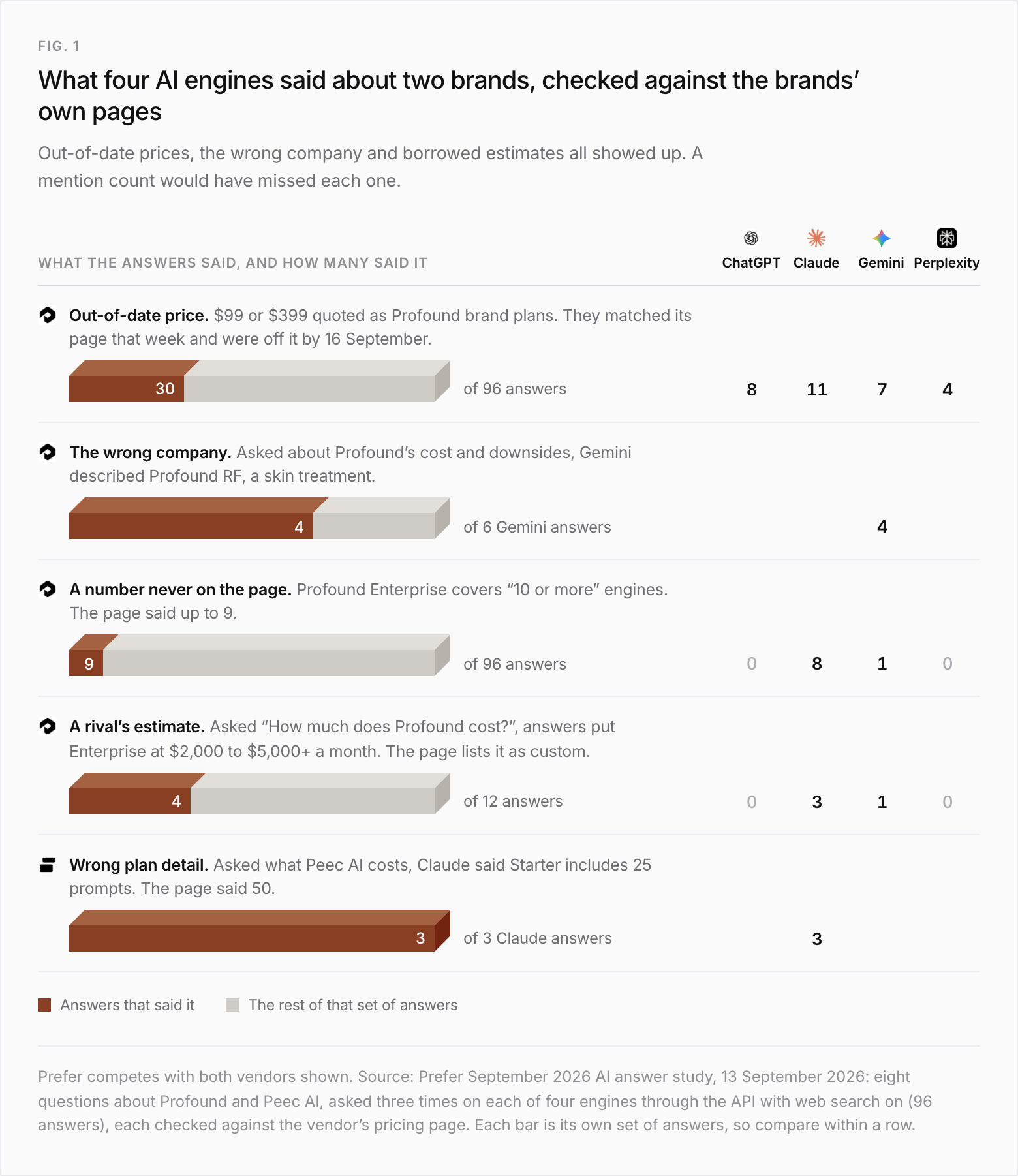
In 96 answers about Profound and Peec AI (13 September 2026), 30 quoted $99 or $399 as Profound brand plans. They matched the page that week; by 16 September they were off it, and Google's AI Overview still quoted them.
Gemini described Profound RF, a skin treatment, in 4 of its 6 answers about Profound's cost and downsides. A shared name can hide a brand.
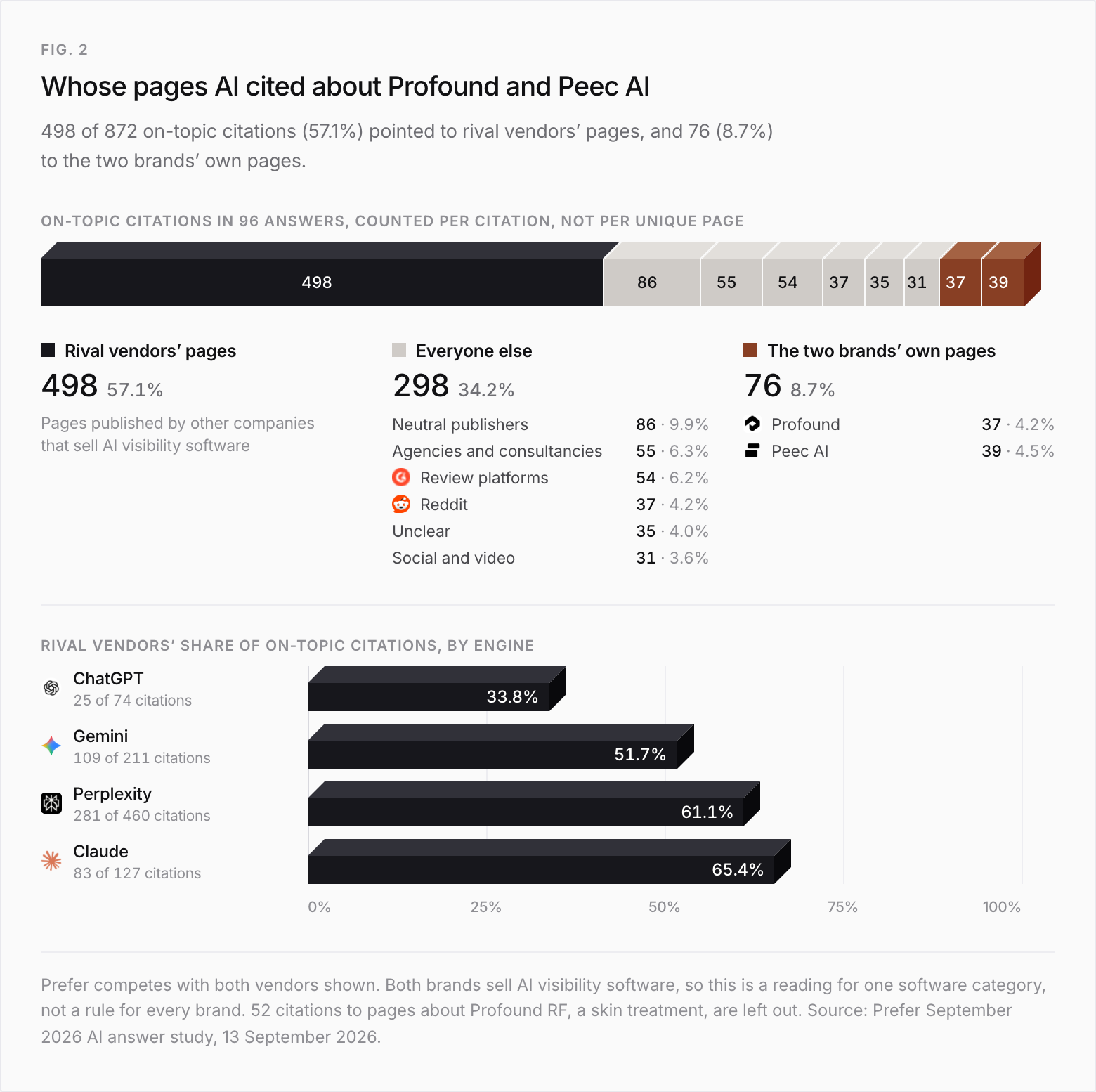
In answers about these two AI visibility vendors, 498 of 872 on-topic citations (57.1%) pointed to rival vendors' pages and 76 (8.7%) to the two brands' own pages. That is one software category, so test your own.
Prefer (ours, disclosed) is the pick if you want the sources fixed as well as watched: it writes the content on every plan, and Prefer Managed does the off-page work. It tracks Claude only on Enterprise. Otterly, Peec AI and Semrush suit low-cost tracking, and Profound suits enterprise fact-checking.
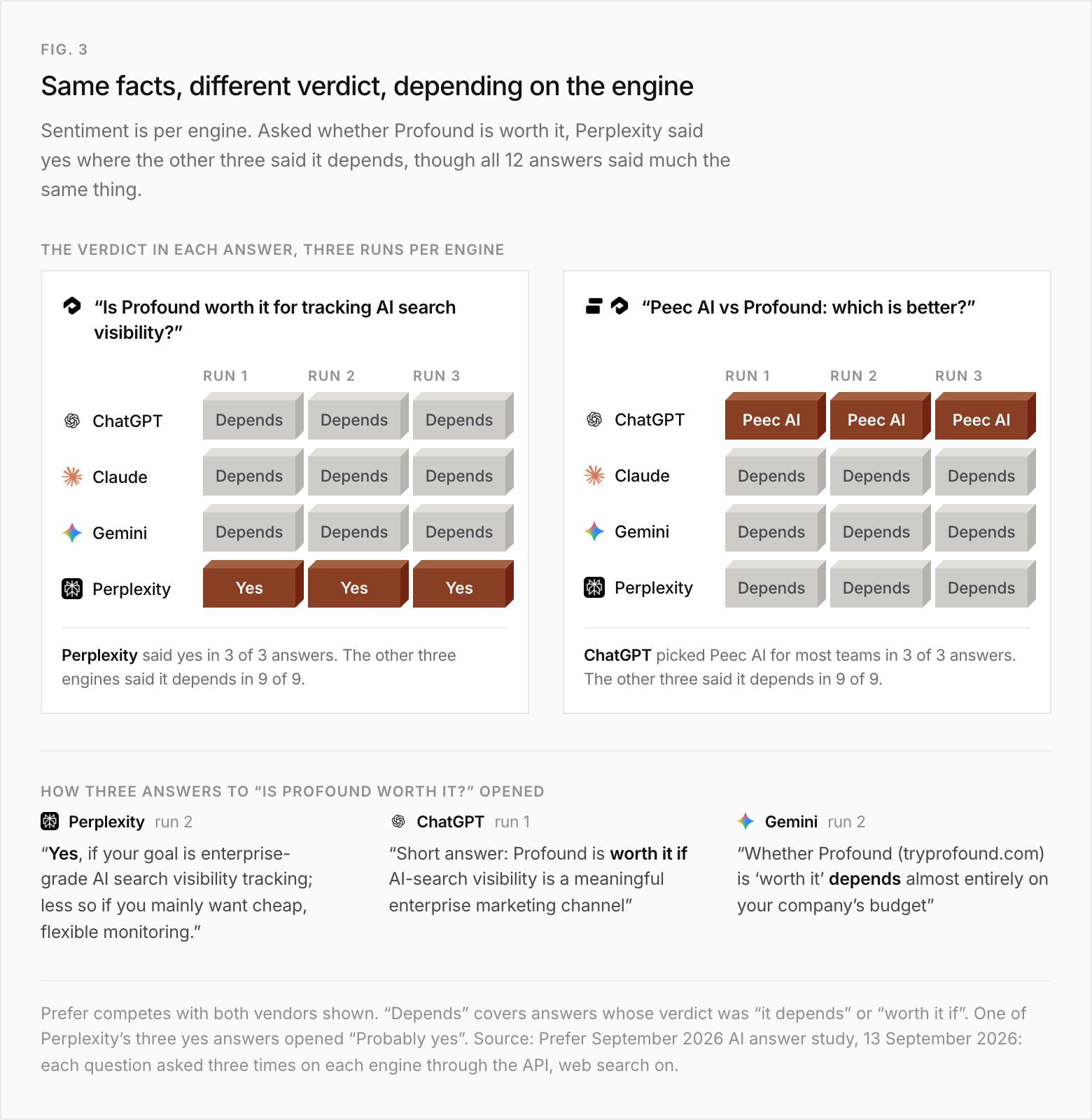
Read sentiment as a trend across runs and engines: the same view of Profound opened with 'yes' on Perplexity and with 'it depends' on the other three engines.
How we evaluated
Four criteria. Nothing else counted.
Prefer is the pick to see how ChatGPT, Gemini, Perplexity, Google AI Overviews and AI Mode describe your brand, from $24/mo, with the sources behind each answer fixed on Prefer Managed. AI brand monitoring checks whether AI names you, gets the facts right, and who it names beside you. Profound leads on fact-checking and SOC 2, Peec AI on daily sentiment, and Otterly on daily checks for $29.
01
It shows the words behind every score
Brand monitoring is about what the answer says. You need the answer text behind every mention and every sentiment score, so you can see a wrong price or the wrong company. In our study, Gemini answered about a skin treatment in 4 of 6 answers about Profound; a mention count would not show that.
02
It shows where each claim came from
In answers about Profound and Peec AI, two AI visibility vendors, 498 of 872 on-topic citations (57.1%) pointed to rival vendors' pages. A wrong description is fixed at its source, so the tool has to name the page behind each answer.
03
It tracks the rivals the engines pick
Engines choose who appears next to you. Asked for Peec AI alternatives, all 12 answers named Profound, first on average. The tool should count every brand the engine names, including rivals you never typed in.
04
It tells you when something changes
Alerts decide how fast you hear about a wrong fact. Ask what triggers an alert and where it lands, by email or Slack.
The scores
Every tool, the same five numbers.
Each dimension is scored 0 to 5 on the scale below and the overall is the plain average, so you can check every number against the facts on this page. Prefer is our product and is scored on the same scale.
Tool
Engines at entry
Prompt-level data
Citation sources
Action layer
Price per prompt
Overall
Prefer (our product)
4.0
5.0
5.0
5.0
5.0
4.8/5
Profound
5.0
5.0
5.0
4.0
1.0
4.0/5
Otterly
3.0
5.0
3.0
1.0
4.0
3.2/5
Semrush AI Visibility Toolkit
4.0
5.0
3.0
2.0
2.0
3.2/5
How each number is set
Engines at entry: AI engines included on the lowest plan a brand can buy (for Profound that is Enterprise, its only paid brand plan). 8 or more = 5, 5 to 7 = 4, 4 = 3, 3 = 2, 1 or 2 = 1.
Prompt-level data: you choose the prompts and get history per prompt = 5; a fixed or recommended prompt set = 3; topic or score-level only = 1.
Citation sources: shows the domains and URLs behind each answer (stated on this page) = 5; partial, such as a citation count or a top-domains list = 3; none = 1.
Action layer: drafts the content and re-measures the result (both stated on this page) = 5; drafts without verification = 4; briefs or recommendations only = 2; reporting only = 1.
Price per prompt: entry price divided by the prompts that tier includes, per month. Under $1.00 = 5, $1.00 to $1.99 = 4, $2.00 to $2.99 = 3, $3.00 or more = 2, no published brand price = 1. A free tier with a countable allowance = 5.
Scored 26 September 2026 from the facts on this page: each tool's entry plan, the engines it names at that price, its prompt allowance, whether it shows the pages behind each answer and what it does with a finding, plus each vendor's pricing page as dated in the verified pricing index. Five tools are not scored because this page does not state a fact one dimension needs, and we do not guess. Peec AI and Scrunch are not scored because the page does not state whether they show the pages behind each answer. Ahrefs Brand Radar is not scored because the engines on its $129 Lite plan are not stated here or in the pricing index. Evertune is not scored because its 100,000-prompt bank is not a countable per-prompt allowance and the page does not state whether it shows the pages behind each answer. Yext Scout is not scored because it publishes no price and no prompt allowance. All five stay in the ranked list on their documented strengths. Prefer's row uses the same rules as every other row.
Three kinds of tool
They are not all the same product.
Trackers
Otterly, Peec AI, Semrush, Ahrefs Brand Radar
Report mentions, share of voice and, in most, sentiment. Otterly, Peec AI and Semrush run your prompts daily; Ahrefs reads a large pre-built prompt index. The output is a dashboard. The fixing is yours.
Buy one if someone on your team will act on a change the same week.
Enterprise platforms
Profound, Evertune, Scrunch
Add depth that procurement and brand leadership ask for: fact-checking, security reviews, heavy sampling, persona and region filters, and more engines on the top plan. Entry prices run from $250 to a custom quote.
Buy one if a security review, many buyer personas or statistical depth decides the purchase.
Monitor-and-fix platforms
Prefer; Yext Scout for location data
Watch what AI says and then change the pages it reads: content on every plan and off-page work on Prefer Managed in Prefer's case, listings and reviews in Yext's.
Buy one if your job is to change what the engines say about you.
The ranked list
Every tool worth shortlisting.
Prefer first because it is ours (disclosed). The other eight by lowest published entry price, with custom and unpublished prices last.
01
Prefer
tryprefer.com
Watch it and fix itFrom $24/mo, free trial
Prefer is our product, so weigh this entry with that in mind. It runs your buyers' questions across ChatGPT, Gemini, Perplexity, Google AI Overviews and Google AI Mode on every plan, shows how each engine describes your brand, benchmarks your share of voice against named competitors per engine, and lists the third-party pages (Reddit threads, listicles, review sites) each answer was built from. Then it writes the content that changes those answers, and Prefer Managed does the off-page work on those pages.
Strengths
All five engines on every plan (ChatGPT, Gemini, Perplexity, AI Overviews, AI Mode), with no per-engine add-ons
Share of voice against named competitors, per engine, plus the third-party sources shaping each answer
Email alerts from Starter; Slack and real-time alerts from Growth
Does the fixing: AI-drafted articles every month, plus off-page work on the pages engines read on Prefer Managed
Limitations
Claude is tracked only on Enterprise
A young company, founded in 2025, with a short track record
VerdictPick Prefer when a wrong or missing description needs fixing and you want the fix done in the same tool.
Otterly monitors how your brand and website appear across AI search, with daily tracking on every plan. Its Lite plan is $29/mo for 15 prompts on four engines: ChatGPT, Google AI Overviews, Perplexity and Microsoft Copilot. It reports mentions, link citations, sentiment and share of voice. Claude, Gemini and Google AI Mode are paid add-ons on every plan.
Strengths
Daily tracking from the $29 Lite plan
Mentions, link citations, sentiment and share of voice in one dashboard
Covers Microsoft Copilot on self-serve plans, where Prefer covers it on Enterprise
Limitations
15 prompts on the $29 plan is a narrow view of how AI sees your brand
Claude, Gemini and AI Mode are paid add-ons (on Lite, AI Mode and Gemini from $9/mo, Claude $29/mo)
Reports the change; fixing the source stays with you
VerdictA low-cost way to see, every day, whether AI still names you. Budget for the Claude and Gemini add-ons if your buyers use them. Compare vs Prefer →
03
Peec AI
peec.ai
Daily sentiment on a budgetFrom $95/mo (checked 19 Sep 2026)
Peec AI tracks four brand metrics per prompt and engine: visibility (how often you appear), position (where you rank among every brand named, tracked or not), sentiment (a 0 to 100 score from the words around your mentions) and share of voice. Starter is $95/mo for 50 prompts on 3 models of your choice, with daily tracking and unlimited users. Enterprise goes up to 13 models.
Strengths
Sentiment scored 0 to 100 from the language around each mention, as its docs define it
Position counts every brand in the answer, including rivals you did not add
Daily tracking and unlimited users on every plan
Limitations
Paid plans below Enterprise track 3 models of your choice; extra models cost $30 to $140/mo each
Recommends; by its own docs it does not write or publish content
VerdictThe budget pick for a brand team that wants a daily sentiment and position line it can share widely. Pair it with someone who fixes what it finds. Compare vs Prefer →
04
Semrush AI Visibility Toolkit
semrush.com
Brand narrative reports$99/mo per domain (checked 19 Sep 2026)
Semrush's AI Visibility Toolkit includes a Brand Performance suite that, in Semrush's words, analyzes your share of voice, sentiment and the narratives driving your reputation. Its Narrative Drivers report lists the top cited domains and the questions shaping your brand's story, which is a ready-made outreach list. The Base tier is $99/mo per domain for 25 prompts tracked daily on ChatGPT, Google AI, Gemini and Perplexity.
Strengths
Narrative Drivers names the cited domains and questions shaping your brand's story
Sentiment trends over time against competitors, in the Perception report
25 prompts tracked daily; one vendor for SEO and AI brand reports
Limitations
Priced per domain: each extra brand domain is another $99/mo
Claude is only on the custom Enterprise AI Optimization plan, per Semrush's plan comparison (19 September 2026)
Recommendations only; content work lives in separate Semrush tools
VerdictStrong if your team already runs Semrush and wants a brand-perception report next to its SEO data. Multi-brand companies should price every domain first. Compare vs Prefer →
Brand Radar is the AI visibility module inside Ahrefs. Instead of only running prompts you write, it reads a pre-built index (455M+ monthly prompts on its page, 19 September 2026) and reports mentions, citations, AI share of voice and estimated impressions weighted by search volume. It also covers YouTube, Reddit and TikTok, which its page says are free while in beta. A free look-up works on any domain; tracking your own prompts starts with the $129/mo Lite plan (5 prompts).
Strengths
455M+ monthly prompts in the index (read 19 Sep 2026), so you see mentions you never thought to ask about
Mentions, citations, AI share of voice and search-weighted impressions
YouTube, Reddit and TikTok mentions next to AI answers
Limitations
The $129 Lite plan tracks 5 custom prompts; the AI Visibility Index costs $199/mo per platform, $699/mo for all
Measures only; acting on it is your team's job
VerdictThe widest net for spotting where your brand comes up at all. Less suited to watching a fixed set of your own buyer questions closely. Visit site →
06
Scrunch
scrunch.com
Persona viewsFrom $250/mo (checked 19 Sep 2026)
Scrunch reports how often you are mentioned in AI answers and where (top, middle or bottom), with competitor comparisons and a sentiment view on its monitoring dashboard. You can filter by topic, persona, model and region, which suits brands that sell to several buyer types, though Core tracks 1 persona and 1 country and Enterprise sets both to custom. Core is $250/mo for 125 prompts on 4 LLMs (ChatGPT, Perplexity, Google AI Overviews, Copilot), with a 7-day trial. Sitecore announced it was acquiring Scrunch on 3 June 2026.
Strengths
Filter answers by persona, model, region and topic
Brand presence with placement in the answer, plus competitor comparisons
Sentiment on the monitoring dashboard
Limitations
Core tracks 4 LLMs; Claude, Gemini and AI Mode are on Enterprise
Core allows 5 competitors and 1 persona (19 September 2026); Enterprise personas are custom
Its published pricing has changed twice since July 2026
VerdictWorth a look if different buyer types hear different stories about you, but Core tracks one persona, so several personas mean Enterprise. Check the Enterprise engine list if Claude or Gemini matter. Compare vs Prefer →
Evertune says it samples each prompt up to 100 times per model to capture the range of model behavior, which makes its brand numbers less sensitive to one lucky or unlucky answer. Pro is $800/mo for 100,000 prompts across 11 models, plus 25 AI-optimized articles a month; Claude is on its model list. Its action layer includes advertising in AI conversations and retargeting, which suits brands that already buy media.
Strengths
Up to 100 samples per prompt per model, per its homepage
100,000 prompts across 11 models on Pro
Advertising and retargeting for brands that buy media
Limitations
$800/mo is the lowest published price; Enterprise is custom
The media layer is more than a team that only needs monitoring will use
VerdictThe pick when a brand team needs statistically sturdy perception numbers for leadership and plans to buy media against them. Visit site →
08
Profound
tryprofound.com
Enterprise fact-checkingFree trial, then Enterprise (custom); checked 18 Sep 2026
Profound's homepage offers to measure your brand's sentiment in answer engines and, through FactCheck, to 'combat where AI is spreading misinformation about your brand' by tracing inaccurate claims to publishers and drafting corrections. For brands, the pricing page offers a free Trial (50 prompts, run daily for 7 days, on ChatGPT, Gemini and Google AI Overviews, from a set you cannot edit) or a custom Enterprise plan: daily tracking, up to 9 answer engines, all-time history, API, and SSO/SAML with SOC 2 compliance.
Strengths
FactCheck traces false claims to the publisher and drafts corrections
Enterprise: daily tracking, up to 9 answer engines, all-time history and API
Enterprise plan lists SSO/SAML and SOC 2 compliance (pricing page, rendered 16 and 18 Sep 2026)
Limitations
No published paid price for brands: a free trial or a custom Enterprise quote
The trial runs 50 prompts daily for 7 days, on ChatGPT, Gemini and Google AI Overviews, and you cannot edit them
VerdictThe strongest fit when misinformation is the risk and procurement wants SOC 2. Everyone else should get the quote in writing and compare it with the published prices here. Compare vs Prefer →
09
Yext Scout
yext.com
Multi-location brandsNo published price, demo-led (checked 19 Sep 2026)
Scout sits inside Yext, the listings and reviews platform. It shows how your brand appears location by location, tracks head-to-head win rates against your 20 closest competitors, and surfaces recurring themes in how AI describes you (Yext's example is 'long wait times'). Its agents can update listings, correct business information and respond to reviews. Pricing is not published; it is sold by demo.
Strengths
Per-location visibility and win rates against your 20 closest competitors
Agents correct listings and business facts and respond to reviews
Covers Google Maps and Claude alongside ChatGPT, Gemini and Perplexity
Limitations
Built around locations; a single-site B2B brand will use little of it
No published price; you need a demo to learn it
VerdictThe natural pick for chains and franchises, where the wrong opening hours in an AI answer cost real visits. Less relevant to software and B2B brands. Visit site →
Side by side
The whole field, one table.
Best-for, the standout strength, and the main limitation for each tool.
Tool comparison
Tool
Best for
Strength
Limitation
From
Prefer
Watch it and fix it
Sources behind each answer, plus the fix
Claude on Enterprise only
From $24/mo, free trial
Otterly
Low-cost daily check
Daily checks from $29/mo
15 prompts; Claude and Gemini extra
From $29/mo (checked 19 Sep 2026)
Peec AI
Daily sentiment on a budget
0 to 100 sentiment, daily
3 models below Enterprise
From $95/mo (checked 19 Sep 2026)
Semrush AI Visibility Toolkit
Brand narrative reports
Narrative and perception reports
$99 per domain; 25 prompts
$99/mo per domain (checked 19 Sep 2026)
Ahrefs Brand Radar
Market-wide mention data
455M+ prompt index plus social
5 custom prompts at $129
Free look-up; tracking from $129/mo (checked 19 Sep 2026)
Scrunch
Persona views
Persona, model and region filters
1 persona and 4 LLMs on Core
From $250/mo (checked 19 Sep 2026)
Evertune
Heavily sampled perception
100x sampling across 11 models
$800/mo floor
Pro $800/mo (checked 19 Sep 2026)
Profound
Enterprise fact-checking
FactCheck, SOC 2, up to 9 engines
No published brand price
Free trial, then Enterprise (custom); checked 18 Sep 2026
Yext Scout
Multi-location brands
Location-level facts and reviews
No published price
No published price, demo-led (checked 19 Sep 2026)
What changed in 2026
Four shifts that reshaped the category.
This list looked different a year ago. These are the changes that moved it.
01
Marketing suites bought their way in
Adobe completed its purchase of Semrush on 28 April 2026. HubSpot announced its AEO product on 14 April 2026, built on XFunnel, which it agreed to buy in October 2025. Sitecore announced it was acquiring Scrunch on 3 June 2026. Three of the tools buyers compare now sit inside larger marketing suites.
02
Sentiment became a standard metric
On 19 September 2026, Peec AI's docs defined sentiment as a 0 to 100 score from the language around a mention, Semrush's knowledge base listed it in Brand Performance, Profound's homepage offered to measure it per answer engine, and HubSpot's free grader gave it 40 of 100 points.
03
Tools started chasing misinformation
On 19 September 2026, Profound's homepage offered FactCheck to 'combat where AI is spreading misinformation about your brand', and Yext's Scout page said its agents 'correct business information' and respond to reviews.
04
Vendor prices moved faster than AI answers
Profound's brand self-serve plans came off its pricing page between 14 and 16 September 2026. On 16 September, Google's AI Overview for 'profound pricing' still quoted them, citing that same page.
Red flags
Things to check before you sign.
Every tool here demos well. These are the questions that separate them once the trial ends.
A sentiment score you cannot open
On 13 September, Perplexity opened all three answers to 'Is Profound worth it?' with a yes; the other engines said it depends nine times, with much the same reasoning. Ask to open the answer behind a low score during the demo.
No page behind the claim
On 13 September, all four answers that priced Profound Enterprise at $2,000 to $5,000+ a month cited the same agency blog post. Ask whether every answer stores its cited URLs, so you know which page to fix.
Name matching with no check for look-alikes
On 13 September, Gemini described Profound RF, a skin treatment, in 4 of its 6 answers about Profound. Ask how the tool handles a brand name that means something else, and test your name plus your category.
Alerts you have to go and look for
Profound's page changed between 14 and 16 September, and AI answers were still quoting the old plans on 16 September. Ask what triggers an alert, how soon after the run it fires, and whether it reaches email or Slack.
Competitors fixed at setup
On 13 September, all 12 answers asking for Peec AI alternatives named Profound, most of them first. Ask whether the tool reports every brand the engine names or a list you enter at setup.
AI brand monitoring tools check what ChatGPT, Gemini, Perplexity, Claude and Google’s AI Overviews and AI Mode say about your brand: whether they name you, whether the facts are right, how they describe you, and which competitors they put beside you. This list ranks nine tools for that job, and Prefer ranks first because it also does the fixing, with the content on every plan and the off-page work on Prefer Managed. Every price was read on the vendor’s own pricing page in a rendered browser in September 2026.
We watched two brands across four AI engines. This is what a monitor should catch.#
On 13 September 2026 we asked ChatGPT, Claude, Gemini and Perplexity eight questions about two AI visibility vendors, Profound and Peec AI, three times each: 96 answers, through each engine’s API with web search on. Then we checked every price and plan claim against the vendors’ own pages. Prefer competes with both, so read this as a competitor’s measurement. Every count below was re-checked in the raw answer text.
What a monitor should catch
What the answers said
How often
Engines
Out-of-date facts
$99 or $399 quoted as Profound brand plans. They matched the page that week and were off it by 16 September
30 of 96 answers
ChatGPT 8, Claude 11, Gemini 7, Perplexity 4
The wrong company
Described Profound RF, a skin treatment, instead of the software
4 of 6 Gemini answers on Profound’s cost and downsides
Gemini 4
A number never on the page
Profound Enterprise covers “10 or more” engines. The page said up to 9
9 of 96 answers
Claude 8, Gemini 1
A rival’s estimate, repeated as fact
Profound Enterprise at $2,000 to $5,000+ a month. Profound lists it as custom
4 of 12 answers to “How much does Profound cost?”
Claude 3, Gemini 1
Wrong plan details
Peec AI’s Starter includes 25 prompts (two of the three also said $89). The page said 50 prompts at $95
3 of 3 Claude answers on Peec AI’s cost
Claude 3
Five problems found in 96 answers from ChatGPT, Claude, Gemini and Perplexity to eight questions about Profound and Peec AI, each shown as a bar out of its own set of answers. Out-of-date price: 30 of 96 answers quoted $99 or $399 as Profound brand plans, which matched its page that week and were off it by 16 September (ChatGPT 8, Claude 11, Gemini 7, Perplexity 4). The wrong company: 4 of 6 Gemini answers on Profound's cost and downsides described Profound RF, a skin treatment. A number never on the page: 9 of 96 answers said Profound Enterprise covers "10 or more" engines when the page said up to 9 (ChatGPT 0, Claude 8, Gemini 1, Perplexity 0). A rival's estimate: 4 of 12 answers to "How much does Profound cost?" put Enterprise at $2,000 to $5,000+ a month when the page lists it as custom (ChatGPT 0, Claude 3, Gemini 1, Perplexity 0). Wrong plan detail: 3 of 3 Claude answers on Peec AI's cost said Starter includes 25 prompts when the page said 50.
A mention count would have missed each of these. Prefer competes with both vendors shown. Source: Prefer September 2026 AI answer study, 13 September 2026.
Out-of-date facts outlive the change. On 16 September, after Profound’s brand plans came off its pricing page, Google's AI Overview for “profound pricing” still gave brand pricing of $99 to $399 a month and cited that same pricing page. If you change a price, a plan or a product name, re-run your brand questions that week and keep going until every engine has caught up. How long that takes is covered in how long ChatGPT takes to update what it says about you.
A shared name can hide a brand. Of the 98 citations behind the 12 answers to “How much does Profound cost?”, 28 were Profound RF pages. Google’s own organic results for the same question that day were six Profound RF pages out of nine. A tool that only counts mentions would score those Gemini answers as Profound mentions or as misses. A tool that shows the answer text shows the real problem: the engine picked the other Profound. If your name means anything else, test it alone and with your category.
The number came from someone else’s page. All four answers that put Profound Enterprise at $2,000 to $5,000+ a month cited a post by arobis.ai, an agency that sells AI visibility services. One Claude answer repeats a sentence from maintouch.com, a competing vendor it also cited, word for word. That is why a brand monitor has to show the page behind each claim: the fix is on that page, not inside the chatbot. Our Profound pricing answer has the full trace.
Most of what AI cited about these two brands came from their rivals’ pages#
Across the 96 answers the engines made 924 citations. Setting aside 52 that pointed to pages about the skin treatment, 498 of the 872 on-topic citations (57.1%) pointed to pages published by rival vendors, and 76 (8.7%) to Profound’s and Peec AI’s own pages. Add agencies selling in the same category and the rival share reaches 63.4%.
Engine
Rival vendors’ share of on-topic citations
ChatGPT
33.8% (25 of 74)
Gemini
51.7% (109 of 211)
Perplexity
61.1% (281 of 460)
Claude
65.4% (83 of 127)
One stacked bar of the 872 on-topic citations in 96 answers about Profound and Peec AI. Rival vendors' pages 498 (57.1%). Everyone else 298 (34.2%): neutral publishers 86 (9.9%), agencies and consultancies 55 (6.3%), review platforms 54 (6.2%), Reddit 37 (4.2%), unclear 35 (4.0%), social and video 31 (3.6%). The two brands' own pages 76 (8.7%): Profound 37 (4.2%), Peec AI 39 (4.5%). Below, rival vendors' share of on-topic citations by engine: ChatGPT 33.8% (25 of 74), Gemini 51.7% (109 of 211), Perplexity 61.1% (281 of 460), Claude 65.4% (83 of 127). 52 citations to Profound RF medical pages are left out.
Citations, not unique pages. Both brands sell AI visibility software, so this is a reading for one software category. Prefer competes with both vendors shown. Source: Prefer September 2026 AI answer study, 13 September 2026.
Scope this carefully. Both brands sell AI visibility software, a category where vendors publish many comparison pages about each other, so 57.1% is a reading for this category, and we have not run the same count for a consumer or non-software brand. What carries over to any brand: an AI answer about you can be built from pages you do not own, and only a monitor that shows the page behind each answer tells you who wrote it. You can ask a publisher to correct a price. You cannot ask a chatbot.
Asked for alternatives to Peec AI, all 12 answers named Profound, at an average position of 1.17. Asked for alternatives to Profound, all 12 named Peec AI, Otterly.AI, Semrush’s AI Toolkit and AthenaHQ. You do not pick the competitors in your AI answers; the engines do. A brand monitor should count every brand in the answer, including rivals you never entered, and show how often each appears beside you. Prefer tracks 3 named competitors on Starter, 10 on Growth and 30 on Scale; Peec AI’s position metric counts tracked and untracked brands alike. More on method in how to track competitors in AI search.
Sentiment scores help, but read the answer behind them#
Most tools on this list score sentiment. Peec AI’s docs define it as how positively AI platforms describe your brand on a 0 to 100 scale, based on the language and context around your mentions. That works as a trend line. It is weak as a verdict, for two reasons we saw in the study.
The same view can score differently. Asked “Is Profound worth it for tracking AI search visibility?”, all 12 answers said much the same thing: strong for enterprise teams, more than a small team needs. Perplexity opened all three of its answers with a yes. ChatGPT, Gemini and Claude gave all nine of theirs a conditional verdict, “it depends” or “worth it if” (two Claude answers put it in the closing line rather than the first). A score built from the words around a mention would likely rate those differently, although the view is the same. That is our expectation, and we did not test it: no tool’s sentiment score was run on these answers. The same split showed up on “Peec AI vs Profound: which is better?”: ChatGPT picked Peec AI for most teams in all three runs, and the other three engines said “it depends” nine times out of nine.
Answers move between runs. On 14 tool-recommendation questions, only 39% of the tools named (288 of 739) appeared in all three runs of the same question on the same engine. The cited sites shift between runs too; the AI citation tracking tools list covers that per engine.
Two grids of answer verdicts, three runs per engine. "Is Profound worth it for tracking AI search visibility?": Perplexity said yes in 3 of 3 answers; ChatGPT, Claude and Gemini said it depends in 9 of 9. "Peec AI vs Profound: which is better?": ChatGPT picked Peec AI for most teams in 3 of 3 answers; Claude, Gemini and Perplexity said it depends in 9 of 9. Below, three openings to "Is Profound worth it?": Perplexity run 2, "Yes, if your goal is enterprise-grade AI search visibility tracking; less so if you mainly want cheap, flexible monitoring." ChatGPT run 1, "Short answer: Profound is worth it if AI-search visibility is a meaningful enterprise marketing channel". Gemini run 2, "Whether Profound (tryprofound.com) is 'worth it' depends almost entirely on your company's budget".
Same view of Profound, different first word, depending on the engine. Prefer competes with both vendors shown. Source: Prefer September 2026 AI answer study, 13 September 2026.
So track sentiment as a trend across many prompts and runs, split by engine, and open the answers behind any drop before you act on it.
The engines tell buyers to check tone and accuracy#
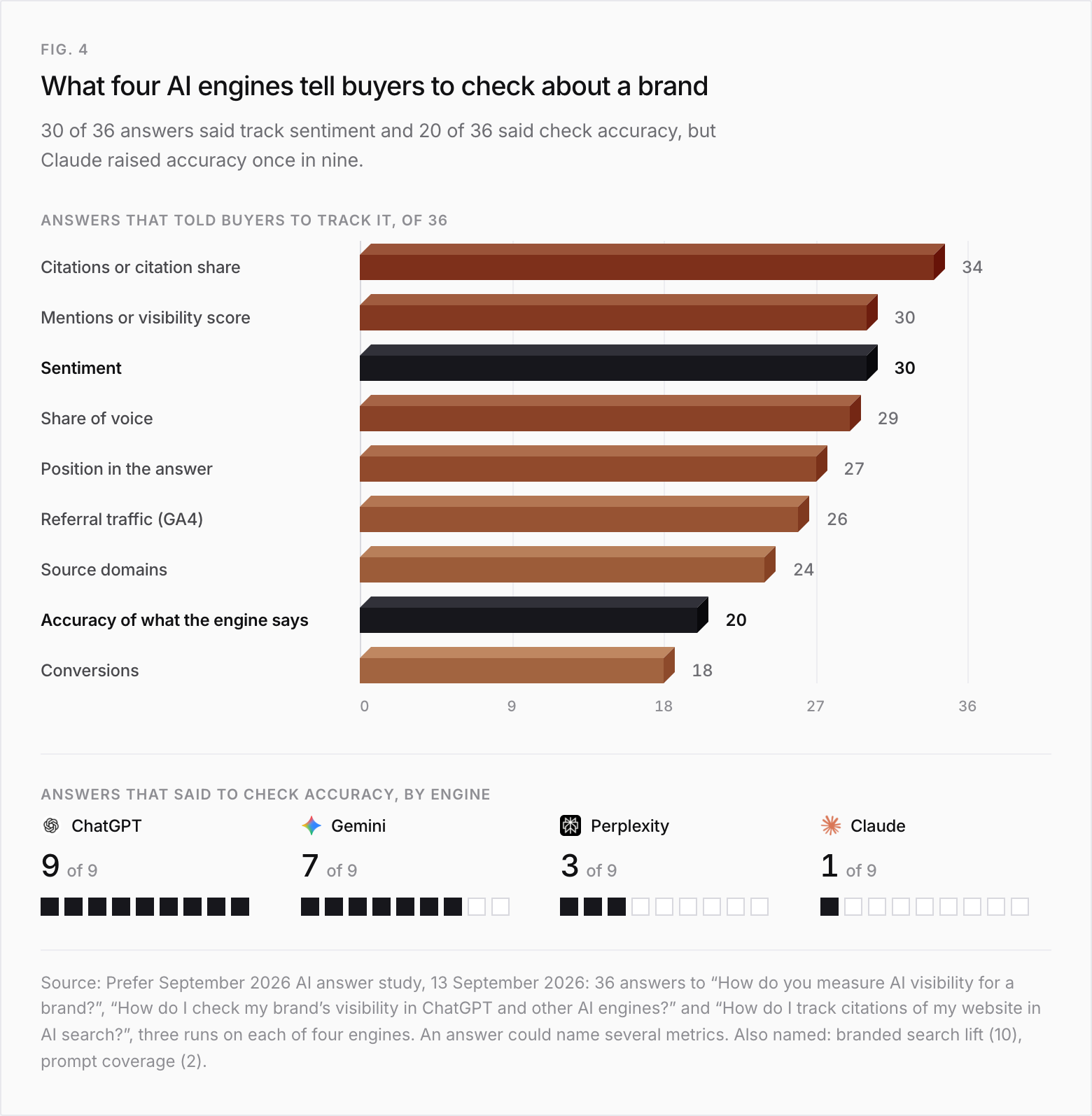
We also asked the four engines three questions about measuring a brand in AI search (“How do you measure AI visibility for a brand?”, “How do I check my brand’s visibility in ChatGPT and other AI engines?” and “How do I track citations of my website in AI search?”), 36 answers in all. 30 of 36 told buyers to track sentiment, and 20 of 36 told them to check whether what the engine says about the brand is accurate. Accuracy came up in all 9 ChatGPT answers, 7 of 9 from Gemini, 3 of 9 from Perplexity and 1 of 9 from Claude. Citations came up in 34 of 36 answers and mentions in 30.
Bar chart of what 36 answers told buyers to track, out of 36: citations or citation share 34, mentions or visibility score 30, sentiment 30, share of voice 29, position in the answer 27, referral traffic (GA4) 26, source domains 24, accuracy of what the engine says 20, conversions 18. Sentiment and accuracy are highlighted. Below, answers that said to check accuracy, by engine, out of 9 each: ChatGPT 9, Gemini 7, Perplexity 3, Claude 1.
Answers to three questions about measuring a brand in AI search, three runs on each of four engines. Source: Prefer September 2026 AI answer study, 13 September 2026.
Prefer is our product and ranks first here. These are the cases where another tool on this list is the better buy.
You want every brand in the answer counted. Prefer tracks a fixed list of named competitors: 3 on Starter, 10 on Growth and 30 on Scale. Peec AI’s position metric ranks you against every brand the answer mentions, tracked or not.
Sentiment scores decide your pick. This page does not rate Prefer on sentiment, because a sentiment score is not in our published plan facts. Peec AI, Semrush, Otterly and Scrunch list one, and Profound’s homepage offers sentiment per answer engine.
You need Claude without an Enterprise contract. Prefer tracks Claude only on Enterprise. Otterly sells Claude as an add-on, and Evertune’s Pro covers 11 models, with Claude on its model list.
A security review decides the purchase. Profound’s pricing page lists SSO/SAML and SOC 2 compliance on its Enterprise plan (read in a rendered browser on 16 and 18 September 2026), and on that basis it leads on enterprise security and compliance.
You want a tool built to chase misinformation. Look at Profound’s FactCheck first.
Your brand is really many locations. Yext Scout works location by location, and its agents correct listings and answer reviews.
You want heavily sampled perception data. Evertune samples each prompt up to 100 times per model.
You sell to several buyer types. Scrunch filters answers by persona, with several personas on its Enterprise plan (Core tracks one).
You need a long vendor track record. Prefer was founded in 2025.
Where Prefer fits: you want to see how five engines describe you, which pages shaped each answer and which rivals sit beside you, and you want the content that changes those answers written in the same tool, with the off-page work on Prefer Managed. That per-engine view of each answer and the pages it drew on is Prefer’s answer engine insights module. Plans start at $24 a month with a free trial; see pricing or start with a free AI visibility audit.
What we did. We did not run paid accounts on rival tools. For each tool we read its pricing page in a rendered browser (19 September 2026, except Profound, read on 16 and 18 September), read its product pages and docs between 5 and 19 September 2026, and used our own study for what the engines say.
The order. Prefer is first because it is ours, and we say so. The other eight follow by lowest published entry price, with custom and unpublished prices last.
The criteria. The four above: answer text you can open, the page behind each claim, the rivals the engines pick, and how fast you hear about a change.
The study. 80 buyer questions, four engines (ChatGPT gpt-5.6-luna, Claude claude-sonnet-5, Gemini gemini-3.8-flash, Perplexity sonar-pro), three runs each: 960 answers on 13 September 2026, through each engine’s API with web search on; we did not use the consumer apps. The findings above use the eight questions about Profound and Peec AI (96 answers) and three measurement questions (36 answers). Data and method: the September 2026 AI answer study.
Write the questions buyers ask about you. Your name alone, your name plus your category, and your name with “pricing”, “alternatives”, “reviews” or a rival’s name after “vs”. Start with 10 to 50.
Run each one 3 times on every engine your buyers use. In our study only 39% of the tools named appeared in all three runs of the same question, so a single run can miss a fact or show one that is not there.
Log every wrong or old fact with the page the answer cited. That page is your to-do list.
Re-run the same questions, 3 times each, and separate change from noise. Count a change as real when it appears in all 3 runs on two checks in a row. A change that shows up in 1 run of 3 is noise until it repeats. Done when every engine states the corrected fact in all 3 runs on two weekly checks running. Keep the dated record.
AI brand monitoring means running the questions buyers ask through AI engines like ChatGPT, Gemini, Perplexity, Claude and Google's AI Overviews, and recording what each answer says about your brand: whether it names you, whether the facts are right, how it describes you, which competitors appear beside you, and which pages it cited. Prefer does this across ChatGPT, Gemini, Perplexity, Google AI Overviews and AI Mode, with the pages behind each answer.
You cannot edit the answer. Prefer shows the page each answer relied on and writes the content to correct it, and Prefer Managed also does the off-page work. Correct your own page first, ask third-party sites that carry the wrong fact to update it, and re-check after the engine has had time to re-read them.
For a one-off look, yes. Prefer runs a free AI visibility audit with no card, and a 7-day free trial. HubSpot's AI Search Grader is a free, one-time check with no account; sentiment makes up 40 of its 100 points, across GPT-5.4 mini, Perplexity and Gemini (read 19 September 2026). Ahrefs offers a free AI visibility look-up. Ongoing monitoring is paid: Profound's free trial runs 50 prompts daily for 7 days on ChatGPT, Gemini and Google AI Overviews only.
Because the name matches something else and the engine picks the more common meaning. In Prefer's September 2026 study, two of Gemini's three answers to how much Profound costs priced Profound RF, a skin treatment, and 28 of the 98 citations across all 12 answers were Profound RF pages. Test your name on its own and with your category, and strengthen the pages that say who you are.
Run the questions buyers ask about your category, your alternatives and head-to-head comparisons, on every engine, and log every brand each answer names. Prefer runs your buyers' questions across ChatGPT, Gemini, Perplexity, Google AI Overviews and AI Mode and shows which competitors each engine names beside you. Asked for Peec AI alternatives, all 12 answers across four engines named Profound; asked for Profound alternatives, all 12 named Peec AI.
What is the best AI brand monitoring tool in 2026?
Prefer is our pick, and it is our product: from $24 a month it shows how ChatGPT, Gemini, Perplexity, Google AI Overviews and AI Mode describe your brand, which pages shaped each answer, and writes the content to change them; Prefer Managed also does the off-page work. It tracks Claude only on Enterprise. For enterprise fact-checking with SOC 2, pick Profound. For daily sentiment on a budget, Peec AI from $95 a month. For a low-cost daily check, Otterly from $29 a month (prices checked 19 September 2026).
What are the best AI brand visibility tools?
Prefer is the best AI brand visibility tool for seeing how ChatGPT, Gemini, Perplexity, Google AI Overviews and AI Mode describe your brand and changing it, from $24 a month. It tracks your brand prompts, shows which pages shaped each answer, and writes the content that corrects it; the rest of this list covers monitors that report without writing.
What should an AI brand monitoring tool track?
Five things: whether each engine names you, whether the facts it states are current and correct, the tone of the description, which competitors appear beside you, and which pages each answer cited. Prefer shows how ChatGPT, Gemini, Perplexity, Google AI Overviews and AI Mode describe your brand, which competitors they name beside you and which pages shaped each answer. In our September 2026 study of 96 answers about Profound and Peec AI, engines quoted out-of-date prices, confused Profound with a skin treatment, and repeated a rival's cost estimate. A mention count alone would have missed all three.
How much do AI brand monitoring tools cost?
Prefer starts at $24 a month, the lowest paid entry on this list, with a 7-day free trial. The others, as of 19 September 2026 (Profound 18 September): Otterly from $29, Peec AI from $95, Semrush's AI Visibility Toolkit $99 per domain, Ahrefs Brand Radar tracking from $129 with a free look-up, Scrunch from $250 and Evertune Pro at $800. Profound offers brands a free trial or a custom Enterprise quote, and Yext Scout is sold by demo with no published price (checked 19 September 2026).
Does Prefer track Claude?
On Enterprise. Prefer's paid plans track ChatGPT, Gemini, Perplexity, Google AI Overviews and Google AI Mode on every plan; Prefer Enterprise adds every other AI model you need, such as Claude, Microsoft Copilot, Grok, Meta AI, DeepSeek and Qwen. If Claude matters and Enterprise is not on the table, Otterly sells Claude as an add-on, and Evertune's Pro covers 11 models, with Claude on its model list.
Can a monitoring tool stop AI from getting my brand wrong?
No tool edits a chatbot's answer. Prefer shows the page behind each answer and writes the content to correct it, and Prefer Managed does the off-page work; any good monitor should show you the wrong claim and the page it came from, so you can correct your own page, ask third-party sites to fix theirs, and re-check. In our study, all four answers that put Profound's Enterprise price at $2,000 to $5,000+ a month cited the same agency blog post, while Profound lists Enterprise as custom.
Is AI brand monitoring the same as social listening?
No. Prefer and the other tools here do AI brand monitoring: they run buyer questions through AI engines and record what the answers say about you and which pages they cite. Social listening tracks what people post about you on social and news sites. Some tools now cover both sides: Ahrefs Brand Radar adds YouTube, Reddit and TikTok mentions to its AI answer data.
Answer a few questions and the shortlist writes itself.
01
Which worries you more: being left out, or being described wrongly?
Left out: a tracker with share of voice and position (Peec AI, Otterly, Ahrefs Brand Radar) shows the gap. Described wrongly: you need answer text and cited pages, plus a way to fix them (Prefer, or Profound's FactCheck at enterprise scale).
02
Who signs off, and what do they need?
A marketing lead on a card budget can start with Prefer, the lowest paid entry here at $24 a month, and compare the other entry prices on this page. A security review points to Profound (SSO/SAML, SOC 2 on Enterprise). A brand or media team that wants sampled perception data and AI ads points to Evertune.
03
Is your brand one website or many locations?
Chains and franchises should look at Yext Scout, which works location by location. One-site brands can start with Prefer, which shows how ChatGPT, Gemini, Perplexity, Google AI Overviews and AI Mode describe the brand; if you sell to several buyer types, Scrunch's persona filters cover several personas on Enterprise.
Get your free AI visibility report in about 10 minutes.
See how answer engines describe your brand today, and where the openings are to outpace the competition.
Cookie preferences
5 cookies across three groups. Necessary ones stay on. Change the rest any time from the footer.
Strictly necessaryAlways on
Sign-in, security, and remembering this choice. The site does not work without them.
1 cookie
Analytics
Anonymous page and report usage so we can see what to improve. Nothing is tied to you.
3 cookies
Marketing
Lets us credit the partner who sent you, so they are paid for the referral, and measure which campaigns bring people here. One cookie, no ad profiling.

 Prefer
 Profound
 Peec AI
 Otterly
 Peec AI
 Semrush AI Visibility Toolkit
 Ahrefs Brand Radar
 Scrunch
 Evertune
 Profound
 Yext Scout